
Niche Edits: What They Are and How to Find Them (2026)

A niche edit is a backlink added to an article that already exists on someone else's site. You don't write anything new: you ask the site owner to edit a published post and insert a link to your page, usually in a sentence where it fits naturally. It's also called a link insertion or a curated link.
In my backlink tier list, niche edits sit in the top tier, next to link swaps and charity links, and one tier above guest posts. In the video below I explain why, and then I use Claude Code to find niche edit opportunities for arvow.com: real articles, the exact sentence where our link would fit, the anchor and who to contact. This article is the written version of that part, with the prompt and the results from the screen.
Niche edits vs guest posts
The two get confused because you often find them on the same sites and pay similar prices. The difference is whether the content already exists.
- Niche edit: the site owner edits a post that is already published, already indexed and sometimes already getting traffic, and adds your link to it.
- Guest post: the site publishes a new article, usually written by you, with a link back to your site.
| Niche edit | Guest post | |
|---|---|---|
| Content | Existing article | New article |
| Indexed and aged? | Yes, from day one | Starts from zero |
| Traffic to the page | Sometimes already there | Has to earn it |
| Control over context | Low: the page may mention competitors or topics you don't want next to you | High: you write the whole article |
| Writing needed | None, just the pitch | A full article to the site's guidelines |
| Price (from my experience) | Roughly the same as a guest post on the same site, and sometimes free | Roughly the same, and sometimes free |
That is why I rank niche edits higher. You're buying (or earning) a place on a page Google already trusts, instead of a new page that has to prove itself. The trade-off is control: the article was written for its own reasons, and it might sit your link next to a competitor. A guest post is the safer choice when the context matters more than the age of the page. If you're going the guest post route, here is how to find guest post opportunities.
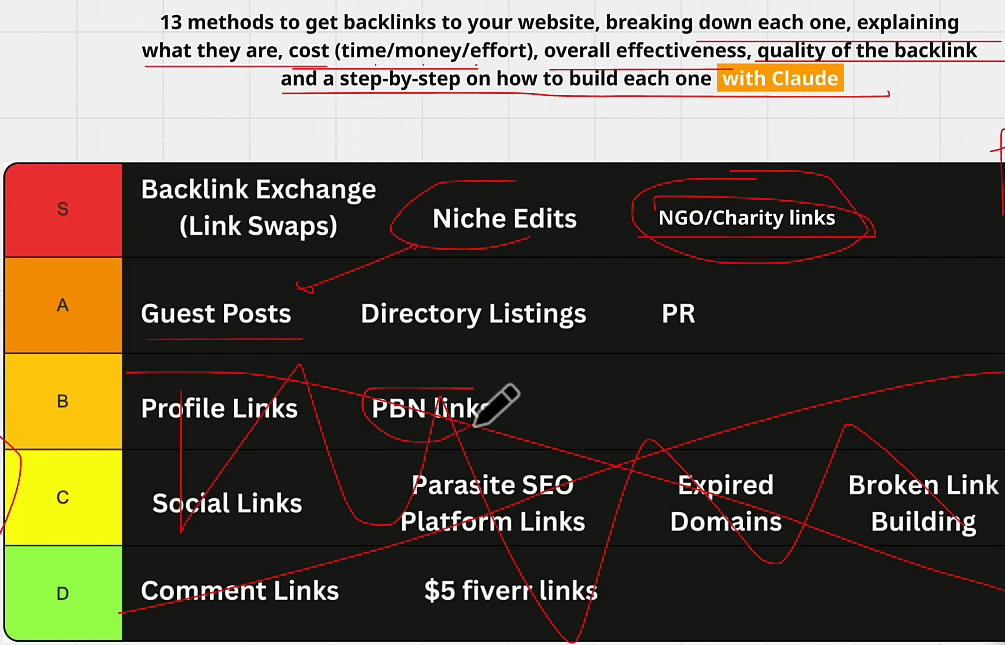
The full reasoning behind every tier is in 13 backlink building methods, ranked. Here I'll stay on niche edits.
What makes a good niche edit target
The whole method rests on finding the right existing article. A good one has four things:
- It's live and it ranks. The point of a niche edit is the age and authority of the page. A post nobody finds gives you none of that.
- Your page genuinely belongs in it. The best targets are lists or guides your product or article should already be in: a "best tools" post that covers your category but not you, or a guide that is missing a point your page explains.
- There's a specific sentence to attach to. "Add a link somewhere" is a weak pitch. "Next to this sentence in your third section" is a strong one.
- It already links out. A post that cites other sources is used to adding them. One with no outbound links usually won't start with yours.
Finding these by hand is the slow part: searching your topic, opening dozens of articles, reading each one for a gap, then finding a contact. That is what I hand to Claude.
The Claude Code prompt that finds niche edits
This is the niche edit prompt I run in Claude Code in the video. It sits in a folder with the other link building prompts, so I can just tell Claude in plain language "get me some guest posts and niche edits" and it picks the right ones.
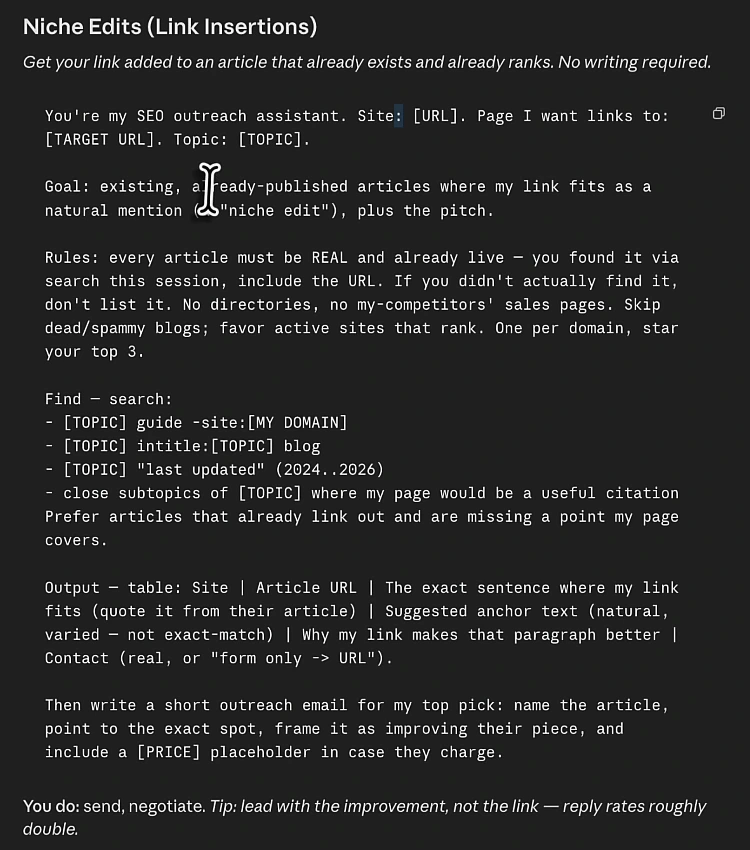
The parts worth copying, even if you write your own version:
- A hard rule against made-up results. Every article must be real, already live and found by a search in that session, with its URL. If Claude didn't actually find it, it doesn't get listed. Without this, an AI will happily invent plausible-looking targets.
- Exclusions. No directories, no competitors' sales pages, no dead or spammy blogs, one result per domain.
- Search patterns. Your topic plus "guide" excluding your own domain, your topic in the title of blog posts, posts "last updated" in the last couple of years, and close subtopics where your page would be a useful citation. Prefer articles that already link out.
- A fixed output table. Site, article URL, the exact sentence where the link fits (quoted from the article), a natural anchor (not exact-match), why the link improves that paragraph, and a contact.
- A pitch for the top pick that names the article, points to the exact spot, frames it as improving their piece and leaves a price placeholder in case they charge.
The tip at the bottom of the prompt is the one I'd underline: lead with the improvement, not the link.
What it found for arvow.com
Claude came back with eight verified opportunities: six where Arvow belonged in an existing list it was missing from, and two where the article was about link building and the natural fit was our backlink exchange.
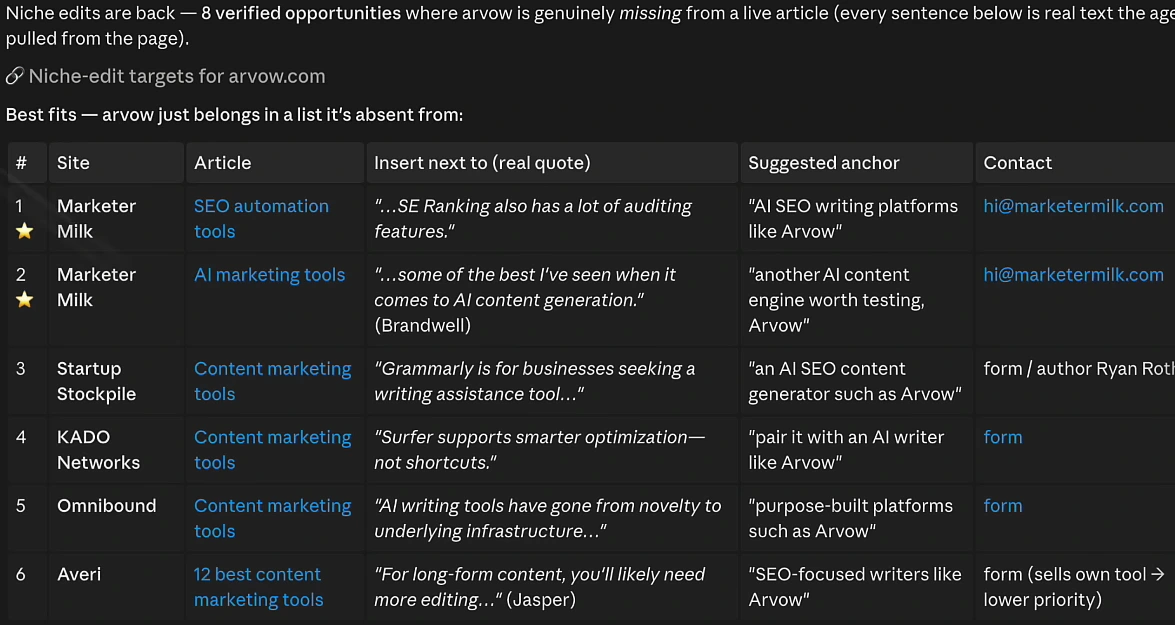
A few things in this table are worth pointing out, because they're what separates a usable list from a pile of URLs:
- The quotes are real. I re-checked the two starred Marketer Milk rows on October 17, 2026. Both sentences are still on the live pages: "SE Ranking also has a lot of auditing features" on the SEO automation tools post, and the AI content generation line on the AI marketing tools post. Check a sample like this every time you run an AI prospecting prompt.
- The anchors are natural. "AI SEO writing platforms like Arvow", "purpose-built platforms such as Arvow". None of them is an exact-match keyword, which is how a real editor would phrase it.
- It ranks by fit, not just by authority. Averi is marked lower priority because it sells its own competing tool, so it's unlikely to add one. That's the kind of judgment you'd otherwise make after the outreach failed.
- The best target is a list with room. The Marketer Milk SEO automation post is a list of 13 tools it says the author uses. A list that names your competitors and not you is the easiest niche edit pitch there is, because the gap is obvious to the editor too.
One honest note: the video stops at the list. It doesn't show the outreach being sent or any link going live, and as of October 17, 2026 neither Marketer Milk page mentions Arvow. A list of opportunities is the start of the job, not a result.
How to pitch a niche edit
The prompt drafts the email, but the structure is simple enough to write yourself:
- Name the article and the exact spot. Quote the sentence. It proves you read the piece.
- Say why the addition makes their article better for their reader, not why you want the link.
- Suggest the wording, including a natural anchor, so the edit takes them a minute.
- Ask what they charge, or offer something instead. If you don't want to pay, offer a link from your own site in return. That's a link swap, and we cover how to do those safely in the backlink exchange guide.
Paying for niche edits: what to know first
Most niche edits on established sites are paid, and Google's spam policies treat buying links that pass ranking credit as link spam. Sites that sell link placements often mark them rel="sponsored" or nofollow, which is the correct way to do it and also means the link passes less (or no) ranking value. So before you pay:
- Ask whether the link will be followed or marked sponsored. Know what you're buying.
- Check the page, not just the domain. A strong domain with a page that gets no traffic is a weak niche edit. We found exactly this gap in donation backlinks, where a DR 91 site's sponsor links were all nofollow.
- Prefer edits that improve the page. The more the link genuinely helps the reader, the more it looks like (and is) an editorial decision, and the more likely an editor says yes for free.
In the video I say the price of a niche edit and a guest post on the same site is usually about the same, and that you can sometimes get either for free. Both match my experience, but prices vary a lot from site to site, so treat any number as a starting point for a negotiation.
Niche edits, step by step
- Pick the page on your site you want links to, and its topic.
- Search for live articles on that topic and its close subtopics that already link out, excluding your own domain and competitors' sales pages.
- For each, find the exact sentence where your page fits and note it.
- Check that the page is live, relevant and gets some traffic. Drop dead or spammy blogs.
- Find a real contact or the contact form.
- Pitch the improvement with the sentence, the suggested wording and a price question.
- Track replies, and verify the link once it's live (and whether it's followed).
Steps 2 to 5 are what the Claude prompt automates. If you'd rather not run prompts at all, the same research is what we do in our Claude link building workflow for charity links, and what Arvow's link building service handles end to end.
FAQ
What is a niche edit?
A backlink added to an existing, already-published article on another site, usually inserted into a sentence where it fits naturally. Also called a link insertion or curated link.
Are niche edits better than guest posts?
In my experience niche edits give a better return: the page is already indexed and often already has traffic. Guest posts give you more control over the context around your link. Both are worth doing; I put niche edits one tier higher.
How much do niche edits cost?
It depends entirely on the site. In my experience they cost about the same as a guest post on the same site, and some sites will add a genuinely useful link for free or in exchange for one from you.
Are niche edits safe?
Paid links that pass ranking credit are against Google's spam policies, and links marked sponsored or nofollow pass little or none. The safest niche edits are the ones that genuinely improve the article, on relevant pages that get traffic.
Want niche edits and guest posts found, pitched and placed for you? See Arvow's link building service.
Generate, publish, syndicate and update articles automatically
The AI SEO Writer that Auto-Publishes to your Blog
- Cancel anytime
- Articles in 30 secs
- Plagiarism Free