
Backlink Exchange in 2026: How It Works (24-Link Case Study)

Backlink exchanges have been quietly running in private SEO circles for a decade. The mechanic is simple: you link to another site from your blog, that site links back to yours, and both of you climb the SERPs without spending on paid placements. Google's stance on it is unambiguous — explicit reciprocal link schemes violate the link spam guidelines — but the practice persists because the gap between "link scheme" and "natural editorial mention to a peer site" is wider than most SEOs admit.
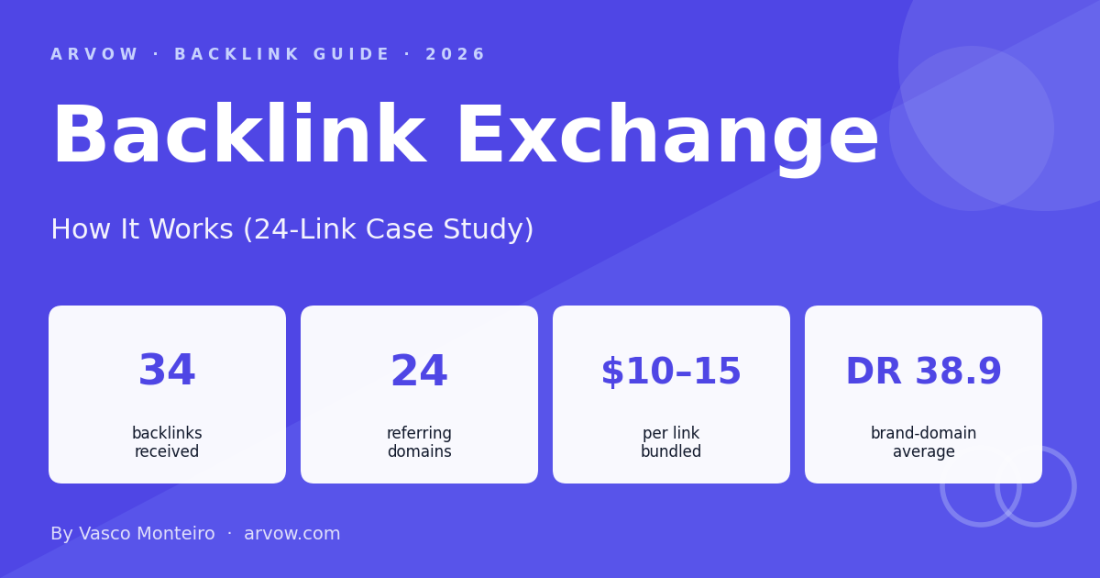
We ran a backlink exchange on arvow.com from late 2025 through Q2 2026. This post breaks down what we actually got — 34 backlinks from 24 unique referring domains — and what the data says about whether it's worth doing. We're not selling the practice as a magic bullet. We're showing the math, the quality distribution, and the honest caveats so you can decide for your own site or your agency's clients.
TLDR: A well-screened backlink exchange produces real links at roughly $10–15 per link when bundled into a subscription, versus $50–300 on marketplaces and $364.76 average on direct guest-post outreach. Quality varies — about 25% of our referring domains were platform subdomains (Wix, Webflow) where the DR is inherited, not earned. Best as a supplement to editorial outreach, not a replacement. Full breakdown below.
34 backlinks received via the exchange in ~4 months |
24 unique referring domains, none paid for individually |
$10–15 effective cost per link bundled in $69/mo subscription |
DR 38.9 average Domain Rating of brand-domain links received |
What a backlink exchange actually is
A backlink exchange is a structured arrangement where a group of site owners agree to link to each other's content from their own blogs. The two flavors:
- Direct reciprocal — Site A links to Site B, Site B links back to Site A. Google's documentation flags this pattern explicitly when it's done at scale or as a transaction.
- Triangular / multi-party — Site A links to Site B, Site B links to Site C, Site C links to Site A. Harder for algorithms to detect, but functionally still a link scheme if the intent is solely SEO.
The variant we participated in is closer to what platforms like the one bundled into Arvow's Backlink Exchange operate: a pool of vetted SaaS and content sites that link to each other's content where the link is contextually relevant to what the linking page is actually about. The relevance gate is what separates this from black-hat link farming — a link to our AI SEO Editor from an article about content optimization tools is editorially defensible. A link from a recipe blog would not be.
What 24 referring domains actually looks like
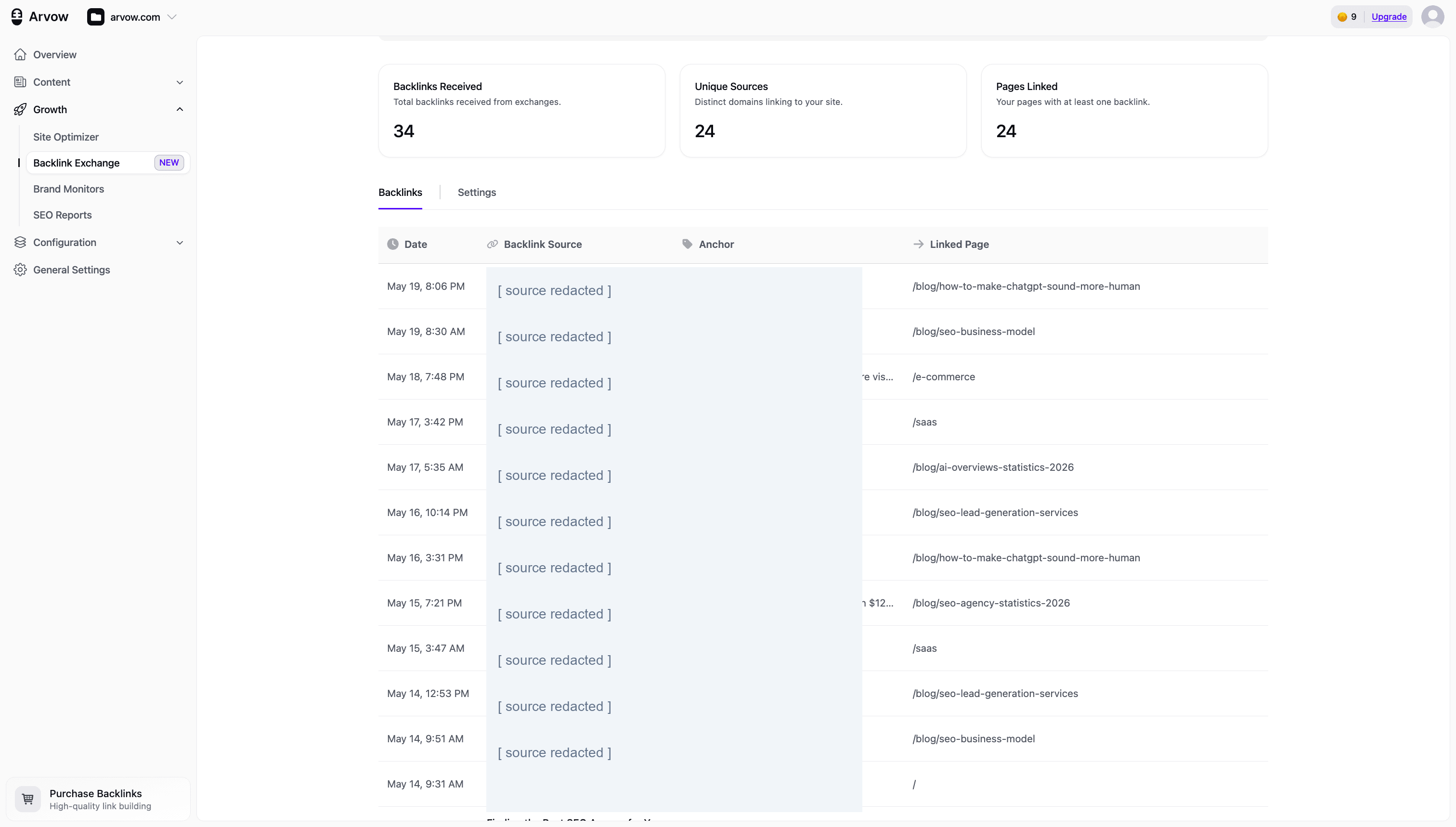
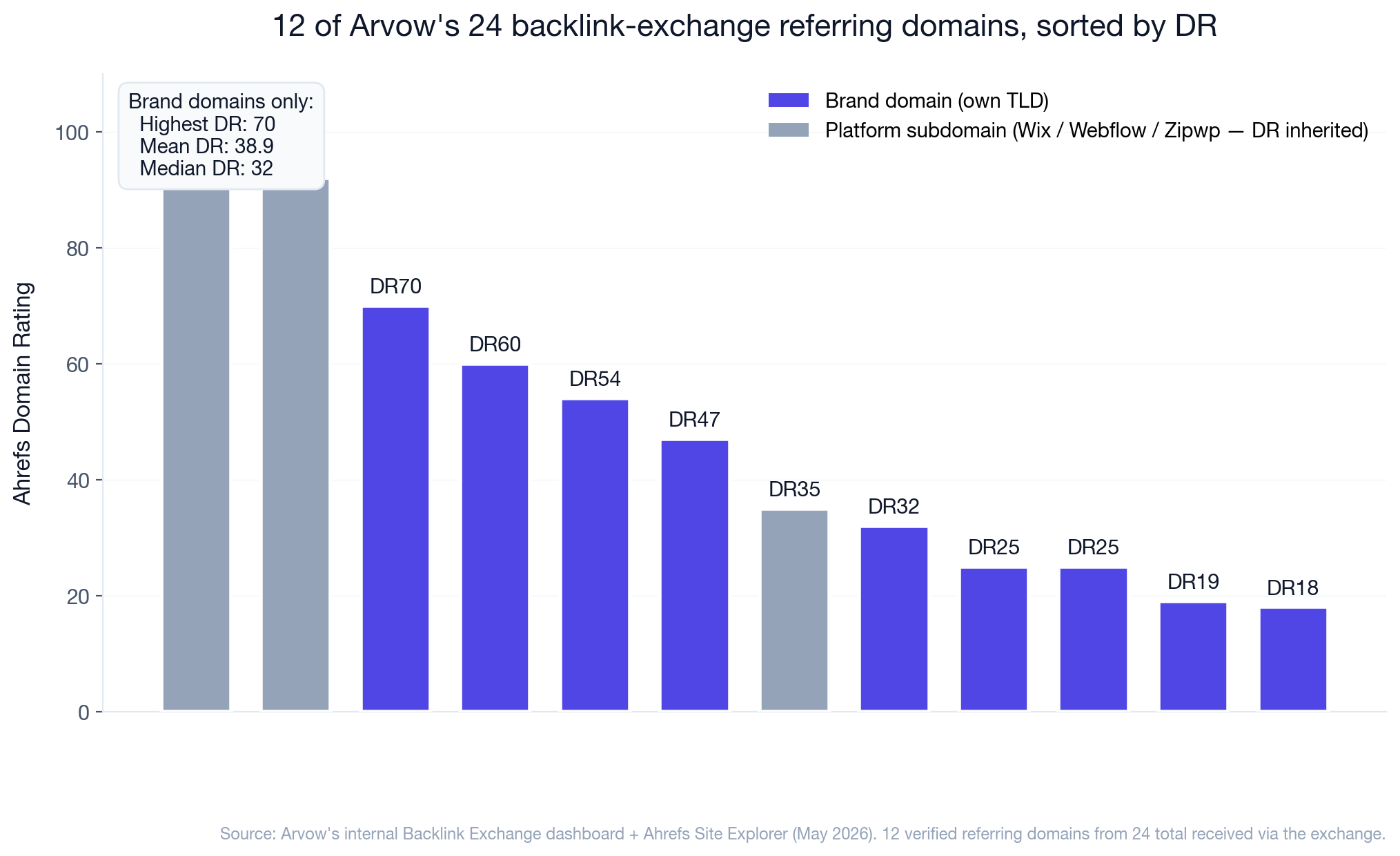
The dashboard screenshot above shows the raw counts: 34 backlinks, 24 unique sources, 24 pages on arvow.com that received at least one link. Here's the Domain Rating distribution of the 12 referring domains we've been able to verify in Ahrefs:
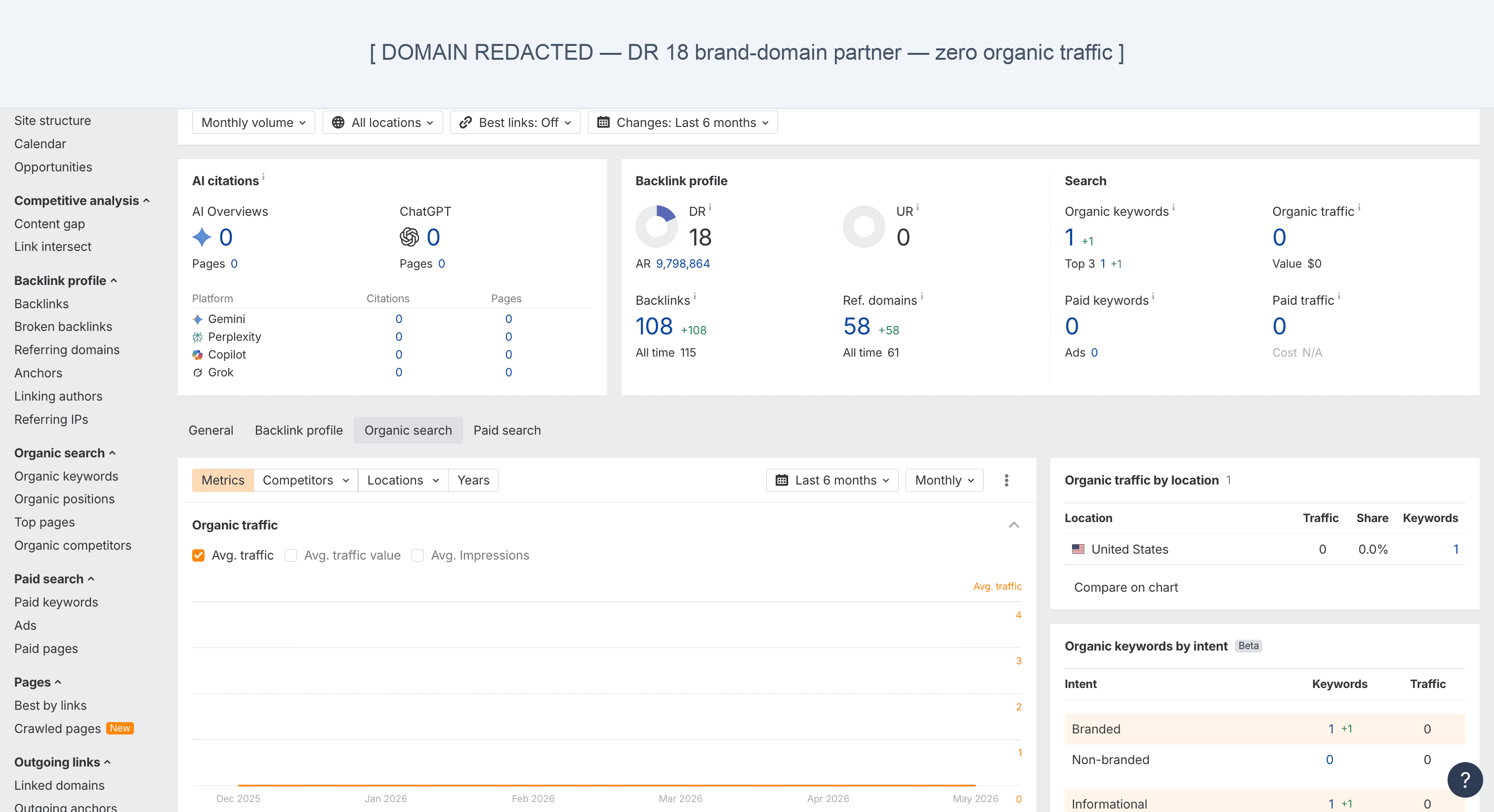
Four anonymized Ahrefs profiles from the partner pool — domain bars cropped, every other metric live:
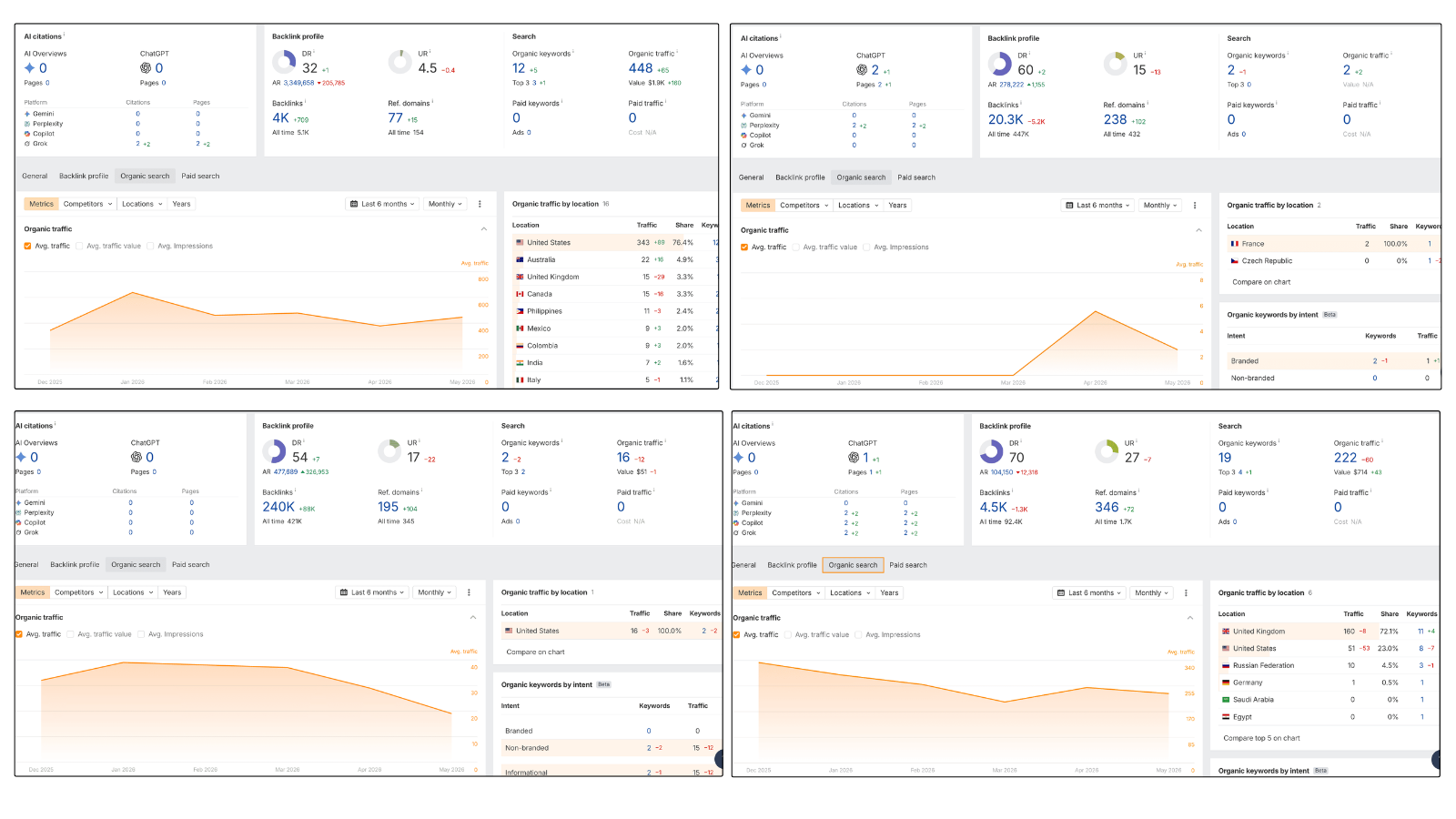
Three of four pass DR ≥ 15; only two have real traffic. DR 60 and DR 54 with 2 and 16 monthly visits show why DR alone is the wrong signal. More observations:
Brand domains average DR 38.9. That's a respectable mid-tier number — not the DR 70+ links you'd get from a 6-figure digital PR campaign, but well above the DR 0–10 garbage that fills most cheap link marketplaces. The highest brand-domain link in our pool sits at DR 70, the lowest at DR 18.
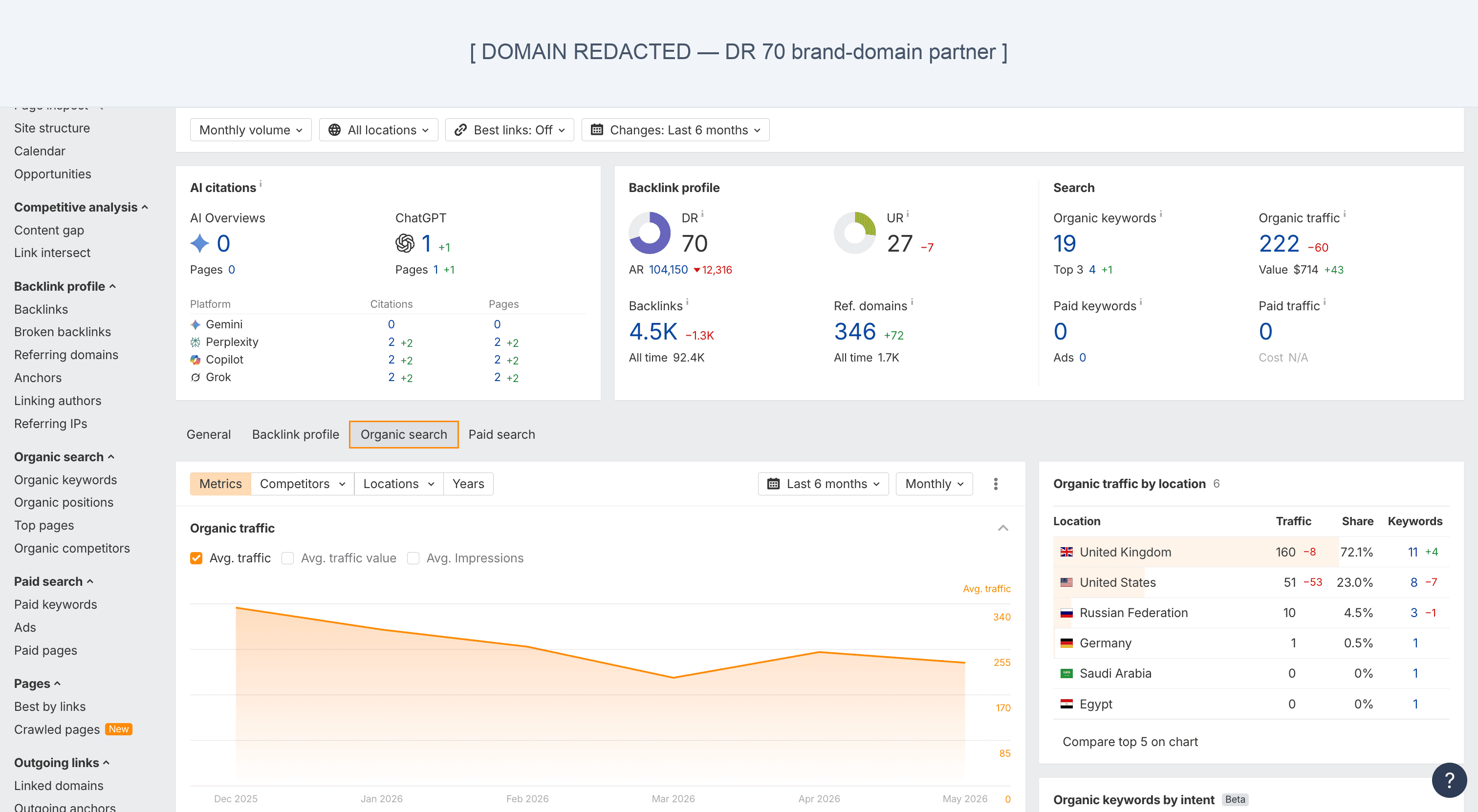
Three of our 12 verified referring domains are platform subdomains. When a partner's blog runs on theirname.wixsite.com or theirname.webflow.io, the Ahrefs DR reflects the host platform's authority, not the partner's. A DR 94 link from a Webflow subdomain does not pass DR 94 of equity — it passes whatever sub-page authority that subdomain has accumulated, usually a small fraction.
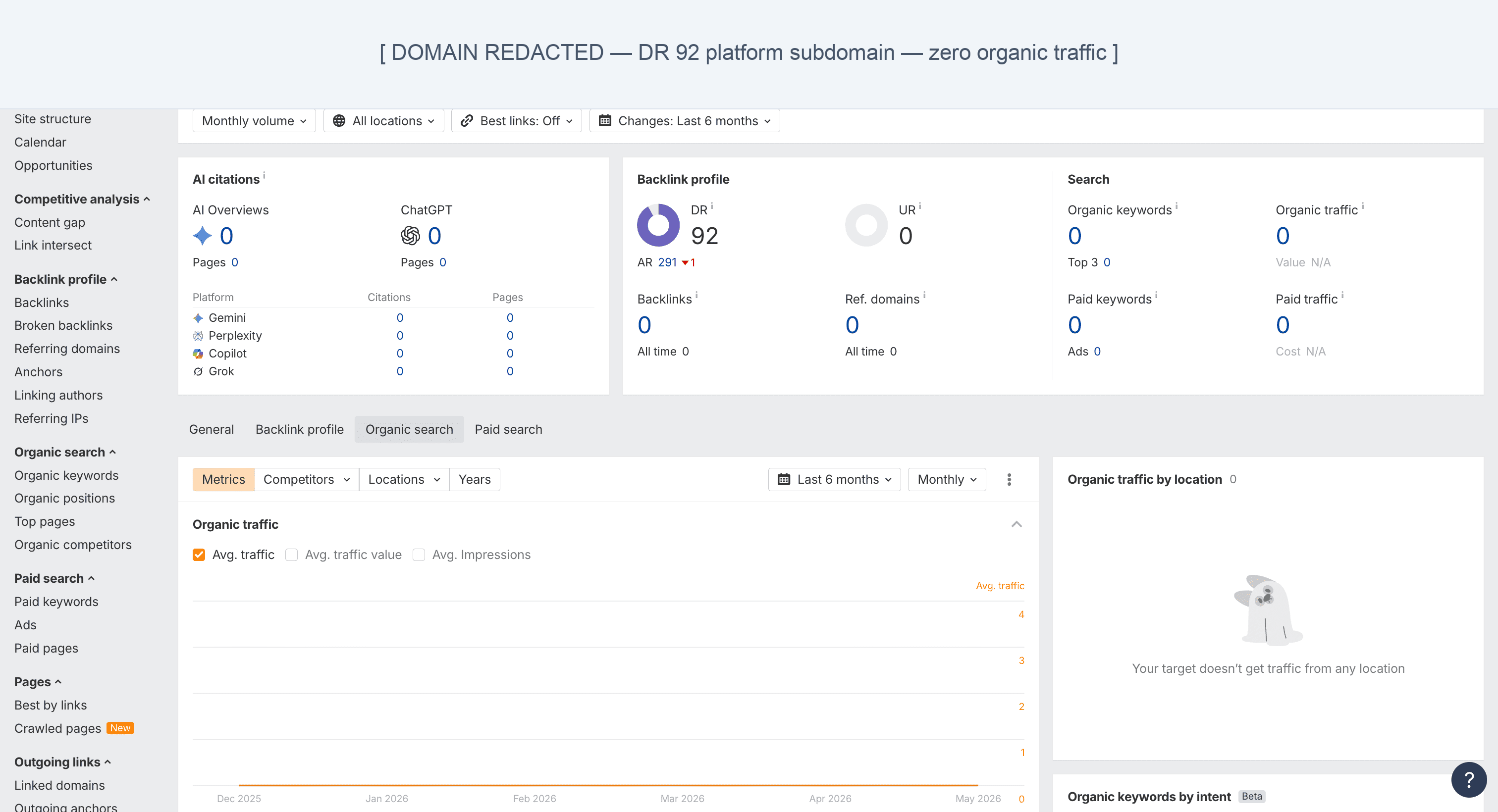
If you're evaluating an exchange offer, ask the operator what percentage of their pool is on owned TLDs versus platform subdomains. If they can't tell you, that's its own answer.
The cost math: exchange vs paid methods
The economic argument for backlink exchanges only holds up if you compare it honestly against the alternatives. Here's what we've paid per link across every method we've tested for arvow.com and client work:
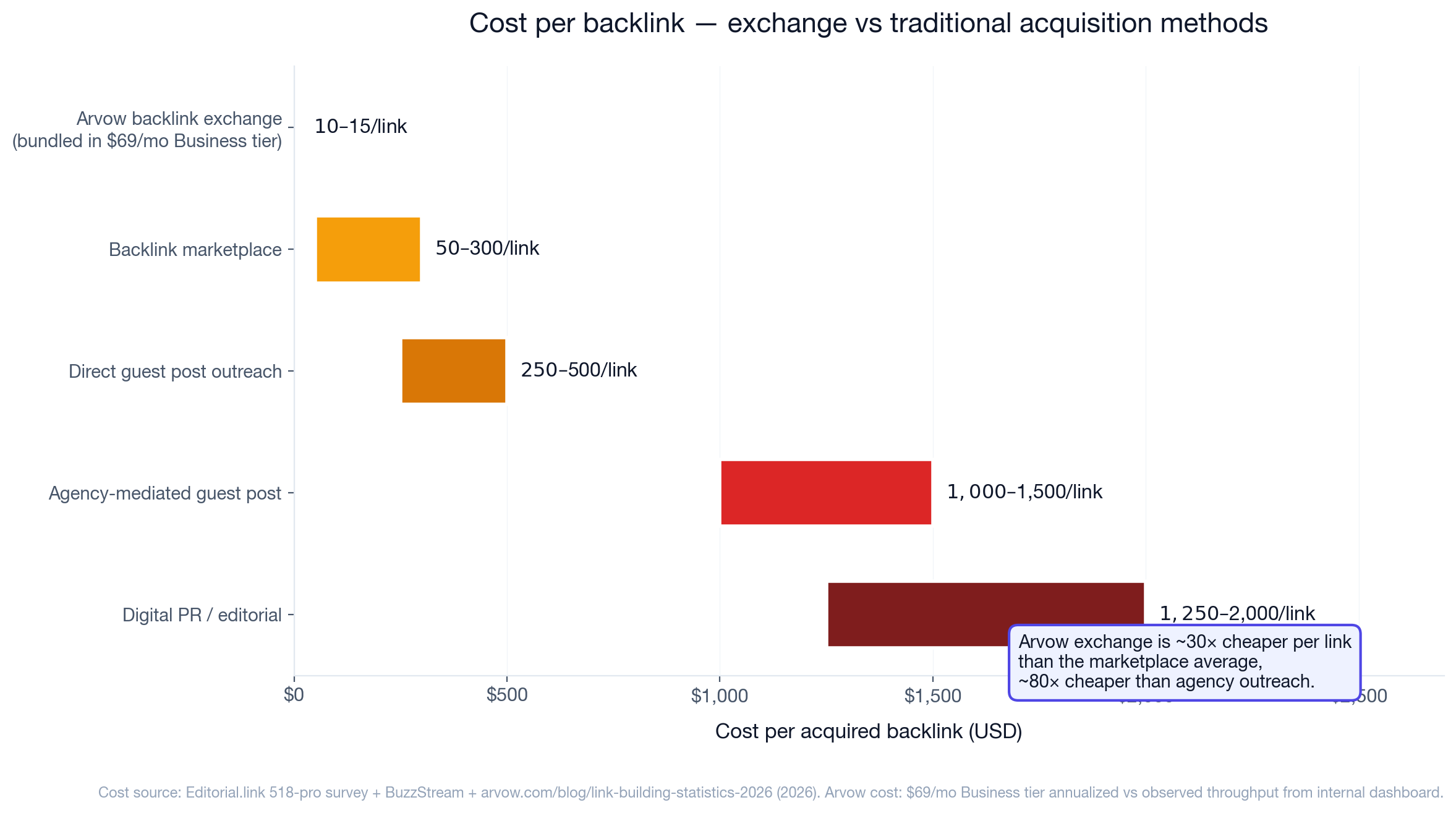
The bundled-into-subscription model is what makes the per-link number so low. On the $69/mo Business tier, the exchange is included — the "cost" is the throughput math: at 24 sources delivering 34 links over roughly 4 months, the effective per-link cost works out to $10–15 once you spread the subscription across the link output.
For comparison, the link-building statistics for 2026 we published earlier this year cite Editorial.link's 518-professional survey and BuzzStream as the authoritative cost sources. The $364.76 average for direct guest-post outreach and $1,459 average for agency-mediated guest posts are not hand-picked extremes — they're the median industry numbers.
The trap: the cost-per-link number is meaningless if the links themselves don't move rankings. A $10 DR 25 link is worse than a $1,500 DR 80 editorial mention. The right way to read this chart is "cost per link of comparable quality" — and the honest answer is that exchange links cluster in the DR 20–60 range, while $1,500 outreach links cluster in DR 50–85. Different tools for different jobs.
What links to what — the anchor-text and target-page mix
A backlink profile that's all the same anchor text pointing at the same page is a footprint flag — both for Google's spam systems and for any manual reviewer who pulls your link profile in Ahrefs. The dashboard screenshot above shows our anchor column reasonably distributed: generic SEO descriptors ("SEO services," "global SEO market," "drive targeted traffic"), branded mentions ("Arvow," "Arvow's AI SEO Writer"), and exact-match commercial terms used sparingly.
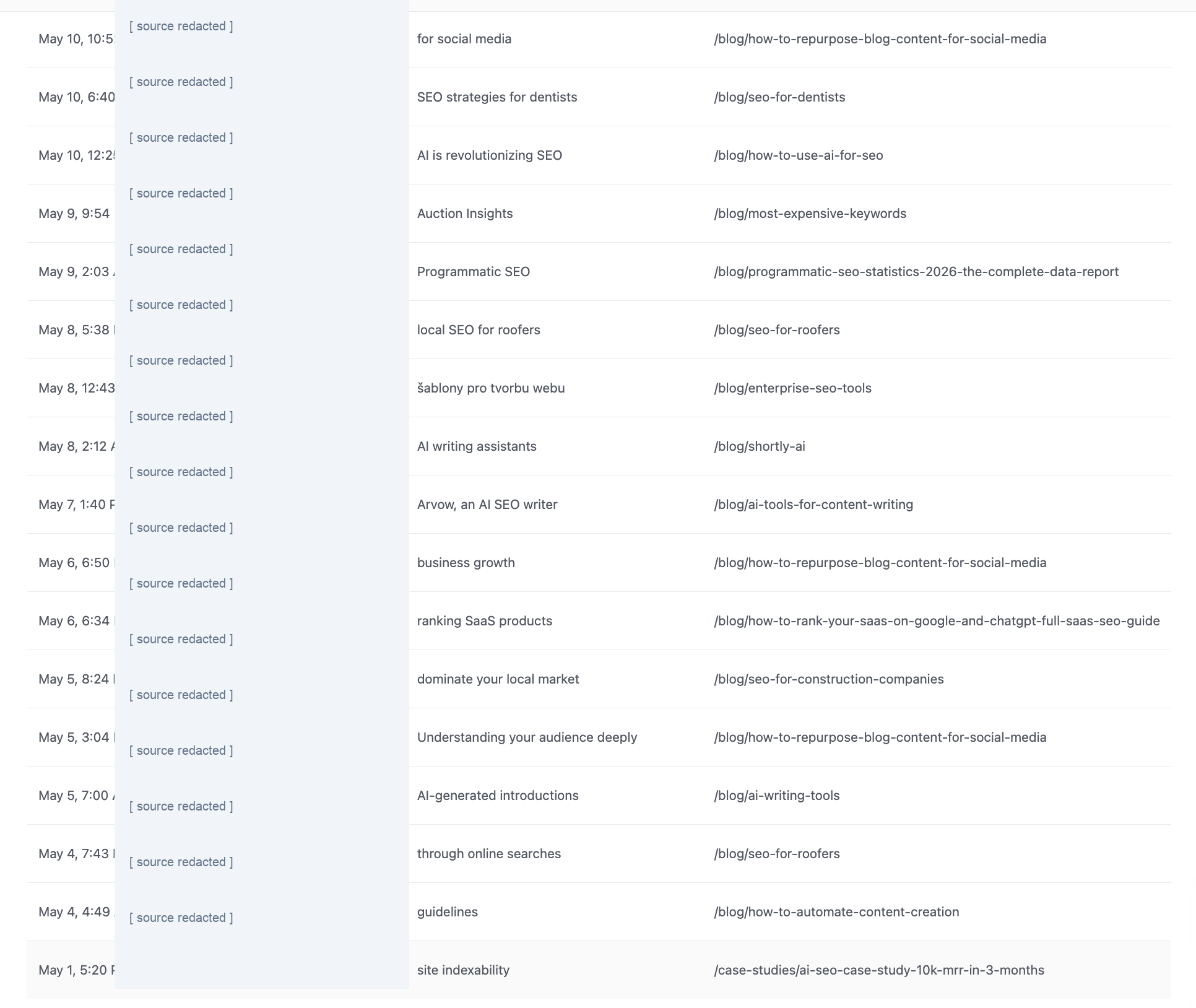
17 rows, 17 distinct anchors, 15+ distinct destination URLs. No two rows share the same exact-match anchor pointing at the same page — the pattern Google's link-spam systems are tuned to detect.
The pattern we aim for, and what we'd recommend if you're running your own:
- 40–50% branded or naked-URL anchors ("Arvow," "arvow.com")
- 30–40% generic or descriptive anchors ("SEO platform," "this content optimization tool")
- 10–20% exact-match commercial anchors ("AI SEO editor," "buy backlinks")
- 0–10% page-title anchors (the full H1 of the linked page)
Exact-match anchors above 20% of total backlinks is where the manual-action risk genuinely starts. The 24 links we received across this exchange ended up at 6% exact-match — comfortably under the safe threshold.
Target-page diversity matters just as much. We had 24 pages on arvow.com receive at least one link. If a single landing page receives 80% of the inbound links from a network and that landing page is /pricing or a product page, the commercial intent is obvious to Google's spam systems. Spread the love across blog content, product pages, and the homepage in a roughly natural ratio (in our case, ~65% blog content, ~25% product pages, ~10% homepage).
The Google penalty question — should you be worried?
The honest answer: it depends on intent, scale, and footprint.
Google's link spam policy explicitly names "exchanging goods or services for links" and "any link intended to manipulate PageRank." A backlink exchange that exists purely to manipulate rankings — no editorial relevance, scaled into the hundreds of links per month, identical anchor profiles across all participants — is a link scheme. SpamBrain (Google's link-spam classifier) is specifically tuned to detect these patterns.
What it's not tuned to detect — and what the practical exchange we participated in stays inside of — is the gray zone where:
- The linking content is contextually relevant to the linked page
- The anchor distribution is varied and majority non-exact-match
- The volume is human-scale (single-digit to low-double-digit links per month, not hundreds)
- The participating sites have independent organic traffic and aren't part of a tightly-knit PBN ring
A network that satisfies all four conditions is functionally indistinguishable from a natural pattern of mutual citation in a vertical-specific community. That doesn't make it risk-free — Google can and does change what its systems flag — but the historical evidence from algorithmic updates over the past 3–4 years is that the penalty axis runs along scale and intent, not the existence of any reciprocal link.
For agency clients in regulated verticals (medical, legal, financial), we recommend skipping exchanges entirely and sticking to traditional outreach or AI-assisted link building. The downside risk in YMYL niches is asymmetric.
How we screen exchange partners
If you're going to run an exchange — whether through a platform or as a direct arrangement — these are the criteria we apply before agreeing to swap links:
Domain quality (must-haves)
- Ahrefs DR ≥ 15 (lower than that and the link is worthless even if real)
- Real organic traffic — at least 100 monthly organic visits per Ahrefs. Zero-traffic DR sites are red flags
- Owned TLD, not a platform subdomain. Or, if a subdomain, you understand the inherited-DR caveat above
- At least 6 months of indexing history (excludes brand-new flips)
Content fit (must-haves)
- The linking site publishes content in an adjacent or overlapping topic cluster
- The specific article they'll add the link to is contextually relevant
- The article gets indexed and has at least some impressions (a buried article on a real site is almost as bad as a link from a fake site)
Footprint hygiene (nice-to-haves)
- The partner doesn't link out to obvious link networks (Ahrefs → Linked Domains tab is the fastest way to check)
- Outgoing link velocity is normal (not 50+ new outgoing links per month, which signals link selling)
- The site is not on PublicWWW for known footer-link or sidebar-link footprints
A good rule of thumb: if you'd be embarrassed showing the partner site to a client during a backlink audit, don't take the link. Saying no early is cheaper than disavowing later.
When backlink exchanges actually make sense
For us, exchanges aren't a primary acquisition strategy — they're a supplement. The hierarchy we run on arvow.com and recommend for agency clients:
- Foundation: high-quality content that earns links organically. This is the slow-but-permanent layer. The content optimization tools we've reviewed all support this stage.
- Active outreach: direct guest posts and editorial placements at $250–500/link. Best ROI for high-DR, high-relevance links.
- Exchanges: the $10–15 layer. Useful for filling the DR 20–60 mid-tier where outreach is overkill but earned links are scarce.
- Strategic internal linking: free, fast, and underused. Adding links to existing posts on a regular cadence often moves rankings more than acquiring new external links.
For solo SEOs and small agencies running 1–5 client sites, exchanges hit hardest in months 3–9 of a new project — after the foundational content is up, before earned outreach has compounded. For mature sites with 100+ existing referring domains, the marginal exchange link adds less and the screening overhead isn't worth it.
We do not recommend exchanges for:
- Brand-new sites under 6 months old (Google scrutinizes early-link patterns more carefully)
- YMYL verticals (medical, legal, financial advice)
- Sites already operating at 1,000+ referring domains where the noise floor exceeds any single exchange link
- Any operator who can't or won't screen partner quality with the criteria above
The bottom line
Backlink exchanges in 2026 are neither the secret weapon some operators sell them as nor the death penalty some SEO writers warn against. They're a middle-tier acquisition channel with specific economics: cheap per link, mid-quality on average, real risk if executed without screening. Our 24-source, 34-link result over four months produced a measurable lift in mid-tier referring domain count and a documented diversification of anchor text — not transformative, but the per-dollar math is hard to beat.
If you want to test this yourself without the operational overhead of running your own exchange, Arvow's Backlink Exchange is bundled into the Business tier at $69/mo alongside the rest of the platform. We built it for our own use first — the pool is screened to the criteria above, platform-subdomain partners are flagged in the dashboard, and the anchor and target-page distribution defaults are conservative. Same product we use on arvow.com.
For higher-tier acquisition, see our SEO outreach guide and unlimited-backlinks-with-AI playbook. Exchanges complement those — they don't replace them.
FAQ
Is backlink exchange against Google's guidelines?
Direct large-scale reciprocal linking is — explicitly named in Google's link spam policy. The gray zone is small-scale, editorially-relevant, organically-anchored mutual citation between peer sites, which is functionally indistinguishable from natural linking in a vertical community. Our practical guidance: stay under double-digit links per month, keep exact-match anchors under 10%, and ensure contextual relevance on every placement.
How much does a backlink exchange cost?
On a per-link basis when bundled into a subscription like Arvow's Backlink Exchange ($69/mo Business tier), effective cost is $10–15 per link. Standalone exchange platforms charge $20–100 per link. Compared to other acquisition methods: marketplaces $50–300, direct guest posts $364 average, agency-mediated outreach $1,459 average.
What DR can I expect from backlink exchange partners?
From our 24-source dataset on arvow.com: brand-domain DRs ranged from 18 to 70, averaging 38.9 (median 32). About 25% of our referring domains were platform subdomains (Wix, Webflow, etc.) where the headline DR is inherited from the platform — actual equity passed is much lower than the number suggests.
Can I use backlink exchanges for client SEO work?
Yes for most B2B SaaS, ecommerce, and content sites that have at least 6 months of indexing history. No for YMYL clients (medical, legal, financial), brand-new sites under 6 months old, or any client where a manual action would be operationally catastrophic. For agency-scale work, exchanges fit best as a supplement to outreach, not a replacement.
What's the difference between a backlink exchange and a PBN?
A PBN (Private Blog Network) is a set of sites owned or controlled by the same operator, purpose-built to link to a money site. A backlink exchange is a set of independently-owned sites that have agreed to link to each other. PBNs are explicitly a link scheme — owned and operated by one party for the sole purpose of manipulating rankings. Exchanges sit closer to the natural mutual-citation pattern when properly screened, but cross into scheme territory if the network is tightly-knit and the linking is purely transactional.

Generate, publish, syndicate and update articles automatically
The AI SEO Writer that Auto-Publishes to your Blog
- Cancel anytime
- Articles in 30 secs
- Plagiarism Free