Is Google Dying? Why AI Agents Are Becoming Its Main Users (2026)

Is Google dying? As a business, no. As a page that people open, read and click through, yes, and I think that part is nearly over. In November 2026 Google still handles about nine in ten searches, and its own numbers say people are searching more than ever. What is ending is the habit of scrolling ten blue links. AI now does that reading for us, and soon AI agents will do the buying and the booking too. I recorded a video walking through why. This is the written version, with the numbers checked.
Is Google dying? The short answer
| Question | Answer | Evidence |
|---|---|---|
| Are people leaving Google? | No | 91.05% search share in October 2026 (StatCounter) |
| Are people searching less? | No | Alphabet reported its highest query growth in five years in Q3 2026 |
| Are people clicking websites less? | Yes | Pew: 8% of visits with an AI summary led to a click, against 15% without |
| Is the stock under pressure? | Yes, recently | Down 18.38% in the month to 9 November 2026, as shown below |
| Will humans keep using the results page? | Less and less | My prediction, argued below |
So when I say Google is dying, I mean the interface. The index behind it is more important than it has ever been.
What the stock chart says
I opened the video with Alphabet's share price, so here it is. On 9 November 2026 the Class C shares closed at $283.93, down 18.38% over the previous month.
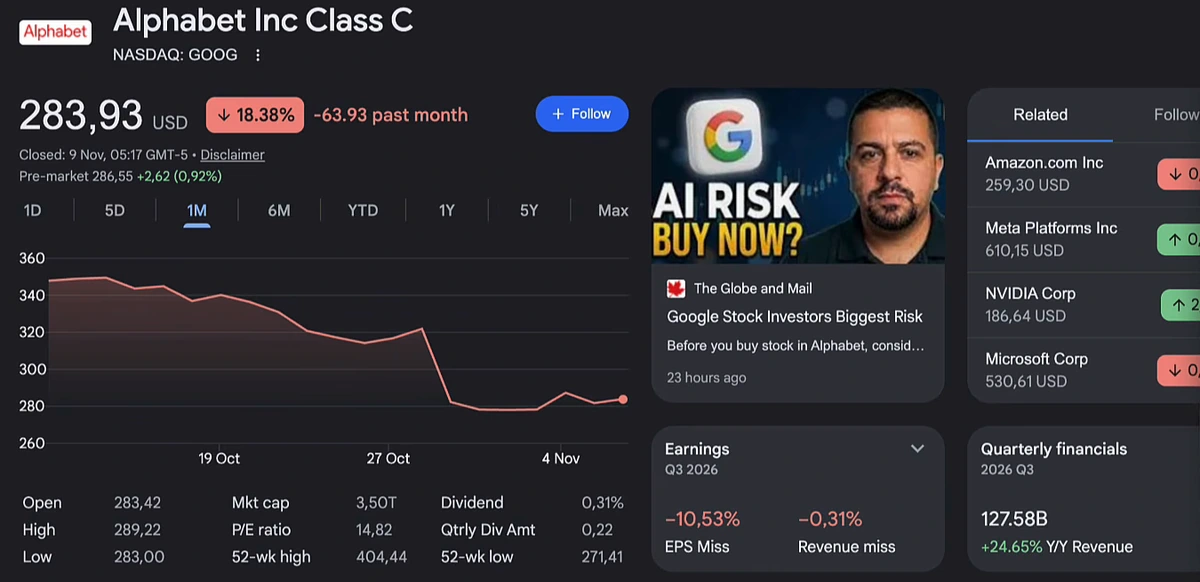
Read the earnings box in that screenshot. Revenue for the quarter was $127.58 billion, up 24.65% on the year. It missed the forecast by 0.31%. Earnings per share missed by 10.53%. The same panel on a five-year view showed the stock up 89.73%. This is a company that grew by a quarter in a year and got punished anyway.
Google's own AI Mode explained why when I asked it.
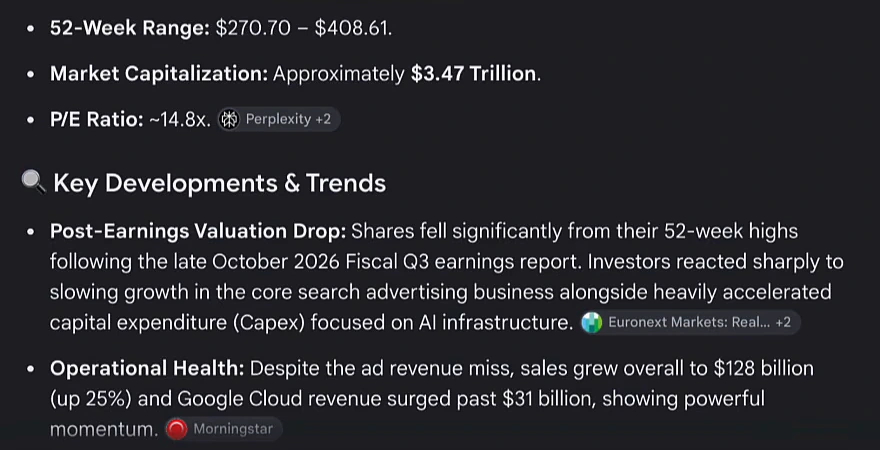
That is an AI-written summary, so treat it as a pointer and not as a filing. It does match my argument. Usage is fine. The worry is the search ad business, which is the part that depends on humans looking at a results page. None of this is investment advice. I am an SEO, and the chart is here because it shows where the pressure is.
Why the results page stopped being useful
When ChatGPT came out, Google was late. You could ask why leather is a good material for a wallet and get an answer in a conversation. On Google you had to open a site, wait for it to load, close the pop-ups and scroll.
Google caught up. It built AI Overviews, which summarise the first page of results, and then AI Mode, which is its own chat product. Alphabet said in July 2026 that AI Mode had passed one billion monthly users. I think Google won that round, for a simple reason: it is already where I type. On my phone I open Safari and ask a full question. On my laptop I open a new tab.
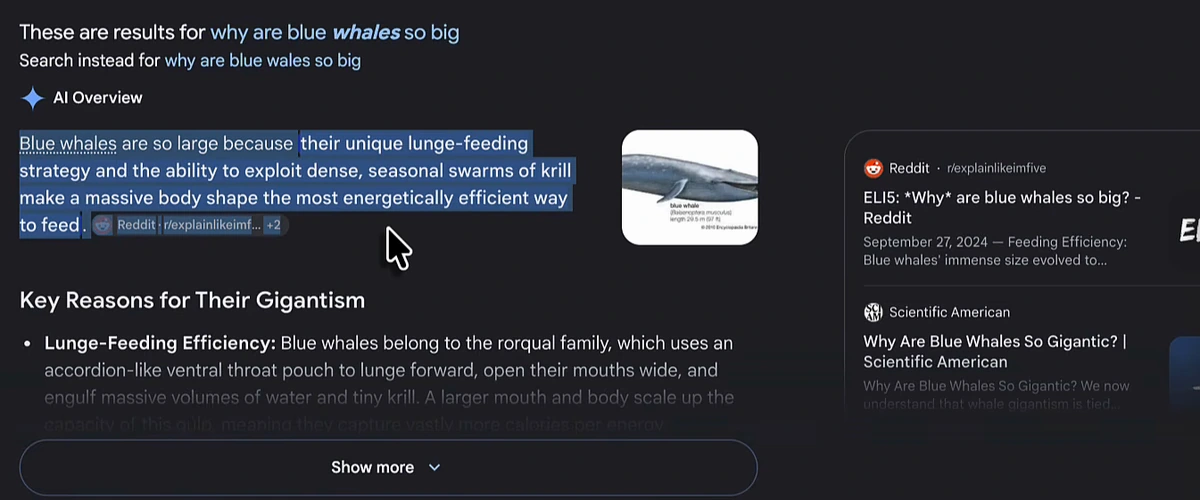
Here is the catch for Google. Once the answer sits at the top, nobody scrolls. Scientific American wrote the explanation and gets a small link in a side panel.
It is the same for shopping. I searched for noise cancelling headphones and opened the Wirecutter guide, which is about as good as a review page gets.
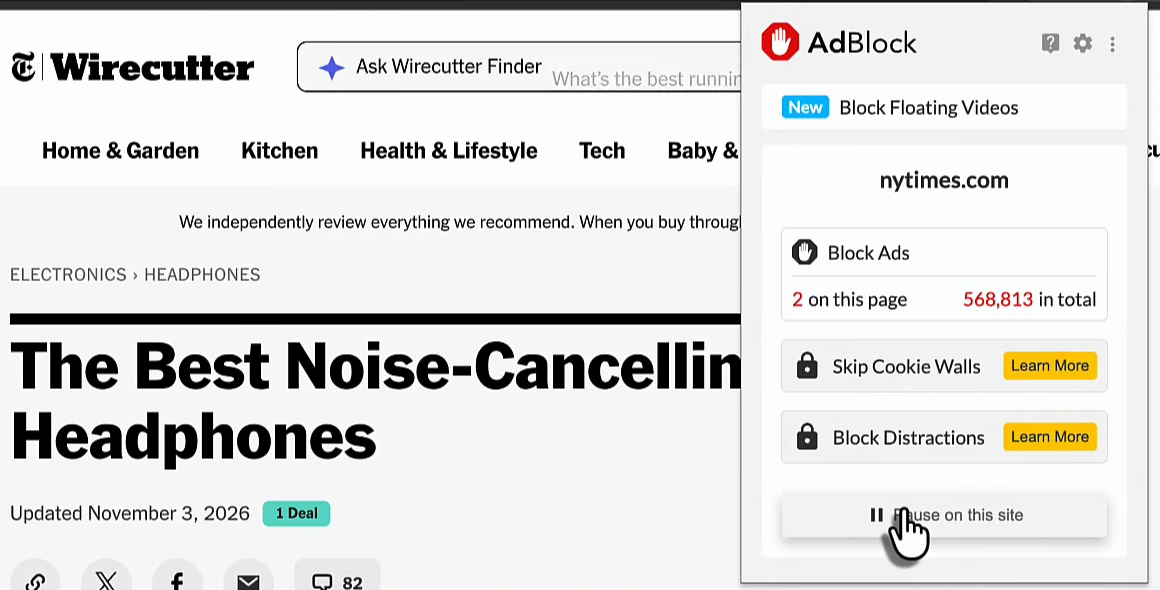
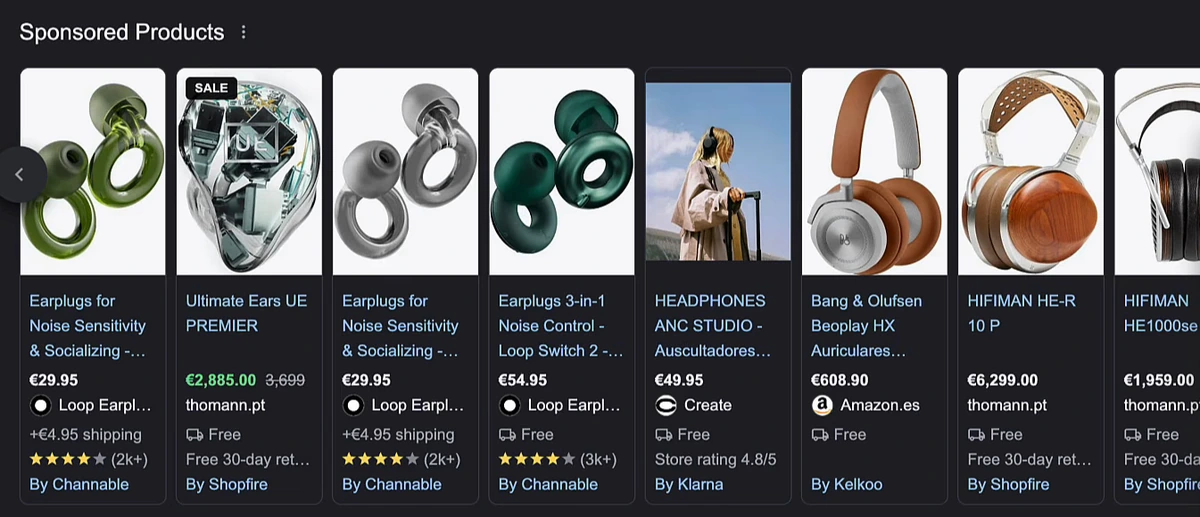
In fairness, my ad blocker counted two ads on that page, which is mild. What slowed me down was the cookie banner, the email prompt and the scroll to reach the picks. Meanwhile the results page had already put products in front of me.
Step one: AI reads the websites, not people
This step has already happened. When I ask why blue whales are so big, something still visits Reddit and Scientific American. It just is not me. The AI retrieves the pages, pulls out what matters and hands me a paragraph.
Pew Research measured the effect in 2025. In visits where Google showed an AI summary, people clicked a normal result 8% of the time. Without a summary it was 15%. The link inside the summary itself got a click 1% of the time.
So websites have a new main reader. I wrote about what that reader wants in how to optimize your website for AI agents, and about what it means for content planning in our zero-click search strategy.
Step two: agents do the buying and the calling
The next step is the one that hurts Google's ad model. Every large AI company is building agents that act for you. You give one an inbox and a payment method, and it researches, compares and buys.
- Meta announced Muse, a personal agent, in September 2026. Meta describes it as an agent that does the work and checks with you before sensitive actions such as a purchase.
- Google has let Search call local businesses for pricing and availability since July 2025 in the US, with a "Have AI check pricing" option. In the video I called it a test. It is a launched feature there. Google has said agentic booking is expanding to local service appointments.
- Amazon is pushing back. In November 2025 it told Perplexity to stop its Comet agent from shopping on Amazon. Amazon was also reported to have blocked Meta's Muse in September 2026.
One correction to the video: I said Amazon blocked Grok. I could not find a report of that. The documented cases are Perplexity and Muse.
Amazon's reaction tells you where the money is. If I say "buy me these earbuds" and an agent places the order, the agent's maker is standing between the shop and the customer. And an agent does not look at ads. Google has struggled to fit ads into AI answers. Fitting them into an agent's errand is harder still.
The same goes for local services. Today I search for a plumber, pick one from the map, open the site and hunt for the phone number.
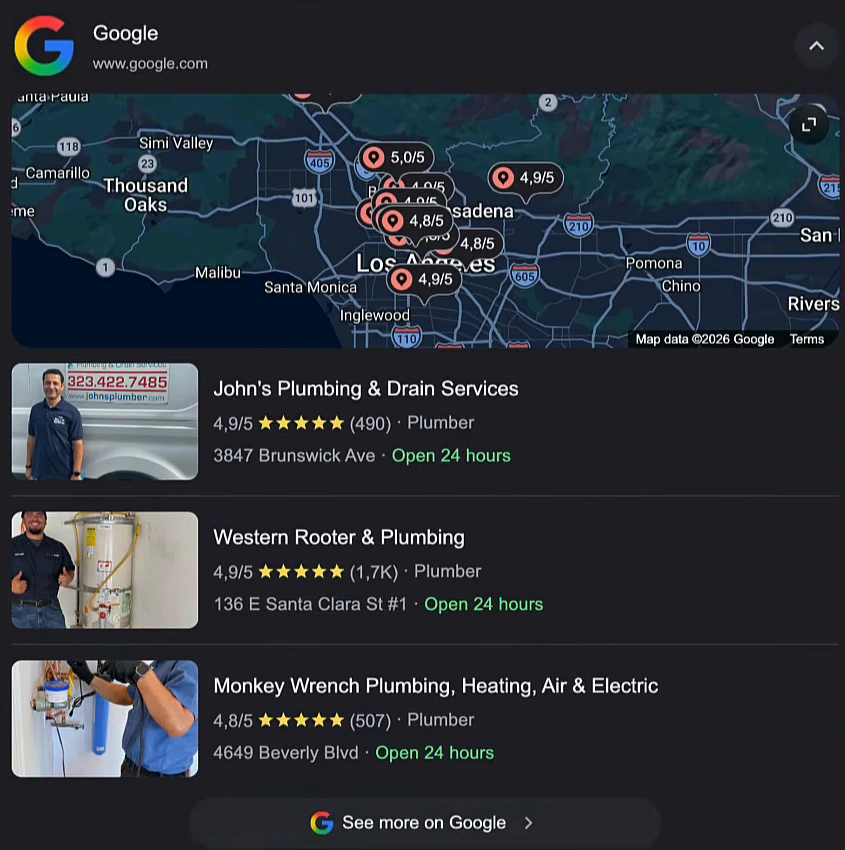
Soon I will say "I need a plumber now, handle it." The agent will ring round, compare price and arrival time, and book one. On the other end there will often be another AI answering.
Why Google still matters
None of this makes Google irrelevant. It makes Google the thing agents use. Google has the index: the sites, the videos, the reviews, the business listings. An agent has to get its facts from somewhere, and that is where they are.
So everything SEOs worked on still counts. You still need a site that loads, content that answers questions, and reviews. The audience changed from a person skimming to a machine reading everything. That is also why I do not think SEO is finished, which I argued separately in is SEO dead.
How to get AI agents to pick your business
You influence an agent the same way you influence a person: brand, content and proof. The difference is the level of detail. People type three words into Google. They give an AI a paragraph: a monitor that is 16:9, does not glare, uses little power and is not from Apple. Long, specific requests get matched to long, specific pages.
Ecommerce: explain the product past the buy button
My usual example is Epic Gardening. Most stores end the product page at the photos and the price. Their raised bed page keeps going: how to use it, which size suits you, what grows in each size, what the bed is made of and why.

Picture the conversation. Someone tells an AI their wooden beds rotted and asks what to buy. It suggests steel. They reply that they heard some steel beds have a coating that leaches into the soil. The AI now needs a brand that says, in plain words, that its coating is non-toxic and tested. This page says exactly that, so this brand gets the link. That conversation is my illustration, not a test I ran, but the page content is real.
Local: reviews that name the job
Google Maps already works this way. I searched for a plumber in Los Angeles and then for "clogged toilet". The businesses changed, and so did the review quote under each one.
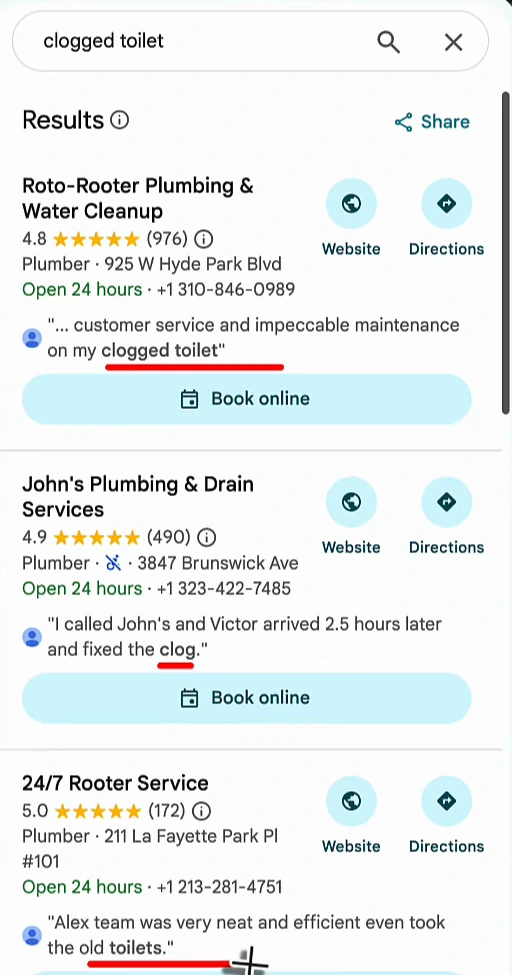
Maps pulls the review that matches the query. An agent choosing a plumber at 2 a.m. will do the same, and it will favour the business whose customers wrote that someone came at night and fixed it. Ask for reviews that say what was fixed, where and when. If you want that to run without chasing people, we built Google review automation for it.
Software and services: be specific about who and why
A feature page that says "our feature does X" is not enough. Say who it is for, why it works for them, and show a case study of that exact customer getting that exact result. I go through the full process in how to get mentioned in AI search.
What I would do this quarter
- Pick your five best-selling products or services and add the section a careful buyer would ask about: materials, limits, who it is not for.
- Rewrite review requests so customers mention the job, the place and the timing.
- Publish case studies by customer type, with numbers.
- Keep the same detail on your socials and your business listing. Agents read those too.
- Track how AI assistants describe you. Our LLM visibility tracker does this.
Want this built for you? Arvow's AI agents research, write and publish detailed content, build backlinks and track how AI assistants describe your brand. See how Arvow works.
FAQ
Is Google dying in 2026?
Not as a company or an index. It held about 91% of search in October 2026 and reported record query growth. What is declining is people reading and clicking the results page themselves.
Is ChatGPT replacing Google?
Partly, for some questions. Google answered with AI Overviews and AI Mode, and for quick questions many people now get an AI answer without leaving Google.
Why did Google's stock fall in late 2026?
The shares fell about 18% in the month to 9 November 2026, after the Q3 earnings report. Revenue still grew about 25% on the year. The summaries I saw pointed to slower search ad growth and heavy AI spending.
Do I still need SEO if AI agents do the searching?
Yes. Agents get their information from the same websites, reviews and listings. The work shifts toward more specific, better-evidenced content.
How do I get AI agents to recommend my business?
Give them detail to match against: product pages that explain materials and use cases, reviews that describe the job done, and case studies for each type of customer.
Generate, publish, syndicate and update articles automatically
The AI SEO Writer that Auto-Publishes to your Blog
- Cancel anytime
- Articles in 30 secs
- Plagiarism Free