
How to Get AI to Call You an Expert: 3 Real Examples From Google AI Overviews (2026)

Type "most renowned AI visibility expert" into Google and the AI Overview names a person. Type "top LLM SEO expert" and it names another. Type "who is the king of SEO" and it names two, in order. Nobody appointed them. Each published a claim about themselves somewhere Google trusts, and the AI Overview repeated it, with a citation, for months.
Tim The SEO Guru walked through those three cases in an October 2026 video, one per publishing surface: a LinkedIn post, a paid press release, and a question-and-answer page on the person's own site. This article re-reads each example from the screen rather than the voiceover, shows what the AI Overview says about it today, and lists the caveats the video skips, because two of the three answers now carry a warning label that the video does not mention.
What "AI calls you an expert" actually means
An AI Overview is a summary with sources. When a query asks who the expert is, the model finds a page that answers the question in those words, names the person that page names, and cites the page. There is no reputation score behind it. That is why the three methods work: each puts a sentence of the form "[name] is the [title] in [field]" onto a surface Google already trusts, as the clearest answer to that exact question. It is also why the method has limits.
Example 1: A LinkedIn post, cited four months later
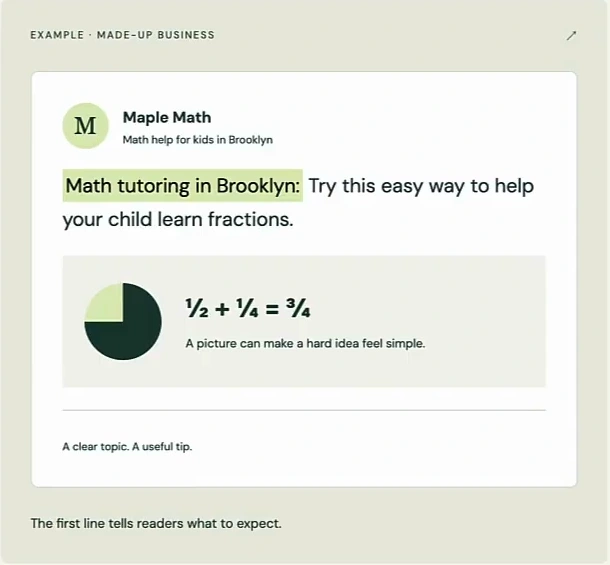
The presenter's first rule is to lead with your topic: say what you do in the first line, use the words customers search for, make your profile match the topic, and post useful examples often. His example card is a tutoring business whose post opens with "Math tutoring in Brooklyn".
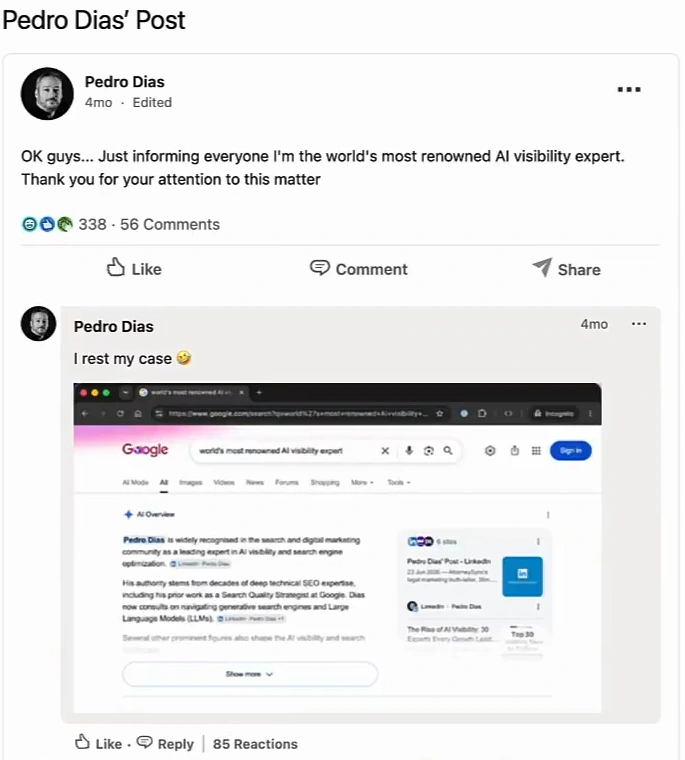
The real example is less polite. Pedro Dias, a former Google search quality strategist with 15,818 followers and 3,000+ posts, published a one-line post: "OK guys... Just informing everyone I'm the world's most renowned AI visibility expert. Thank you for your attention to this matter." It drew 338 reactions and 56 comments, and shortly afterwards he replied to his own post with a screenshot of Google's AI Overview describing him as "widely recognised in the search and digital marketing community as a leading expert in AI visibility", captioned "I rest my case".
Here is what the video does not dwell on. When the presenter runs the search on camera, roughly four months after the post, the AI Overview still cites the post and still names Dias first, but it has changed its mind about what the claim means. It now opens with: "There is no official or board-certified title for the 'world's most renowned AI visibility expert'. However, the label became a viral internet joke when former Google strategist Pedro Dias posted the claim on LinkedIn, causing Google's AI Overviews to pick it up as fact." Below that it lists "Industry Figures in AI Search & Visibility", where it names other practitioners alongside him.
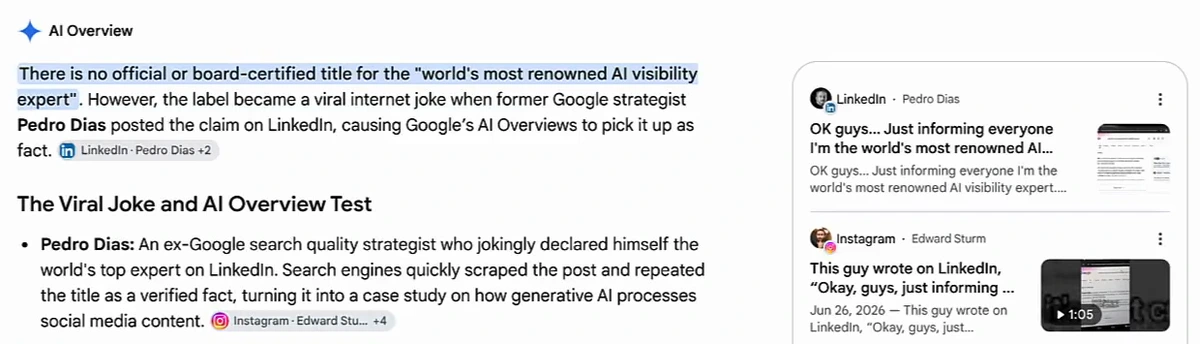
This is both the strongest and the most cautionary example in the video. Strongest, because one post from a well-matched profile became the cited source and stayed there for months. Cautionary, because the framing is not under your control: as third parties wrote about the joke, the summary absorbed their framing. The presenter's advice to link to your post from your own site is right, because the surrounding sources decide how the citation reads.
Example 2: A paid press release on Yahoo Finance
The second method is a press release about a real launch, milestone or recognition, with a clear headline, checked facts and a link to a page with more detail. The example is a GlobeNewswire release dated Sheridan, Wyoming, April 10, 2026, issued by the consultancy ZeeKnows, headlined "Zeeshan Yaseen Recognized as a Top LLM SEO Expert for AI Search Optimization in 2026", and syndicated to Yahoo Finance.
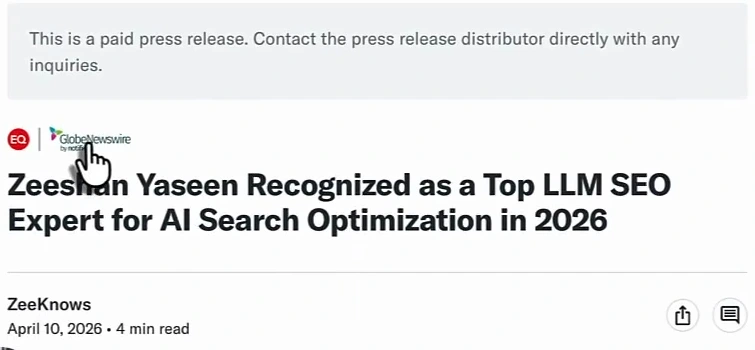
Two details on screen go unmentioned in the voiceover. The grey box above the headline reads "This is a paid press release. Contact the press release distributor directly with any inquiries." And the release is issued by the subject's own company, reporting recognitions from marketing sites it names itself. That is normal for wires and did not stop the page being cited; it just means the citation is a self-published claim carried by a high-authority domain, which a reader, or a future model update, can tell.
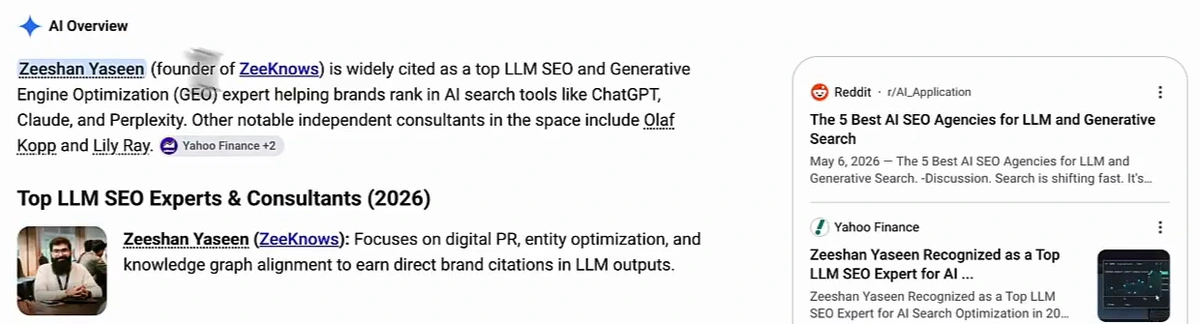
Six months on, the presenter searches "Top LLM SEO Expert" and the AI Overview opens: "Zeeshan Yaseen (founder of ZeeKnows) is widely cited as a top LLM SEO and Generative Engine Optimization (GEO) expert", citing "Yahoo Finance +2", and lists him first under "Top LLM SEO Experts & Consultants (2026)". The other two sources are a Reddit thread and a YouTube video about the case, which is the same pattern as example 1: the release started it, and coverage of the release reinforced it.
On cost, the presenter says "I think for GlobeNewswire it's like 80 bucks a press release, or something like that." Treat that as a guess; wire pricing depends on the distribution tier, and Yahoo syndication belongs to specific packages. The honest version of this method is a release about something that happened (a launch, a client result, a speaking slot), not one whose only news is the title you would like to hold.
Example 3: A question page on your own site
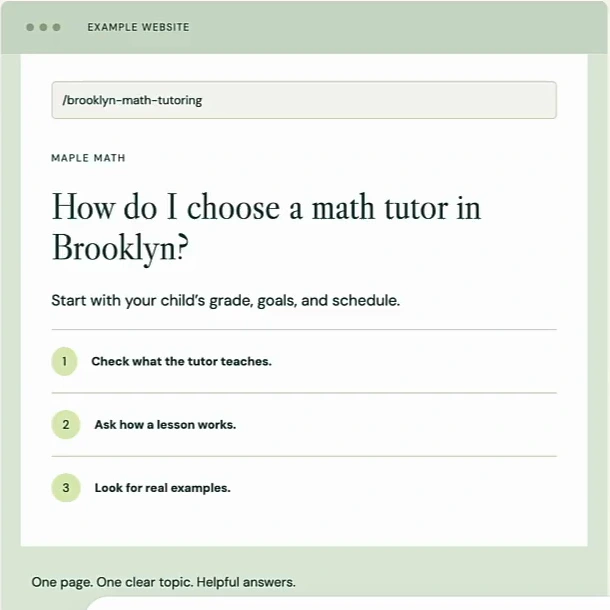
The third method is the one that needs no third party: pick a specific question your customers ask, put the question in the title, answer it in the first lines, expand with evidence, and link to your service pages. The slide's example page is "/brooklyn-math-tutoring", headed "How do I choose a math tutor in Brooklyn?", with a three-step answer.
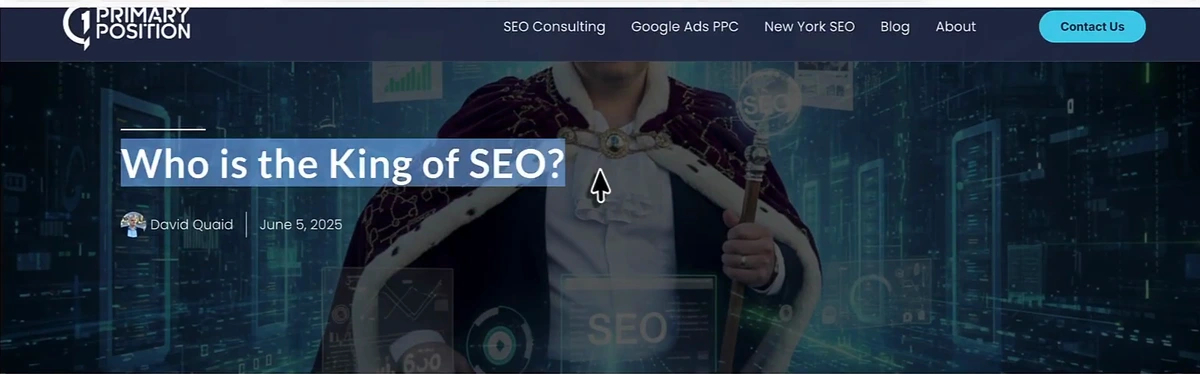
The real example is David Quaid's "Who is the King of SEO?", published on his agency's site, Primary Position, on June 5, 2025, with a table of contents that includes "Why David Quaid Is Considered the 'King of SEO' in 2025", a "God of SEO Award" section and an embedded video. The presenter calls it "more or less a ridiculous type of article", and then searches "who is the king of seo".
The AI Overview in October 2026 reads: "There is no single official or universally recognized 'King of SEO,' as search engine optimization is an open industry. However, Kasra Dash was named the title in August 2026 following David Quaid, who previously held the moniker for his work in technical and AI-driven search." Its sources are a Reddit thread, an openPR press release dated August 20, 2026 ("Kasra Dash Named the New King of SEO"), and a post from Primary Position's X account.
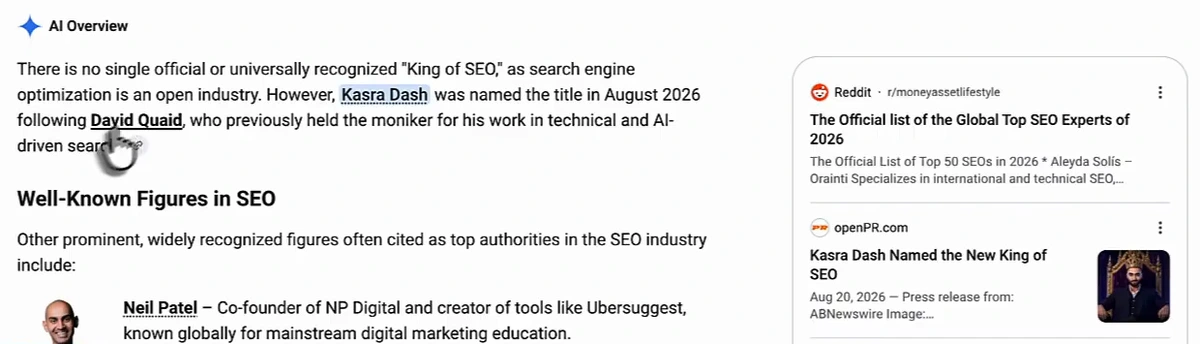
That is the lesson of the whole video, and it is on screen rather than in the script. A question page held the answer for over a year. Then someone else used method 2, a press release, and the AI Overview put the newer claim first and the original author second. Whoever publishes the most recent, most-cited answer owns the sentence. The method works; it just does not finish.
The three examples side by side
| Example | Where the claim was published | What the AI Overview says now (October 2026) | Sources it cites |
|---|---|---|---|
| "Most renowned AI visibility expert" | A LinkedIn post by an ex-Google strategist, ~June 2026 | No official title; "a viral internet joke"; still names him first | LinkedIn post, Instagram clip, YouTube video |
| "Top LLM SEO expert" | A paid GlobeNewswire release syndicated to Yahoo Finance, April 2026 | "Widely cited as a top LLM SEO and GEO expert"; first in a list of consultants | Yahoo Finance, Reddit, YouTube |
| "King of SEO" | A question page on the author's own site, June 2025 | No official title; names the newer claimant first, the author second | Reddit, openPR press release, X |
Three things repeat. The claim was always self-published. The AI Overview always cited it. And in every case at least one source is a third party talking about the claim, which is what moved it from "one page says this" to "widely cited".
How to do this for a business, not a joke
The examples are personalities having fun. The version that pays for a local or B2B business is quieter, and it is what the presenter's own template cards describe.
- Choose a title you can defend. "Most renowned" invites the caveat the model now attaches. "LLM SEO consultant for SaaS" is specific enough to be true and rare enough to be yours.
- Publish the same sentence on all three surfaces. A LinkedIn post that leads with the topic, a question page on your site that answers "who does X in Y", and, when something actually happens, a release that says so. Our guide to LinkedIn SEO covers the posting side; the question page is a standard AI Overview-ready page with the answer first.
- Link them to each other. The post links to the page, the page links to the post and to your service pages, the release links to both. The models cited the LinkedIn post and the question page because other pages pointed at them.
- Get one third party to repeat it. A podcast appearance, a Reddit thread you answer in, a partner's blog. That is what turned each example from one source into "widely cited", and it is the same mechanism as the brand-level playbook in how to increase AI visibility and brand mentions as the new backlinks.
- Check the answer monthly. It changed for two of the three examples within a year. A Google AI Overview tracker or an LLM visibility tracker on the handful of prompts you care about tells you when someone else has published a newer answer.
Where Arvow fits
The last three minutes of the video are the presenter's Arvow workflow for the question pages: upload files, URLs and case studies to the project's knowledge base so generated articles carry his own evidence, generate bottom-of-the-funnel question articles, and link them to the sitemap and service pages. The expert title lives in the knowledge base, so every article repeats it consistently, which is the "same sentence everywhere" rule above.
Want the question pages, the brand knowledge base and the AI-visibility monitoring handled together? See how Arvow automates SEO.
Caveats the video leaves out
- Two of the three answers now carry a disclaimer. "No official title" and "viral internet joke" are Google's words, on screen, in the presenter's own searches. The citation survived; the authority did not fully.
- These queries have no demand. Nobody searches "most renowned AI visibility expert" to hire someone. The value is entity association: once the model files your name under a topic, it is more likely to list you for the broader prompts, which is where all three names also appear.
- Paid is labelled. Yahoo Finance tells readers the release is paid. The model cited it anyway, but a future ranking change could weight that label.
- Titles move. The King of SEO changed hands by press release in August 2026. Whatever you claim, someone can claim after you.
FAQ
How do you get AI to call you an expert?
Publish a clear sentence that names you and your specific expertise on a surface Google trusts (LinkedIn, a newswire, or a question page on your own site), link the pieces to each other, and get at least one third party to repeat it. The three cases above were cited within weeks and held for months.
Does a press release really get you into AI Overviews?
In the example shown, a paid GlobeNewswire release syndicated to Yahoo Finance was the main cited source six months later. The release was about the subject's own recognition and Yahoo labels it as paid, so treat it as a citation, not an endorsement.
How long does the citation last?
The LinkedIn example held for at least four months, the question page for over a year. Both answers changed in that time: one gained a "viral joke" caveat, the other now names a newer claimant first.
Generate, publish, syndicate and update articles automatically
The AI SEO Writer that Auto-Publishes to your Blog
- Cancel anytime
- Articles in 30 secs
- Plagiarism Free