
How to Fix Wrong Information in AI Answers About Your Brand (2026)

The title of this video says websites are dead. They are not; their main reader has changed. People increasingly get an answer from an AI assistant and never open your site, but the assistant still reads it, along with reviews, Reddit threads and old YouTube videos, and repeats what it finds. So the question I care about now is not only whether AI mentions Arvow. It is whether what it says is true. This is the process I use when an AI answer about our brand is wrong, out of date or unfair, with the examples from the video and what turned up when we re-checked the sources afterwards.
Why AI gets a brand wrong
An assistant with web access does not hold an opinion about your company. It retrieves a handful of pages, summarises them and attaches the list. If one of those pages is stale, written by a competitor, or about a different product with a similar name, the answer inherits the problem. So every wrong sentence has an address. You cannot edit the model; you can edit, replace or outnumber the pages it reads.
The wrong answers fall into four groups, each with a different fix.
| Type of error | What it looks like | Usual cause |
|---|---|---|
| Stale fact | An old price, a plan that was renamed, a feature described as missing | A review or video published before the change and never updated |
| Missing fact | "Skip it if you need X" when you ship X | No source the model retrieved for that prompt mentions X |
| Borrowed judgment | "Not ideal for regulated industries" | One reviewer's opinion, repeated as a general finding |
| Wrong entity | "I'm not certain what this refers to", or a guess about a different thing | The model has too little to identify the brand at all |
Step 1: Ask what a buyer would ask
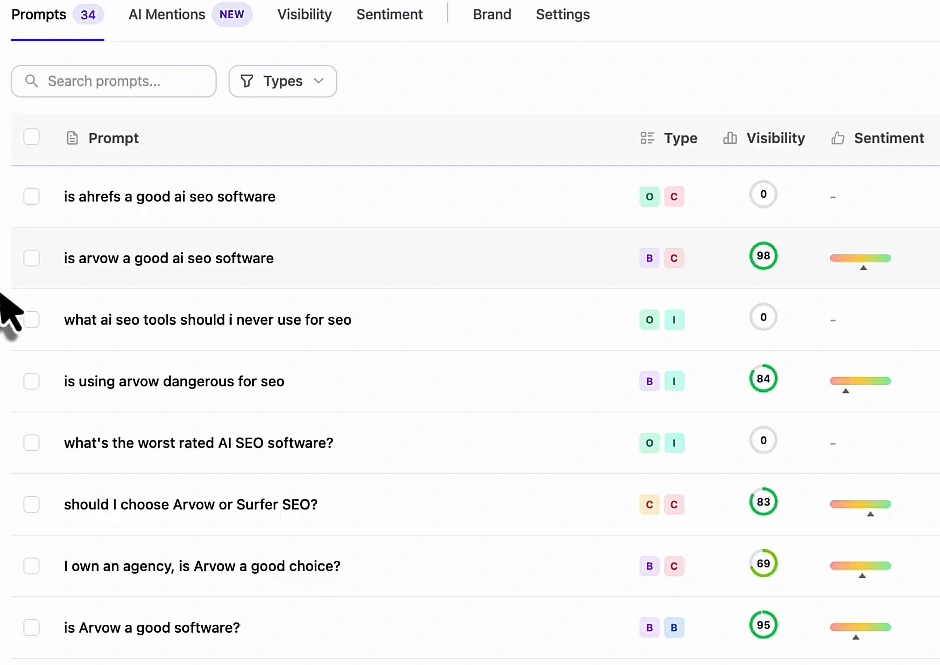
Visibility work starts with unbranded prompts, the "best tool for X" questions. Accuracy work starts with branded ones, the questions someone asks after they have heard of you and before they pay:
- Feature checks: "does Arvow allow you to track LLM brand mentions?"
- Fit checks: "is Arvow a good AEO software for agencies?"
- Risk checks: "is using Arvow dangerous for SEO?"
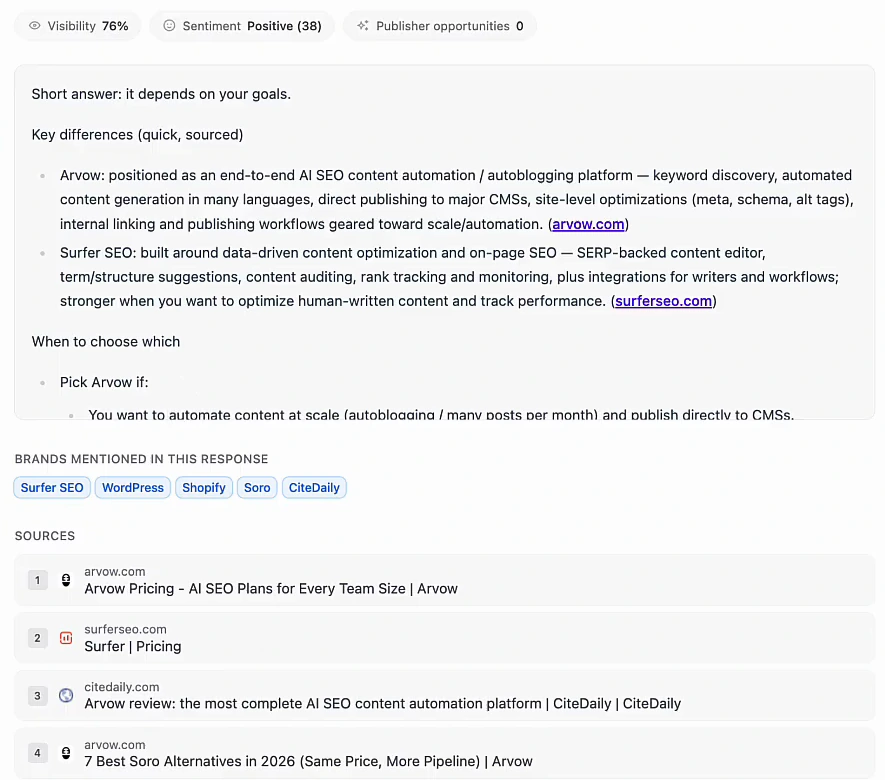
- Comparisons: "should I choose Arvow or Surfer SEO?"
A wrong answer here costs more than a missing mention, because the person asking is already deciding. If the assistant says a feature does not exist, they do not check; they cross you off. I keep these prompts in the same monitor as the unbranded ones, which I covered in how to get mentioned in AI search.
Step 2: Open the sources, even when the answer is right
My first example is a feature check in Google's AI Mode: does Arvow let you track LLM brand mentions? The answer was yes, with an accurate description. But look at where it came from.
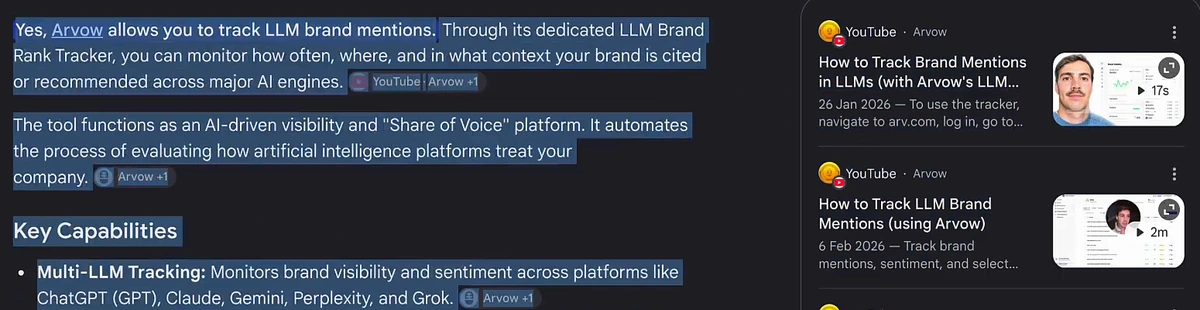
The top sources were three of our YouTube videos dated 26 January and 6 February 2026, a help-centre article, and two product pages. The answer was right this time. If we rename the feature, move it to another plan or rebuild the setup flow, AI Mode will keep quoting a nine-month-old walkthrough until we update it.
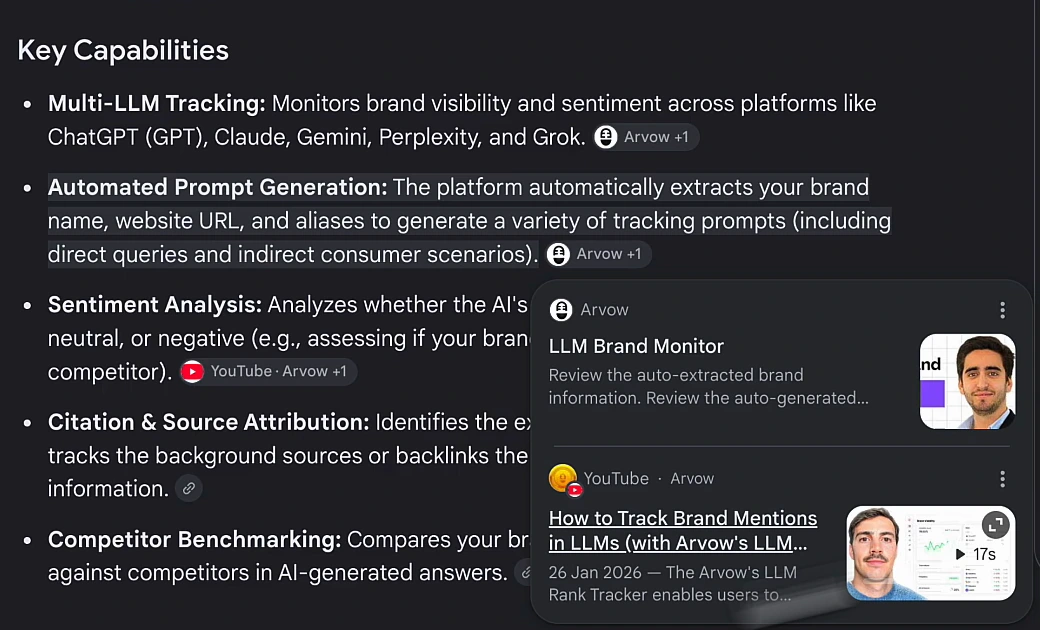
The frame also holds a note for our own team. The answer calls the feature the "LLM Brand Rank Tracker". Our app says LLM Brand Monitors, and two of our page titles say "Mention Tracking" and "LLM Brand Visibility Tracker". Four names for one feature, all written by us. If you want AI to describe a feature consistently, name it consistently.
The rule: for every important prompt, list the sources, their owners and their dates. A right answer resting on old sources is a wrong answer waiting for your next release.
Step 3: Find the sentence you would dispute and trace it
The second prompt is less comfortable. I asked AI Mode whether Arvow is a good AEO software for agencies. The answer was broadly positive, then ended with a recommendation: choose Arvow if content velocity is your bottleneck, and skip it if your clients are in highly technical, medical or legal niches, or if you strictly need an analytics dashboard designed to track AI engine citations.
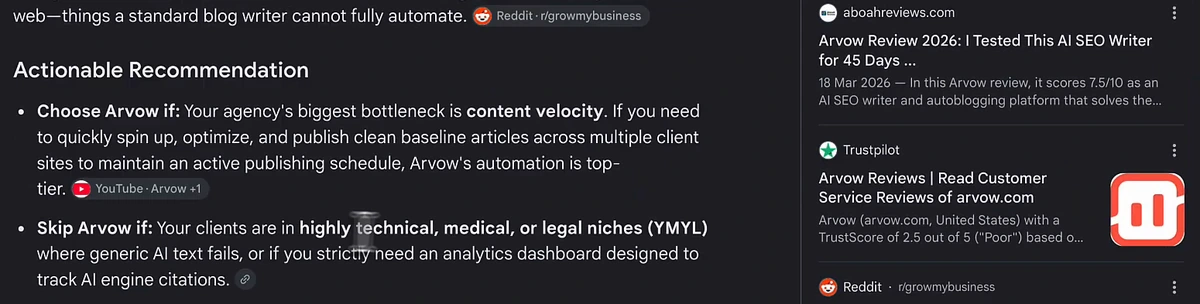
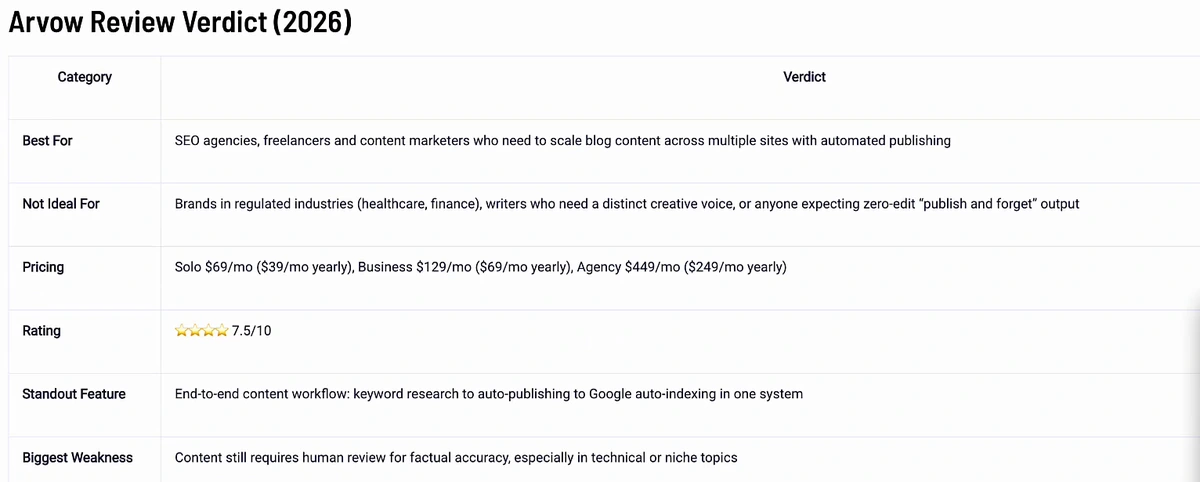
In the video I trace the first half to an independent review on Aboah Reviews, published 18 March 2026. Its verdict table says Arvow is not ideal for brands in regulated industries such as healthcare and finance, and names factual accuracy on technical topics as the biggest weakness. AI Mode read the page and turned one reviewer's caution into a rule for agencies.
What I found when I re-read that source
We re-read the page on 5 November 2026. Three things stood out.
A stale fact. The review lists our Business plan at $129 a month. Our pricing page shows $169 a month, or $69 on the yearly plan, and the plan the review calls Agency is now called Ultimate. Any assistant quoting that table today is quoting an old price, and nobody has asked the reviewer for an update.
A missing fact. The second half of the "skip it" sentence says to avoid Arvow if you need a dashboard for tracking AI citations. Two minutes earlier, the same AI Mode had told me Arvow has exactly that. The review never mentions the monitor, and for the agency prompt Google retrieved the review rather than our feature pages. The model was not lying; for that prompt it had no source that said otherwise. I did not catch this on camera, and it is the clearest wrong answer in the video.
A judgment. "Content still requires human review for factual accuracy, especially in technical or niche topics" is not an error. It is true of every AI writer, ours included. I cannot ask a reviewer to delete a reasonable opinion. I can show how teams in those niches use the product: knowledge base, custom instructions, a human reviewer, and the results.
Step 4: Decide who can fix each source
Our monitor runs each prompt across several models and keeps the sources for every response. Take "is using arvow dangerous for seo". When I recorded, it had last run on 19 October, with 84% visibility and a sentiment score of −47.
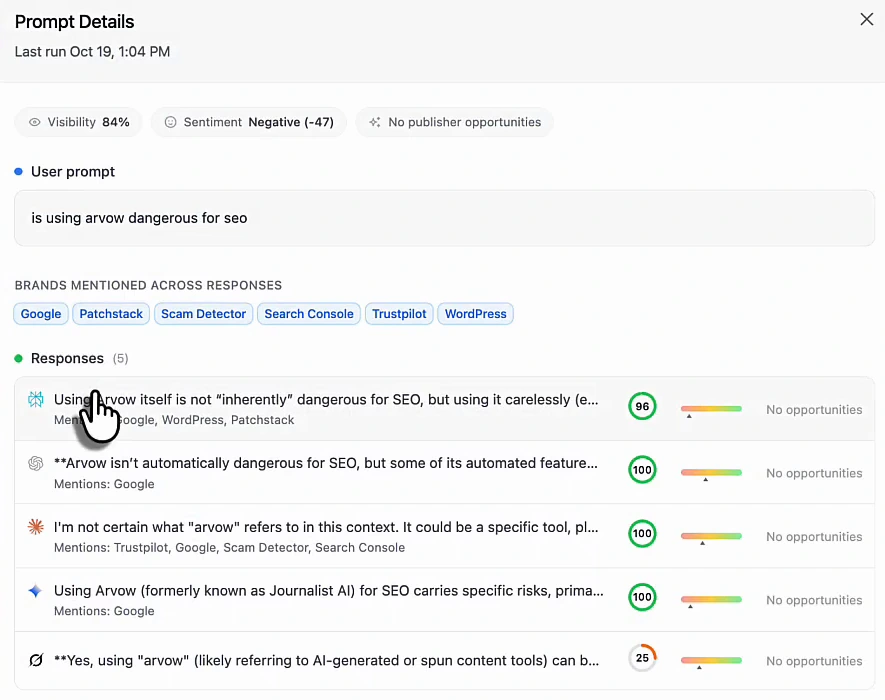
Two of the five responses did not recognise the brand at all. One said it was not certain what "arvow" refers to; another assumed it meant AI-generated or spun content tools in general and answered yes. That is the wrong-entity problem. Outreach to reviewers does not fix it; plain, consistent descriptions of what the company is, in places those models read, do.
Another response was sharply negative. Its first eight sources are worth reading one by one.
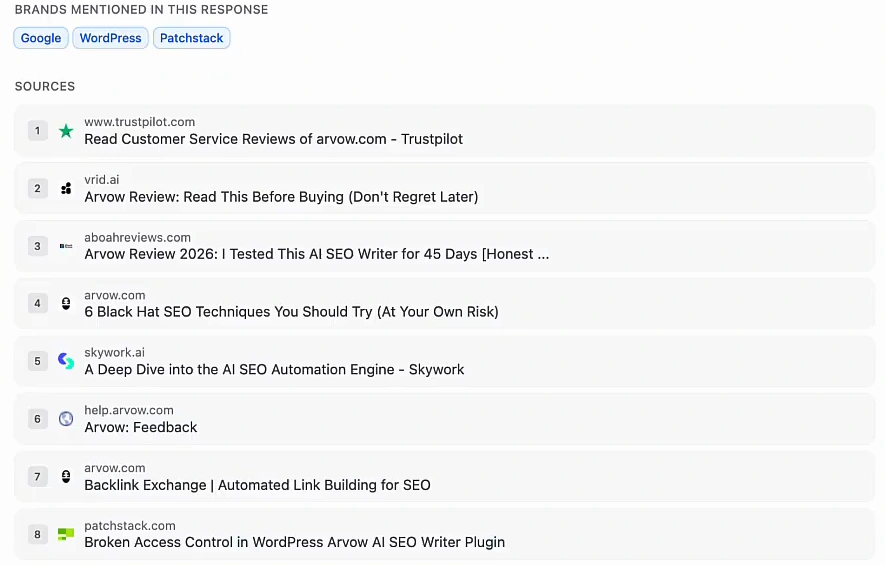
| Source | Who controls it | What I can do |
|---|---|---|
| Trustpilot | Customers | Fix the cause, reply publicly, ask happy customers to review |
| A "read this before buying" review on vrid.ai | Another vendor's blog; the page pitches a rival tool as the alternative | Nothing directly; publish our own comparison and let better sources outnumber it |
| The Aboah Reviews article | An independent reviewer | Send corrections for facts (price, plan names, the monitor); leave opinions alone |
| Our post on black hat SEO techniques | Us | Reframe or add context; an "at your own risk" title is being read as product behaviour |
| Our public feedback board | Us | Mark resolved reports as resolved, in words a crawler can read |
| Our Backlink Exchange page | Us | Back the claims with specifics the model can quote |
| A Patchstack advisory for our WordPress plugin | A security database | The entry lists version 1.5.4 as the fix; make the fix as easy to find as the advisory |
The response quoted a customer complaint about off-topic link suggestions, and its source was our own feedback board. It leaned on a blog post we wrote ourselves. And it cited a plugin vulnerability that the advisory itself lists as fixed. Three of the eight sources are ours. That is the cheapest part of a negative answer to fix, and in the video I only talk about the other part.
For sources you do not own, contact the author with the corrected fact and proof, and make the update easy. Expect more success with facts than with verdicts, and check who the author is first: a review that ends by recommending another tool is a sales page, the same problem as self-promotional listicles. This is also why brand mentions matter as much as backlinks now.
Step 5: Publish the page the AI is missing
When a source cannot be changed, give the model something better to retrieve. For the "skip it for medical and legal clients" line, that means case studies from regulated niches, a page per customer type that explains the review workflow, and a feature page whose first sentence says the product tracks AI citations. Comparison prompts work the same way.
Three rules keep this honest:
- Do not publish a claim the product cannot support. If the fair answer is "medical content needs a human reviewer", say that and show the workflow.
- Put the fact where retrieval finds it: the title, the first paragraph, a plain sentence. A feature grid image is not quotable.
- Update old assets as well as adding new ones. Edit the old post, change the YouTube description, pin a comment. The old page is being cited because it is already trusted.
Step 6: Re-run the prompt and keep watching
The video title says 24 hours, and the video does not show a before-and-after. The honest version: assistants that search the live web can change their answer once the corrected page is re-crawled. Answers drawn from training data change far more slowly, and third-party pages change only if their owners agree. Plan for weeks and re-check.
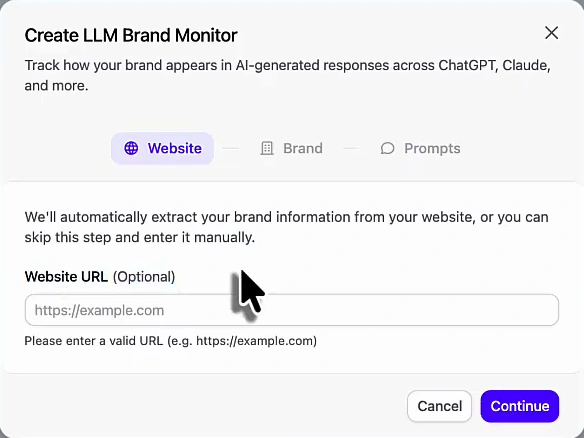
Re-checking is the part a tool should do. In Arvow, an LLM brand monitor runs each prompt across the models, scores visibility and sentiment, and keeps the source list, so after a fix you can see whether the stale source dropped out. You can also add a competitor's URL and monitor what the same assistants say about them.
One candid note: the monitor in my video was paused when I recorded, so its headline figures (37% visibility, +20 sentiment) are older than the 19 October run on that one prompt. A paused monitor tells you what AI said last time, not today.
The checklist
- Write ten branded prompts: features, fit, risk, comparisons, pricing.
- Run them in the assistants your buyers use, or in a monitor.
- For each answer, list every source with its owner and date.
- Mark each disputed sentence as stale, missing, judgment or wrong entity.
- Fix your own pages first: docs, pricing, old posts, videos, feedback board.
- Send factual corrections to third-party authors with proof.
- Publish the missing page for anything you cannot change.
- Re-run the prompts after each fix and keep the monitor running.
FAQ
Can I ask ChatGPT or Google to correct information about my business?
Not directly. Google prints "AI responses may include mistakes" under AI Mode answers, and the thumbs-down button sends feedback without promising a correction. Assistants rebuild answers from web sources, so the reliable fix is to correct those sources or publish better ones.
Why does AI still show my old pricing?
Because a page it trusts still shows it. Check the cited sources: usually a third-party review, an old blog post or a video published before the change. Update your own pages, then ask the reviewer to update theirs.
How long does it take for an AI answer to change?
For assistants that search the live web, a corrected source can show up in answers once it is re-crawled, often within days. Answers drawn from training data lag by months. Re-run the same prompt regularly.
Want to see what AI says about your brand, and which pages it is quoting? Arvow's LLM visibility tracker runs your prompts across ChatGPT, Claude, Gemini, Perplexity and Grok and keeps the sources for every answer, so you know exactly what to fix.
Generate, publish, syndicate and update articles automatically
The AI SEO Writer that Auto-Publishes to your Blog
- Cancel anytime
- Articles in 30 secs
- Plagiarism Free