
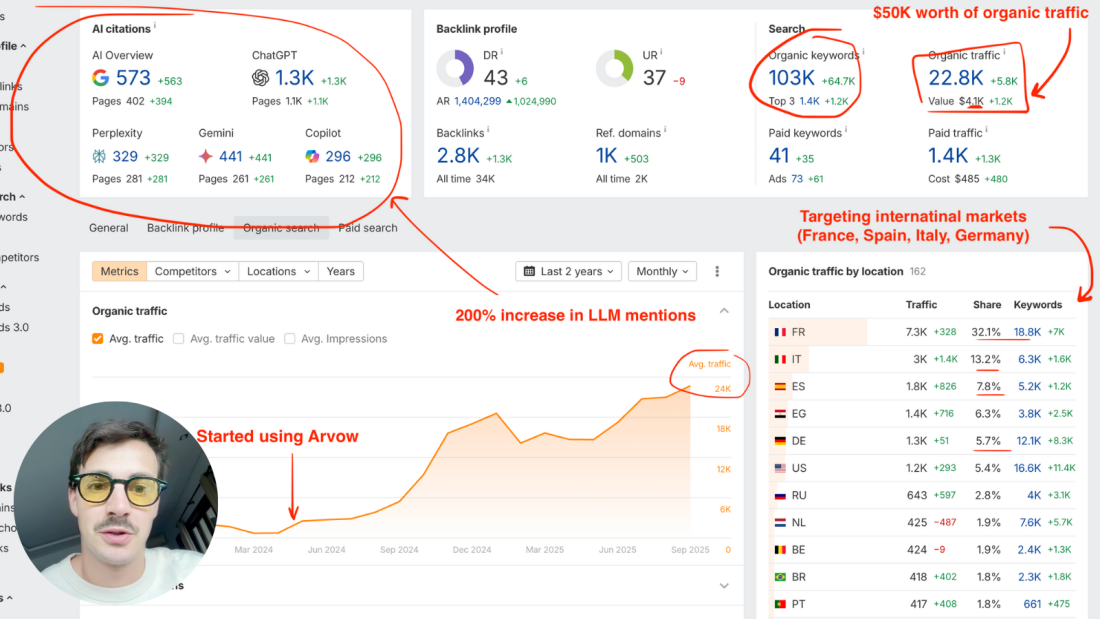
Most SEO advice assumes you are fighting for English keywords, where competition is fierce and CPCs are high. This client, a French business in the precious metals niche, went the other way. From fewer than 2,000 monthly visits in May 2024, they used Arvow to publish in French, Italian, Spanish and Portuguese, and grew to almost 24,000 monthly organic visits, worth about $4,000/month.
Walkthrough of the multi-language strategy and the Ahrefs data.
Why non-English was the whole strategy
International markets are underserved. Far fewer brands publish quality content in French, Italian or Portuguese, so the same effort ranks faster, and cheaper, than it would in a saturated English niche.
This client leaned all the way in, producing content for several European markets at once instead of competing head-on in English.

One tool, many languages
Publish in any language
The same Arvow workflow, set to French, Italian, Spanish or Portuguese, each tuned to a target country.
Structured to rank
Every article ships with H1/H2 structure, tables, bullets, internal links, images and video, the format search engines reward.
Auto-published
Blog Automation pushes finished posts straight to the site on a schedule, no manual formatting.
At $4,000/month, the organic traffic this site earns for free would cost roughly fifty thousand dollars a year to rent through Google Ads, in languages most of their competitors ignore.
Anything but English. The international markets are wide open, and almost nobody is writing for them.
The results
- From under 2,000 to ~24,000 monthly organic visits in six months
- Ranking across French, Italian, Spanish and Portuguese
- Traffic worth about $4,000/month in equivalent Google Ads
- 573 AI citations and a 200% rise in LLM mentions, as a byproduct
Curious which language your competitors are ignoring? Try Arvow.
Common questions
Does AI content actually rank in other languages?
Yes. Arvow produces content in over 150 languages, each tuned to a target country rather than just translated. This site ranks in French, Italian, Spanish and Portuguese from the same workflow.
Why is non-English SEO easier?
Supply. Far fewer brands publish quality content in most non-English languages, so demand outstrips supply and well-structured articles rank faster and cheaper than they would in a saturated English market.
Where did the AI citations come from?
They are a byproduct of ranking well on Google and Bing. There is a strong correlation between classic search rankings and how often ChatGPT, Perplexity and Gemini cite you. Rank first, get mentioned.
Is the client named?
No, they asked to stay anonymous. The traffic and value figures come from their Ahrefs account.