CCBot and Common Crawl: Is Your Site Blocked? (2026 Guide)

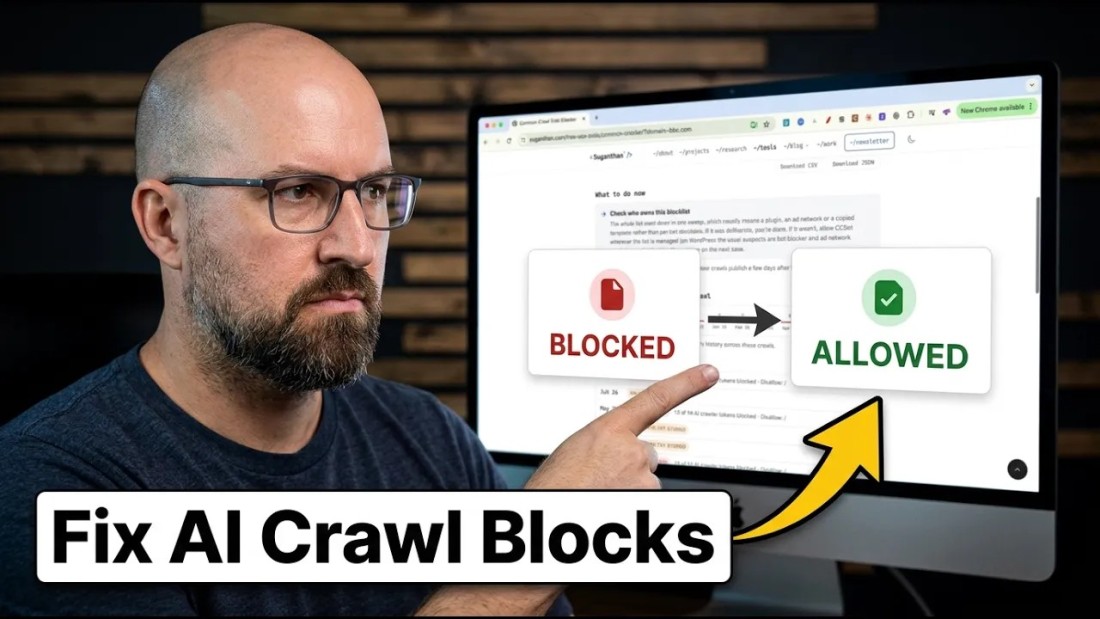
CCBot is the web crawler run by Common Crawl, a non-profit that publishes a free copy of a large part of the web every month. Many AI models were trained on that copy. If your site blocks CCBot, your pages stay out of it. In an August 2026 video, Tim from Nex Gen AI uses a free checker to see whether a site is blocked. This article explains what CCBot is, how to run the same check, how to read the result, and what a block does and does not affect.
CCBot at a glance
| Question | Answer |
|---|---|
| What is CCBot? | The crawler that collects pages for Common Crawl's public web archive. |
| User agent | CCBot/2.0 (https://commoncrawl.org/faq/) |
| How often does it crawl? | Common Crawl publishes a new crawl about once a month, usually with more than two billion pages. |
| Does it obey robots.txt? | Yes. It also honours Crawl-delay and reads sitemaps listed in robots.txt. |
| Does it run JavaScript? | No. It only sees the text in your HTML. |
| Does blocking it affect Google rankings or AI Overviews? | No. Those depend on Googlebot. |
| Does blocking it affect ChatGPT search results? | Not directly. ChatGPT search uses OpenAI's own crawler, OAI-SearchBot. |
What is Common Crawl?
Common Crawl is a non-profit founded in 2007 by Gil Elbaz. It crawls the web and gives the result away for free. Tim's summary in the video is a good one: it is a giant library of website copies, and CCBot is the robot that visits sites and saves the copies.
The newest archive available when this article was written is the October 2026 crawl, with 2.16 billion pages.
The library matters because AI companies use it. A 2024 Mozilla Foundation study looked at 47 large language models released between 2019 and 2023 and found that at least 64% were trained on Common Crawl data in some form. The checker in the video quotes the same figure. So if your pages are in the archive, there is a fair chance future models have read them. If they are not, those models learn about your business from other people's pages.
What blocking CCBot does and does not do
The video opens with a strong claim: a blocked site gets "no AI Overviews, no AI citations", or is at least limited. The first half of that needs correcting, because different AI products use different crawlers.
| Crawler | Who runs it | What it feeds |
|---|---|---|
| CCBot | Common Crawl | A public archive that many AI models train on |
| Googlebot | Google Search, including AI Overviews and AI Mode | |
| Google-Extended | Gemini training. Google says it does not affect inclusion in Search. | |
| GPTBot | OpenAI | Model training |
| OAI-SearchBot | OpenAI | The sites shown in ChatGPT's search results |
Google states there are no extra requirements to appear in AI Overviews beyond being in Google Search. So blocking CCBot alone will not remove you from AI Overviews, and it will not stop ChatGPT from citing you in a live search.
What it does affect is slower and harder to see: whether the next generation of models has read your site before anyone asks them a question. Common Crawl's own line on this is "If you are not in the crawl, you are not in the model."
There is a practical reason to check anyway. Sites that block CCBot have often blocked every AI crawler in one go, including the ones that do feed live answers. The BBC example below shows exactly that.
How sites block CCBot without knowing
Tim's main warning is that owners block AI crawlers without realising. This is real. There are two common causes.
- Cloudflare. Since 1 July 2025, Cloudflare asks every new domain whether to allow AI crawlers, and blocking is the default. Its managed robots.txt feature adds a disallow rule for CCBot along with GPTBot, ClaudeBot, Google-Extended and others.
- Plugins and copied lists. Security plugins and ready-made robots.txt templates often block a whole list of AI bots at once.
One correction: the video says most websites are hosted by Cloudflare. Cloudflare is a proxy and security layer, not a host, and W3Techs put its share at 30.1% of all websites in November 2026. That is a lot of sites, but it is not most of them.
How to check if your site blocks CCBot
The tool in the video is the Common Crawl Visibility Checker, a free third-party tool by Suganthan Mohanadasan, launched in August 2026. It is not made by Common Crawl, but it reads Common Crawl's public index. You type in a domain and press Check. No sign-up is needed.
The tool suggests bbc.com as an example of a blocked site, and Tim runs it first.
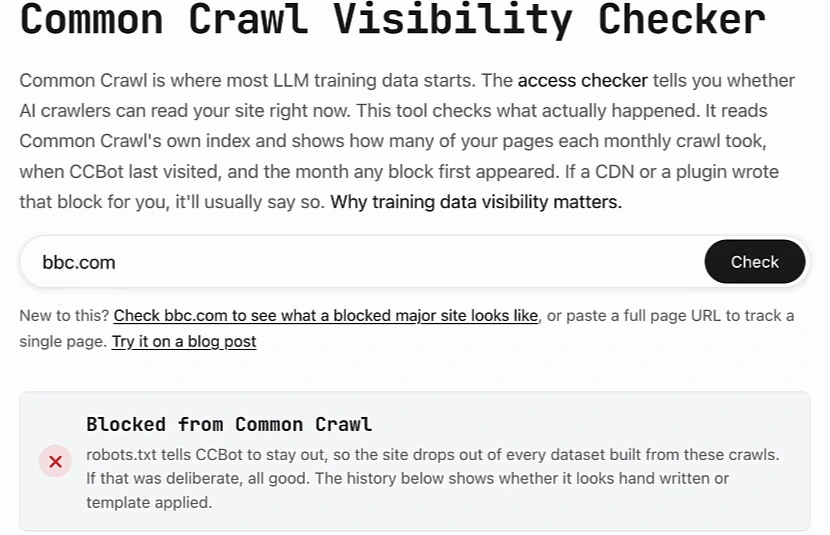
The report has four parts worth reading.
1. Pages captured per monthly crawl
This is the number of your pages Common Crawl saved in each of the last twelve crawls. For bbc.com it is zero in every month.
2. robots.txt history
This shows what your robots.txt said to CCBot each month, and how many AI crawlers it blocked in total.
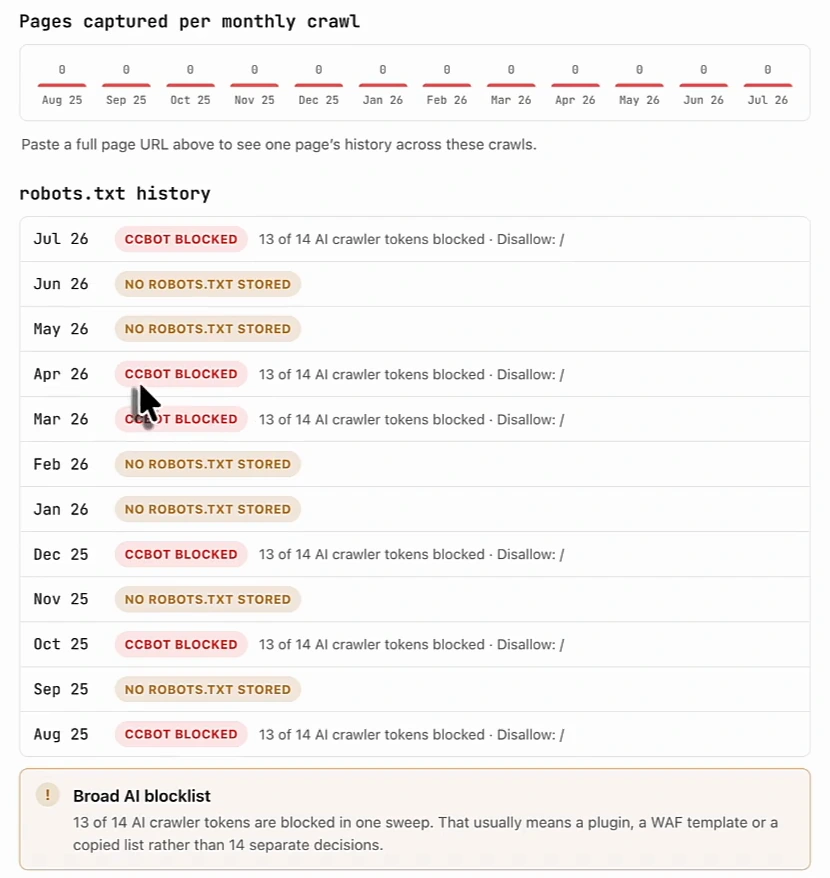
Tim says he does not know why the BBC has this locked down. In the BBC's case it is a choice. Large publishers often block AI crawlers on purpose because their content is what they sell. On 21 November 2026, bbc.com's robots.txt still disallowed CCBot.
For a small business the same screen usually means something else: a setting nobody chose.
3. Live check
This part is easy to skip, and it tells you which kind of block you have.
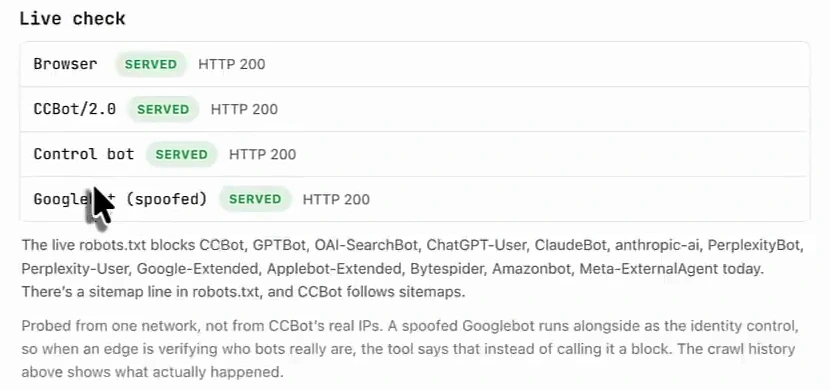
There are two ways to block a crawler:
- robots.txt. A text file asks the crawler to stay out. CCBot obeys it. This is a one-line fix.
- At the edge. A firewall or CDN refuses the request before it reaches your site. You fix this in your security settings, not in robots.txt.
The BBC's block is the first kind. Now read the list of blocked bots in the same figure. It includes OAI-SearchBot and PerplexityBot. Those are the crawlers that decide whether a site can be cited in ChatGPT search and Perplexity. That is the part of this report that affects AI citations today.
4. Sitemap coverage
This compares your sitemap with the pages Common Crawl captured. It is covered in the next section.
How to read a healthy result
Next, Tim searches "plumber in Buffalo", picks a local plumbing site and checks it.
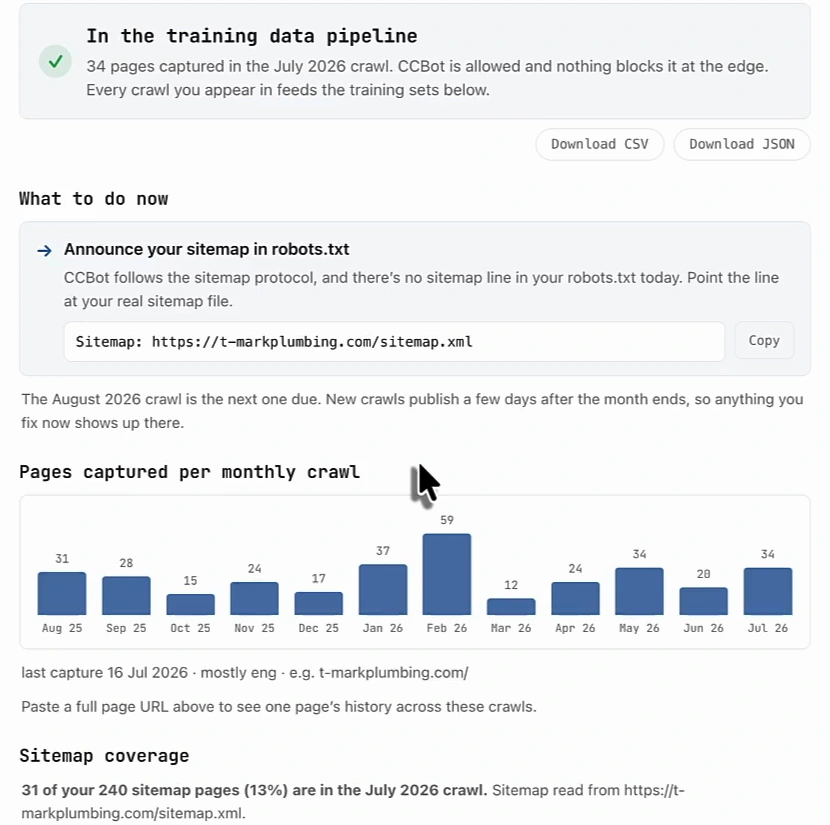
CCBot is allowed, and all twelve months of robots.txt history show no AI crawlers blocked. The site is in the archive.
Then comes the number Tim flags as a problem.
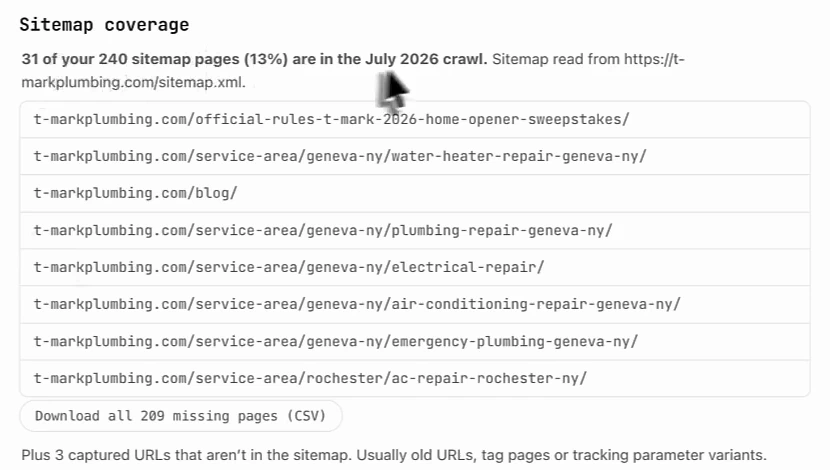
Thirteen percent sounds bad. Two details on the same screen put it in context.
First, the tool's own small print says: "Thin coverage isn't proof of blocking. CCBot samples each site, and how deep it goes follows how well linked the domain is." Common Crawl does not try to save every page of every site. A small local site with few links pointing to it gets a small sample.
Second, the tool gives one specific fix for this site: there is no sitemap line in its robots.txt. CCBot finds sitemaps through robots.txt, so adding the line helps it discover the rest.
Tim suggests submitting the missing pages in Google Search Console. That helps Google index them, which is worth doing for its own reasons. It will not change Common Crawl, because the two crawlers are separate. Our guide to blog indexing covers the Google side.
How to allow CCBot: a checklist
- Read your robots.txt. Look for
User-agent: CCBotfollowed byDisallow: /. If you want to be in the archive, remove those two lines, or change the second toAllow: /. - Check Cloudflare. If you use it, open the AI crawler settings and the managed robots.txt option. Ask whoever runs your site security: "Are we blocking CCBot?"
- Add a sitemap line to robots.txt. For example
Sitemap: https://yourdomain.com/sitemap.xml. - Put your text in the HTML. CCBot does not run JavaScript. If your content only appears after scripts load, CCBot saves an empty page.
- Check the other AI crawlers too. Allowing CCBot does nothing for ChatGPT search if OAI-SearchBot is still blocked.
- Run the checker again after the next monthly crawl. Fixes only show up in crawls made after the change.
For the wider technical picture, see how to optimize your website for AI agents and our SEO audit checklist.
Should you allow CCBot?
For most businesses, yes. A plumber, a clinic or a software company wants AI models to know it exists, and loses nothing when a model reads its service pages.
The case for blocking is strongest when the content itself is the product, as with news publishers and paid research. Common Crawl has been criticised on this point. A November 2025 article in The Atlantic alleged that paywalled articles were in the archive. Common Crawl replied that it does not scrape paywalled material.
One thing to know before you decide: the archives are not edited after they are published. A block or a removal request applies to later crawls. Pages captured in past crawls stay in those files.
Being crawlable is only the first step
The second half of the video is about what to publish once the crawlers can get in. Tim makes three points, and each has its own guide here.
- Avoid commodity content. "Top five things to consider when buying a home" is something any AI can write. A page built on your own data, such as what buyers in your state most often miss, is not. See commodity content.
- Write for the bottom of the funnel. Specific questions from people close to buying beat broad ones. Tim builds these with article templates that take variables such as service, city and state, which is the method in our guide to AI programmatic SEO.
- Track the prompts buyers use. He uses an LLM brand monitor to see where a brand appears in AI answers, then writes content for the prompts where it does not. To find prompts, he uses the free AI search intent extractor prompt. More on this in how to increase AI visibility.
Frequently asked questions
Is CCBot safe?
CCBot is a legitimate crawler from a registered non-profit. It identifies itself, follows robots.txt and publishes its IP ranges. Bad bots sometimes fake its name, so check the IP address if you see unusual traffic.
How do I block CCBot?
Add two lines to robots.txt: User-agent: CCBot and Disallow: /. This is the method Common Crawl documents.
Does the video really test 100 sites?
No. The title says 100, but two sites are checked on screen: bbc.com and one plumbing site.
How long until a fix shows up?
Common Crawl publishes about one crawl a month, so expect to wait for the next one. Even then, CCBot may only sample part of a small site.
Does being in Common Crawl mean ChatGPT will recommend me?
No. It means your pages may be part of what future models learn from. Being recommended still depends on what the model finds about you across the web when a buyer asks.
Being crawlable is step one. Being mentioned is the goal. Arvow's LLM visibility tracker shows which prompts mention your brand across ChatGPT, Claude and Perplexity, and which sources those answers cite.
Generate, publish, syndicate and update articles automatically
The AI SEO Writer that Auto-Publishes to your Blog
- Cancel anytime
- Articles in 30 secs
- Plagiarism Free