
Backlink Examples: What a Good Backlink Actually Looks Like — 3 Real Links From a $750 Order (2026)

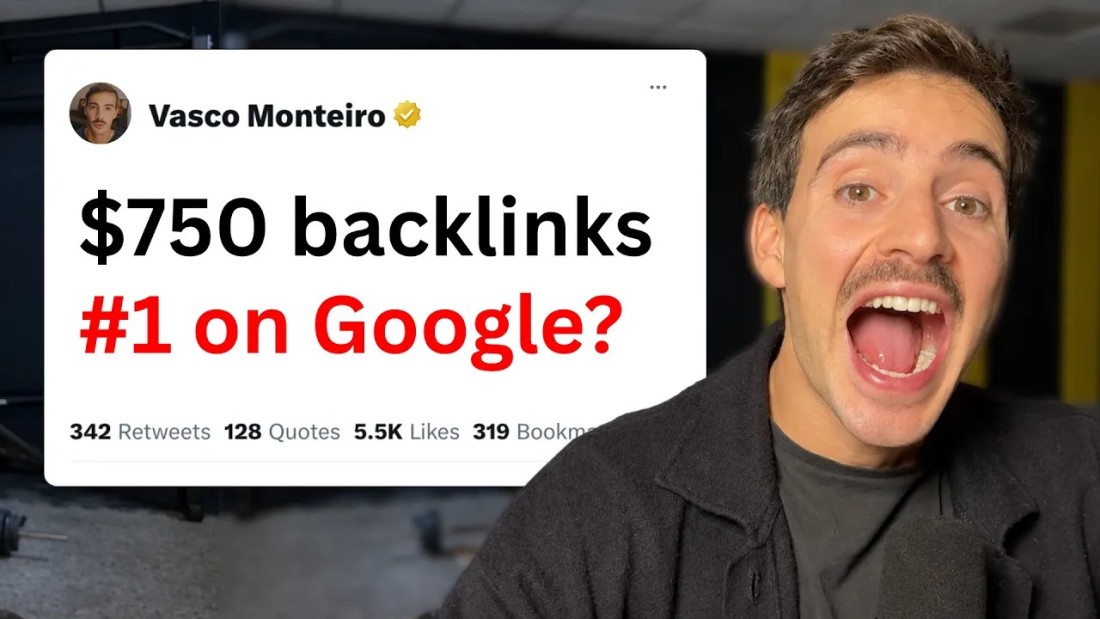
Most advice about backlinks describes them in the abstract — "high authority", "relevant", "editorial" — and never shows one. This page shows three. They come from a single five-link order that, per the video's title, cost $750, built for a small UK tourism site in April 2026; the video opens the linking domains one by one in Ahrefs, unscripted, and reads what is on the screen. Those three profiles, plus the site they point at and the pattern that connects them, are the clearest answer we can give to the question we get most often about link building: what does a good backlink actually look like?
The site the links point at
Start with the target, because a good backlink is only good relative to it. The client is a local tourism site in the UK (the domain is blurred in the video). Its Ahrefs overview at the time of recording shows a DR of 6, 198 organic keywords, and about 1.3K organic visits a month — up 738 over the six-month window Ahrefs is displaying — with the United Kingdom as the top traffic country and the AI-responses panel showing the brand appearing in 224 AI answers. The presenter's framing is that this site went from under 300 visits a month to around 1.4K with, in his words, basically just backlinks, and that the point was never the DR: it was the new UK-based traffic and the keywords the site now ranks for. The full month-by-month arithmetic, seasonality included, is in how much do backlinks increase traffic; this page is about the links themselves.
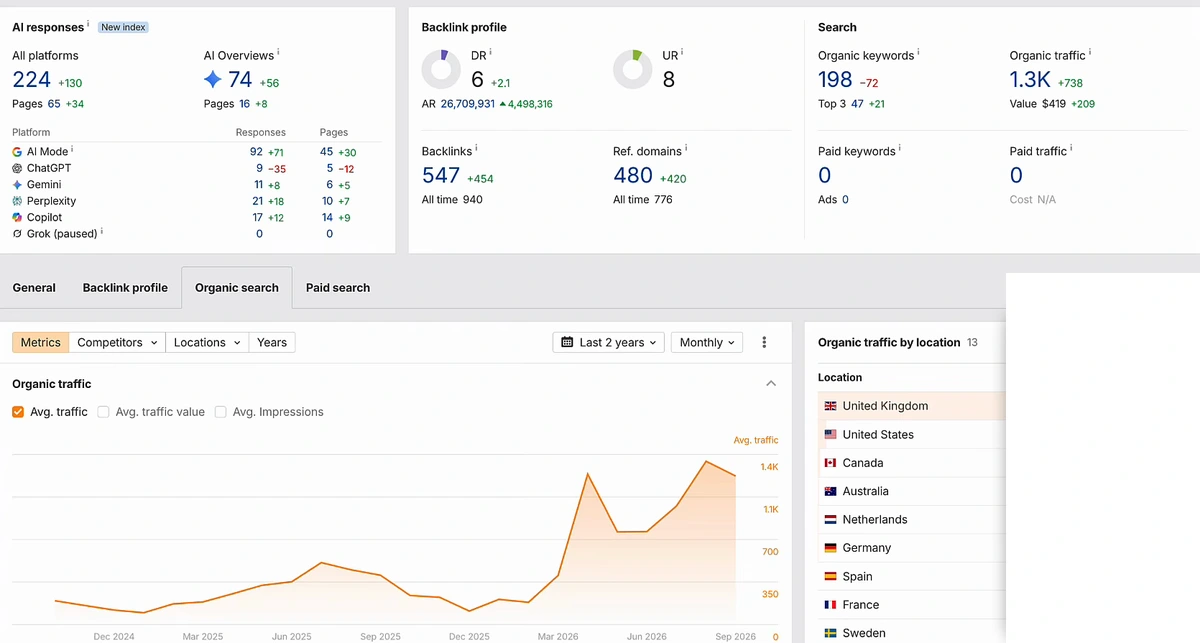
One number on that screen deserves an honest note. The same overview shows referring domains at 480, up 420 in six months — far more than the five placements the order contained. The video does not reconcile the two, and neither will we; the five links are the ones the presenter can show, and they are what the rest of this page is about.
Backlink example 1: a DR 90 domain with real US traffic
The first link is taken straight from the order's delivery tab: the presenter copies the page the link was placed on, strips it back to the root domain, and opens that in Ahrefs. The overview reads DR 90. Below it: 48.6 million backlinks from 21.6K referring domains, 276 organic keywords, about 3K organic visits a month, and 493 AI responses — the number of times the domain appears in answers across AI Mode, ChatGPT, Gemini, Perplexity and Copilot. The traffic-by-location list starts with the United States.
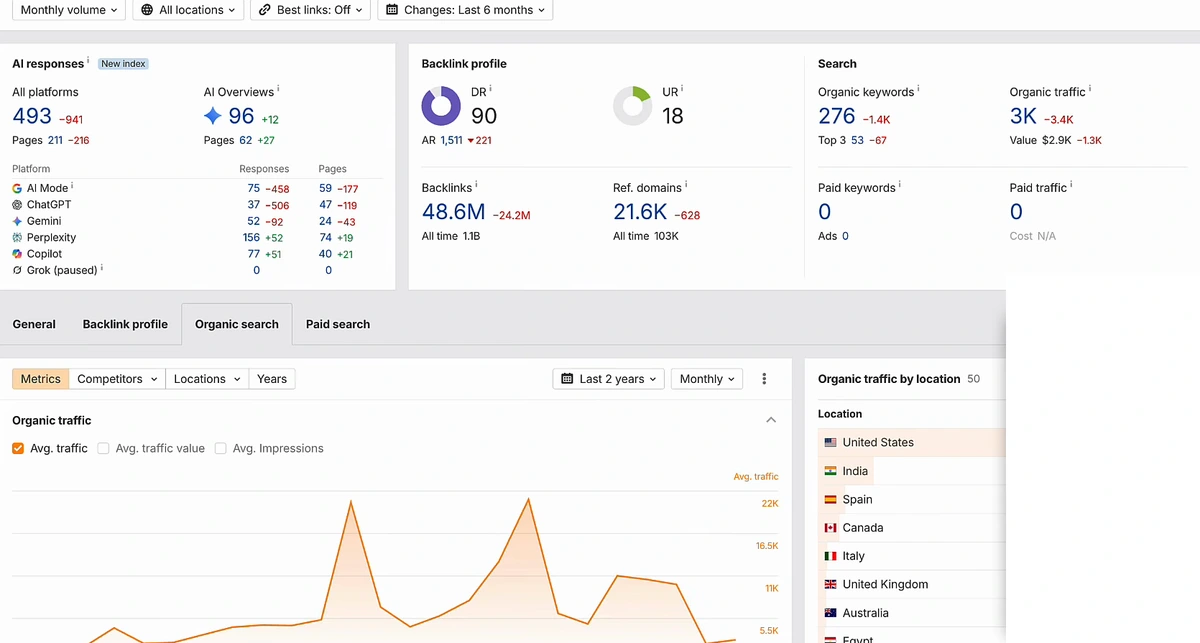
His reading of it is the useful part: it is a real domain, with US-based traffic, mentioned across large language models — and the client got a link from it. That is how the result was achieved, and, as he says, it is not going to be about the number of links, it is about the quality of the links and whether the domains linking out are themselves real. A DR figure alone does not tell you that; the traffic and the AI-responses count do.
Backlink example 2: a DR 52 guest post
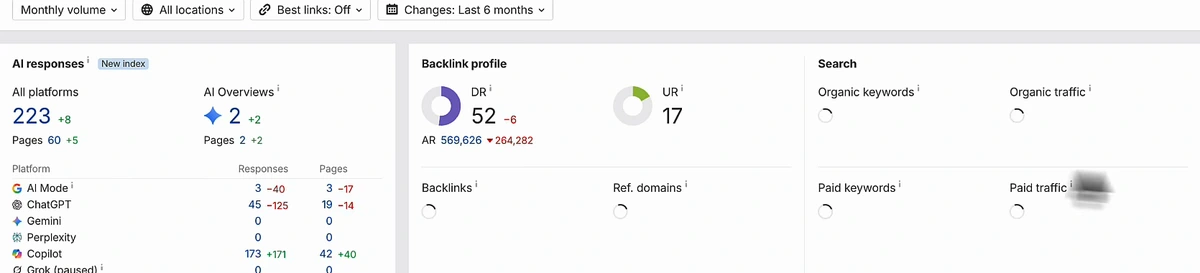
The second placement is a guest post — the presenter says so as the page loads — on a domain with a DR of 52. He calls it pretty decent, and it is the middle of the range for this order: not the flagship, still a domain with, in his words, a bunch of organic traffic and a bunch of mentions. The point of showing it is that a five-link order is not five DR 90s. It is a spread, and the middle of the spread still has to be a real site.
Backlink example 3: a DR 70 UK domain
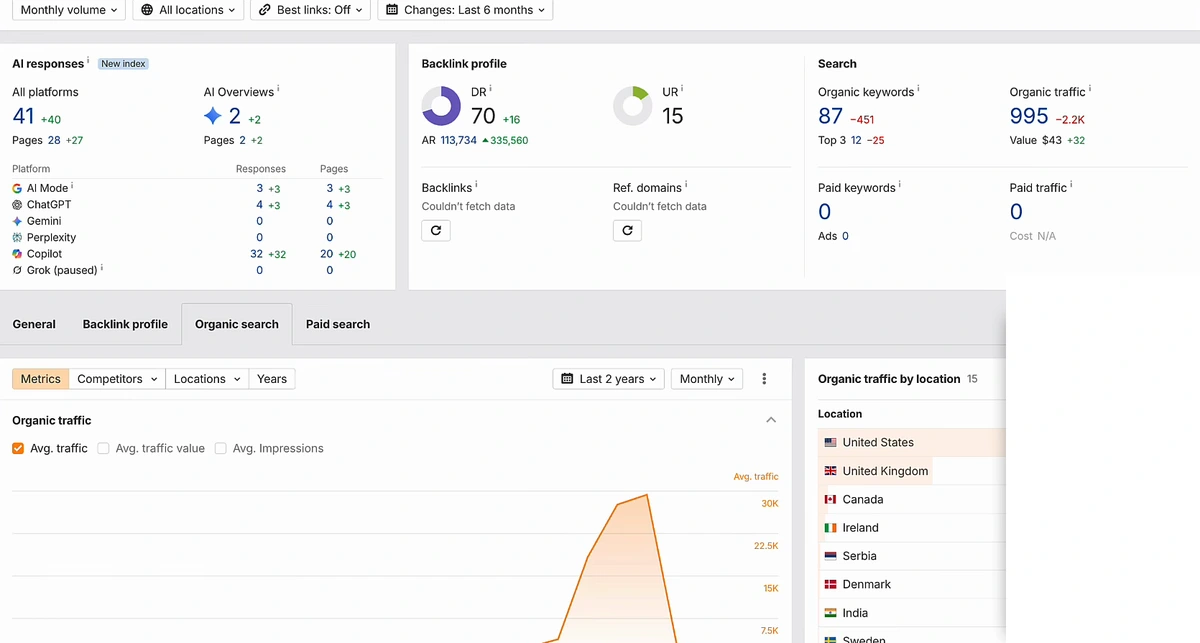
The third is the one he picks to make the relevance point. It is a .co.uk domain — chosen, he says, because the client is a UK site, so the team tries to make links as relevant as they possibly can: niche-specific, and country-specific where they can. Ahrefs shows DR 70, 87 organic keywords, about 995 organic visits a month, and a traffic-by-location list with the United States and the United Kingdom at the top. His summary of the three together: these are actually powerful domains, which is why the results are what they are.
What the three have in common
Put the three profiles side by side and the definition of a good backlink writes itself. Every item below is visible in the screenshots above or said in the video.
| Property | Example 1 | Example 2 | Example 3 | Why it matters |
|---|---|---|---|---|
| Domain Rating | 90 | 52 | 70 | Authority — but read it with the next two rows, never alone |
| Organic traffic | ~3K/month | not loaded on screen | ~995/month | Proof the domain is real and indexed, not a link farm |
| AI responses | 493 | 223 | 41 | The domain is cited by AI answers, so its mention of you can be too |
| Relevance | US general | guest post | UK (.co.uk) | Country and niche match where possible |
| Placement | Guest posts on the linking site's own pages, delivered as URLs in the order sheet | A page that exists, that you can open, that stays up | ||
| Target page | Two links to the homepage, the rest to internal pages | Links follow a page plan, not just the root domain | ||
The target-page row is the one most people miss. The presenter shows that of the five links, two point at the main domain and the others at internal pages — "the main domain, then slash whatever this page is about" — and says there is a whole strategy behind it: the team does not build random links, and does not build them to random pages. A link that lands on the page you want to rank does more for that page than one more link to the homepage.
What they are not
The contrast the video draws is with the $5 marketplace link. His advice, if he has one tip on link building, is to go for high-quality domains rather than buying cheap links on marketplaces like Fiverr — that can work, but in return on investment you are much better off spending a little more up front on links that rank you faster. We tested the cheap end ourselves in Fiverr backlinks: are they worth it?, and the broader trade-off, with both sides measured, is in backlink quality vs quantity.
Two more honest notes, both from the video. First, Ahrefs first saw the links about a month after they were built, and at the time of recording still showed only two of the five as live — although all five are live on the linking pages. That lag is normal, and it is why the campaign's own delivery sheet, not a crawler, is the record of what was built; how long backlinks take to work has the timelines. Second, the site is a tourism site, so some of the spring rise is seasonal recovery; the presenter's own "keep it honest" card says the honest claim is the trajectory since April, and that the site blew past the previous summer's peak — 1.3K against 531.
Three ways to get links like these
The presenter is explicit that he has nothing to sell in the video that he does not also teach for free, and he lists the options in order.
1. Build them yourself
Two long tutorials on his channel show how to build exactly the kind of links delivered in this order, including with Claude Code doing the outreach and drafting. Our written version of that workflow is how to build backlinks with Claude. The links in the order sheet, he says, are the same links he teaches you to build.
2. Order them
If you do not have the time or head-space, the same team that built these five will do it for you through Arvow's backlink building service: the order goes on the same sheet shown in the video, and the deliverables are the placed URLs. Links are manual and permanent, and the pricing is on that page.
3. Let Arvow's network build them automatically
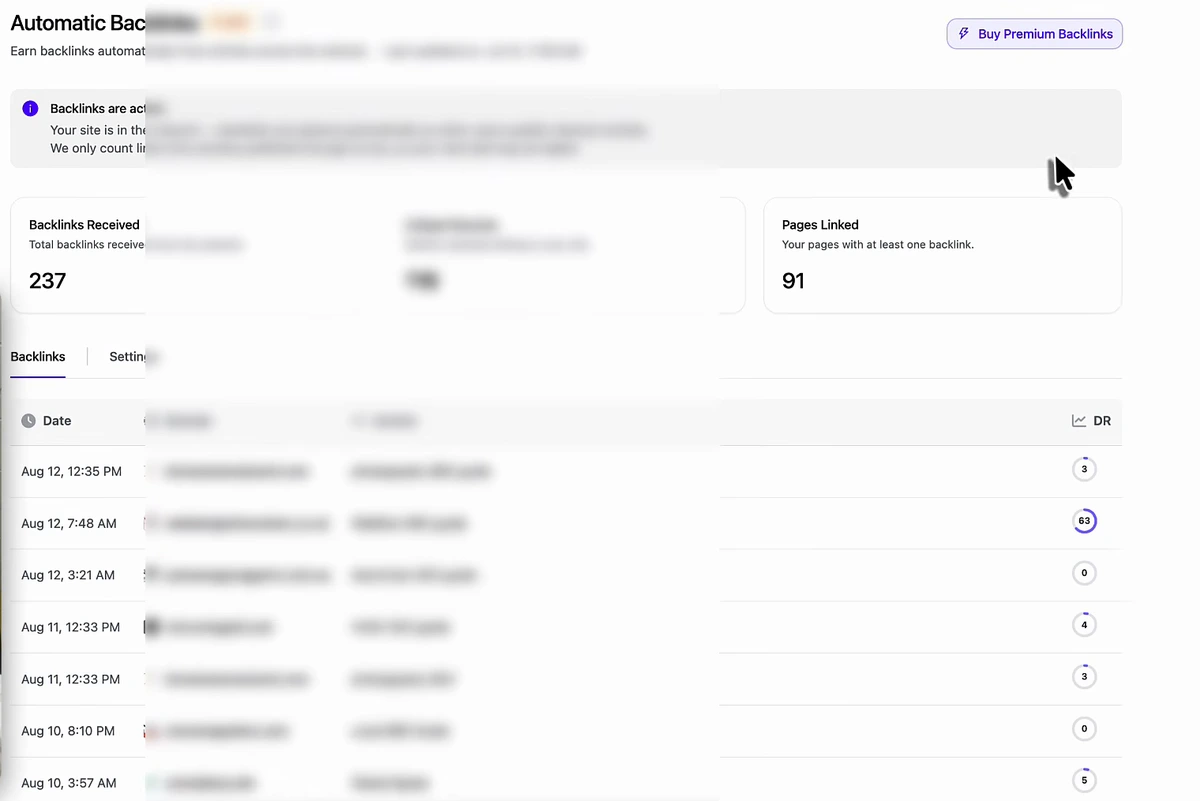
The cheaper, more automated route is the automatic backlinks feature inside an Arvow account. The presenter opens his own: 237 backlinks received, 91 pages linked, and a running list of placements with the referring domain's DR next to each — a DR 9 and a DR 16 that day, a DR 47 and a DR 23 the day before, a DR 43 a couple of weeks earlier and, he reads out, a DR 63. These are not the DR 90 above; they are the affordable layer that runs on its own.
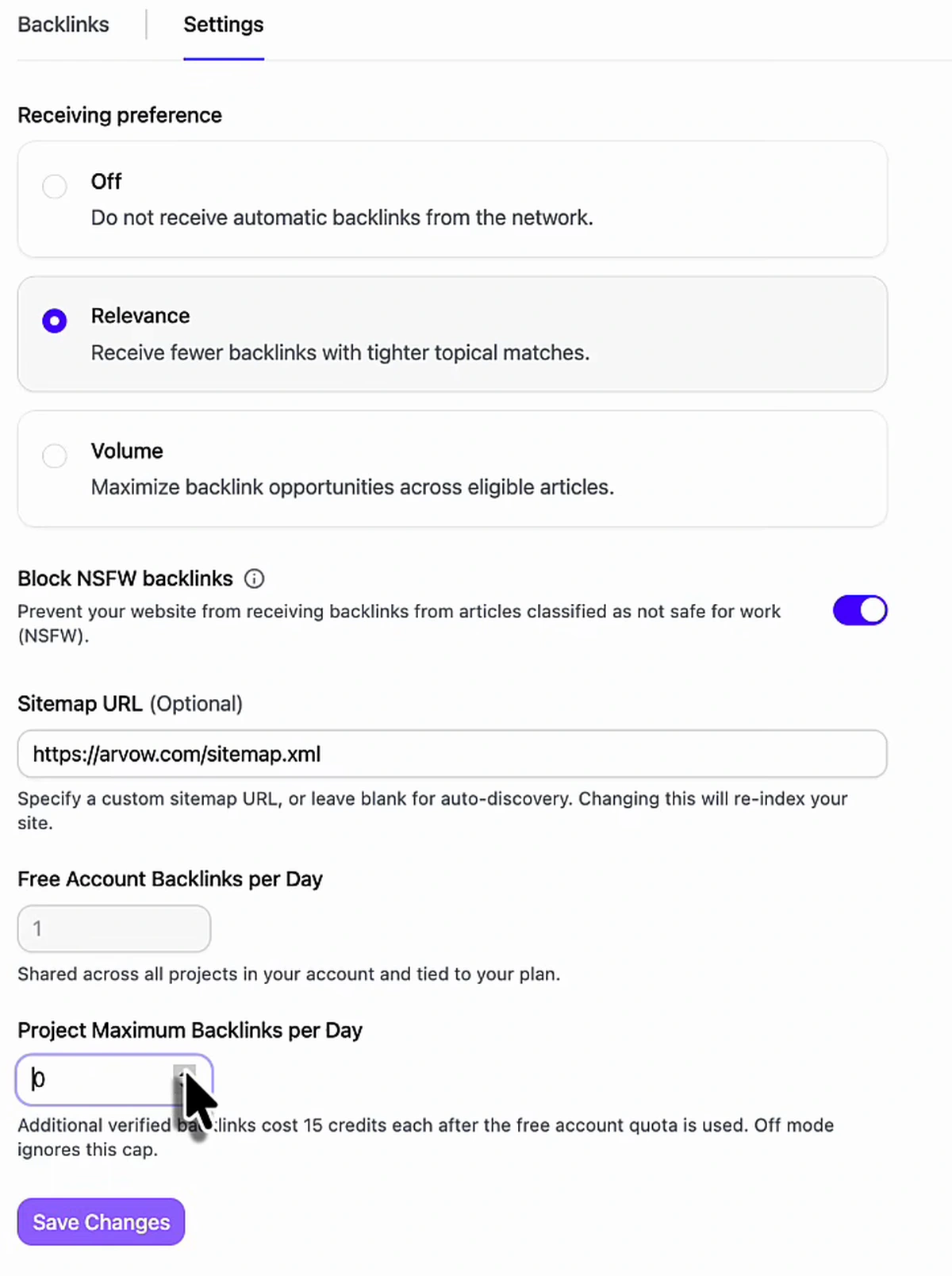
One setting decides what kind of links you get. The receiving preference has three positions — off, relevance, or volume — and he keeps his on relevance, which receives fewer backlinks with tighter topical matches; volume maximises placements across eligible articles. You can also block NSFW sources, point it at a sitemap, and cap the number of backlinks a project takes per day.
Whichever route you take, the test is the one this video runs on camera. Take any link you have been sold or built, strip it to the root domain, open it in Ahrefs, and look for the three things the examples share: authority you can see, organic traffic that proves the site is real, and enough presence in AI answers that its mention of you travels. If a link fails all three, it is not one of these.
Arvow builds the links on this page two ways: a manual backlink building service that delivers placed URLs on domains like the three above, and an automatic backlink network inside every account that adds relevance-matched links to your pages on its own.
Generate, publish, syndicate and update articles automatically
The AI SEO Writer that Auto-Publishes to your Blog
- Cancel anytime
- Articles in 30 secs
- Plagiarism Free