
How to Increase AI Mentions in 2026: The Exact Playbook Behind a 70% Overnight Lift

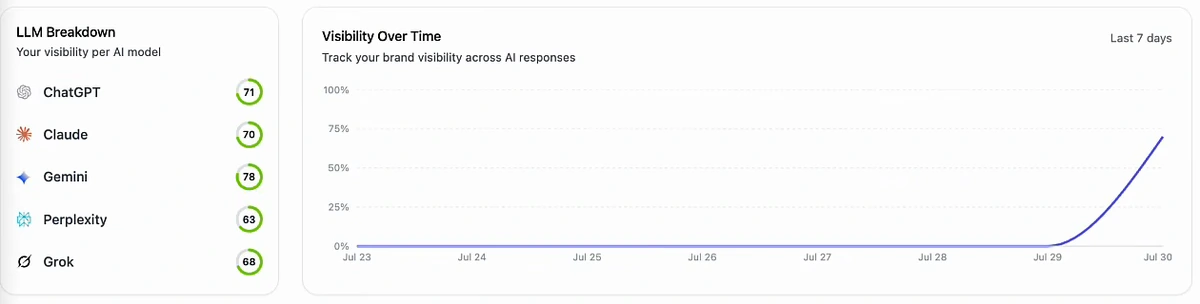
I just watched a client's brand go from invisible to mentioned in 70% of tracked AI responses — across ChatGPT, Claude, Gemini, Perplexity and Grok — in what looks on the chart like a single day. The monitor had been running for a couple of weeks showing nothing. Flat zero. Then one re-run later, the line goes vertical.
I want to be precise about the timing, because "overnight" is doing some work in that sentence. Our LLM visibility tracker re-runs every prompt every three days, so the honest claim is: the jump happened somewhere inside a 24-to-72-hour window. Either way, it was not a six-month SEO grind. It was two specific moves, and this article is the full breakdown of both.
The result we're working backwards from
Here is the monitor after the jump. Three numbers matter: 70% visibility across all LLMs, +33 sentiment (positive), and 12 prompts being tracked.

Visibility means the brand actually appears in the AI's answer. Not "the model has heard of them" — the brand is named, recommended or cited in the response a buyer reads. And the spread across models is tight: ChatGPT at 71, Claude at 70, Gemini at 78, Perplexity at 63, Grok at 68. This wasn't one model deciding to like us. All five moved together, because all five read the same web.
Mentions are half the job — sentiment is the other half
Something people constantly get wrong, or ignore completely: it is not enough to be mentioned. Would you want your client's brand showing up in every AI answer if the answer said "it's overpriced and the reviews are bad"? Of course not. You want the mention and you want the model to recommend you while it's at it.
On this monitor, sentiment rose to +33 (positive) at the same time visibility spiked — the models weren't just naming the brand, they were describing it well. If you're new to reading these two numbers together, I broke the whole framework down in my guide to AI brand monitoring.
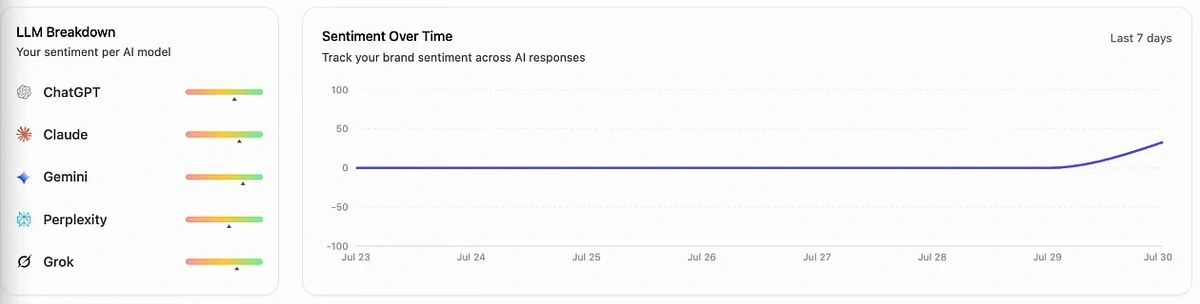
That linkage is the point of the whole method. Sentiment followed visibility because we chose which pages would do the mentioning. When the new citations describing your brand are pages you wrote or placements you negotiated, the tone of the mention is baked in. It also cuts the other way — you could, in theory, run this exact playbook against a brand with hostile content. I don't recommend or condone that, and it's genuinely trashy behaviour. But the fact that it would work should tell you how literal this mechanism is.
Step one: pick prompts worth winning
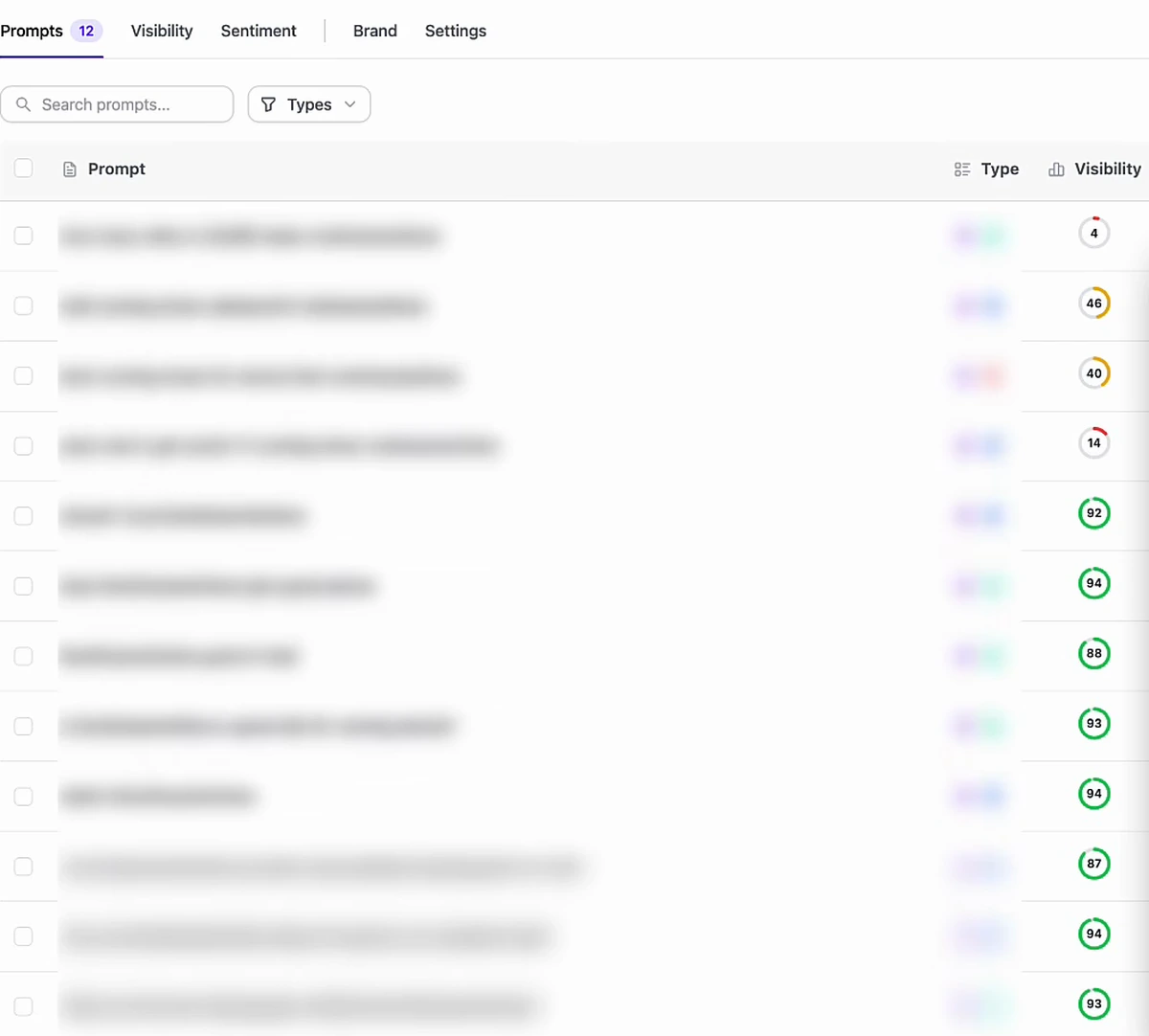
Before any of the clever stuff, we made a collection of 12 prompts. A lot of thought went into them, and two rules did most of the work.
Non-branded prompts only
Not a single one of the 12 has the client's name in it. Branded prompts are a rigged game: ask any model "is Apple a good phone brand?" and of course Apple gets mentioned — the name is in the question. If you want a number that reflects real discovery, track the prompts a stranger would type before they know you exist. (Branded prompts still have a diagnostic use, which I cover in how to track ChatGPT brand mentions — they just aren't the win condition.)
Buying intent over volume
It's the same logic I always give for keywords. If I ran an iPhone repair shop, I could rank for "how to repair an iPhone" — but someone typing "how" wants to do it themselves. The searcher typing "where to repair an iPhone" or "how much does iPhone repair cost" is looking for someone to pay. A plumber gains nothing from ranking first for "what's a plumber." Same principle here: we only picked prompts where a recommendation could plausibly turn into a visit and a purchase.
One more opinion, since the tool will happily suggest prompts for you when you add a brand: don't outsource this thinking. You know what your customers ask better than any AI does. Use the suggestions as a starting point if you like, but the prompt list is the strategy — write it yourself.
Step two: find out who the models are actually citing
Here's where the real work started. Take one of the 12 prompts — this one was sitting at 40% visibility. Open it up and you get the response from each model, side by side, with wildly different results: 90 on one model, 85 on another, and 0, 10 and 15 on the rest. The average hides everything; the per-model view is where the opportunities are.
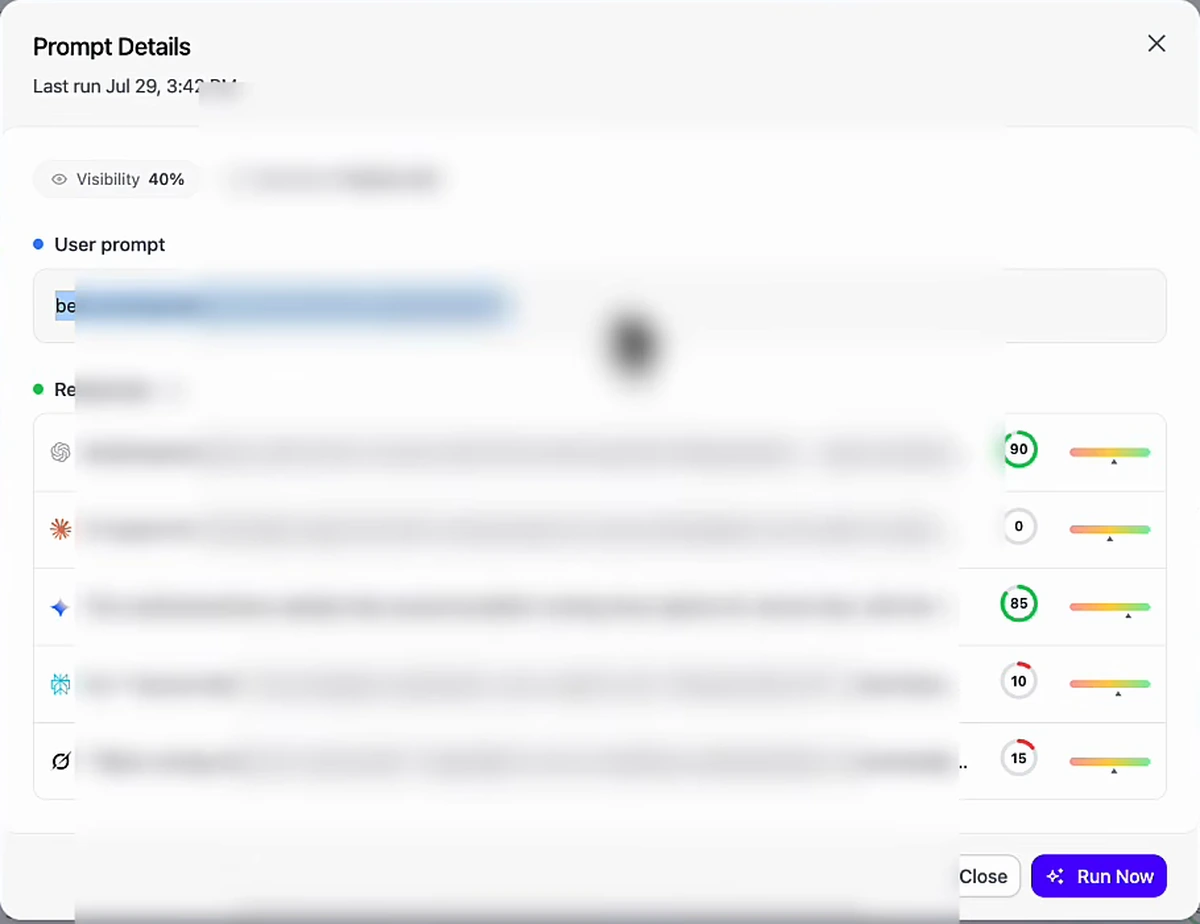
I opened the Perplexity answer for that prompt. The client wasn't mentioned. Three other brands were — one of them twice. And every one of those mentions traced back to the sources cited under the answer. The model wasn't expressing a preference; it was summarising the two or three pages it pulled in. One of those pages was a listicle — "the 7 best [product category] for [a specific customer profile]" (I'm hiding the niche to protect the client). The brands in that listicle were the brands in the answer. One-to-one.
That's the entire secret, honestly. AI answers are assembled from citations. Change what gets cited, or change what the citations say, and the answer follows. Which gives you exactly two plays.
Play one: build a source that deserves the citation
I analysed the cited listicle — structure, keywords, the specific comparison angle — and we produced a similar piece of content targeting the same terms, mentioning the same things, just better and with our client included where they legitimately belong. Not vaguely-related content: a direct, deliberate sibling of the exact page the model was already pulling from. The bet is simple — if the model trusts that shape of page for this prompt, a stronger page of the same shape has a real chance of joining the citation set. For this client, it did.
Play two: pay your way into the sources that already win
Sometimes your new content doesn't get picked up, or you can't realistically out-publish what's already ranking. So for some prompts we went to the publishers of listicles that were already being cited and paid them to include the client's brand. That's it. A brand mention, purchased, on a page I knew for a fact the models were reading — because the citation list told me so.
I know how unglamorous that sounds. But think about what you're buying: not a backlink for some abstract authority metric, but a seat in the exact document an AI reads before it answers your buyer's question. The citation list turns media buying from spray-and-pray into a sniper shot. It's the same reason roundup placements matter so much in every AI visibility tool comparison I've written — listicles are load-bearing infrastructure for LLM answers.
Why this works in days, not months
Classic SEO makes you wait on crawls, indexing, and link equity settling in. This is a different pipeline. Models with retrieval — Perplexity most aggressively, but all five to some degree — re-fetch sources constantly. The moment the winning listicle includes your brand, the very next retrieval can include you in the answer. Our monitor happened to re-run within its three-day cycle and caught the flip.
That's also why the chart looks the way it does: weeks of flat zero while content was being produced and placements negotiated, then everything landing at once. If you try this, expect the same shape. It looks like nothing is working, right up until all of it works simultaneously.
The playbook, in order
- Write 12 non-branded prompts with buying intent. You, not a tool — you know your customers.
- Track them across all five models. The per-model spread matters more than the average.
- Open every prompt where you score low and list the cited sources behind the winning brands.
- Play one: produce a better sibling of the cited content, targeting the same terms, with your brand included.
- Play two: where your content doesn't get picked up, pay the already-cited pages for a mention.
- Wait one re-run cycle. Visibility and sentiment move together when you chose the sources well.
Want to run this on your own brand or your clients'? The LLM visibility tracker handles the prompts, the per-model breakdowns and the citation lists — or start free with the LLM brand mention tracker and see who the models are citing instead of you.
FAQ
How do you increase AI mentions for a brand?
Find the exact pages AI models cite when answering the prompts you care about, then either publish a stronger version of that content with your brand included, or get your brand added to the cited pages directly. AI answers are assembled from citations, so changing the citation set changes the answer.
How fast can AI visibility realistically improve?
Faster than traditional SEO, because retrieval-based models re-fetch sources continuously rather than waiting on rankings. In this case the brand went from 0% to 70% visibility between monitoring runs — a window of one to three days — after a couple of weeks of groundwork that showed nothing on the chart.
Do branded prompts count as AI visibility?
Not meaningfully. If the brand name is in the prompt, every model will mention it — the same way "is Apple a good phone brand?" guarantees Apple appears. Real AI visibility is measured on non-branded prompts, where the model has to choose to bring you up.
Can you pay to be mentioned by ChatGPT or Perplexity?
Not directly — there's no ad unit inside the answer. But you can pay for inclusion in the pages those models already cite, which produces the same result. The key is knowing which pages are actually in the citation set, which is what a brand monitor is for.
How many prompts should you track?
This campaign used 12, all non-branded, all with buying intent. That's enough to cover the queries that precede a purchase without diluting your effort across prompts that would never convert anyway. Depth of intent beats breadth of coverage.
The uncomfortable version of the lesson: AI models don't have opinions about your brand — they have reading lists. This client's 70% didn't come from brand magic; it came from finding the reading list and getting on it, twice over. If you'd rather have my team run the whole thing for you, that's exactly what our done-for-you SEO service does. Either way, stop optimising for the model. Optimise for what it reads.
Generate, publish, syndicate and update articles automatically
The AI SEO Writer that Auto-Publishes to your Blog
- Cancel anytime
- Articles in 30 secs
- Plagiarism Free