
Claude Code SEO Case Study: How a SaaS Hit 34K Visitors/mo in 2026


Most of what you read about Claude Code SEO is theory. This is the other kind. A software business went from roughly 6,000 organic visitors a month to an estimated 34,400, with a traffic value of $19,300 per month — and the ad-spend column on the same dashboard reads $0. I recorded the whole walkthrough with the dashboard open, precisely because screenshots are easy to fake and live numbers are not.
One thing before we start: this is a case study, not a tutorial. If you want the workflow itself — the exact prompt, the setup steps, the free-tool ideas — I've published a separate Claude Code SEO guide that covers all of it. This post is here to answer a more basic question: does the strategy actually produce anything?
The numbers, straight from the dashboard
Here is the site's search profile as it stood when I recorded: 2,100 organic keywords, 482 of them in Google's top three positions, an estimated 34,400 organic visits per month, and 481 referring domains. Now look at the paid row underneath: 3 paid keywords, 28 paid visits, cost $0.
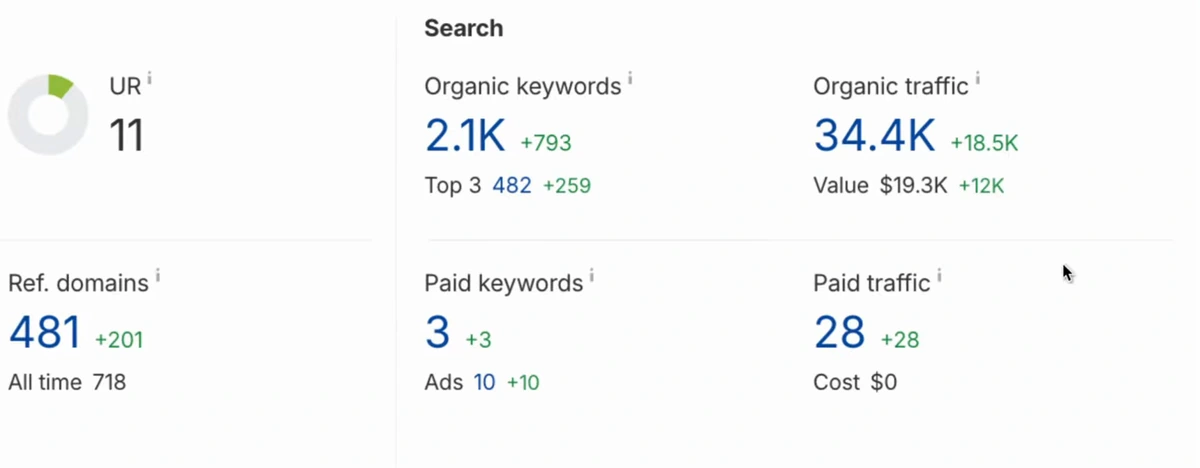
That "Value $19.3K" figure is the interesting one. It is the tool's estimate of what the same clicks would cost if you bought them as ads. As I say in the video, ranking for this many keywords at this volume would take roughly $20,000 a month in Google Ads budget. This company gets the equivalent for free, every month, because organic is the scaling channel — the traffic compounds instead of resetting to zero when the card gets declined.
From 6K to 34K — and a double in the last six months
Growth curves matter more than snapshots, so here is the two-year view. In July 2024 the site was doing 6,288 average monthly visits. The line climbs steadily through 2025 and then bends sharply upward in 2026, finishing around the 34K mark in June.
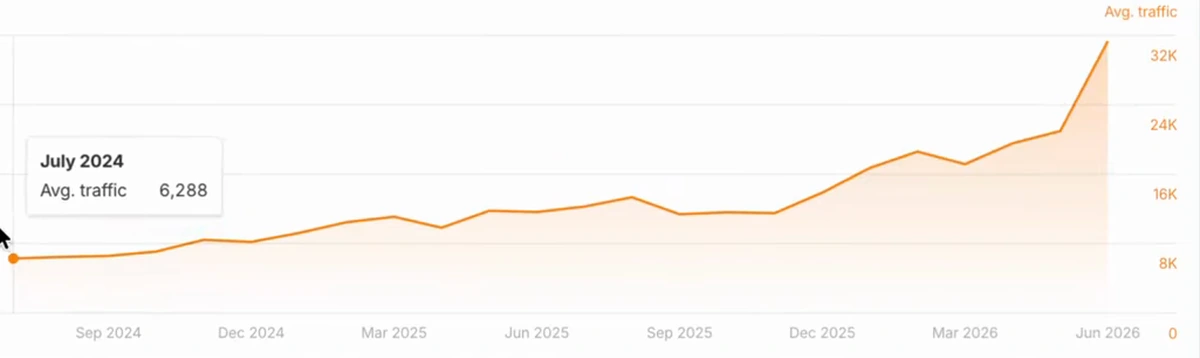
If you switch the same chart to a six-month window, the site goes from about 16K to 34K — it roughly doubled in the first half of 2026. That acceleration is the part I care about, because it lines up with the period where content was being produced systematically rather than occasionally. Compounding is the whole argument for SEO, and this curve is what compounding looks like.
The side effect nobody prices in: AI citations
Here is the bonus that never shows up in a Google Ads comparison. Because the site now has hundreds of pages answering specific questions, AI search engines have started citing it. The AI responses panel on the same dashboard shows 41 citations in Google's AI Overviews across 18 pages, 75 in ChatGPT across 17 pages, and a long tail across every other model: 34 in Google's AI Mode, 35 in Gemini, 21 in Perplexity, 30 in Copilot, and 182 in Grok.
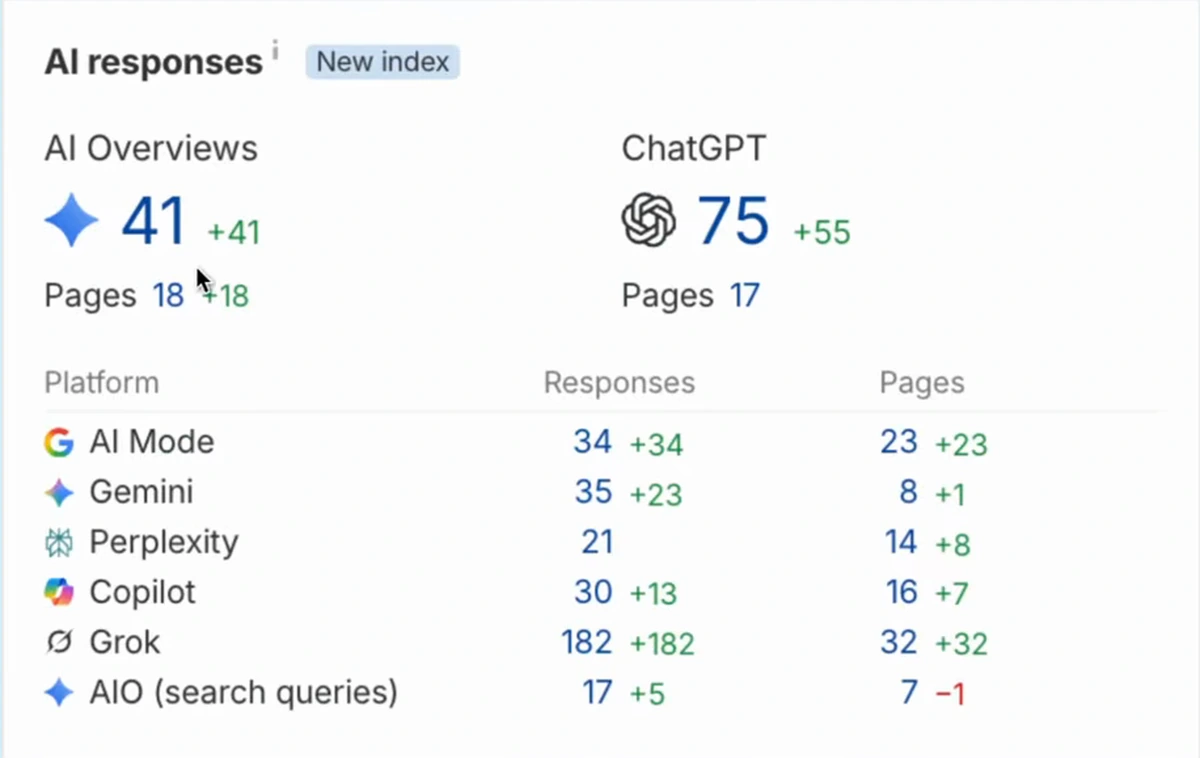
Nobody planned this in 2024. The pages were written to rank on Google, and the LLMs adopted them anyway — which is why I keep telling SaaS founders that classic SEO and AI visibility are not competing strategies; they are the same asset viewed from two angles. If you want to see whether the models are already citing (or misrepresenting) your own brand, that is exactly what an LLM visibility tracker is for.
The two-phase playbook behind the growth
The system itself is simple enough to describe in one paragraph, which is exactly why I am not turning this post into a tutorial. Phase one: free tools. Small widgets — calculators, generators, checkers — that Claude Code can build in about fifteen minutes each and embed on your site with an iframe, each one targeting a search query with real volume. Phase two: a content machine. You hand Claude your website URL and it works through a fixed pipeline — find three to five competitors, map their content, run a gap analysis on the topics they cover and you don't, expand each gap into long-tail keywords, cluster and prioritize them, and present a content plan for approval.
The prompt that runs that pipeline, plus the list of free-tool ideas by SaaS category, lives in the full guide linked above. What I want to show you here is what the pipeline outputs when you point it at a real company.
I ran it live on a SaaS I don't even own
To prove the workflow isn't cherry-picked, I ran it on camera for TubeLab, a YouTube analytics SaaS I have no affiliation with — I simply found them online and used their site as the demo. Claude identified their real competitors (vidIQ with hundreds of blog posts across roughly eight categories, OutlierKit with fifty-plus posts, NexLev with a light blog), mapped what each one publishes, and flagged the topics every competitor covers that TubeLab doesn't: YouTube SEO and video ranking, titles-thumbnails-CTR, monetization, and Shorts.
Then it expanded those gaps into a prioritized plan. The final output: 28 keywords organized into 6 clusters, with 10 marked high priority, 13 medium, and 5 low — each keyword tagged with the article format it should become.
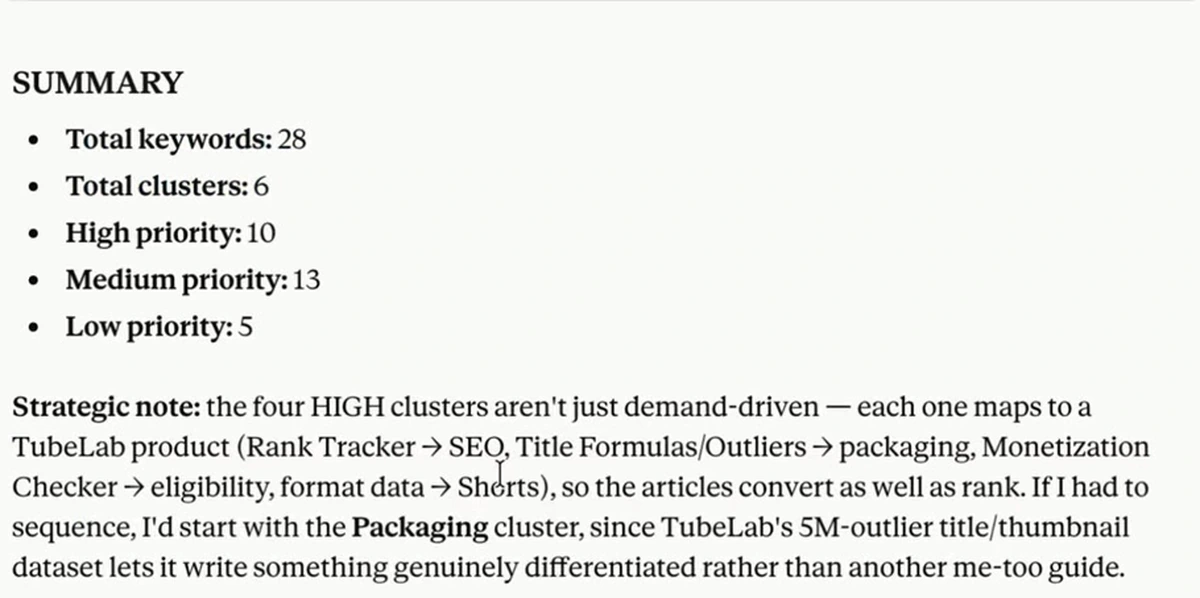
Notice the strategic note under the summary. Claude didn't just count search volume — it mapped each cluster to one of TubeLab's actual product features so the articles convert rather than just rank. That is the part a generic keyword tool never gives you.
From content plan to autopilot
A keyword list is worthless if the articles never get written, so the second half of the demo wires the plan into Arvow, the content engine I use. After feeding the knowledge base (your site, documents, PDFs — context that keeps the articles on-brand) and connecting an integration, you create a campaign, enable AutoBlog, and set the schedule.
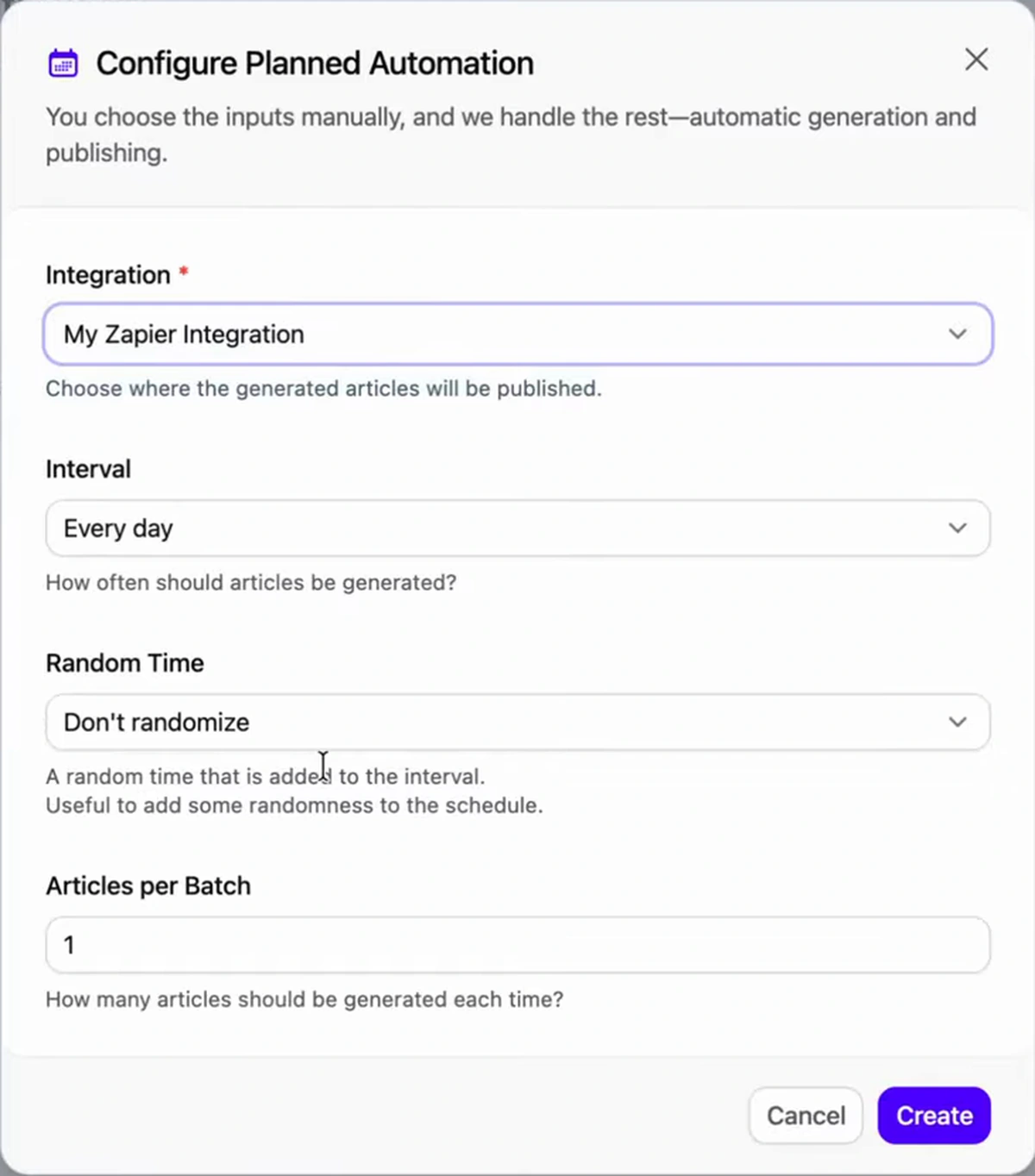
My settings advice from the video: one article per day if your site is new, up to three per day if you already have traction. Then load the keywords Claude gave you — I add them in batches of about 60 so the automation has two months of runway before anyone needs to touch it again. Ask Claude to export the content plan as a CSV and you can import the whole thing in one go. That is the entire ongoing workload: refill the keyword queue every couple of months. This is the same engine behind Arvow's AI SEO agent, which takes over the research step too.
What the machine actually publishes
For the demo I used the keyword "how to go viral on youtube shorts" from Claude's plan, left the title blank so the AI could write its own, and started the AutoBlog. Here is the article that came out the other end.

The full piece has internal links, pull quotes, bullet lists, related YouTube embeds, and an FAQ section whose answers I fact-checked on camera — the Shorts advice it gives (under 60 seconds, post consistently) is genuinely correct. And because the integration is connected, it published straight to the website. No copying, no pasting, no downloading. It just went live.
What this case study actually proves
- The output is real: an estimated 34,400 organic visits per month, up from about 6,000 two years earlier, with the steepest growth in the most recent six months.
- The economics are lopsided: $19.3K/mo in estimated traffic value against $0 in ad spend, versus the roughly $20K/mo Google Ads would charge for the same clicks.
- The moat compounds: 481 referring domains and citations from every major LLM — 41 in AI Overviews and 75 in ChatGPT — earned as a by-product of ordinary SEO content.
- The system is repeatable: I reproduced the research half live on a company I don't own, and it produced a 28-keyword, 6-cluster plan in one sitting.
I keep a growing collection of results like this in our case studies, because "trust me" is not an SEO strategy — receipts are.
FAQ
What results did Claude Code SEO produce in this case study?
The SaaS grew from roughly 6,000 to an estimated 34,400 organic visits per month over two years, with the traffic roughly doubling in the first half of 2026. The dashboard values that traffic at about $19,300 per month, and the site spends nothing on ads.
How much would this traffic cost in Google Ads?
Around $20,000 per month, based on the dashboard's traffic-value estimate of $19.3K — that is what buying the same clicks at market CPC rates would cost. The organic version also keeps compounding, while paid traffic stops the moment the budget does.
Do you need to know how to code to copy this workflow?
No. The research pipeline runs from a single prompt pasted into Claude, and Claude Code handles the technical work of building and embedding the free tools. The content production side runs inside Arvow, which is a normal web app with no code involved.
How many keywords should you load into the autoblog?
About 60 at a time. At one article per day that gives the automation two months of runway before you need to refill the queue — and if you ask Claude to export its content plan as a CSV, you can import all of them in one step.
Does this strategy also improve AI search visibility?
Yes, as a by-product. The site in this case study earned 41 citations in Google's AI Overviews, 75 in ChatGPT, and mentions across Gemini, Perplexity, Copilot, and Grok without ever targeting the models directly. You can check what LLMs currently say about your own brand with a free LLM brand mention tracker.
Is this article a step-by-step tutorial?
No — it is deliberately the proof, not the instructions. The full walkthrough with the exact Claude prompt, the free-tool idea list, and the Arvow setup lives in the dedicated Claude Code SEO guide linked at the top of this page.
Want the same content machine without building it yourself? Arvow's AI SEO agent runs the research, writes the articles, and publishes them to your site on schedule — the exact engine used in this case study.
The dashboard is the argument. From 6K to 34K a month, $19.3K in monthly traffic value, $0 in ad spend, and every major LLM citing the site as a source — all from free tools plus a content machine that runs while you build product. If 2026 is the year you stop renting traffic, this is what owning it looks like.

Generate, publish, syndicate and update articles automatically
The AI SEO Writer that Auto-Publishes to your Blog
- Cancel anytime
- Articles in 30 secs
- Plagiarism Free