
Toxic Backlinks: Should You Disavow or Ignore Them? (2026)

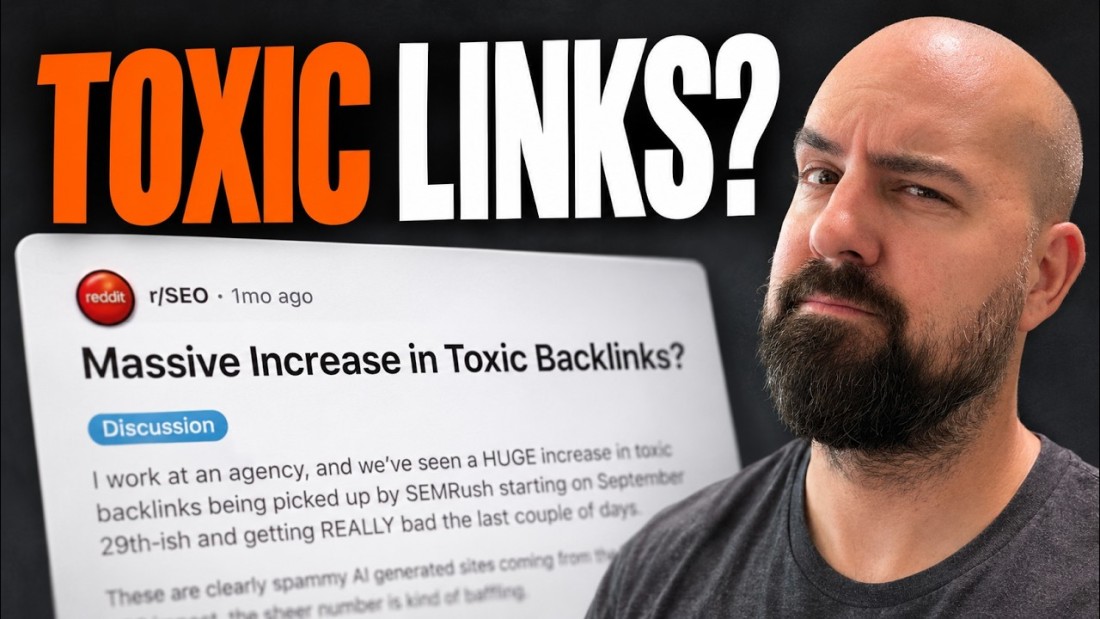
Toxic backlinks are links that an SEO tool has scored as risky, usually because they come from spammy, auto-generated or irrelevant sites. The phrase belongs to the tools, not to Google, and that gap is the whole story. In a November 2026 video, Tim reads through an r/SEO thread from an agency that watched Semrush flag thousands of new toxic links in a few days, then compares the replies with what Google has said. We went through the same thread and checked every claim against Google's documentation and its staff's public statements. The short version: a spike in a tool's toxic count is not a penalty, most sites should do nothing, and the cases where a disavow file is worth your time are narrow and easy to recognise.
The short answer
| What you are seeing | What it means | What to do |
|---|---|---|
| A sudden jump in "toxic" links in a tool, rankings steady | A spam network has linked to you and to many other sites | Nothing. Note the date and move on |
| The same jump, and rankings fell the same week | Probably unrelated. Check updates, technical changes and content first | Diagnose the drop on its own evidence |
| A manual action for unnatural links in Search Console | Google's reviewers found a pattern of manipulative links | Remove what you can, disavow the rest, request reconsideration |
| Links you or a previous agency paid for or built at scale | Real link spam, by Google's definition | Clean up. This is the case the disavow tool exists for |
What a toxic backlink is, and who decides
Google has a link spam policy. It does not have a toxicity score. The policy defines link spam as "creating links to or from a site primarily for the purpose of manipulating search rankings" and lists examples: paying for links, excessive link exchanges, automated link creation, low-quality directory links, and links stuffed into footers and templates across many sites. Every example describes something a site does to gain rankings. None describes something done to a site by a stranger.
The toxic label comes from backlink audit tools. Semrush, the tool in the thread, says its Backlink Audit checks each link against "dozens of toxic markers" and assigns a Toxicity Score from 0 to 100, where a higher score means a link is "more likely to be risky—not links that are automatically harmful". That wording is from Semrush's own guide, dated January 2026. The same guide says "most toxic backlinks don't require action, because Google often ignores low-quality links".
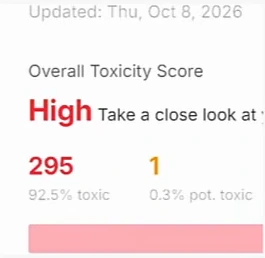
So the dashboard's red number and the vendor's written advice point in different directions. The score measures how spammy the linking sites look. It does not measure what Google did with those links, and no outside tool can see that.
What the Reddit thread got right
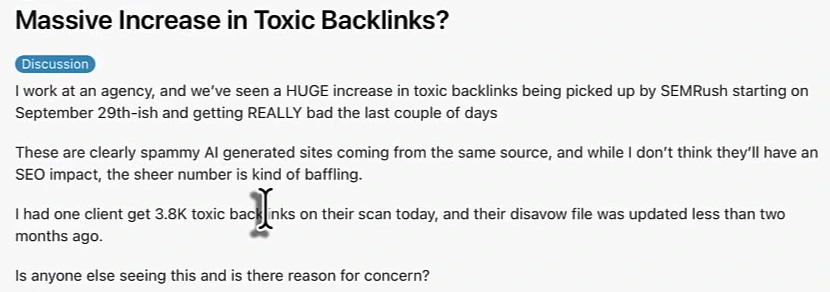
The post describes a wave that started around 29 September 2026: thousands of links from sites the agency calls clearly spammy and AI-generated, all from what looks like one source. The replies mostly agree on three things, and all three hold up.
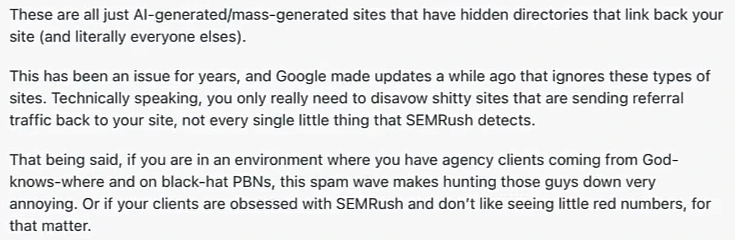
- It is happening to everyone. Several commenters report the same increase across all their sites. One saw a spike in PDF spam in a different tool from mid-September. The original poster later describes the sources as mass-generated sites with hidden directories that link to "literally everyone".
- Google most likely ignores it. This is the most upvoted position in the thread, and it matches Google's public guidance, covered below.
- The real cost is time. The poster calls the influx "more of a workflow problem than anything else". Another reply asks whether disavowing at scale every few weeks is a good use of agency hours when rankings are not moving. It is not.
That follow-up matters for the video's title, which says your site might be under attack. An attack is aimed at someone. A network that links to every site it can crawl is not aimed at you, and nothing in the thread suggests a competitor is behind it.
Three claims in the thread that need correcting
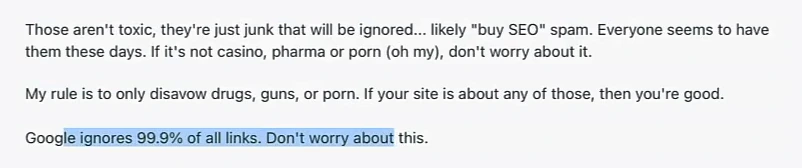
"Google ignores 99.9% of all links"
Tim calls this one false in the video, and we agree that it is unsupported. We could not find any Google statement behind the number. Google staff have said the company is good at ignoring irrelevant links, which is a different claim from ignoring nearly all of them. Links still count: Google's December 2022 link spam update says that when spammy links are neutralised, "any credit passed by these unnatural links are lost", which only makes sense if other links pass credit.
"Only disavow drugs, guns or porn"
A tidy rule, and not Google's. The link spam policy is about manipulation, not about industries. A link from a casino blog that someone placed naturally is not link spam, and a paid link from a clean-looking business site is. Sorting your disavow file by topic gets both cases wrong.
"Semrush says the site is in danger"
Nobody in the thread says this outright, but it is the fear behind the post. Google does not read third-party scores. John Mueller of Google was blunt about it on Reddit in May 2024: "The concept of toxic links is made up by SEO tools so that you pay them regularly." In February 2024, replying to a site owner worried about a Semrush toxic-backlink warning, he wrote: "You're not going to get your rankings back by following Semrush's report or by disavowing those links."
What Google says to do about spam links
Gary Illyes of Google was asked in 2024 how to alert Google to sabotage through toxic links. His answer, as reported by Search Engine Journal that June: "I know what I would do: I'd ignore those links." He added that Google is "really, REALLY good at ignoring links that are irrelevant to the site they're pointing at", and that you can still disavow or file a spam report if you feel like it. This is the remark Tim refers to in the video.
Google's help page for the disavow tool says the same thing in drier language. "In most cases, Google can assess which links to trust without additional guidance, so most sites will not need to use this tool." It gives two conditions for disavowing, and both must be true:
- You have "a considerable number of spammy, artificial, or low-quality links" pointing to your site, and
- the links "have caused a manual action, or likely will cause a manual action".
The page also carries a warning: the tool is "an advanced feature and should only be used with caution", and used incorrectly it "can potentially harm your site's performance". The full text is on Google's disavow help page.
The second condition is the one most toxic-link clean-ups skip. A manual action is not a guess. It appears in Search Console under Security & Manual Actions, with the wording "a pattern of unnatural, artificial, deceptive, or manipulative links pointing to your site". If that report is empty and you never bought or built links, a spam wave does not meet Google's bar.
When a backlink spike does deserve attention
Ignoring is the default, not a rule without exceptions. Look closer in four cases.
| Case | Why it differs | Action |
|---|---|---|
| You have a manual action for unnatural links | A human reviewer has already decided | Ask for removals first, disavow what remains, then request reconsideration. Google says blindly disavowing everything "is not considered a good-faith effort" |
| You inherited paid links or a private blog network | These are links the site sought out, which is what the policy targets | Disavow at domain level and stop the source |
| The spam links send real visitors | The poster's own test: sites "sending referral traffic" are worth a look | Check analytics for referral spam and odd landing pages |
| The links point at URLs that should not exist | May be a sign of hacked pages or injected content on your own site | Inspect those URLs. This is a security job, not a link job |
If you do build a disavow file, Google's format is simple: one URL or domain per line, domain:example.com for a whole domain, UTF-8 text, up to 100,000 lines and 2MB.
A five-minute check before you touch anything
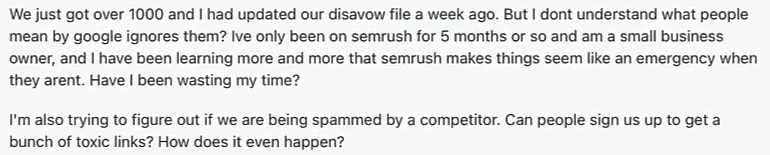
That question got an automated moderator reply and little else. Here is the answer we would give, as a checklist.
- Open Search Console, Manual Actions. "No issues detected" settles most of it.
- Look at rankings and clicks for the two weeks around the spike. Flat means the links did nothing. A drop needs its own diagnosis: compare the date with known updates such as the August spam update.
- Sample twenty of the flagged domains. One repeating pattern (same TLD, same template, same hidden directory) means a network, as one commenter suggests. Networks are the easiest thing for Google to discount.
- Ask whether you built any of them. If nobody at your company or agency paid for or placed these links, they are not yours to answer for.
- Write one line in the client report. "Spam network, industry-wide since late September, no manual action, no ranking change, no action taken." That line is the fix for the workflow problem.
For the small business owner: the weekly disavow was not harmful if it listed only obvious junk, but it was not needed either, and the tool's own vendor says so. The hours are better spent on links that count. We cover what those look like in backlink examples, how many you need in how many backlinks do you need, and what happens with none at all in can you rank without backlinks.
What the video does not show
Two things are worth knowing before you repeat the video's advice to a client.
First, the Google statements are spoken, not shown. The screen stays on the Reddit thread for the first five minutes. The sources in this article are ours: Google's disavow and manual actions help pages, its spam policies, the December 2022 link spam update, and the Mueller and Illyes remarks as reported by Search Engine Roundtable and Search Engine Journal. They support Tim's conclusions, with the caveat above about the 99.9% figure.
Second, the thread is about a month old in the recording, and the Semrush widget in it is dated 8 October 2026. We found no statement from Semrush about a spike around 29 September, so the cause is the commenters' reading, not a confirmed one.
The last two minutes of the video are a tour of Arvow, which Tim says he moved to from Semrush, working through its MCP connection inside ChatGPT or Claude. The tour does not run a backlink audit. Where it connects to this topic is the habit it replaces: asking a question in plain language ("did rankings move the week these links appeared?") is a better first step than opening a dashboard built to show red numbers. If you use Semrush and want our view of where it earns its price, see our Semrush review.
Want to see your real backlink profile, Search Console data and AI visibility from one chat? Connect Arvow's MCP to ChatGPT or Claude and ask.
FAQ
Do toxic backlinks hurt SEO?
Spam links you did not create almost never do. Google says it can assess which links to trust in most cases, and its staff have repeatedly told site owners to ignore them. Links you bought or built to manipulate rankings are different: those can lead to a manual action.
Should I disavow toxic backlinks from Semrush?
Only if Google's two conditions are met: a considerable number of spammy or artificial links, and a manual action that exists or is likely. A high Toxicity Score alone meets neither. Semrush's own guide says most toxic backlinks need no action.
Can a competitor hurt my site with spam links?
It is the fear behind the term negative SEO, and Google's answer has been consistent: it ignores links that are irrelevant to the site they point at. In the thread, the links hit every site the commenters manage, which points to a network, not a rival.
Does Google use Semrush Toxicity Score or any spam score?
No. Those scores are each vendor's estimate, built from that vendor's crawl. Google's systems, including SpamBrain, work from Google's own data. A third-party warning can prompt you to look. It cannot tell you what Google concluded.
Generate, publish, syndicate and update articles automatically
The AI SEO Writer that Auto-Publishes to your Blog
- Cancel anytime
- Articles in 30 secs
- Plagiarism Free