
The Best LLM Visibility Tracker Software for Agencies in 2026 (Real Per-Client Costs)

Every "best AI visibility tracker" list is written for a brand tracking one brand. Agencies do not have that problem. They have ten, or forty, and the question is never "does this tool track ChatGPT" — every tool tracks ChatGPT. The question is what the eleventh client costs, whether the prompt allowance is shared or per-client, and whether the report you hand over can carry your logo instead of the vendor's.
Almost nothing published on this topic answers those three questions, because almost every list is a feature grid. So this one is built on a different axis: what each tool actually costs and constrains once you run ten clients on it.
Disclosure, because nobody else makes it: Arvow builds one of the tools in this list. Essentially every "best tools for agencies" article ranking for this query is published by a vendor that puts itself at number one. We have put Arvow where its agency capabilities actually place it, and named the two places it is currently the wrong choice. Check the numbers yourself — every price below was read off the vendor's own pricing page in August 2026.
The three things that decide agency fit
Feature parity across these tools is closer than the marketing suggests. What separates them is structural.
1. Is the prompt allowance pooled or per-client?
This is the single biggest cost driver and it is buried in every pricing page. Two tools can both advertise "100 prompts" and mean opposite things. Pooled means 100 prompts spread across your entire roster — ten clients get ten prompts each, which is not a report, it is a rounding error. Per-client means 100 prompts for each brand you add.
Trakkr publishes 50 prompts per brand. Semrush's allowance is pooled account-wide. Otterly's Standard tier gives unlimited workspaces but a shared prompt pool, so the workspaces are free and the thing that costs money is rationed. Read the unit, not the number.
2. What does "white label" actually mean here?
Every vendor claims it. It means four different things, and only the fourth is what a client-facing agency needs:
| Level | What you get | Good enough for a client? |
|---|---|---|
| 1 — Branded export | A PDF or CSV with your logo dropped on top | For a monthly email, yes |
| 2 — Theming | Your logo and colours inside the vendor's UI | Vendor name still visible |
| 3 — Custom-domain portal | A live dashboard at reports.youragency.com, no vendor branding | Yes — this is the real thing |
| 4 — Client logins | Level 3 plus per-client accounts and role permissions | Yes, and it scales |
Ahrefs has none of these at any published tier. Profound publishes none. Otterly's own documentation says there is no native white-label and points you at a Looker Studio connector, which is level 1. Trakkr sells a genuine level 3 portal — as a +$49 per brand per month add-on, so white-labelling ten clients costs roughly as much again as the plan itself.
3. Can you run a prospect without paying for them?
Agencies win AI-visibility work by showing a prospect their own bad numbers in the pitch. Tools that make you provision a paid client slot to do that quietly tax your sales process. Profound, Peec and Scrunch all ship some form of pitch or prospecting environment; most of the cheaper tools do not.
The comparison
Entry price is the cheapest tier that actually unlocks AI visibility tracking — not the vendor's headline number, which is often an SEO plan with the feature switched off.
| Tool | Entry price for AI visibility | Clients on that tier | Prompt allowance | Real white label |
|---|---|---|---|---|
| Trakkr | £79/mo (Growth) | 1 · 10 on Scale £395/mo | 50 per brand | Yes — +$49/brand/mo |
| Rankscale | $99/mo (Pro) | 10 dashboards | 1,200 credits pooled | Growth $385/mo |
| Knowatoa | $59/mo (Starter) | Unlimited sites | Pooled by tier | Advertised, tier unclear |
| Nightwatch | €79/mo (Starter) | 5 · 100 on Agency €399/mo | 50 prompts / 1,500 responses | Professional tier up |
| Arvow | $169/mo (Business) | Unlimited monitors | 3,000 credits pooled | No — see below |
| Peec AI | ~€175/mo (agency Essential) | Sized by client count | Credit-based | Looker Studio only |
| Otterly | €189/mo (Standard) | Unlimited workspaces | 100 pooled | Looker Studio only |
| Scrunch | $500/mo (Agency Core) | 3 brand workspaces | Per workspace | Not published |
| Profound | $99/mo (Starter, ChatGPT only) | 1 · agency add-on unpublished | 50 · 100 on Growth | Not published |
Checked August 2026. Several of these vendors render pricing client-side and change it often — re-check before you quote a client.
Where each one actually lands
Trakkr is the most explicitly agency-shaped product here. Scale at £395/mo covers ten brands at 50 prompts each with unlimited team and client seats, and the maths is transparent: roughly £40 per client per month. The white-label add-on pricing is the catch — budget for it rather than discovering it.
Rankscale gives you ten brand dashboards at $99/mo, which is the cheapest route to double-digit clients. The constraint is credits: 1,200 across ten clients is about 120 each, so a client with a serious prompt set will eat the pool. White label only arrives at $385/mo.
Knowatoa is the cheapest credible entry at $59/mo and the only tool here with genuinely unlimited client sites on one account. Its questions are pooled, so the economics depend on your average client depth. The Looker Studio and NinjaCat integrations at $199/mo matter if you already build client reports there.
Nightwatch is the best value if you also need classic rank tracking, because AI visibility is bundled into a mature rank tracker rather than sold as a second subscription. One tool covers both halves of the client report, seats are unlimited on every plan, and the Agency tier holds 100 sites.
Peec AI is the only vendor with purpose-built agency pricing rather than brand pricing relabelled, sized explicitly by client count, with unlimited users and no per-seat fees. Its published numbers move; get a quote rather than trusting a screenshot.
Otterly buys you unlimited workspaces at €189/mo, but Claude, Gemini and Google AI Mode are all paid add-ons on top — which is the per-platform pricing pattern that makes agency budgets unpredictable.
Scrunch caps Agency Core at three brand workspaces for $500/mo. Past three clients you are into unpublished Enterprise pricing, and Claude, Gemini and Grok are Enterprise-only. Hard to recommend for a roster.
Profound has the strongest brand in this category and the least agency-legible pricing. Starter is $99/mo but tracks ChatGPT only; Growth is $399/mo for three engines. The agency plan adds client workspaces but does not publish what a client workspace costs — you have to ask. For an agency modelling margin before it sells the service, that is a real problem.
And the ones that did not make it
Ahrefs Brand Radar is excellent for pitching — its prompt database lets you pull a prospect's AI-visibility snapshot with no setup and no tracking spend — and poor for delivery: no white label at any tier, and prompts are metered in check packages. Use it to win the work, not to report on it. Semrush unlocks AI Search on its $199/mo tier, but prompts are pooled account-wide and extra seats are $45/mo each, so per-client economics degrade fast. Writesonic caps published plans at one or two projects, which disqualifies it outright. Athena starts at $295/mo with credits that thin out quickly across a roster.
What the client report has to show (and what most tools flatten)
Tool choice is downstream of one question: what are you actually putting in front of the client? A single "AI visibility: 61%" number is the wrong answer, and it is the answer most dashboards default to.
Here is a brand monitor from a January 2026 walkthrough of Arvow's LLM brand monitor, tracking Gymshark across six prompts. The headline says 61%.
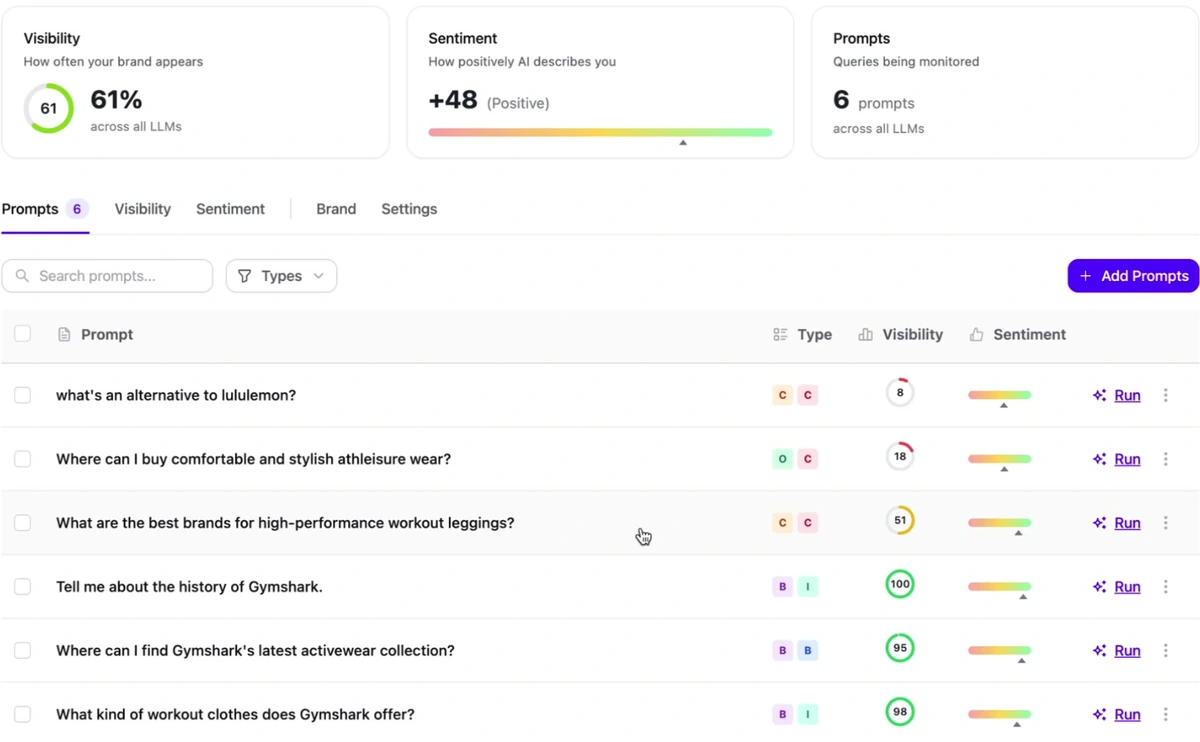
Read the rows instead of the average. The three prompts that name the brand — "Tell me about the history of Gymshark", "Where can I find Gymshark's latest activewear collection", "What kind of workout clothes does Gymshark offer" — score 100, 95 and 98. Of course they do; the brand name is in the question. The three that do not name it — "what's an alternative to lululemon", "Where can I buy comfortable and stylish athleisure wear", "What are the best brands for high-performance workout leggings" — score 8, 18 and 51.
Those second three are the only ones representing a customer who does not already know the client exists. The headline 61% is an average of a number that is guaranteed to be high and a number that is the actual business problem. Any tool whose client-facing report cannot separate branded from unbranded prompts is selling you a vanity metric, and a client who checks will catch it.
The same applies per model. One brand, four assistants, four different answers:
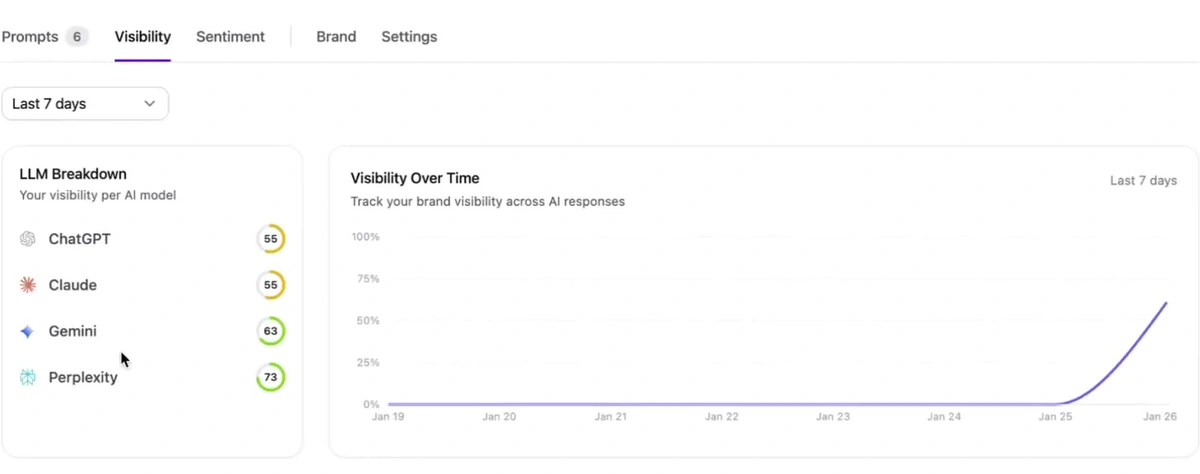
Clients do not ask "how is my AI visibility". They ask "why doesn't ChatGPT mention us". A per-model breakdown answers that; a blended score cannot. And at prompt level it gets sharper still — on the alternatives prompt, the brand appeared in Gemini and scored zero in both ChatGPT and Claude:
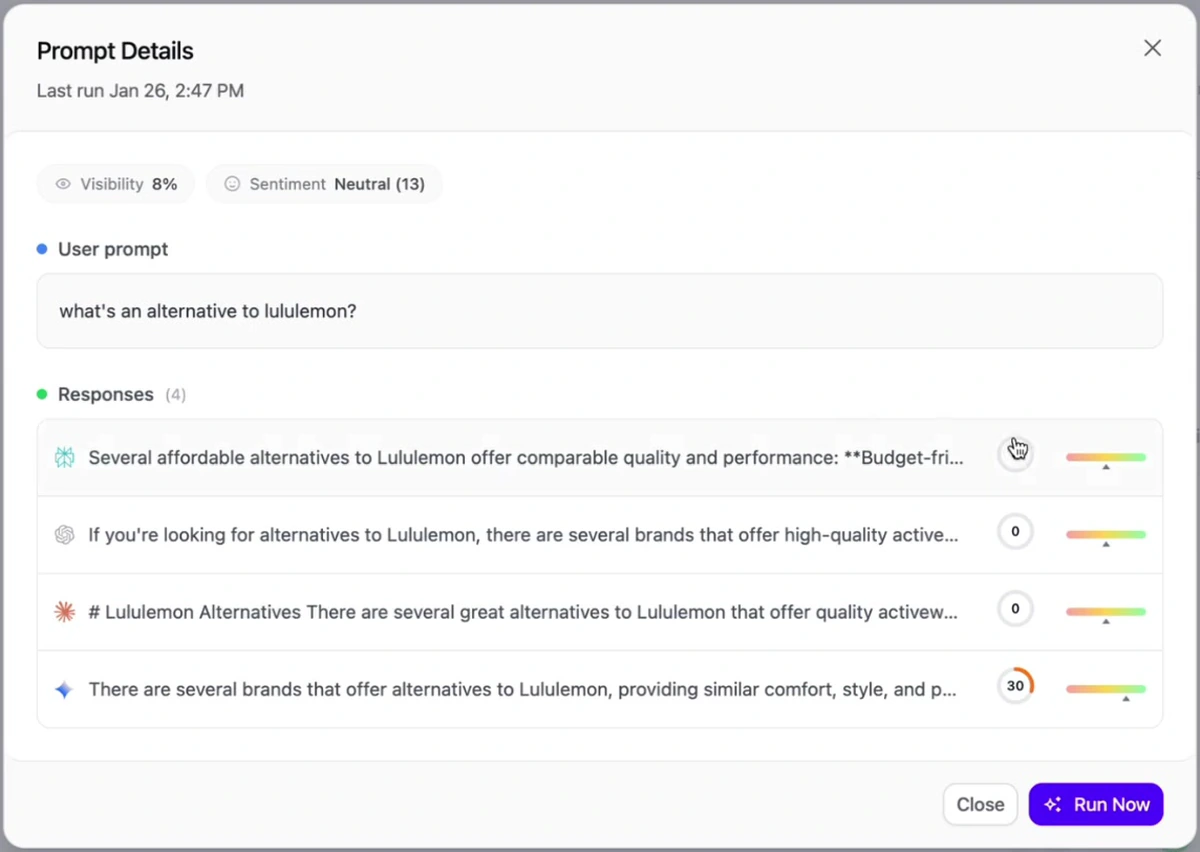
That is the level of granularity worth paying for, because it is the level at which you can do something: find the source the model is citing for that answer and get the client into it. The full guide to reading a visibility audit walks through what to do once you can see this.
Model the cost per client before you buy
The mistake agencies make is comparing monthly plan prices. The number that matters is cost per client per month at your actual roster size, and for credit-based tools that requires arithmetic the pricing page does not do for you.
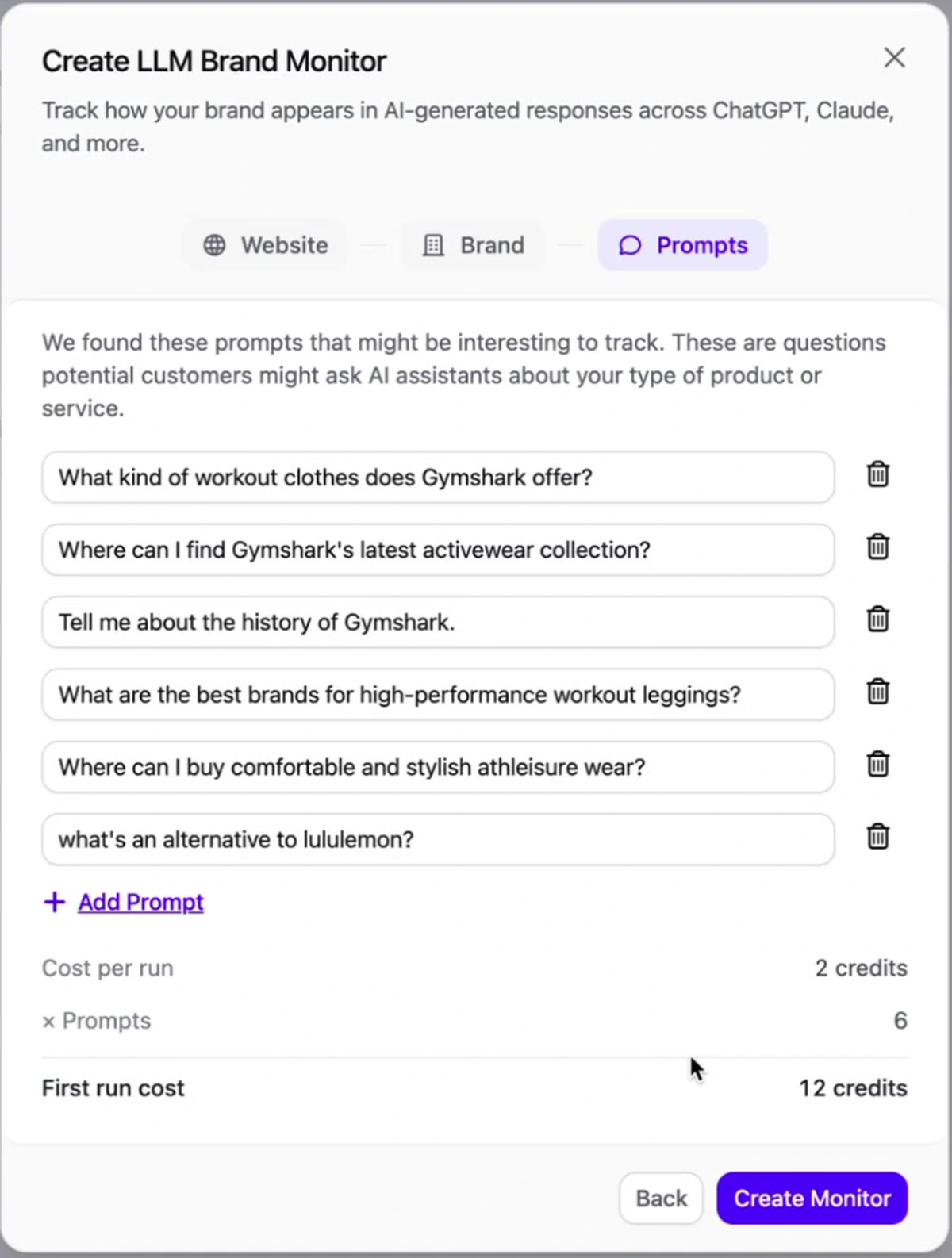
Work it through for any credit-based tool. Arvow's documentation currently prices the brand monitor at 6 credits per prompt per run, and monitors run daily. A client on 10 prompts is 60 credits a day, roughly 1,800 a month. The Business plan carries 3,000 credits a month. That is one client, not ten.
This is the honest limit of the tool: Arvow's brand monitor is built for a brand watching its own visibility, and for an agency it prices per volume rather than per client. If you run ten clients on daily monitoring you are on the Ultimate tier or topping up, and you should model that before you sell the retainer. Run the same sum against Trakkr's 50-prompts-per-brand or Rankscale's pooled 1,200 and you will get very different answers depending on how deep your prompt sets go.
Do this once, in a spreadsheet, at 5 / 15 / 25 clients. It reorders the shortlist almost every time.
Two places Arvow is currently the wrong pick
Being specific, because a list that never criticises its own publisher is not worth reading.
If white-labelled AI visibility reporting is the requirement, Arvow does not do it yet. Arvow's white-label reports are genuinely good — custom domain, your logo and colours, unlimited clients, no per-client fee — but they carry Google Search Console data: clicks, impressions, positions. They do not carry brand-monitor data. If your client deliverable must be an AI-visibility dashboard on your own domain, Trakkr's portal add-on or Rankscale's Growth tier is the honest answer today.
If you need per-client credit ring-fencing, it is not there either. Credits pool at the account level, so one client's deep prompt set draws down the same balance as everyone else's. Tools that meter per brand make cost allocation trivial; a pooled balance means you are doing the attribution yourself.
Where Arvow does fit an agency is the case where AI visibility is one line in a broader retainer rather than the whole product: five models queried on one price with no per-platform add-ons, sentiment scored alongside visibility, and the same subscription covering content production and client reporting. If you are already running client content through it, adding monitors is cheap. If AI visibility monitoring is the service you sell, buy the tool built for that. The LLM visibility tracker page has the current feature set, and the agency page covers the content side.
How to pick, by agency size
- 1–3 clients, AI visibility as an add-on. Whatever your existing stack includes. If you are on a rank tracker already, check whether it now bundles AI visibility — Nightwatch does, and a second subscription is hard to justify.
- 4–10 clients, reporting inside your existing dashboards. Knowatoa or Rankscale. Cheap per client, and both feed Looker Studio rather than forcing a new client-facing surface.
- 10+ clients, AI visibility is the product you sell. Trakkr or Peec. Per-brand allowances, unlimited seats, real client portals. Budget for white-label as a line item, not a footnote.
- Enterprise clients who will recognise the vendor. Profound, and negotiate. Get the client-workspace price in writing before you commit to a retainer.
- Pitching, at any size. Ahrefs Brand Radar, regardless of what you use for delivery. Pulling a prospect's numbers before the first call is worth the subscription on its own.
FAQ
What is the best LLM visibility tracker for agencies?
For an agency running ten or more clients where AI visibility is the service being sold, Trakkr and Peec AI are the strongest fits, because both price per client brand rather than pooling allowances and both include unlimited seats. For agencies adding AI visibility to an existing retainer, Knowatoa ($59/mo, unlimited sites) and Rankscale ($99/mo, 10 dashboards) are the cheapest credible entries. Nightwatch is the best pick if you also need classic rank tracking in the same tool.
Which AI visibility tools offer real white-label reporting?
Very few, once you define the term. A custom-domain client portal with no vendor branding is available from Trakkr (+$49 per brand per month on Scale), Rankscale (Growth, $385/mo) and Nightwatch (Professional tier up). Ahrefs Brand Radar, Profound and Scrunch publish none. Otterly and Peec route branded reporting through a Looker Studio connector, which is a branded export rather than a portal.
How much should an agency budget per client for AI visibility tracking?
Roughly $40–60 per client per month at ten clients on the per-brand tools, before white-label add-ons. Trakkr's Scale plan works out near £40 per brand; Rankscale's ten dashboards at $99/mo is under $10 each but constrained by a shared credit pool. Credit-based tools need modelling rather than division — a daily monitor on ten prompts can consume 1,800 credits a month for a single client.
Are pooled prompt allowances a problem for agencies?
Usually yes. A pooled allowance means every client competes for the same budget, so adding a client silently degrades everyone else's coverage, and cost attribution becomes manual. Semrush, Otterly, Rankscale and Arvow all pool; Trakkr and Nightwatch meter per brand or per site. Pooling is fine at three clients and painful at twenty.
Do these tools agree with each other?
Not closely, and any agency selling this service should say so before a client discovers it. LLM answers vary by session, by personalisation and by model version, so two tools querying the same prompt on the same day can return different visibility figures — and a client who opens ChatGPT and does not see what your report claims will ask about it. Report trends over weeks rather than single-day percentages, and keep the per-model breakdown visible so the variation is explained rather than hidden.
Can I track a prospect's AI visibility before they sign?
Yes, and it is the most effective pitch in this category. Ahrefs Brand Radar can pull a snapshot with no setup. Profound, Peec and Scrunch ship dedicated pitch or prospecting workspaces that sit outside your paid client slots. Confirm the pitch environment is not billed as a client seat before you build a sales process on it.
The category is young enough that the leaders are not obviously better than the challengers — they are better known. What separates the tools for an agency is not the model list, which is converging, but whether the pricing model matches the way agencies actually grow: one client at a time, each needing its own numbers, its own report and its own margin. Build the spreadsheet before you pick. For the broader tool landscape outside the agency question, our roundup of AI visibility trackers covers the single-brand case.

Generate, publish, syndicate and update articles automatically
The AI SEO Writer that Auto-Publishes to your Blog
- Cancel anytime
- Articles in 30 secs
- Plagiarism Free