
10 Tips to Rank #1 in AI Search in 2026 (Backed by 1 Billion Data Points)

Ahrefs just did something nobody in the AI SEO space had done at this scale: over the past six months they analyzed more than 1 billion data points across 14 studies, and their CMO Tim Soulo published the ten findings that came out of it. I have been running my own experiments on this for my sites and my client sites, and several of these numbers confirm things I could only argue anecdotally before. Some of them also quietly kill tactics people are still charging money for.
Here are the ten findings, what each one means in practice, and the live demos I ran to sanity-check them. If you are putting work into ranking in AI search right now, these are the numbers that decide whether that work compounds or evaporates.
1. Publish "best X" listicles — they are what AI cites
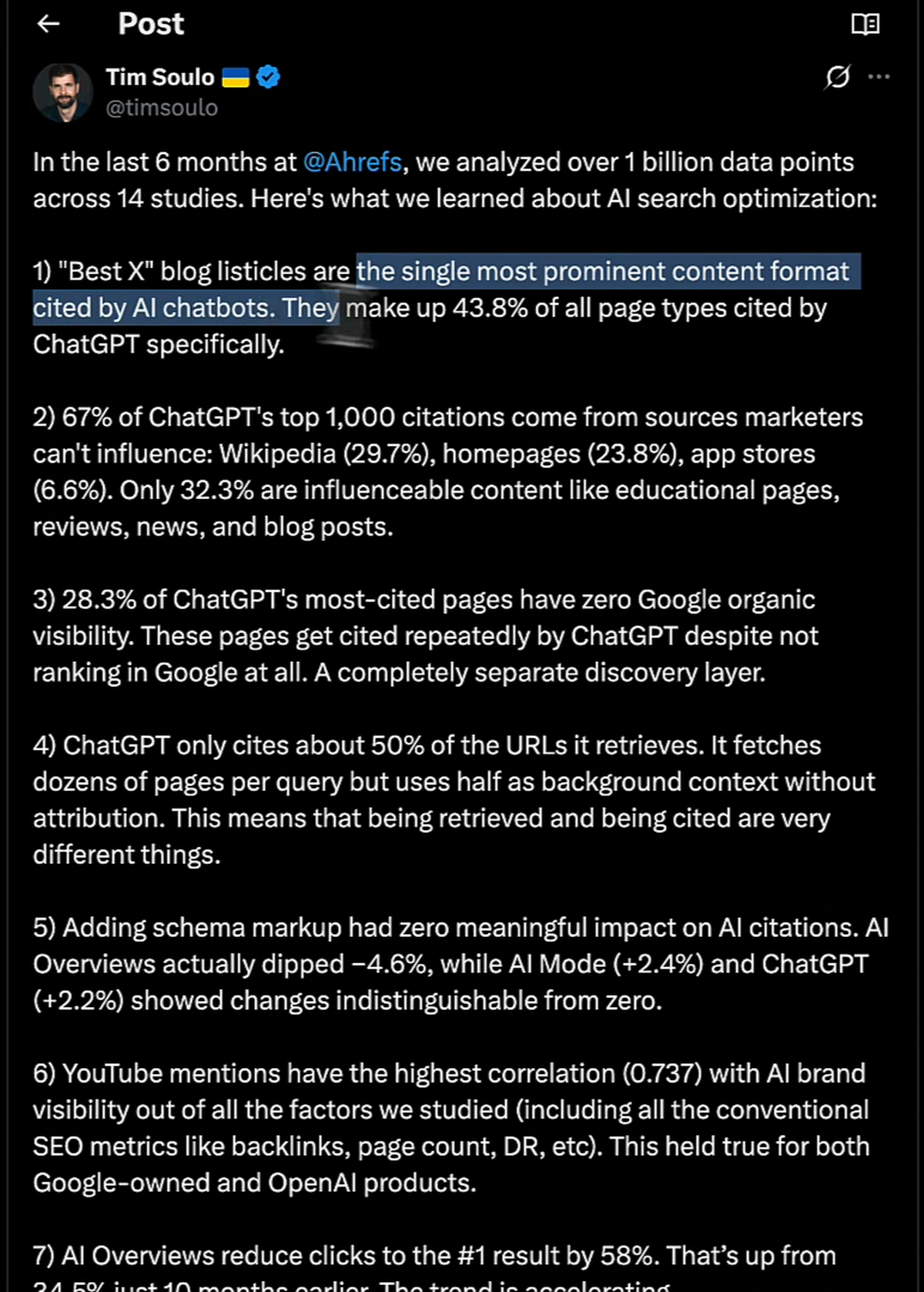
"Best X" listicles are the single most cited content format in AI search — 43.8% of all page types cited by ChatGPT. Not one format among many. The dominant one, by a wide margin.
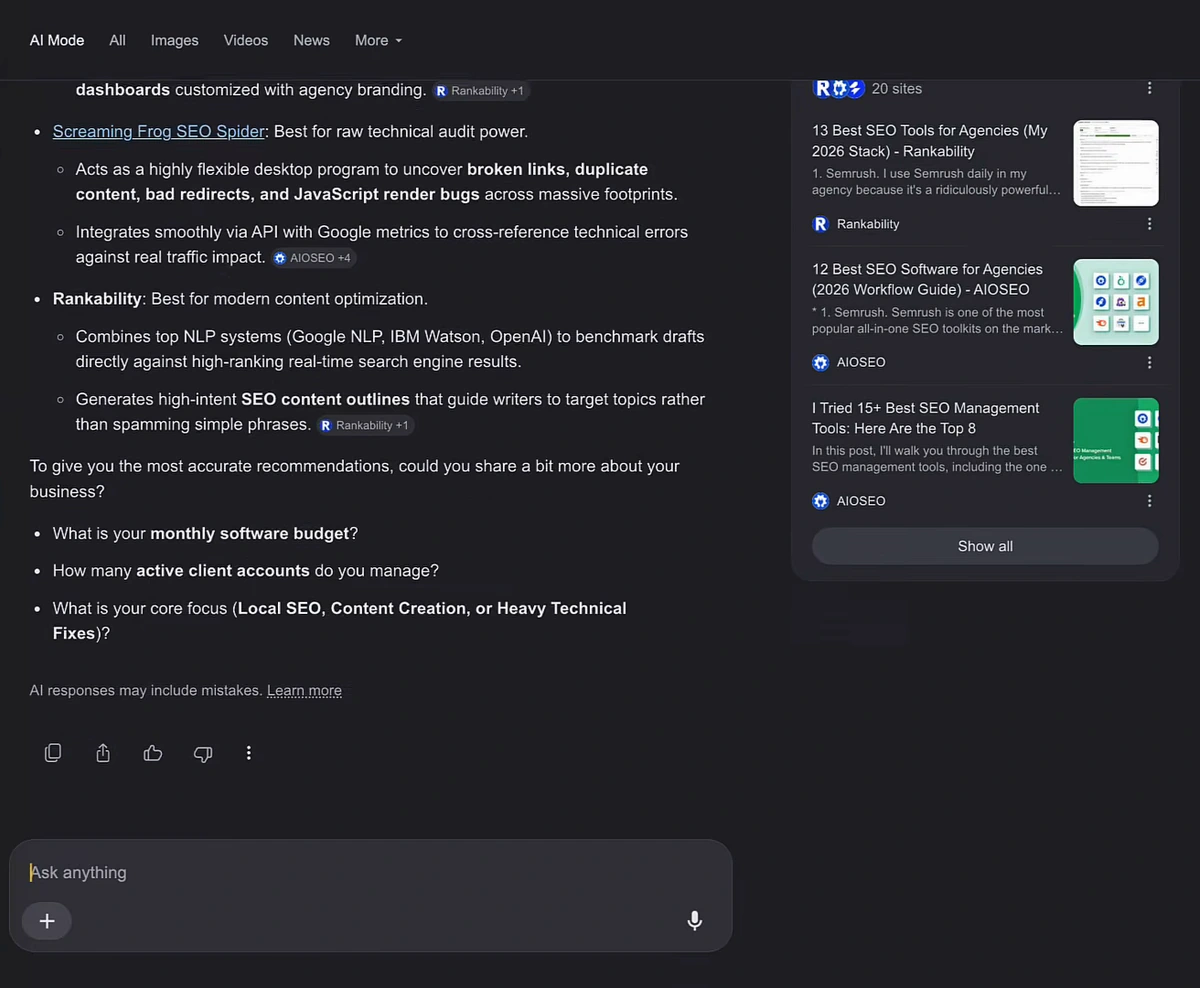
I tested this live. I asked ChatGPT for the best AI SEO software for agencies, then ran the same query through Google's AI Mode. Then I opened the sources panel on both. Listicle, listicle, listicle: "13 best," "12 best," "15+ best." Not every source is a listicle, but most of them are, on both engines.
If your content plan for AI search does not include list-format pages for the commercial queries in your niche, you are ignoring the format that wins 43.8% of the citations.
2. Focus on the 32.3% of citations you can influence
67% of ChatGPT's top 1,000 citations come from sources marketers cannot touch: Wikipedia at 29.7%, homepages at 23.8%, app stores at 6.6%. Only 32.3% are influenceable content — educational pages, reviews, news, and blog posts.
The wrong reading is "two thirds of the game is rigged, why bother." The right reading: the influenceable third is dominated by exactly the content formats you can produce this week. Reviews and blog posts are the levers. Pull them.
3. Stop treating Google rankings as the ticket in
28.3% of ChatGPT's most-cited pages have zero Google organic visibility. Nearly a third of the pages ChatGPT leans on most do not rank on Google at all. They get cited repeatedly anyway.
This is the finding I have been shouting about the longest. AI search is a completely separate discovery layer. A page buried on page ten of Google can be pulled into an answer because the model judged it valuable for that specific prompt. There is no one-to-one relationship between Google rankings and LLM citations — so a "we'll do AI SEO once we rank" strategy has the order backwards.
4. Optimize for retrieval, not just the citation list
ChatGPT only cites about 50% of the URLs it actually reads. It fetches dozens of pages per query and uses half of them as background context, without attribution. Being retrieved and being cited are two different things.
Practically, this means your influence on AI answers is bigger and quieter than the sources panel suggests. Your page can shape an answer without ever being named in it. It also means the goal is to be in the retrieval set first — you cannot be cited if you are never fetched.
5. Do not bet on schema markup
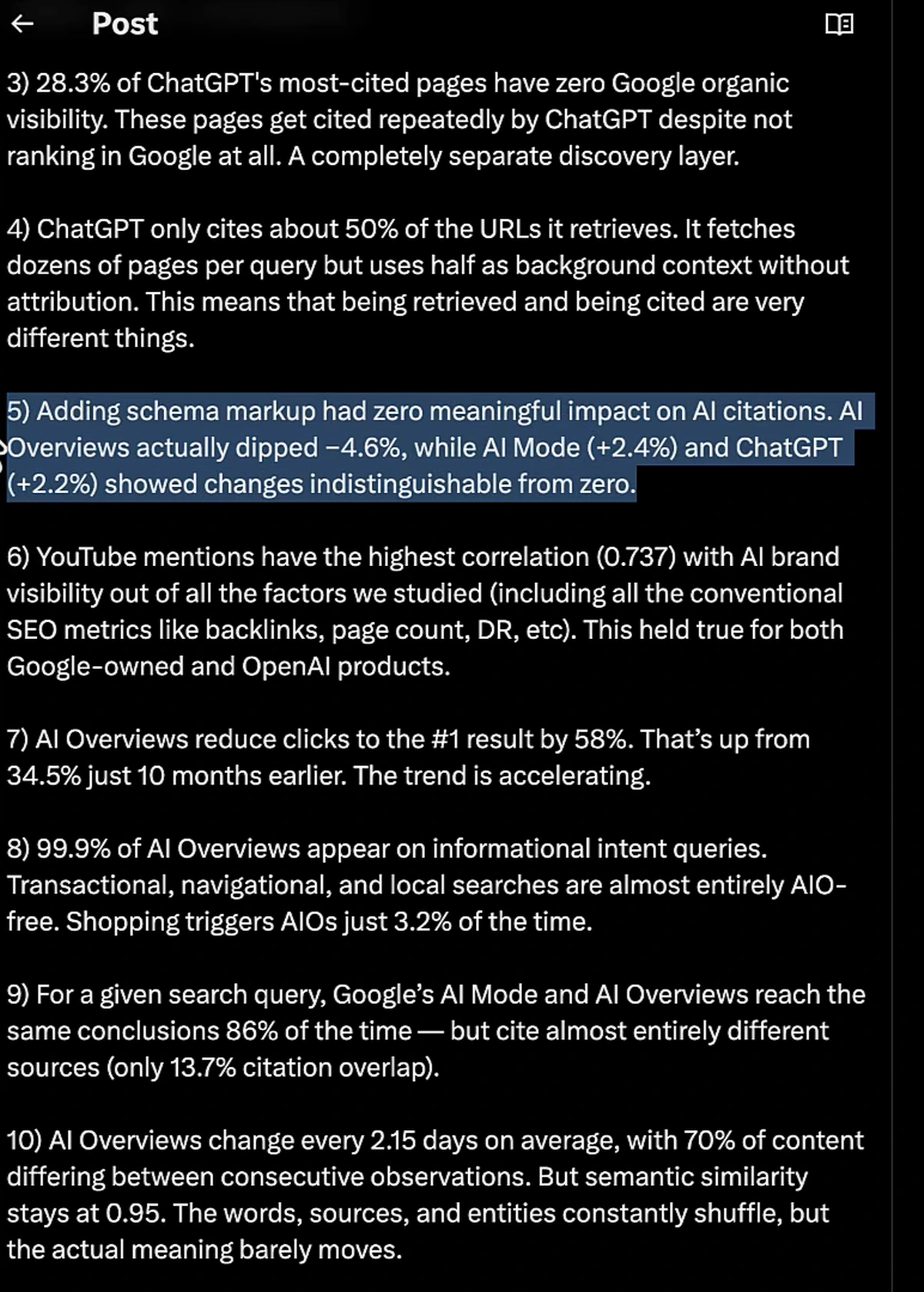
Adding schema markup had zero meaningful impact on AI citations. In the Ahrefs data, AI Overviews actually dipped 4.6% after schema was added, while AI Mode (+2.4%) and ChatGPT (+2.2%) showed changes indistinguishable from zero.
Schema still has its uses in classic SEO, but as an AI citation tactic it is dead weight. If an agency is selling you schema implementation as the path into ChatGPT answers, the largest dataset we have says you are buying nothing.
6. Get talked about on YouTube
YouTube mentions have the highest correlation with AI brand visibility of every factor studied — 0.737 — beating backlinks, page count, and DR. And it held true for both Google-owned and OpenAI products, so this is not just Google favoring its own platform.
Every conventional SEO metric we obsess over correlates with AI visibility less than whether people mention your brand on YouTube. If you are deciding between one more backlink campaign and finally showing up on camera — or getting other channels to talk about you — the data now has an opinion.
7. Accept that ranking #1 buys fewer clicks than it used to
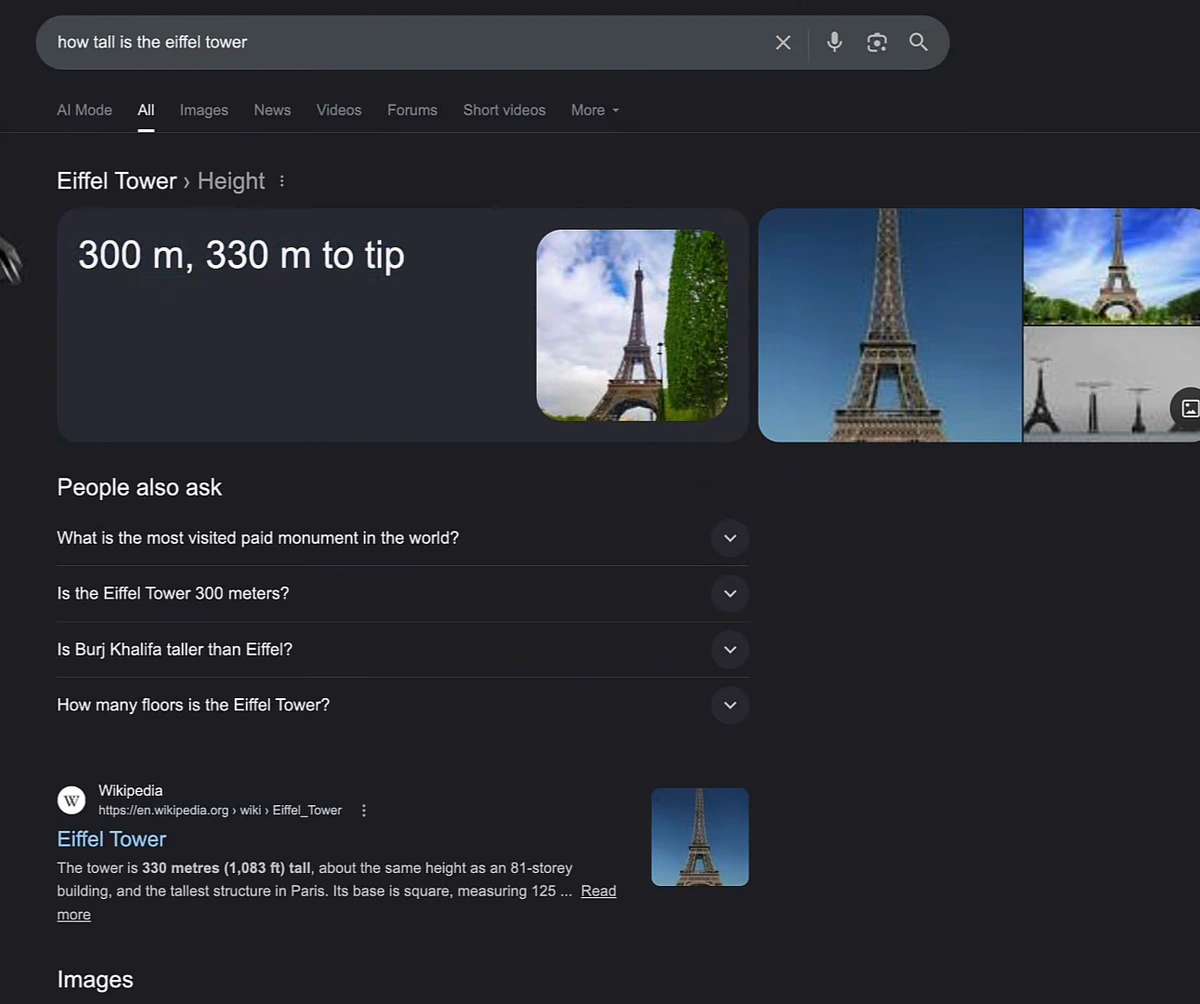
AI Overviews reduce clicks to the #1 result by 58% — up from 34.5% just ten months earlier. The trend is accelerating, not stabilizing.
My favorite demo of this: search "how tall is the Eiffel Tower." The answer is sitting right there on the results page. Why would anyone click the Wikipedia result below it? They don't — and increasingly, they don't click yours either, even when you hold position one.
8. Know which queries have been absorbed by the machine
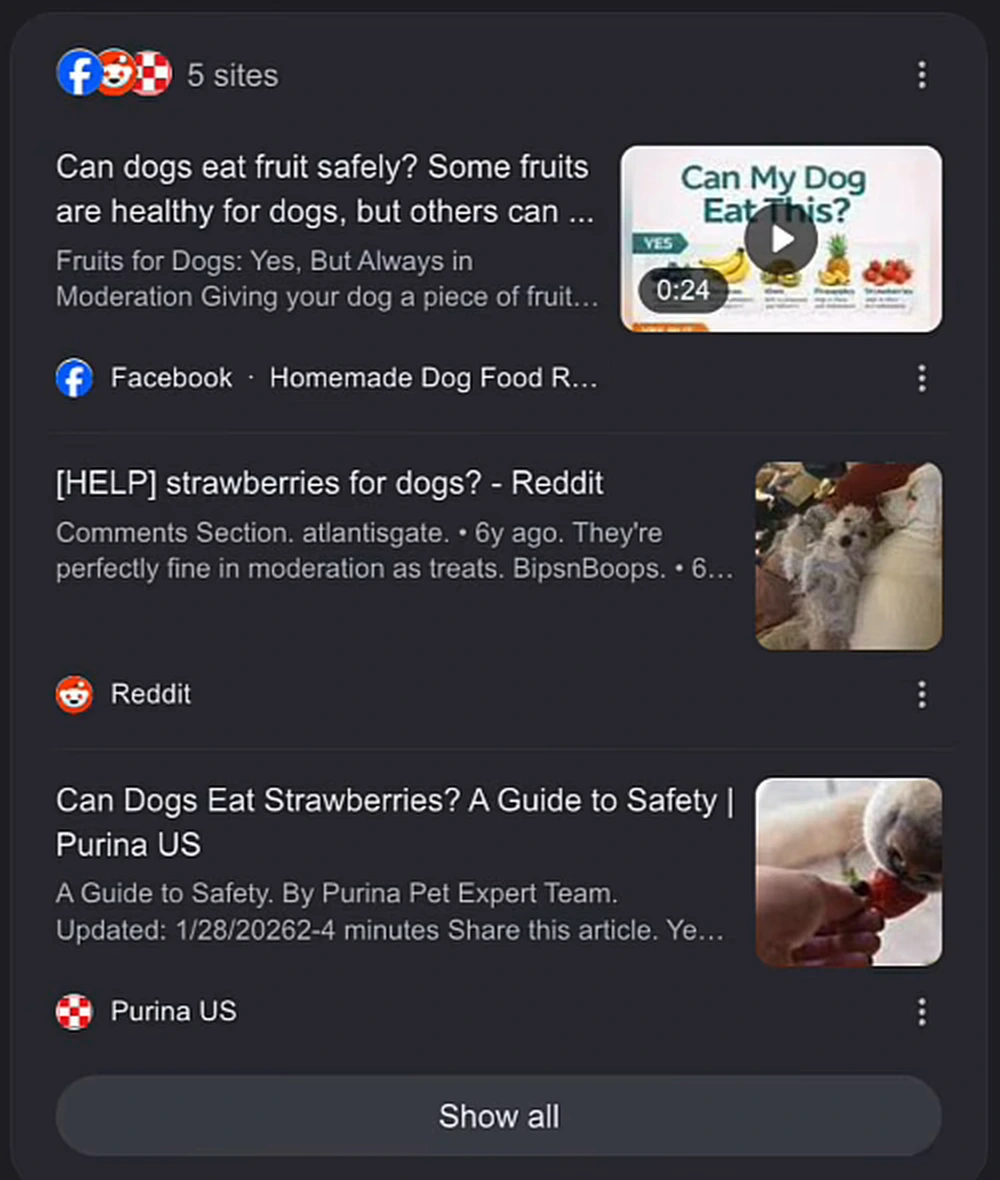
99.9% of AI Overviews appear on informational intent queries. Transactional, navigational, and local searches are almost entirely AIO-free, and shopping queries trigger them just 3.2% of the time.
Commodity informational content — the "can dogs eat strawberries" tier of the internet — has been fully absorbed into the answer layer. That traffic is not coming back. But the flip side is genuinely good news: the queries closest to money still deliver clicks. I break down how the search and answer layers split in my guide to SEO vs AEO.
9. One placement is never enough — the engines barely share sources
Google's AI Mode and AI Overviews reach the same conclusion 86% of the time — but their citations overlap only 13.7%. Two products from the same company, agreeing on the answer while reading almost entirely different pages.
Expect these products to keep converging — AI Overviews already hands you off to AI Mode when you keep the conversation going. But until the citation pools merge, you need presence across many sources, not one perfect page. This is also why I track prompts across ChatGPT, Claude, Gemini, Perplexity, and Grok in my LLM visibility tracker instead of assuming one engine speaks for the rest.
10. Keep publishing — the answers reshuffle every two days
AI Overviews change every 2.15 days on average, with 70% of the content differing between consecutive observations — yet semantic similarity stays at 0.95. The words, sources, and entities constantly shuffle while the actual meaning barely moves.
Read that as a standing invitation. The conclusions are sticky, but the citation slots behind them rotate constantly, which means fresh, relevant pages get pulled in all the time. A brand that publishes consistently keeps re-entering the draw; a brand that shipped one great page in 2024 slowly rotates out of it.
What I am doing with this data
Ahrefs is a roughly $100-million-a-year company with crawl power across a huge slice of the web — not Google-scale, but more than enough to trust these patterns. And much of it matches what I have seen in my own client work over the past two years. I keep a running collection of numbers like these in my GEO statistics roundup, and the direction is consistent: AI search is a separate layer with its own rules, and the rules reward specific, repeatable moves.
So here is my playbook, straight from the ten findings: publish listicles for every commercial query in the niche (finding 1), concentrate on reviews and blog content because that is the influenceable third (finding 2), stop waiting for Google rankings as permission (finding 3), aim to be in the retrieval set everywhere (findings 4 and 9), skip the schema theater (finding 5), invest in YouTube presence (finding 6), and keep shipping because the citation slots reshuffle every two days (finding 10). Then measure whether it is working — tracking your ChatGPT brand mentions is the feedback loop that tells you which of these levers is actually moving your visibility.
FAQ
What content format gets cited most in AI search?
"Best X" listicles. In Ahrefs' analysis of over 1 billion data points, listicles make up 43.8% of all page types cited by ChatGPT — the single most prominent format. If you want AI citations, list-format content for commercial queries is the highest-probability play.
Do I need to rank on Google to get cited by ChatGPT?
No. 28.3% of ChatGPT's most-cited pages have zero Google organic visibility. AI search operates as a separate discovery layer, so a page that ranks nowhere on Google can still be cited repeatedly if the model finds it valuable for a specific prompt.
Does schema markup help you get cited by AI?
The Ahrefs data says no — adding schema markup had zero meaningful impact on AI citations. AI Overviews dipped 4.6% after adding it, and changes in AI Mode and ChatGPT were indistinguishable from zero. Schema has other uses, but it is not an AI citation tactic.
What is the fastest way to increase AI brand visibility?
Get mentioned on YouTube. YouTube mentions showed the highest correlation with AI brand visibility (0.737) of every factor Ahrefs studied, ahead of backlinks, page count, and domain rating — and it held for both Google and OpenAI products.
How often do AI Overviews change?
Every 2.15 days on average, with 70% of content differing between consecutive observations. But semantic similarity stays at 0.95 — the sources and wording rotate constantly while the conclusions barely move. Consistent publishing keeps you in the rotation.
How do I know if any of this is working for my brand?
Track it. Run your target prompts across ChatGPT, Claude, Gemini, Perplexity, and Grok on a schedule and watch mentions, citations, and sentiment move. You can start free with a free LLM brand mention tracker before committing to a full monitoring setup.
Finding 1 is an instruction: AI engines cite listicles, so someone in your niche has to write them. Arvow's AI SEO agent researches, writes, and publishes citation-ready content on autopilot — and the LLM visibility tracker shows you when the models start quoting it.
A billion data points later, the uncomfortable summary is this: the tactics most people are still paying for — schema, rank-first thinking, one hero page — are exactly the ones the data just demoted. The tactics that look almost too simple — listicles, reviews, YouTube, relentless publishing — are the ones holding up the answers. Pick your side of that trade before the next 2.15-day reshuffle.
Generate, publish, syndicate and update articles automatically
The AI SEO Writer that Auto-Publishes to your Blog
- Cancel anytime
- Articles in 30 secs
- Plagiarism Free