Google November 2026 Core Update: What Changed and What to Do Next

The Google November 2026 core update began rolling out on 10 November 2026 at 10:06 a.m. Pacific time. Google says it applies globally, to all languages, and that the rollout may take up to two weeks. When we checked Google's Search Status Dashboard on 18 November, the update was still listed without a completion date. Tim The SEO Guru walked through the update in a video published on 17 November. This article sets out what Google has confirmed, what is only a forecast, which pages are most exposed, and when it makes sense to open Search Console.
Google November 2026 core update: the confirmed facts
| Question | Answer on 18 November 2026 |
|---|---|
| Official name | November 2026 core update |
| Start | 10 November 2026, 10:06 a.m. Pacific |
| Expected length | "Up to 2 weeks", which points to about 24 November |
| Scope | Global, all languages |
| Status | Still rolling out, no end date posted |
| Stated target | None. Google called it a regular update |
| Core updates so far in 2026 | Three: March, May and November |
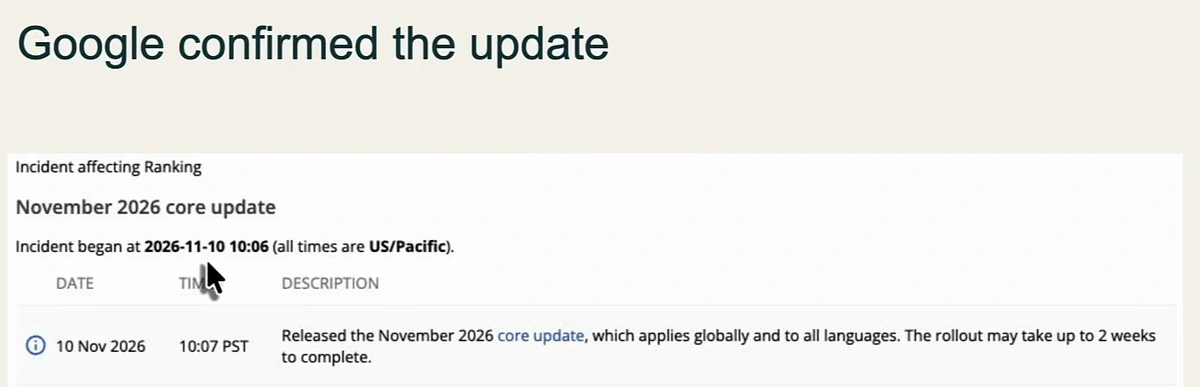
Google did not publish a blog post or name anything the update is aimed at. Its only public description, quoted by Search Engine Roundtable and Search Engine Journal, is that this is a regular update meant to better surface relevant, satisfying content from all types of sites. You can follow the rollout on the Search Status Dashboard, which is the only place the end date will be confirmed.
Did it start before 10 November?
The video quotes a Reddit commenter who believes the update began around 19 October. There is something behind that. Search Engine Roundtable reported unconfirmed ranking volatility on 16 October, 20 and 21 October, 24 October, 26 and 27 October, and again on 8 and 9 November. On 21 October it suggested Google might be testing ahead of a core update.
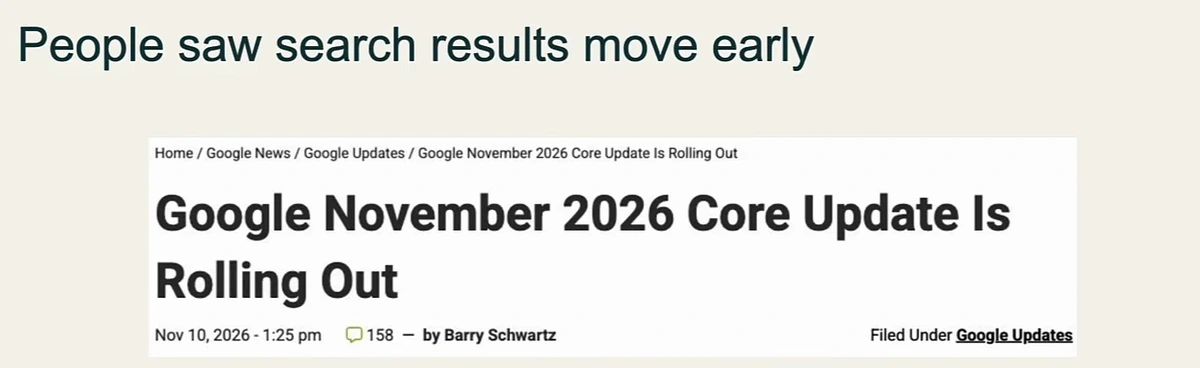
None of this proves the core update started early, and the video's own slide says so. It does matter for one practical reason, which we come back to below: the weeks before 10 November were not a calm baseline.
The "Panda-style" claim is a forecast
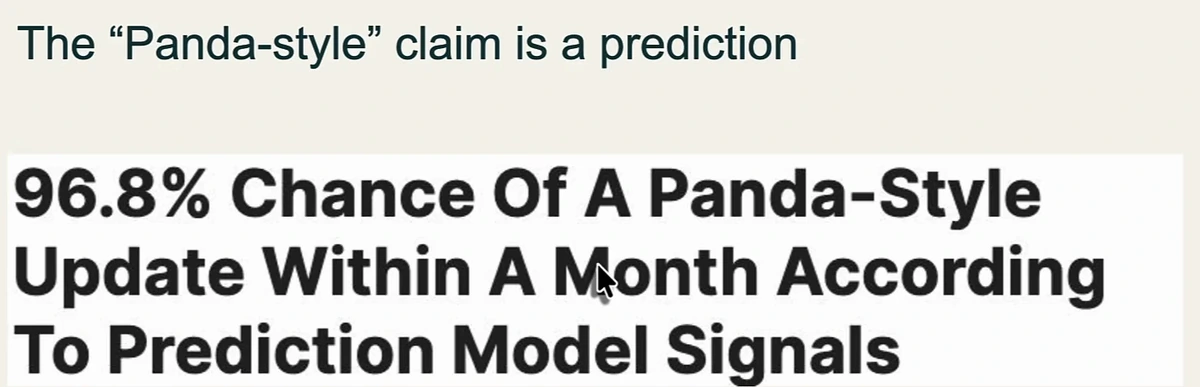
The video also shows a headline claiming a 96.8% chance of a Panda-style update within a month, based on prediction model signals. The slide credits it to Dan Taylor at Search Engine Journal, dated 15 October 2026. We could not find the claim in the news coverage we read, so we are reporting it as the slide presents it.
Three things are worth keeping straight:
- It is one author's forecast that an update would happen. It says nothing about the odds of your site losing traffic.
- Google has not described the November update as a Panda update or as a quality update of any specific kind.
- Panda was a 2011 update aimed at site quality. Sites full of shallow or copied pages lost visibility. People bring it up now because mass-produced AI pages look like the same problem.
Which pages are most exposed
Since Google named no target, the useful guide is its standing documentation on helpful content. The video condenses it into five warning signs:
- Lots of AI pages with little human review
- Rewritten ideas with nothing useful added
- Pages built only to pull in search visits
- Fake authors, photos, or claims about their skills
- Rushed pages with errors and little proof
The first three trace to a passage in Google's helpful-content guide that defines two attributes of a page's main content: effort and originality.
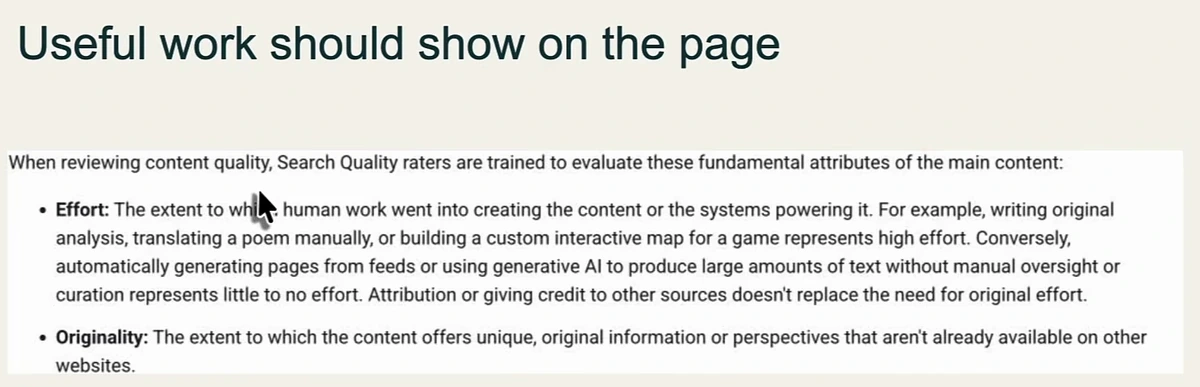
Google's wording is specific. Using generative AI to produce large amounts of text without manual oversight or curation counts as little to no effort. Crediting your sources does not replace original work. Originality means offering information or perspectives that are not already available on other sites.
That is not a ban on AI. The same documentation asks you to fact-check AI output before publishing and warns against generating many pages without adding value. We cover where the line sits in is AI content bad for SEO and in our guide to commodity content.
Fake authors
The fourth warning sign has its own passage in Google's guide, and it is blunt.
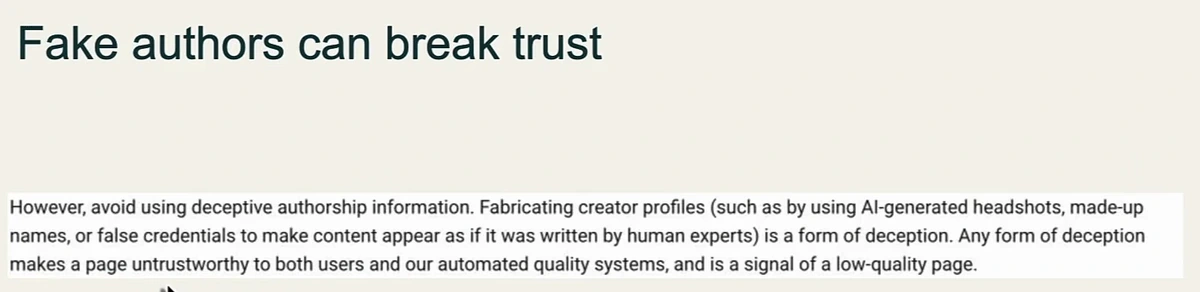
AI-generated headshots, made-up names and false credentials are described as deception, and deception is called a signal of a low-quality page for both users and Google's automated systems. If your blog has invented personas, replace them with the real people who review the content.
A five-question check for any page
The video borrows a short audit from Cyrus Shepard's work on content effort. Run it on the pages that matter most to you:
- Can readers find the answer fast?
- Did I add something new?
- Did I show proof, such as photos or test results?
- Did I add more than a quick search would find?
- Did I explain the details that help people decide?
For a product page, the video's examples are your own photos and a real product test, clear size, material and care details, and honest answers to common buyer questions.
When to check Search Console
Google's core update documentation gives a fixed order of steps, and the video reads them out.
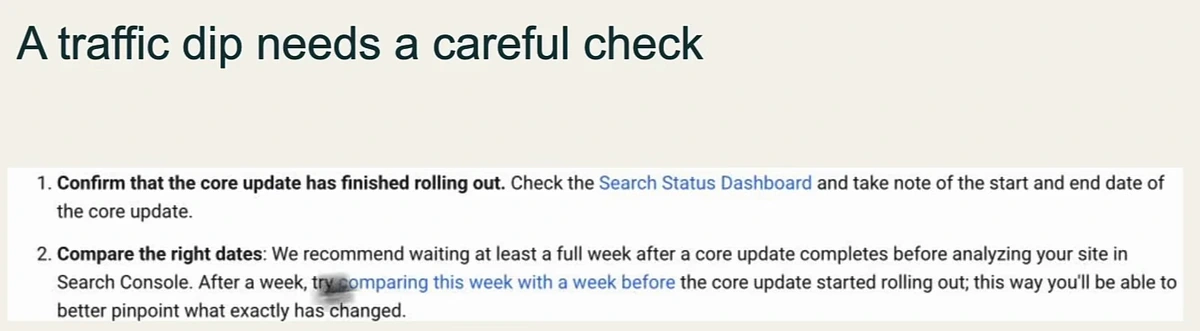
- Confirm the rollout has finished. Note the start and end dates from the dashboard.
- Wait at least a full week after it completes. Then compare that week with a week before the update started.
- Size the drop. Google's example of a small drop is position 2 to 4, and it says no drastic action is needed. Its example of a large drop is position 4 to 29, which calls for a deeper assessment.
- Look at search types separately: Web, Images, Video and News.
If the update finishes on schedule around 24 November, the earliest sensible analysis date is about 1 December.
The Black Friday problem
A second Reddit comment in the video points out that the update lands just before the busiest time of year for online stores. Black Friday is 27 November and Cyber Monday is 30 November, so both fall inside or just after the rollout window.
Our own caution for stores: the comparison Google recommends will be distorted this time. The week after the update contains Cyber Week demand, and the week before it contains the unconfirmed volatility of 8 and 9 November. Compare average position and impressions per query, not just clicks, and check the same week last year before blaming or crediting the update. Our guide to diagnosing a Google traffic drop covers the wider process.
Two weeks is an estimate
| Core update | Start | End | Length |
|---|---|---|---|
| March 2024 | 5 Mar 2024 | 19 Apr 2024 | 45 days |
| March 2025 | 13 Mar 2025 | 27 Mar 2025 | 14 days |
| June 2025 | 30 Jun 2025 | 17 Jul 2025 | 17 days |
| December 2025 | 11 Dec 2025 | 29 Dec 2025 | 18 days |
| March 2026 | 27 Mar 2026 | 8 Apr 2026 | 12 days |
| May 2026 | 21 May 2026 | 2 Jun 2026 | 12 days |
| November 2026 | 10 Nov 2026 | Not yet posted | Up to 2 weeks |
The video cites the 45-day March 2024 rollout as the reason not to trust the estimate. That one is the outlier. The two earlier updates this year both finished in about 12 days, inside Google's window. Two of the three in 2025 ran over it by a few days.
What to do, and what not to do
- Do not rewrite pages during the rollout. Rankings are still moving, and you will not be able to tell your edit from the update.
- Avoid quick fixes. Google's documentation says this in those words and asks for meaningful improvements.
- Treat deletion as a last resort. Google says to remove content only if it cannot be salvaged. Our content pruning guide explains how to decide.
- Expect recovery to be slow. Google says some changes take effect in days, others take several months, and some may wait for the next core update.
- Keep a log of your edits so you can see what changed and when.
How the video uses Arvow for this
The second half of the video is a tour of Arvow, the tool the presenter uses to produce content. Arvow is our product, so read this section with that in mind. Nothing in it was tested against the November update.
The argument is that technical structure is the easy part and unique input is the hard part. The knowledge base accepts files, URLs and pasted text, so case studies, statistics and training material can feed every article. A Google Business Profile and Search Console can be connected as well.
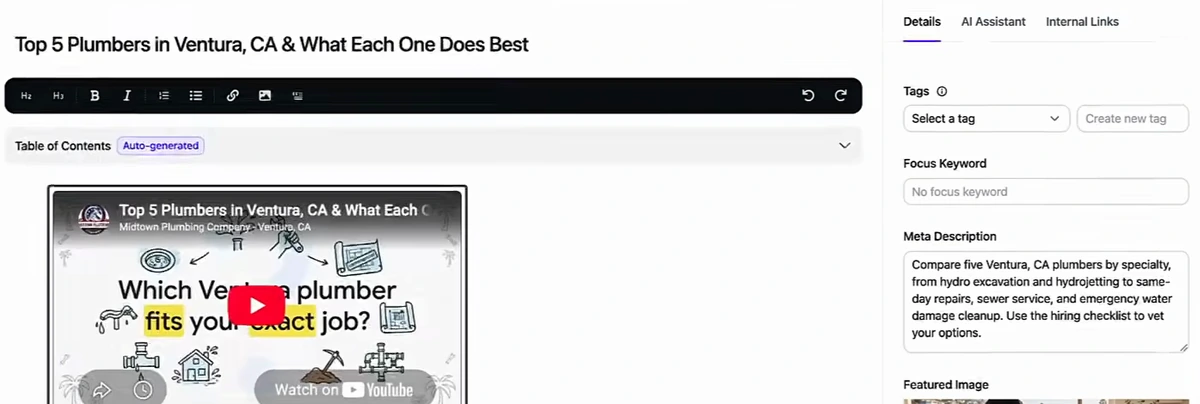
The demo article has headings, a table of contents, a meta description and image alt text. Its Focus Keyword field is empty, which is a reminder that generated drafts still need the human review Google's first warning sign is about.
The video then connects Arvow to ChatGPT or Claude through the Arvow MCP, so you can ask the assistant to look through Search Console for weak pages and keyword gaps. That step is described but not run on screen. The video closes with an Ahrefs screenshot of an unnamed site.

The same screenshot, with the same figures, appeared in a video from the same presenter that we covered on 10 November, the day the update began. It shows growth before the update. It is not evidence of how the site came through it.
Want content built from your own proof? Add your case studies, data and brand material to Arvow's knowledge base and review every draft before it goes live. Try Arvow.
FAQ
When did the Google November 2026 core update start?
On 10 November 2026 at 10:06 a.m. Pacific time, according to Google's Search Status Dashboard.
When will the November 2026 core update finish?
Google said the rollout may take up to two weeks, which points to about 24 November 2026. On 18 November it had not been marked complete. The dashboard will show the end date.
Is the November 2026 core update a Panda update?
Google has not said so. The "Panda-style" label comes from a forecast published in October, before the update was announced.
Does the November 2026 core update penalise AI content?
Google named no target. Its guidance says large amounts of AI text published without human oversight count as low effort, and that AI content should be fact-checked and add value. AI use by itself is not the issue.
My traffic dropped. Should I change my pages now?
No. Google recommends waiting until the update finishes, then at least one more full week, before analysing Search Console. Small position changes need no drastic action.
Generate, publish, syndicate and update articles automatically
The AI SEO Writer that Auto-Publishes to your Blog
- Cancel anytime
- Articles in 30 secs
- Plagiarism Free