✨ Hello 2026: 40% Off on Yearly Plans
hrs
min
sec
Back to Case Studies

Yoga Brand Grew from 900 to 5,000/mo Without Spending a Dollar on Ads

Yoga Brand Grew from 900 to 5,000/mo Without Spending a Dollar on Ads

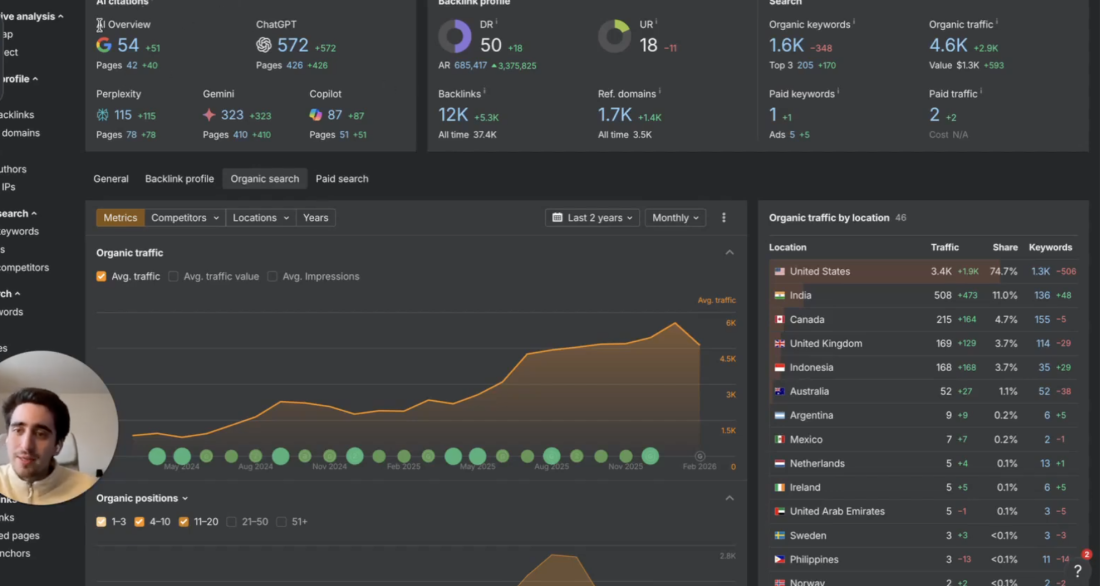
An e-commerce brand selling yoga mats scaled their store traffic from 900 to nearly 5,000 monthly visitors — all through organic SEO, zero ad spend. But the real story isn't just Google traffic. The brand is now cited across 572 ChatGPT mentions, 54 Google AI Overviews, plus appearances in Gemini, Perplexity, and Copilot. That's free traffic from the most trusted recommendation engine consumers use today. Here's the five-step strategy they followed.


The Challenge

Like most e-commerce brands, this company was stuck in the paid ads cycle. Facebook Ads and Google Ads can drive traffic, but the moment you pause a campaign or a creative burns out, the traffic disappears overnight. You're renting visibility, not owning it.

The brand wanted a different approach — one that would build compounding, long-term traffic they actually owned. They needed an organic content strategy that could drive qualified visitors to their store, rank for product-related keywords, and get their brand recommended by AI platforms where consumers increasingly go for product advice.


The Strategy

The brand used Arvow to build a fully automated SEO content engine for their Shopify store. The setup followed five steps — configured once, then left to run on autopilot.

Step 1: Connect the Shopify store. They linked their Shopify store to Arvow through the native integration. The setup process takes about a minute — connect the store, configure the blog name, set an author, choose whether articles publish immediately or save as drafts. They chose to publish directly.

Step 2: Build a knowledge base. This is what separates generic AI content from content that actually sounds like a real brand. They uploaded business assets into Arvow's knowledge base — their website URL, product descriptions, PDFs about their brand story, and text documents covering their unique selling points. Every article Arvow generates draws from this context, producing content grounded in the brand's actual identity rather than generic filler.

Step 3: Set up a keyword feed. Instead of paying for expensive keyword research tools, they used Arvow's built-in feed feature. They entered their store URL, a few seed keywords (like "yoga" and "yoga mat"), up to three competitor URLs, and set the target country and language. The system generated a list of low-competition, low-difficulty keywords — exactly the kind of terms where a newer brand can realistically rank and capture traffic.

Step 4: Launch the autoblog. They created a campaign, enabled full automation mode, and connected the keyword feed to their Shopify integration. From there, they set the publishing cadence — in their case, one article per day. Arvow handles the rest: pulling keywords from the feed, generating fully optimized articles, and publishing them directly to the store's blog.

Step 5: Customize the article template. Before starting the autoblog, they fine-tuned the article template to match their brand. This included setting the tone of voice, point of view, and formality level. They added custom prompts for special instructions, connected their knowledge base so every article would be informed by their actual business context, and input their sitemap to ensure automatic internal linking across the store. They also enabled AI-generated images and automatic YouTube video embeds for richer content.


The Results

Organic traffic: From 900 to nearly 5,000 monthly visitors — a 5x increase driven entirely by blog content.

Traffic value: Approximately $1,300/month in equivalent Google Ads spend. That's what a competitor would need to pay monthly to get the same keywords and traffic volume.

AI citations: 572 ChatGPT mentions, 54 Google AI Overviews, plus citations in Gemini, Perplexity, and Copilot. These aren't just impressions — they're trusted recommendations that carry far more weight than a paid ad.

Content volume: The store now has 238 pages of blog content, all generated through the same automated system.

Top traffic sources: The pages driving the most traffic are all blog posts — optimized articles with proper heading structure, tables, images, and internal links back to product pages.


Why LLM Citations Matter More Than Ad Clicks

Here's something this case study makes clear: an AI recommendation is fundamentally different from a paid ad.

When someone sees a Facebook ad for a yoga mat, they don't trust the brand yet. They know it's paid placement. They're skeptical. The conversion path is long — you need creative, landing pages, retargeting, and often multiple touchpoints before they buy.

But when someone asks ChatGPT "what's the best yoga mat?" and it recommends your brand, the trust is already built in. The AI is acting as a neutral advisor. The consumer arrived at your store because a system they trust pointed them there. That's a fundamentally warmer lead than any ad click.

This brand now has 572 of those moments happening through ChatGPT alone — plus hundreds more across other LLMs. And every one of those citations costs them nothing.


Owned Assets vs. Rented Traffic

The core argument for this strategy comes down to a simple distinction:

Paid ads rent traffic. You pay Google or Meta, you get visitors. You stop paying, the visitors stop coming. Your creatives burn out, your costs go up, and you're back to zero. You never own anything.

SEO content builds assets. Every article published to your blog is a permanent asset sitting on your domain. It ranks, it compounds, it drives traffic month after month without additional spend. Even if you stop producing new content, the existing articles continue working.

This yoga mat brand now has 238 blog posts — 238 assets they own outright. Each one is a potential entry point for a customer who's searching for something related to yoga, fitness, or wellness. That's a moat no ad campaign can replicate.


Key Takeaways

E-commerce brands can compete on SEO, not just ads. You don't need a massive ad budget to drive traffic to your store. A consistent content strategy targeting the right keywords can deliver thousands of monthly visitors for free. This works especially well for e-commerce brands in niches where consumers research before purchasing.

The knowledge base is the secret to non-generic content. Uploading your brand assets — product docs, website copy, brand guidelines — into Arvow's knowledge base means the AI writes content that reflects your actual business. It's the difference between content that sounds like every other AI article and content that sounds like you.

One article per day compounds fast. 238 blog posts didn't appear overnight, but they didn't require a content team either. One article per day, published automatically, adds up to a library of rankable content within months. The autoblog handles the entire workflow.

Internal linking is a ranking factor you can't afford to skip. By inputting their sitemap into the template configuration, every article automatically included internal links to relevant product pages and other blog posts. This signals topical authority to both Google and LLMs — and it drives visitors deeper into the store where they can actually buy.

AI images have caught up. The brand used AI-generated images throughout their articles instead of stock photos. The quality is high enough that there's no meaningful difference to the reader, and it eliminates the cost and hassle of sourcing visuals for every post.


Try It Yourself

If you're running a Shopify store — or any e-commerce site on Wix, Webflow, or another platform — the playbook is simple: connect your store, build your knowledge base, set up a keyword feed, customize your template, and launch the autoblog. One setup, then it runs forever.

Arvow AI SEO Writer
Generate, publish, syndicate and update articles automatically

The AI SEO Writer that Auto-Publishes to your Blog

  • Articles in 30 secs
  • No credit card
  • Join 25,260+ businesses