

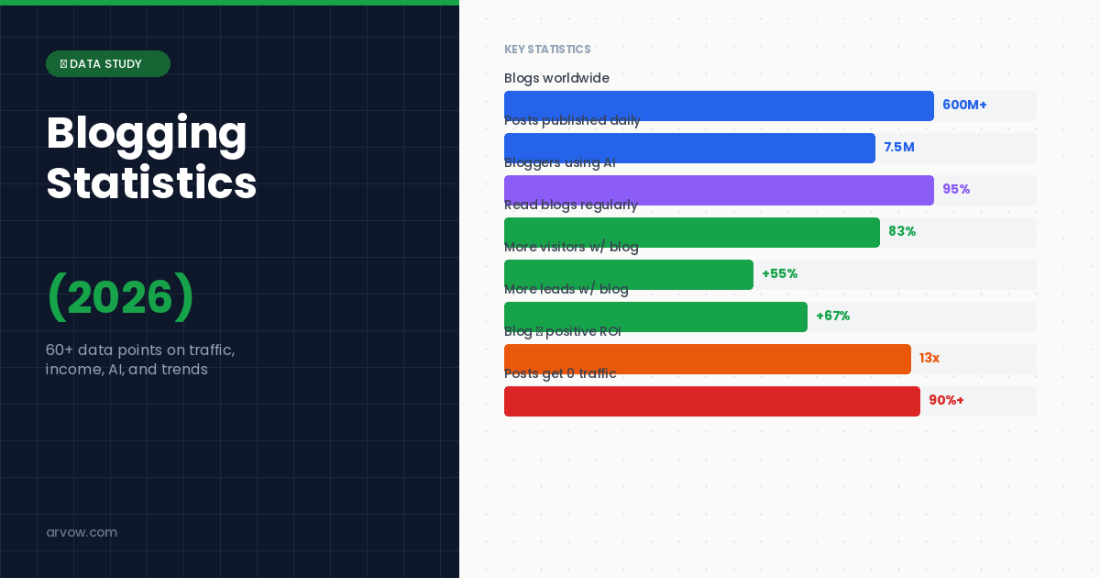
There are over 600 million blogs worldwide, publishing 7.5 million posts every single day. Despite predictions of blogging's death, the data tells a different story: 83% of internet users read blogs, businesses with blogs see 55% more website visitors, and marketers who prioritize blogging are 13x more likely to see positive ROI. We aggregated data from Orbit Media's 12-year annual survey, HubSpot, Backlinko, RankIQ, and 20+ other sources to compile the most comprehensive collection of blogging statistics available.
Key Takeaways
- There are over 600 million blogs worldwide — 31.6% of all websites (Tech Business News)
- 7.5 million blog posts are published every day — 2.7 billion per year (Tech Business News)
- 83% of internet users (~4.4 billion people) read blogs (HubSpot)
- The average blog post is 1,333 words and takes 3h 48m to write (Orbit Media, 2025)
- 95% of bloggers now use AI at least sometimes (Orbit Media, 2025)
- Businesses with blogs see 55% more website visitors and 67% more leads (HubSpot)
- Marketers who prioritize blogging are 13x more likely to get positive ROI (DemandSage)
- WordPress powers 60 million blogs; Tumblr hosts 518 million (Various)
- Food blogs have the highest median income at $9,169/month (RankIQ)
- Over 90% of blog posts receive zero traffic from Google (Ahrefs)
- How Many Blogs Are There?
- Blog Readership and Traffic Statistics
- Blog Content Statistics (Length, Format, Frequency)
- How Long Does It Take to Write a Blog Post?
- AI and Blogging Statistics
- Blogging and SEO Statistics
- Business Blogging Statistics
- Blog Income Statistics
- Blogging Platform Statistics
- Most Popular Blog Niches
- Blogger Demographics
- Blog Promotion Statistics
- What Separates High-Performing Blogs
- The Future of Blogging
1 How Many Blogs Are There?
The blogosphere is enormous — and still growing.
| Metric | Value | Source |
|---|---|---|
| Total blogs worldwide | 600 million+ | Tech Business News |
| Blogs as % of all websites | 31.6% | Tech Business News |
| Total websites worldwide | 1.9 billion | Internet Live Stats |
| Blog posts published daily | 7.5 million | Tech Business News |
| Blog posts published per year | 2.7 billion+ | Tech Business News |
| WordPress posts per month | 70 million | WordPress.com |
| U.S. bloggers (posting monthly+) | 31 million+ | Statista |
| Global content creators | 207 million | LinkTree |
Nearly one-third of every website on the internet is a blog. And the volume keeps climbing: WordPress alone accounts for 70 million new posts every month — roughly 2.3 million per day on a single platform.
2 Blog Readership and Traffic Statistics
Blogs aren't just being published — they're being read by billions.
| Metric | Value | Source |
|---|---|---|
| Internet users who read blogs | 83% (~4.4B people) | HubSpot |
| WordPress.com monthly page views | 20 billion | WordPress.com |
| WordPress.com monthly visitors | 409 million | WordPress.com |
| Readers who read blogs 1–4x per month | 29% | HubSpot |
| Readers who read blogs daily | 18% | HubSpot |
| Readers who skim rather than deep-read | 73% | HubSpot |
| People who only read the headline | 80% | CopyBlogger |
| Average time on a blog post | 52 seconds | OptinMonster |
| Consumers who made a purchase after reading a blog | 61% | 99firms |
| Readers who visit blogs to learn something | 62.2% | TechJury |
The largest blog reader demographic is 41–60 year olds (37%), followed by 25–40 (32%). The majority of blog traffic is still driven by Google — making SEO the most important distribution channel for blog content.
3 Blog Content Statistics (Length, Format, Frequency)
Orbit Media has tracked blog content trends annually since 2014. Here's how things have evolved:
After peaking at 1,427 words in 2023, average post length has declined for two consecutive years — down to 1,333 words in 2025. This is likely driven by AI enabling faster production and a shift toward more focused, intent-driven content.
However, longer content still wins: 39% of bloggers who publish 2,000+ word posts report strong results, compared to just 21% overall (Orbit Media, 2025).
| Content Format | % of Bloggers Using It | Source |
|---|---|---|
| How-to articles | 76% | Orbit Media |
| Lists / listicles | 54% | Orbit Media |
| Images in posts | 88% | Orbit Media |
| Statistics in posts | 60% | Orbit Media |
| Contributor/expert quotes | 45% | Orbit Media |
| Videos embedded | 26% | Orbit Media |
| Original research published | 49% | Orbit Media |
| Audio content | 7% | Orbit Media |
Only 3% of bloggers publish daily. But here's the kicker: 57% of bloggers who see strong results publish daily or multiple times per week (Orbit Media). Frequency matters — but only when quality stays high.
4 How Long Does It Take to Write a Blog Post?
Writing time peaked at 4 hours 10 minutes in 2022, then started declining — likely due to AI adoption. In 2025, the average blog post takes 3 hours and 48 minutes (Orbit Media).
But more time doesn't always mean more results. The real signal is this: bloggers who spend 6+ hours per post are nearly 2x more likely to report strong results than those who spend under 2 hours (Orbit Media). The extra time goes toward research, original data, expert quotes, and editing — the elements that separate top-performing content from the pack.
5 AI and Blogging Statistics
AI adoption in blogging has gone from zero to near-universal in just three years.
In 2022, virtually no bloggers used AI. By 2025, 95% use it at least sometimes (Orbit Media). Here's how bloggers are using AI:
| AI Use Case | % of Bloggers (2025) | Change vs 2023 |
|---|---|---|
| Generating ideas | 66% | +23pp |
| Writing headlines | 58% | +17pp |
| Writing outlines | 54% | +14pp |
| Creating visuals | 24% | New |
| Writing full drafts | 25% | +4pp |
| Suggesting edits | 40% | +19pp |
| Writing promotional emails | 21% | New |
The most interesting finding from Orbit Media: there is not yet a strong correlation between AI usage and better blog performance. The bloggers getting strong results aren't just using AI — they're combining it with original research, expert quotes, and extensive editing.
Arvow's AI generates full blog articles from a keyword, with SEO optimization, images, internal links, and auto-publishing to your CMS — WordPress, Shopify, Wix, Webflow, Ghost, Blogger, or Squarespace.
Try 3 Free Articles →6 Blogging and SEO Statistics
SEO is the #1 long-term traffic driver for blogs — and the data backs it up:
| Metric | Value | Source |
|---|---|---|
| Blogs increase indexed pages by | 434% | Hostinger |
| Websites with blogs have more inbound links | 97% more | HubSpot |
| Bloggers using SEO as a traffic source | 66% | Orbit Media |
| Bloggers who say SEO is the most vital traffic method | 71% | Orbit Media |
| Bloggers who update old posts for SEO | 71% | Orbit Media |
| Content refreshers reporting "strong results" | 2.5x more likely | Orbit Media |
| Blog posts that get zero traffic from Google | 90%+ | Ahrefs |
| Pages that reach top 10 search results | 5.7% | Ahrefs |
| Highest-ranking content average word count | <1,300 words | Tech Business News |
The single most impactful SEO tactic for bloggers: updating old content. Bloggers who refresh existing posts are 2.5x more likely to report strong results, yet 29% of bloggers still never update their published posts.
7 Business Blogging Statistics
| Metric | Value | Source |
|---|---|---|
| B2B companies with blogs | 71.7% | Backlinko |
| Fortune 500 companies with blogs | 54%+ | Tech Business News |
| Businesses with blogs: more website visitors | +55% | HubSpot |
| Businesses with blogs: more leads per month | +67% | HubSpot |
| Businesses with blogs: more email traffic | 2x more | DemandSage |
| Marketers prioritizing blogging → positive ROI | 13x more likely | DemandSage |
| B2B buyers who read blog content during purchase | 71% | DemandGenReport |
| B2B marketers using blogging as top channel | 59% | CMI |
| Marketing managers using blogs in strategy | 93% | Various |
8 Blog Income Statistics
Fewer than 10% of all 600 million blogs generate revenue — but those that do can be highly profitable.
| Metric | Value | Source |
|---|---|---|
| Blogs generating any revenue | <10% | WebTribunal |
| Average U.S. blogger salary | $103,446/year | Wix (internal data) |
| Highest-earning state for bloggers | California ($123,543) | Wix (internal data) |
| Food blog median monthly income | $9,169 | RankIQ |
| Top individual blogger earnings | $1M+/month | Target Internet |
| % of blogger income from affiliates | 42.2% | RankIQ |
| % of food blogger income from ads | 44% | RankIQ |
| Bloggers' main reason for blogging: income | 66% | GrowthBadger |
Affiliate marketing is the single largest income source for bloggers (42.2%), followed by display advertising. The most profitable niches are food, personal finance, and online business.
9 Blogging Platform Statistics
Tumblr hosts a staggering 86% of all blogs by volume — though many are inactive microblog accounts. For professional and business blogging, WordPress remains dominant:
| Metric | Value | Source |
|---|---|---|
| B2B blogs using WordPress | 61.1% | Backlinko |
| B2B blogs using HubSpot | 9.4% | Backlinko |
| B2B blogs using Drupal | 2.2% | Backlinko |
| WordPress monthly posts | 70 million | WordPress.com |
| WordPress monthly comments | 77 million | WordPress.com |
10 Most Popular Blog Niches
Food blogs dominate high-traffic categories, capturing nearly 43% of blogs with 50,000+ monthly sessions (RankIQ). However, the most started blog niche is lifestyle (25% of new blogs), despite food being more profitable and generating more traffic.
| Niche | % of New Blogs | Median Monthly Income |
|---|---|---|
| Lifestyle | 25% | Varies |
| Food | 13% | $9,169 |
| Personal Development | 9.6% | Varies |
| Entrepreneurship | 7.9% | Varies |
| Personal Finance | ~7% | High (2nd most profitable) |
11 Blogger Demographics
| Metric | Value | Source |
|---|---|---|
| Male bloggers | 52.43% | BloggersPassion |
| Female bloggers | 47.38% | BloggersPassion |
| Largest age group | 25–34 | Various |
| Bloggers with a bachelor's degree | 38% | First Site Guide |
| Bloggers who view blogging as a career | 50% | FirstGuide |
| Blogs that fail within 18 months | 80% | Various |
| Country with most bloggers | United States | Various |
| Most popular blogging language | English (48%) | WordPress |
12 Blog Promotion Statistics
Social media is the most popular promotion channel, but SEO drives the most consistent long-term traffic. Only 34% of bloggers use email marketing — a major missed opportunity given its high conversion rates.
The average blogger spends 2 hours promoting each post — about half the time they spend writing it (Orbit Media). The old rule of "80% promotion, 20% creation" isn't being followed by most bloggers.
13 What Separates High-Performing Blogs
Orbit Media's 12 years of data reveal clear patterns about what drives blog results. Here are the tactics most correlated with "strong results":
| Tactic | % Reporting "Strong Results" | Overall Benchmark |
|---|---|---|
| Publish 2,000+ word posts | 39% | 21% |
| Publish daily | 57% | 21% |
| Spend 6+ hours per post | 35% | 21% |
| Include original research | Higher | 21% |
| Include contributor/expert quotes | Higher | 21% |
| Update old content regularly | 2.5x more likely | 21% |
| Use a formal editorial process | Higher | 21% |
| Include audio in posts | 30% | 21% |
| Include video in posts | 28% | 21% |
| Document content strategy | 64% | 38% (small bloggers) |
The theme is clear across all of Orbit Media's data: big efforts drive big outcomes. Every extra element — original research, expert quotes, visuals, longer posts, higher frequency — correlates with better results. The highest-performing blogs combine multiple elements rather than relying on any single tactic.
14 The Future of Blogging
Blogging isn't dying — it's evolving. Here are the trends shaping blogging's future:
| Trend | Key Data Point | Source |
|---|---|---|
| Content marketing industry growth (2023–2027) | +$584 billion | Technavio |
| Content marketing industry size by 2032 | $2 trillion | Allied Market Research |
| AI adoption among bloggers | 95% (and rising) | Orbit Media |
| Traditional search volume decline predicted | -25% by 2026 | Gartner |
| Blog post length trend | Declining (AI effect) | Orbit Media |
| Original research → strong results | Growing correlation | Orbit Media |
| LinkedIn newsletters as distribution | Rising rapidly | Orbit Media / Andy Crestodina |
The biggest strategic shifts for bloggers in 2026:
AI handles first drafts, humans add depth. 95% of bloggers use AI, but the top performers use it for efficiency — not as a replacement for original thinking. The winning formula is AI-generated first drafts enhanced with proprietary data, expert quotes, and personal experience.
Content needs to rank AND get cited by AI. With ChatGPT, Perplexity, and Google AI Overviews entering the picture, your blog posts now need to be structured for both traditional search engines and AI citation. This means clear answer capsules, structured data, and factual, link-worthy content.
Updating old content matters more than ever. Bloggers who refresh existing posts are 2.5x more likely to see strong results — and Google's algorithm increasingly rewards freshness signals.
Σ Summary: Blogging by the Numbers
| Statistic | Value | Source |
|---|---|---|
| Total blogs worldwide | 600 million+ | Tech Business News |
| Blog posts published daily | 7.5 million | Tech Business News |
| Internet users who read blogs | 83% | HubSpot |
| Average blog post length (2025) | 1,333 words | Orbit Media |
| Average time to write a blog post | 3h 48m | Orbit Media |
| Bloggers using AI | 95% | Orbit Media |
| Blog posts getting zero Google traffic | 90%+ | Ahrefs |
| Websites with blogs: more inbound links | 97% more | HubSpot |
| Businesses with blogs: more visitors | +55% | HubSpot |
| Businesses with blogs: more leads | +67% | HubSpot |
| Blogging → positive ROI likelihood | 13x more likely | DemandSage |
| B2B companies with blogs | 71.7% | Backlinko |
| Food blog median income | $9,169/mo | RankIQ |
| Content marketing industry size (2032 proj.) | $2 trillion | Allied Market Research |
| Blogs that fail within 18 months | 80% | Various |
Methodology and Sources
This article aggregates data from the following sources. Each statistic is cited inline. We update this page quarterly as new data becomes available.
- Orbit Media Annual Blogger Survey (2014–2025)
- HubSpot State of Marketing Report (2026)
- Backlinko B2B Blog Analysis
- Tech Business News Global Blog Statistics
- RankIQ Blog Niche and Income Report
- WordPress.com Official Statistics
- Ahrefs Content Study
- GrowthBadger Blog Statistics
- DemandSage Marketing Statistics
- Statista Blogging Data
- First Site Guide Blogger Survey
- 99firms Blogging Statistics
- WebTribunal Blog Data
- TechJury Blog Research
- OptinMonster Blogging Statistics
- Content Marketing Institute Reports
- DemandGen Report B2B Research
- Wix Blog Statistics (internal data)
- Gartner Search Predictions (2025–2026)
- Allied Market Research / Technavio
- BloggersPassion Demographics Data
- LinkTree Creator Report
This page is updated every quarter with the latest data. Bookmark it for future reference.