
Claude AI Watermark: What It Means for Your SEO Content in 2026

If you've been pasting Claude output straight into your blog, this is the week to pay attention. According to reporting I walked through on camera, Anthropic is rolling out watermarking for text generated by Claude — not a visible stamp like on an image, but a statistical pattern woven into the words themselves. Invisible to your readers. Readable by any system that holds the key.
There's a lot of noise around this story, so I want to do it properly: separate what Anthropic has actually said, what is still speculation (including my own), and what I'd change in a content workflow either way. Some of the panic is justified. Some of it isn't.
What was actually announced
The evidence I show in the video is TechCrunch's August 15, 2026 report on Anthropic's own blog post explaining how Claude's new watermarks will work.
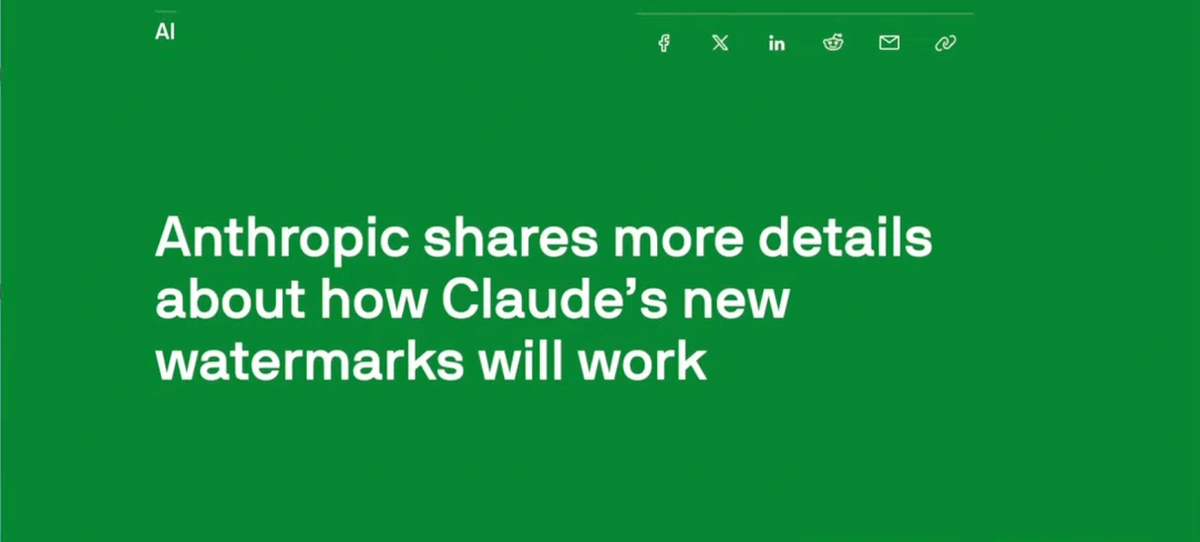
The reported reason is regulatory, not moral: Anthropic revealed it would watermark Claude's output to comply with the EU AI Act's Transparency Code, which requires AI companies to use systems that make it possible to identify AI-generated content.
Users did not take it calmly. The same report points to a Reddit poster calling the move a conspiracy against innocent Claude users, and to Business Insider reporting that "dozens" of users on X claimed to cancel their Claude subscriptions over it. People were using this output for their jobs, their websites, their school work — and suddenly it comes with a signature attached.
How the watermark works, according to Anthropic
This is the part most people are getting wrong, so here is what the reporting actually describes — each point is on screen in the video:
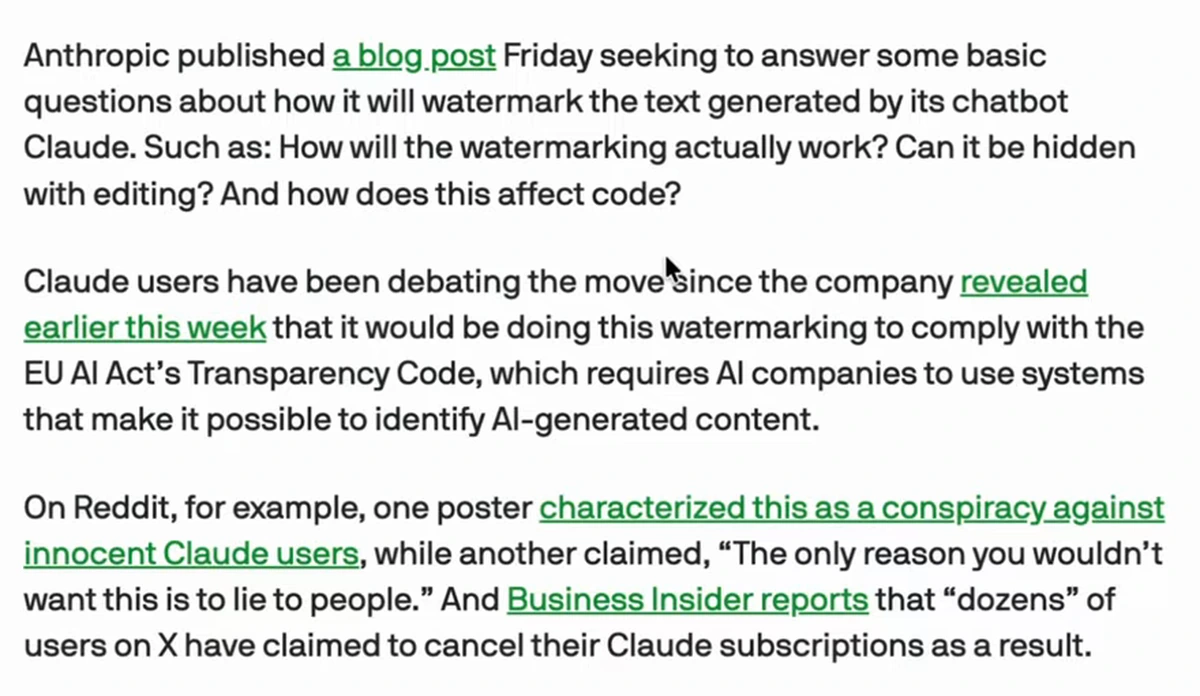
- It hides in "low-stakes choices." When Claude picks between near-equivalent words — "overcast" versus "grey" for the weather — it can follow a pattern that is "undetectable to the reader, but is detectable to anyone who has a key that encodes it."
- It's built on SynthID Text, the approach the Google DeepMind team outlined back in 2024. This is not some experimental in-house trick; it's the industry's reference method.
- A watermark detection API is planned. That is the detail I'd stare at if I ran an SEO operation. A key that only Anthropic holds is one thing; a public detection endpoint is another.
- It is not "AI detection." Detectors like Pangram guess from writing tells — the "this isn't X, it's Y" construction. Anthropic explicitly says checking for a watermark is fundamentally different from picking up on patterns. No false-positive vibes; either the signature is present or it isn't.
- Editing barely helps. Anthropic's own answer: "light editing probably won't remove the watermark completely," while "a complete rewrite where every word is replaced will." If you rewrite every word, you were never really using AI for speed anyway.
- Code carries less of it. Working code leaves little room for arbitrary word choice, so the watermark mostly lives in things like comments and has, in Anthropic's words, a negligible effect on the code itself.
Claim versus demonstrated — keeping this honest
I get worked up about this on camera, so let me be precise here about which statements carry what weight:
| Statement | Status |
|---|---|
| Anthropic is watermarking Claude's text output | Announced by Anthropic, per the reporting shown in the video |
| The watermark survives light editing but not a full rewrite | Anthropic's own statement |
| Other model providers will follow | Reported: Anthropic says other major model developers signed the same Code of Practice and will implement their own watermarks |
| Quality of Claude's output will degrade | User speculation — Anthropic denies it ("indistinguishable from an unwatermarked one"); nothing demonstrated either way |
| Google will use watermarks to demote content | Not demonstrated by anyone. My prediction, not a fact |
That last row matters. Nobody has shown Google reading these watermarks today. What I'm arguing is about incentives: once a detection API exists, any crawler that wants provenance data can have it, cheaply and without false positives. Google has spent two decades punishing every scaled shortcut once it became reliably identifiable. I don't think this time is different — but you should know that's a forecast, not a screenshot.
What I'd do about it
To be clear, this isn't "never touch Claude again." I still use it daily for technical work — my Claude Code SEO guide is exactly that. The exposed workflow is one specific thing: generating article text in a consumer chatbot and pasting it onto your site, at scale, as your organic traffic strategy. With AI search already reshaping how pages get cited — the GEO statistics I've collected show how fast that shift is happening — publishing content that announces its own provenance to every crawler is a risk I wouldn't carry.
My answer, and the one I show in the video, is to move that production into a purpose-built pipeline instead. I use Arvow, which generates the article through its own multi-step SEO workflow rather than handing you chatbot output — so what lands on your site isn't text stamped by a consumer AI assistant, and it comes out structured for search instead of structured for a chat window. There are two ways to run it.
Method 1: standard SEO articles
The basic flow takes two inputs: an SEO keyword, and optionally a title. That's genuinely all you need to start — but the ranking power is in the configuration behind it:
- Knowledge base: upload PDFs, URLs and files about your business, so the article reflects what you actually do instead of generic filler. That context is what makes Google read it as non-commoditized content.
- Formatting and structure: tables, quotes, lists, key takeaways and a table of contents, toggled per campaign.
- Linking: feed it your sitemap and it places internal links automatically; external links can be automated too.
- Images and video: AI-generated images with alt text written for you, plus optional YouTube embeds. Auto-translation into multiple languages is one more toggle.
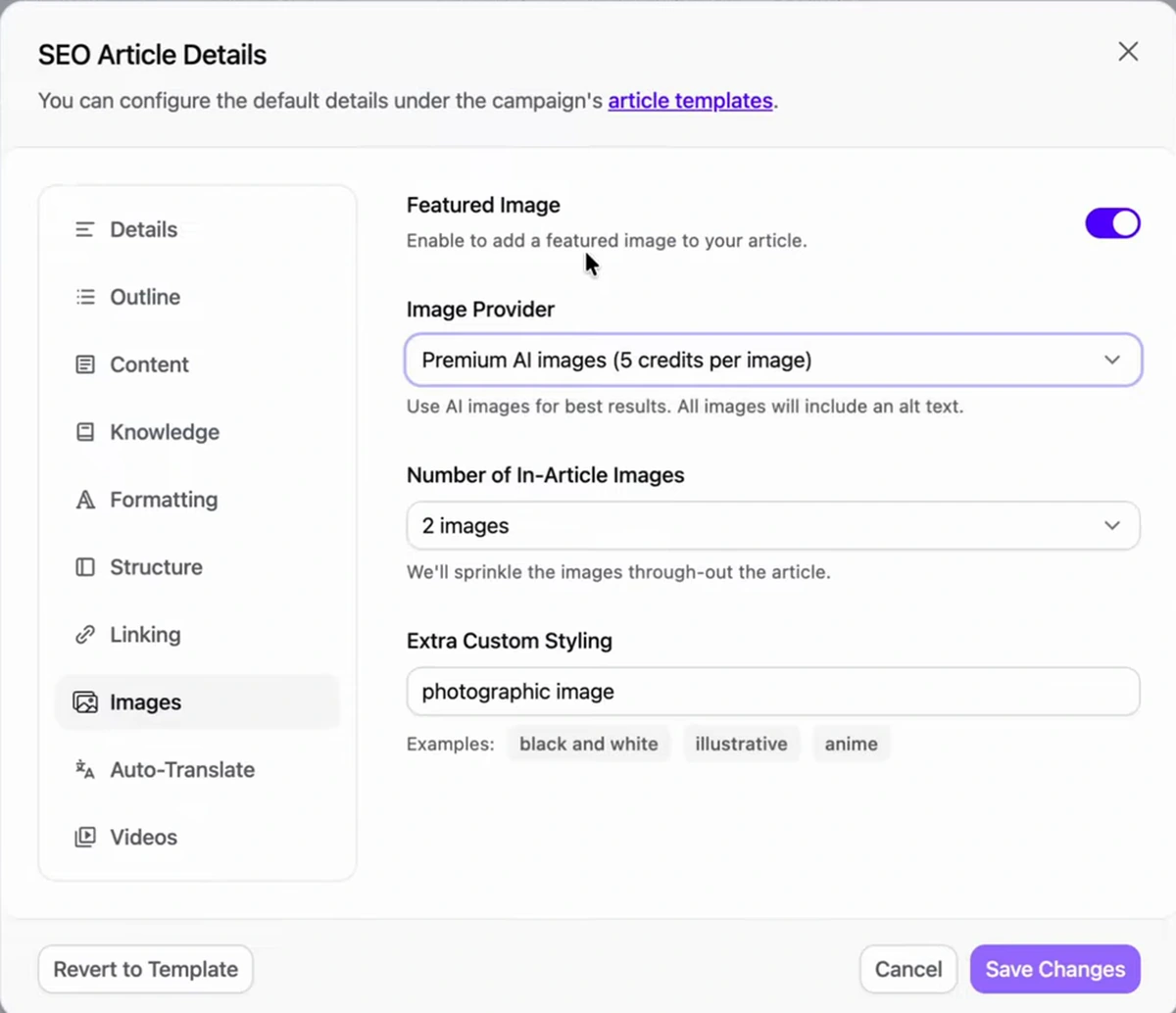
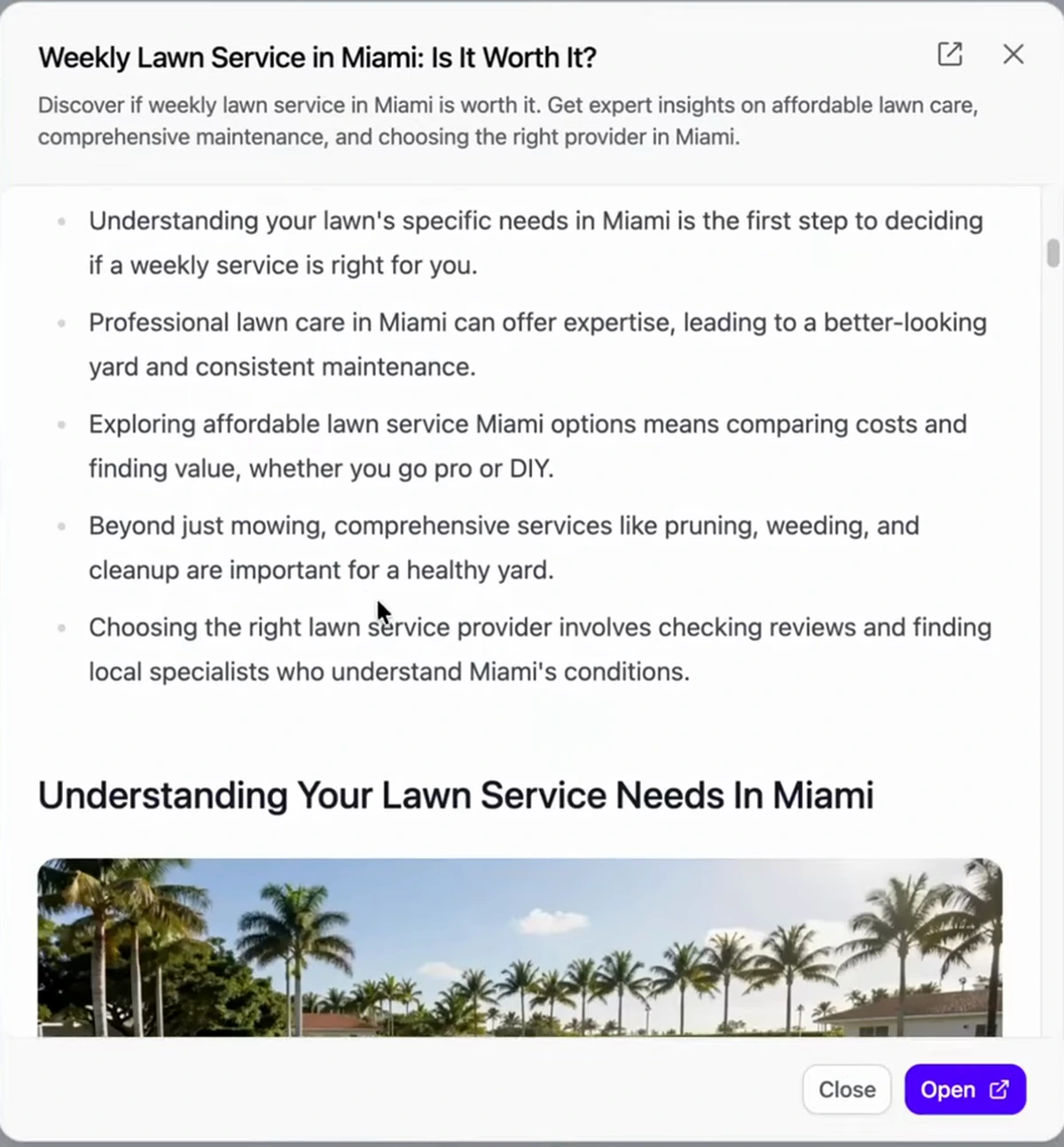
The demo article in the video — a weekly lawn service piece for Miami — comes out with key takeaways up top, clean H2/H3 structure, photographic images, internal links and meta data already handled.
Publishing is a direct integration rather than copy-paste: WordPress, Blogger, Ghost, Webflow, Shopify, GoHighLevel and other builders connect straight to the platform. If you want proof it translates into traffic, the case studies are public — I reference them in the video for a reason.
Method 2: custom article templates
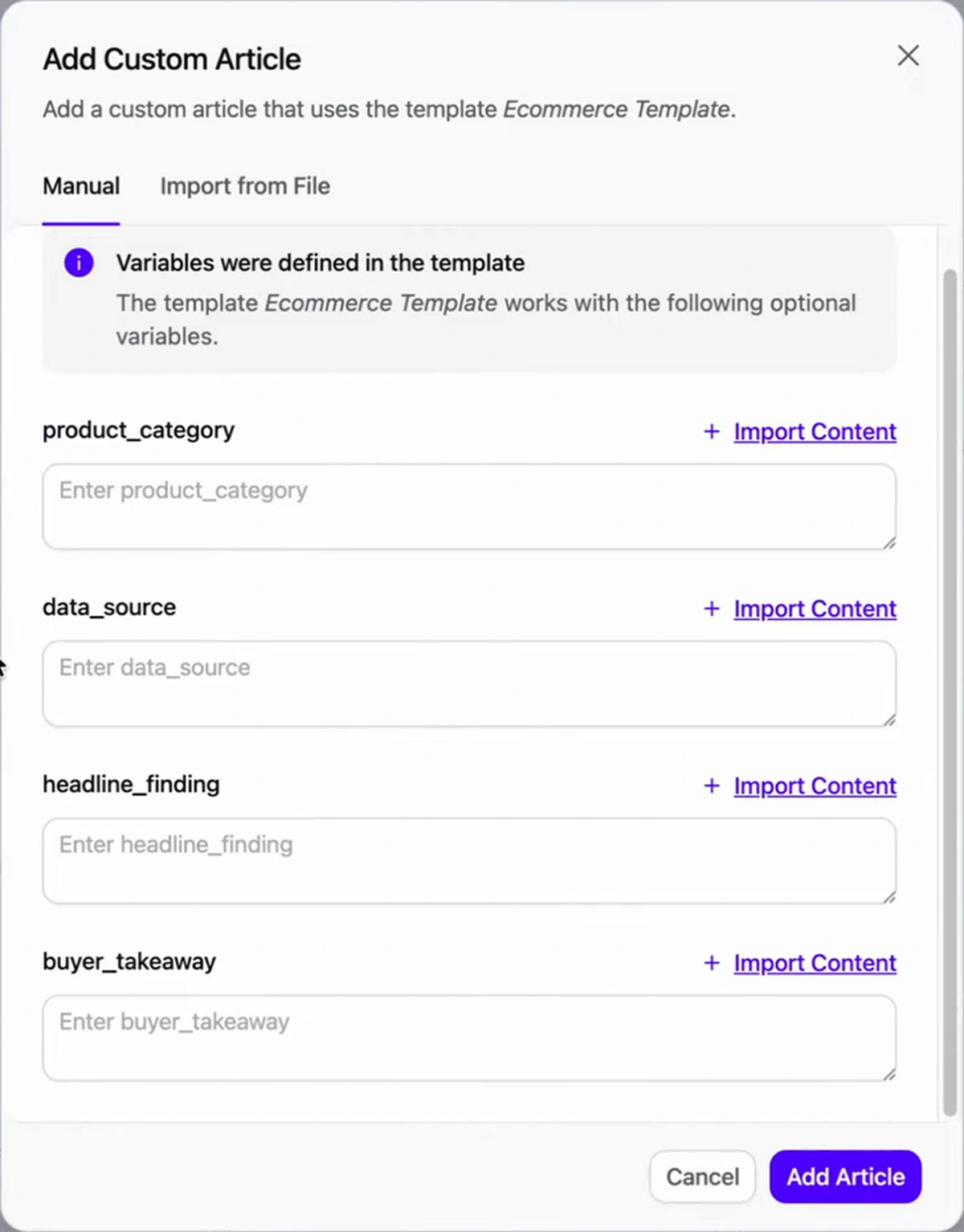
If keyword-plus-title feels too shallow for your niche, custom templates are the deeper level. You define a template from a prompt, then attach your own variables, structure outline, knowledge base, linking and images. Every article generated from it follows your blueprint.
The examples I show in the video are the ones I actually keep in my account:
- Plumbing (local service): variables for service, city and state — so one template stamps out service pages across every city you cover.
- Real estate: variables like first_hand_pattern, common_mistake and insider_advice, which force genuinely first-hand material into every draft.
- E-commerce: product_category, data_source, headline_finding and buyer_takeaway for data-backed category content.
The sample output I open on camera is a sink-leak-repair article for Buffalo, New York, built from the plumbing template: phone-number call to action, pricing table, service-area section, images. That's a page shaped like something a local business would actually publish — not a chat answer wearing a blog post costume.
FAQ
Is Claude really watermarking its output?
Per the reporting shown in the video: yes — Anthropic published a blog post describing text watermarking for Claude, rolled out to comply with the EU AI Act's Transparency Code. The watermark is an invisible statistical pattern in word choices, not a visible label.
Can Google detect Claude-generated content now?
Anthropic plans to release a watermark detection API, which would let any system check text for the signature. Nobody has demonstrated Google actually using it in ranking yet — treat that as an open risk rather than a confirmed penalty, but the technical capability is being handed out.
Does editing the text remove the watermark?
Mostly no. Anthropic's stated position is that light editing probably won't remove the watermark completely; only a complete rewrite where every word is replaced will. At that point you've spent more effort than writing from scratch.
Will ChatGPT and Gemini watermark their text too?
According to the same report, Anthropic said Claude won't be the only watermarked chatbot — other major model developers have signed the same Code of Practice and will be implementing their own watermarks. I'd plan on this becoming the default across providers.
Does the watermark make Claude's output worse?
Anthropic says no — a watermarked response is supposed to be indistinguishable from an unwatermarked one to a reader. Some users are skeptical since the watermark constrains word choices. Neither side has demonstrated anything publicly, so I file this under "watch."
Should I stop using AI for content entirely?
No. The risk sits specifically with raw chatbot output pasted at scale. AI content produced through a proper SEO pipeline — with your business knowledge, structure, internal links and clean technical SEO — is a different product, and it's how search and answer engines get fed content worth citing.
Want AI content without the chatbot-watermark problem? Arvow's AI SEO agent researches, writes, interlinks and publishes articles built for rankings — knowledge base in, structured article out, straight to your CMS. Generate your first articles free and compare them with what your chatbot gives you.
The cheap era of copy-paste AI content was always going to end; the only question was whether it would end with an algorithm update or a signature baked into the text. Looks like it's the signature. Adapt your pipeline before the crawlers adapt for you.
Generate, publish, syndicate and update articles automatically
The AI SEO Writer that Auto-Publishes to your Blog
- Cancel anytime
- Articles in 30 secs
- Plagiarism Free