A Texas plumbing company pulls around 93,000 organic visits a month from Google, almost all of it through 100 programmatic pages that each target one service in one city. Nothing about it is clever. The pages are plain, the domain rating is only 40, and anyone can copy the pattern. This teardown shows exactly how it works, then rebuilds it with a Claude prompt and Arvow. The company is not named.
The competitor teardown: 100 location and service pages, reverse engineered in minutes.
One pattern, one hundred times
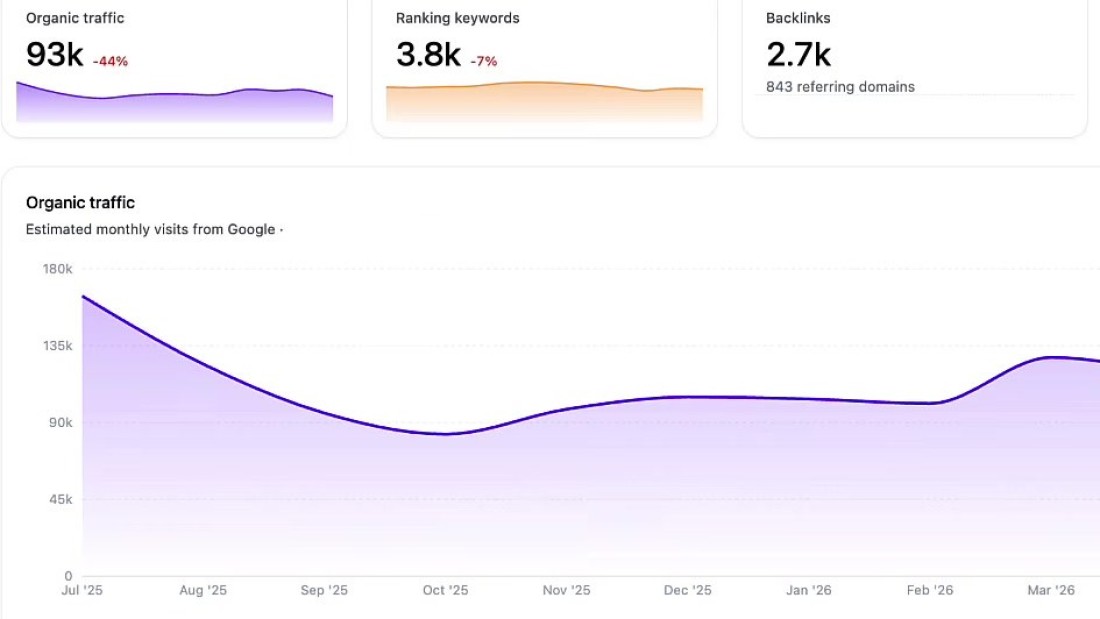
The teardown starts in Arvow's Site Explorer with the competitor pasted in. Around 93,000 monthly visits, 3,800 ranking keywords, 2,700 backlinks from 843 referring domains, and a domain rating of 40. Nothing exotic in any of it.
Open the top pages and the whole engine is visible. One page per service per city. The /air-conditioning/ page pulls 13,000 visits a month, /plumbing/ pulls 9,000, then a long tail of /garland-air-conditioning/, /frisco-plumbing/, /plano-plumbing/ and /mckinney-plumbing/. The URL is always the location plus the service. The pages themselves are plain, a hero on top and a wall of text below the fold that no human reads, written purely so Google understands the page.


Domain rating is not the excuse
The obvious objection is authority, and it does not hold here. The domain rating is 40, which is not high, and every domain starts at zero. Backlinks lift it over time, and 843 referring domains is what got this site to 40.
The real barrier is that most people never build the pages, or they build them the lazy way. One template, a single word swapped, air conditioning to plumbing, the other 99% identical. Google stopped rewarding that years ago. The pages have to be genuinely different, which is exactly the part that used to make this too much work.
Rebuild it in three steps
The teardown is only useful if you can copy it, and the whole thing rebuilds in an afternoon.
Research the target
A Claude prompt fetches the homepage and key pages, then extracts the business, its services, the cities it serves, its trust signals and its voice. All from a single URL.
Extract the variables
The same prompt turns that research into two lists, a service variable and a location variable. Plumbing, air conditioning, drain cleaning, crossed with every city the business covers.
Generate unique pages
Arvow builds one page per combination from a custom template, each written fresh for that service and city, not a find and replace. The autoblog then publishes them on a schedule.

Location plus service, repeated for every city the business serves. That single structure carries almost all of the 93,000 monthly visits. The work is not the idea, it is producing a hundred pages that are actually distinct, which is the part AI now does in minutes.
The strategy is simple. It is just not easy, and that gap is exactly where the opportunity is.
What the teardown shows
- ~93,000 monthly visits from roughly 100 pages, one trade in one Texas metro
- Every top page is location plus service, like /frisco-plumbing/ and /plano-air-conditioning/
- 3,800 keywords ranked on a domain rating of just 40
- The pages are plain, most traffic lands above the fold and never scrolls
- The catch is uniqueness, one template with one word swapped no longer ranks
Want to reverse engineer a competitor like this? Do it with Arvow.
Common questions
Does programmatic SEO still work in 2026?
Yes, when the pages are genuinely unique. This Texas plumber ranks around 100 location and service pages for roughly 93,000 monthly visits. What stopped working is the old way, one template with a single keyword swapped and the rest identical. Google now rewards pages that actually differ from each other.
Do I need a high domain rating for this?
No. The site in this teardown has a domain rating of 40, which is not high, and every domain starts at zero. Backlinks raise it over time. Low authority is a reason to start building links, not a reason to skip the pages.
What is a location plus service page?
It is one page targeting one service in one city, like plumbing in Frisco or air conditioning in Plano, with the city and the service both in the URL. People search that way, service plus location, so a page that combines both matches the intent better than either on its own.
How does Arvow build the pages?
A Claude prompt researches the business from its URL and extracts service and location variables. Arvow then generates one unique page per combination from a custom template, and the autoblog publishes them to WordPress, Shopify, Webflow or your CMS on a schedule.