
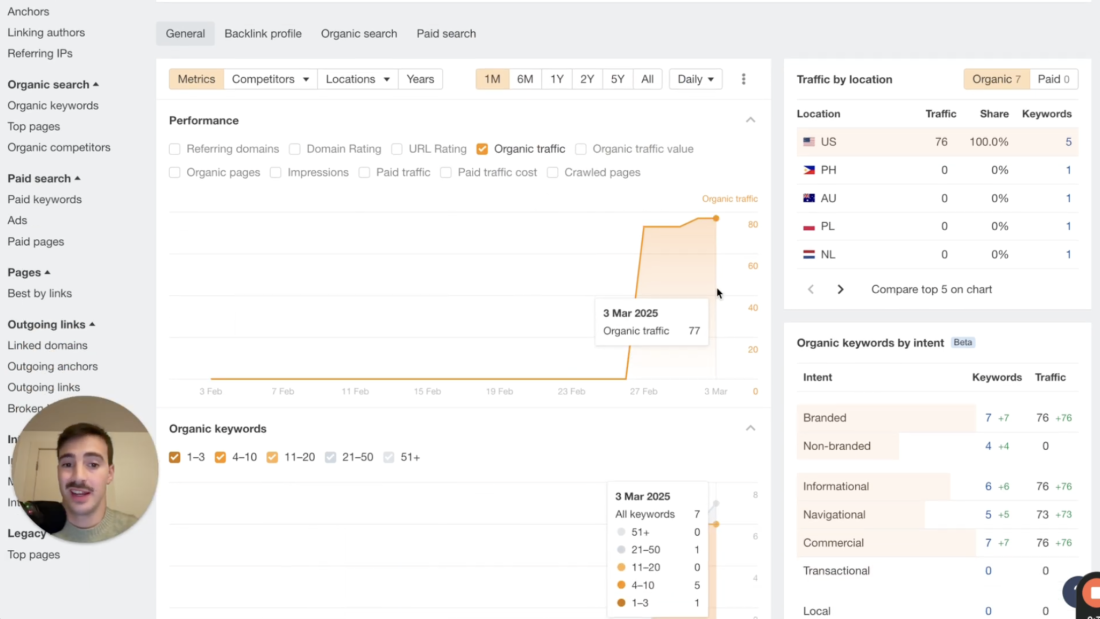
We published one AI-written post targeting a competitor's name and its alternatives. Within hours it ranked and pulled about 80 organic visits. Small number, big point: every one of those visitors is a competitor's unhappy customer, ready to switch.
Watch how the page was written and why it ranks.
The strategy: target the competitor
Instead of chasing a high-volume keyword full of tire-kickers, we targeted “[Competitor] alternatives.” It gets only ~30 searches a month, but the intent is pure gold: those searchers already know the competitor, are dissatisfied, and are actively looking to switch.
Within a few hours of publishing, it was ranking and pulling visits:

What made the page work
- A clear comparison between our product and the competitor.
- Screenshots and contextual images for trust.
- Internal links to supporting pages, and multiple CTAs throughout.
- Human-edited AI content for clarity and tone.
- Keyword modifiers: [Competitor] alternative for agencies, [Competitor] cheaper alternative, [Competitor] vs [our product].
These 80 are not vanity traffic. They are people trying to leave a competitor, landing on a page built to convert them into a trial or sale.
Traffic can be a vanity metric. Eighty visitors ready to switch off your competitor are worth more than eight thousand who will never buy.
What you can take from it
- Ranked in under 24 hours for a bottom-of-funnel, money-driven keyword.
- Target intent, not volume, competitor and “alternatives” searches are tiny but they convert.
- Structure the page to sell: comparison, proof, CTAs, and a light human edit for tone.
Common questions
Isn't 80 visitors too small to matter?
Not when they are this qualified. Someone searching “[competitor] alternatives” is mid-purchase and unhappy with what they have. A handful of those converts better than thousands of casual visitors.
How do you rank in 24 hours?
Low-competition, high-intent keywords with little existing quality content rank fast, especially with a well-structured, genuinely useful page and quick indexing.
What keywords should you target?
Your competitors' brand names plus modifiers like “alternatives,” “vs,” and “cheaper alternative.” Low volume, but the highest commercial intent you can find.
Rank for the searches your competitor's unhappy customers make, then convert them. See how Arvow works.