✨ Hello 2026: 40% Off on Yearly Plans
hrs
min
sec
Back to Case Studies

Construction Company Automated Their Entire SEO Workflow in Under 8 Months

Construction Company Automated Their Entire SEO Workflow in Under 8 Months

A local construction company in Portugal — specializing in remodeling old houses and reselling them — went from minimal online presence to consistent organic traffic growth in less than 8 months. They did it by combining Arvow's custom templates with a fully automated publishing pipeline, all tailored specifically for local SEO. Here's the exact strategy they used and how any local business can replicate it.


The Challenge

Portugal isn't the most competitive SEO market in the world, but it's far from easy. Established players in the construction and real estate space already dominate the top positions for high-value keywords. For a local remodeling company without a dedicated marketing team, competing against these bigger brands through manual content production wasn't realistic.

They needed a system that could consistently produce locally relevant, SEO-optimized content — in Portuguese — without requiring them to become SEO experts or hire a content team.


The Strategy

The company used Arvow as their end-to-end SEO automation platform, but what made this case study different from a standard autoblog setup was the use of custom templates — a feature that allowed them to produce highly tailored local content at scale.

Building a custom template with AI assistance. Rather than using Arvow's default SEO article template, the team created a custom template specifically designed for local business content — essentially a programmatic SEO approach for local search.

Here's how they built it: they fed Arvow's custom template documentation into an AI assistant (Claude or ChatGPT both work), along with an example of a well-performing template. Then they prompted the AI to generate a new template optimized for local business content, following current SEO best practices. The output included two things: a generation prompt (the instructions the AI follows when writing) and a markdown outline (the structure every article follows).

The template used four variables as inputs: business type, city, region, and year. This meant the same template could generate unique, locally optimized articles for any combination — "Best Plumber in Dallas, Texas — 2026 Guide" or "Top Construction Company in Lisbon, Portugal — 2026 Guide" — all from one reusable framework.

Connecting to WordPress. The company runs their site on WordPress, so they installed the Arvow plugin directly from the WordPress plugin directory. The setup took seconds: install, activate, click connect. From there, they configured the post status (published), assigned an author, set categories to auto-assign, and confirmed Elementor compatibility so the articles would match their existing blog layout.

Launching the automated campaign. With the template built and the CMS connected, they created a campaign inside Arvow and linked it to their WordPress integration. From there, they had two options: generate articles manually one at a time, or enable the autoblog to publish a set number of articles per day on full autopilot. They used both — manual generation when they wanted to review specific pieces, and automation for ongoing volume.

Optimizing for local SEO signals. A few extra steps made the content work harder for local search. They added their sitemap to the template configuration so Arvow could automatically insert internal links to relevant pages on their site — a critical ranking factor that most local businesses neglect. They also connected their knowledge base, uploading brand assets, documents, and business-specific context so the AI could write content that actually sounded like their company, not generic filler.


The Results

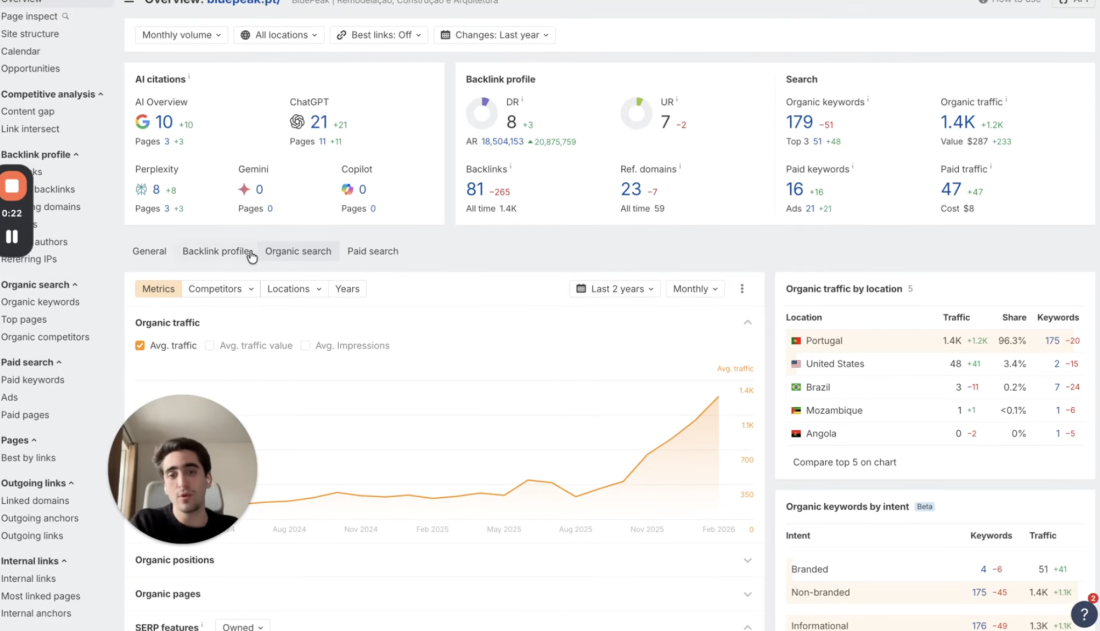
Organic traffic: Consistent growth since August 2025, with the site now pulling meaningful search traffic in the Portuguese market.

Content quality: Every article followed a custom-built structure tailored to local search intent — headings, paragraphs, and sections all defined by the team rather than relying on a generic format.

Time to results: Less than 8 months from setup to visible, compounding organic growth.

Automation level: The entire workflow — keyword targeting, content generation, publishing, and indexing — runs without manual intervention. Indexing requests are submitted automatically after each article is published, so there's no need to manually ping Google through Search Console.


The Custom Template Advantage

Most businesses using AI content tools stick with the default settings. That works — Arvow's default template is already optimized for ranking. But the construction company's approach shows what happens when you go a step further.

Custom templates let you control every aspect of the article output: the generation prompt that guides the AI's writing style, the exact outline structure (which headings, where images go, where tables appear), the variables that make each article unique, and the tone and formatting that match your brand.

For local businesses, this is especially powerful. A default "best X in Y" article is fine, but a custom template that consistently includes local context, neighborhood references, service-area specifics, and structured calls to action will outperform generic content every time.

And if building a template from scratch sounds intimidating — it's not. The team used AI to build their AI template. They fed the documentation and an example into Claude, described what they wanted, and had a production-ready template in minutes. If you can write a prompt, you can build a custom template.


Key Takeaways

Custom templates unlock programmatic local SEO. By defining variables like business type, city, region, and year, you can produce dozens of locally targeted articles from a single template. This is how local businesses scale content without scaling costs.

Use AI to build your AI templates. You don't need to understand markdown or prompt engineering to create a custom template. Feed the Arvow documentation and an example into ChatGPT or Claude, tell it what you want, and let it generate both the prompt and the outline for you.

Internal linking matters more than most people think. Adding your sitemap to the template configuration ensures every article automatically links to relevant pages on your site. This builds topical authority and helps search engines understand the relationship between your content — something the SEO editor makes easy to fine-tune after generation.

Portugal — and every non-English market — is an opportunity. Just like the German and Vietnamese case studies on our case studies page, this one reinforces the same principle: local markets with lower competition and strong demand are where AI content delivers the fastest results. If you're operating in a non-English market, you're sitting on an advantage most businesses ignore.

The whole workflow takes minutes to set up. Install the WordPress plugin, connect your site, build a template with AI, launch a campaign. From there, the system handles everything — generation, publishing, indexing. You focus on running your business.


Try It Yourself

Whether you're a construction company in Portugal, a plumber in Dallas, or any local business anywhere in the world, the strategy is the same: build a custom template for your niche, connect your CMS, and let Arvow automate the content engine that drives organic traffic to your business.

Arvow AI SEO Writer
Generate, publish, syndicate and update articles automatically

The AI SEO Writer that Auto-Publishes to your Blog

  • Articles in 30 secs
  • No credit card
  • Join 25,260+ businesses