
How Much Money Can You Make With Rank and Rent SEO in 2026?


"How much can you make with rank and rent?" is the question every video about the model promises to answer, and almost none of them do. What they answer instead is a different question: what does the arithmetic produce if you accept a particular set of assumptions?
That is not a criticism. The arithmetic is genuinely the useful part — it is what you take into a negotiation with a business owner, and it is what tells you whether a niche is worth three months of your life before you buy the domain. But a model is not a forecast, and the difference matters when the number on the thumbnail is six figures.
So here is the whole calculation from an August 2026 walkthrough, worked end to end, with every input shown on screen and every assumption named. Where the evidence contradicts the assumption — and in one important place it does — I have said so.
If you want the build side of this — exact match domains, call forwarding, Google Business Profile setup, backlinks — that is covered separately in the nine rank and rent tips. This piece is only about the money.
The whole model on one whiteboard
Five steps, and the entire thing fits in a single frame:
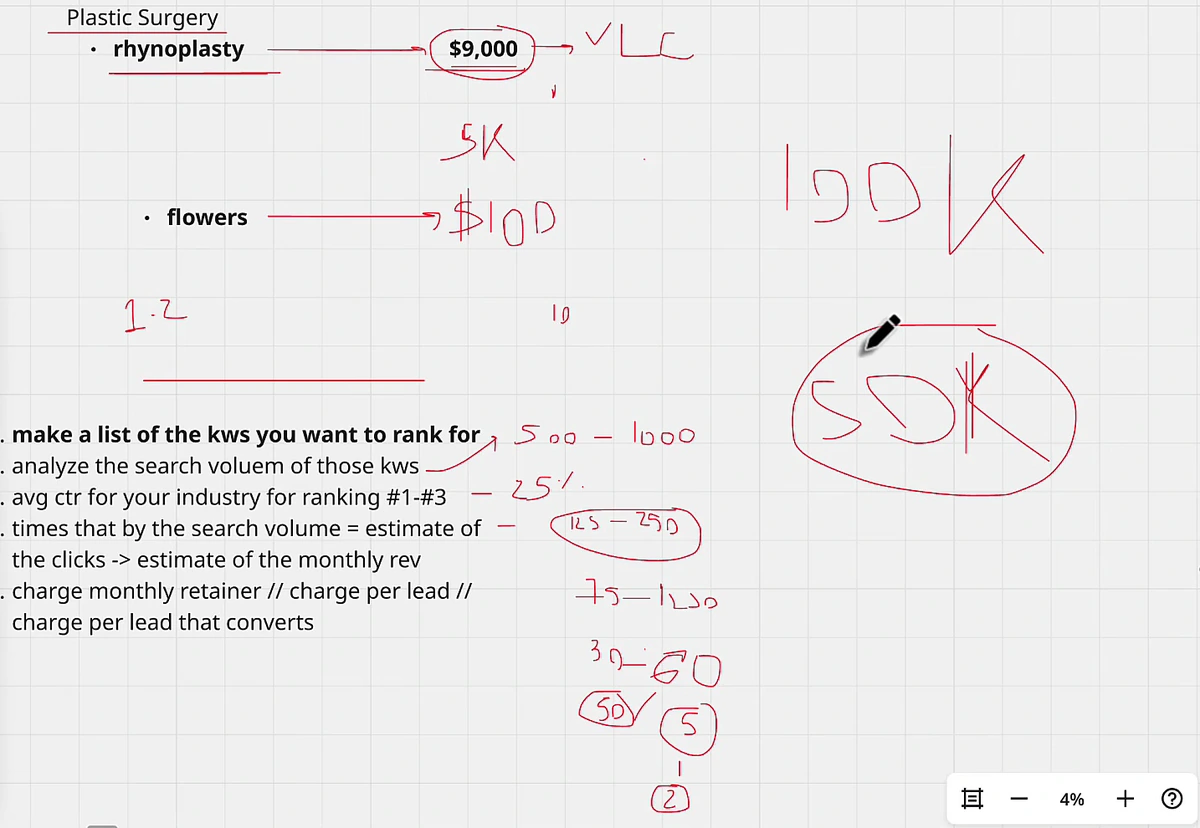
Read the steps as a chain, because each one multiplies the last:
- List the keywords you want to rank for.
- Pull the search volume for those keywords.
- Find the average click-through rate for your industry at positions #1–#3.
- Multiply CTR by volume to get monthly clicks, then walk the clicks down to leads.
- Pick a pricing model: monthly retainer, per lead, or per lead that converts.
Every step below is one link in that chain. The thing to watch is how much of the final number is measured and how much is assumed — because by step four, most of it is assumed.
Step 1: the ticket is the only input you cannot fix later
The model opens with a comparison, not a calculation. Rhinoplasty against flowers.
For the ticket value, the walkthrough just searches the price. Google's AI Overview returns the range:
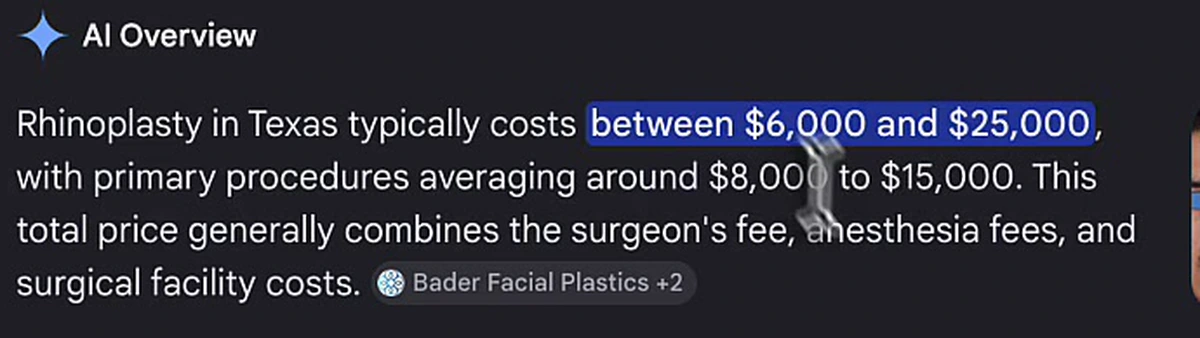
From that range he takes $9,000 — deliberately below the $8,000–$15,000 average band, to keep the model conservative. Then the part that actually matters: what will the clinic pay for a lead that converts at $9,000? His answer is around $5,000, reasoning that a surgeon keeping a ~40% margin can hand over the rest and still be well ahead.
Now run the same logic on the flower shop. A $100 bouquet, a 50% margin, and the most a florist can rationally pay for a converting lead is $50.
Same ranking effort. Same content. Same backlinks. One lead is worth $5,000 and the other is worth $50 — a hundred to one, decided entirely by the niche you picked before you wrote a single page. This is why "choose a high-ticket niche" is not generic advice in rank and rent; it is the one variable that no amount of SEO skill can compensate for afterwards.
Note that $5,000 is a reasoned estimate of what a clinic could pay, not a quoted market rate. It is the opening position in a negotiation, and it is where the model starts drifting from measurement toward argument.
Step 2: local search volume is tiny, and that is not the problem you think
Here is where most people quit. You niche down to "rhinoplasty Plano", you check the volume, and the tool tells you almost nothing is there.
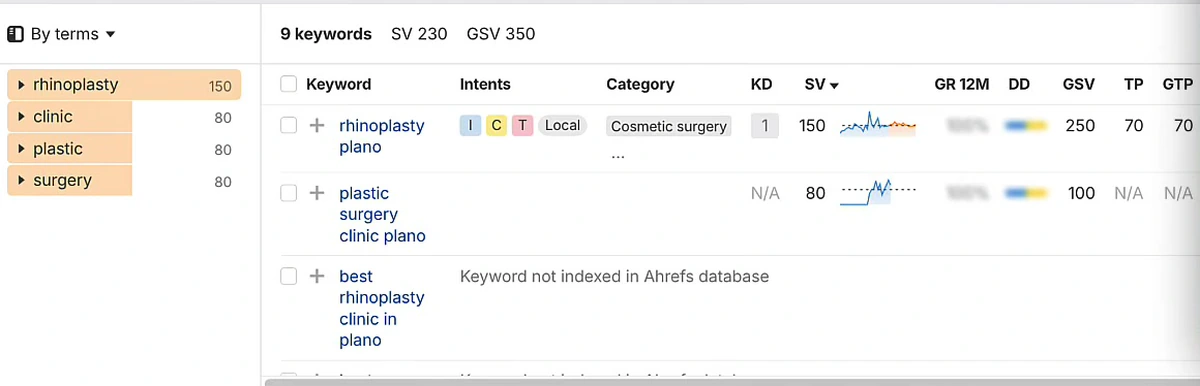
Two readings of that screenshot, and they pull in opposite directions.
The optimistic one, which the video makes: an unindexed keyword is not a zero-demand keyword. It means the tool lacks the data, which for a five-word city-level buying query is normal. Someone typing "best rhinoplasty clinic in plano" has picked the procedure, picked the city, and is comparing providers. That is the bottom of the funnel. One of those a month can be worth more than a thousand visitors on an informational term, and no keyword tool will ever tell you it exists.
The realistic one, which is worth saying out loud: you cannot build a revenue forecast on searches that no tool can measure. The KD 1 is the genuinely reliable signal in that frame — these terms are close to unguarded, which is the actual case for hyper-local targeting. The volume upside is a reasonable bet, not a number you can multiply.
The model then rounds up from the measured 230 to 500–1,000 monthly searches, on the assumption of a fuller keyword set than the nine on screen. That is a defensible planning figure, but it is roughly two to four times the volume actually evidenced, and everything downstream inherits the gap. If you run this yourself, run it on your measured number first and treat the rounded one as the optimistic case.
Step 3: the CTR assumption, where the model is weakest
Step three needs a click-through rate for positions #1–#3. The walkthrough asks Google, and the answer that comes back is more interesting than the one that gets used:
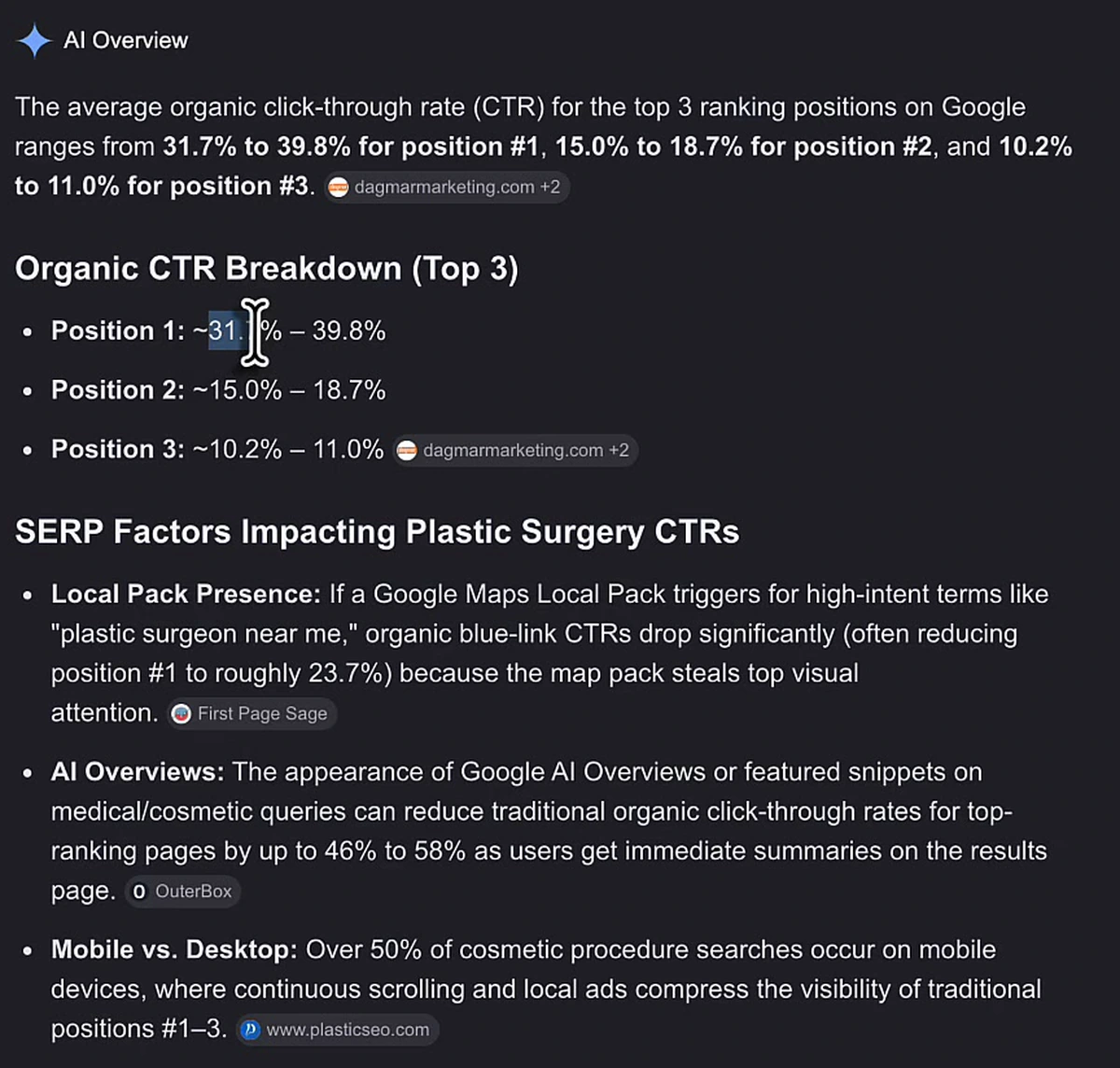
The headline numbers are 31.7%–39.8% for position #1, 15.0%–18.7% for #2 and 10.2%–11.0% for #3. The model takes 25%, presenting it as conservative because it sits below the position-one band.
But look at what the same screenshot says directly underneath, for this exact industry:
- Local pack presence: when a Maps pack triggers on a high-intent term like "plastic surgeon near me", organic CTR at position #1 drops to roughly 23.7%.
- AI Overviews: on medical and cosmetic queries, an AI Overview or featured snippet can cut organic CTR for top-ranking pages by 46% to 58%.
- Mobile: over 50% of cosmetic procedure searches happen on mobile, where scrolling and local ads compress positions #1–#3 further.
Every keyword in this model is a high-intent local query for a medical procedure. That is precisely the SERP where a Maps pack triggers and an AI Overview appears. So 25% is not a conservative estimate of the blended CTR for these terms — on the evidence in the same screenshot, it is closer to a ceiling. A local pack alone pulls position one to about 23.7% before an AI Overview takes its share.
This is not a reason to abandon the model. It is a reason to run it twice. Use 25% for the optimistic case and something nearer 10–15% for the case where the SERP looks like the SERP these keywords actually have. The gap between those two runs is roughly the honesty margin on the final number.
It also reframes what you are building. If the Maps pack is eating the clicks, the pack is the asset — which is why the build guide puts so much weight on ranking the Google Business Profile rather than the website alone.
Step 4: from 1,000 searches to two clients
With volume and CTR chosen, the funnel is arithmetic. Reading the right-hand column of the whiteboard:
| Stage | Number | Where it comes from |
|---|---|---|
| Monthly searches across the keyword set | 500–1,000 | Rounded up from 230 measured |
| × CTR at positions #1–#3 | 25% | Assumed; see step 3 |
| Monthly clicks to the site | 125–250 | Calculated |
| Stay past the first screen | 75–120 | Assumed ~50% bounce |
| Actually browse the site | 30–60 | Assumed ~50% again |
| Working figure | ~50 | Midpoint |
| Call or fill the form | 5 | Assumed ~10% |
| Convert to a paying patient | 2 | Assumed ~40% of leads |
Two clients a month. It sounds like failure until you multiply it by the ticket: at $9,000 a procedure, those two are $18,000 of revenue for the clinic, and at the $5,000-per-converting-lead figure from step one, $10,000 a month for you.
Ten thousand a month is $120,000 a year, which is how a model like this arrives at a six-figure headline. Worth being clear about what that number is: four of the eight rows in that table are assumptions rather than measurements, and they compound. Halve the CTR to match the SERP reality from step three and you are at one client a month, not two. Use the measured 230 searches instead of the rounded 1,000 and you are well below that again.
None of which makes the model useless — it makes it a range. The honest output is "somewhere between one client a quarter and two a month, depending on how the SERP treats me", and the value of doing the arithmetic is that you find out which niches cannot clear the bar even in the optimistic case. A florist at $50 a lead needs 200 converting leads a month to reach the same place. That is the decision the model is actually for.
Step 5: retainer, per lead, or per lead that converts
Three ways to charge, and they are not equivalent. The ranking below is his, and the reasoning behind it is first-hand.
| Model | You get paid when | The catch |
|---|---|---|
| Monthly retainer | Every month, regardless | Simplest to run and to reconcile. Usually needs an existing relationship before the client will commit. |
| Per lead | A call or form comes through | You carry no risk on their sales ability. Requires call tracking you both trust. |
| Per lead that converts | They close the deal | Your income depends on someone else's sales process — and you have no control over it. |
That third row is the one he has actually been burned by. Driving calls to a business that was slow to pick up, unfriendly when it did, and did not follow up, he was paid on their conversion rate while having no ability to change it. The leads were fine. The closing was not. Getting paid per lead rather than per closed lead moves that risk back where it belongs.
The practical sequence, if you are starting cold: open on per-lead, prove the volume for a couple of months, then convert to a retainer once there is enough trust to justify it. Whichever you choose, all three need the same plumbing — a tracked number on the site forwarding to the client's phone, so that neither side is arguing from memory about how many calls came in. The setup for that is in the build guide, and if you are pricing this as a service rather than renting the asset, the SEO pricing breakdown covers the retainer side in more detail.
Lifetime value is the number you negotiate with
The $50K and $100K circled on the right of the whiteboard are not monthly revenue. They are lifetime value, and they exist in the model for one reason: leverage in the pricing conversation.
The argument runs like this. High-ticket local services are high-friction and high-trust. Someone who has a rhinoplasty go well does not shop around for the next procedure — the walkthrough describes exactly this pattern from working in the niche: Botox, then a breast augmentation, then something else, all with the same surgeon. The same holds for lawyers: the person you called after one accident is the person you call after the next.
So when a clinic values your lead at one $9,000 procedure, that is the wrong denominator. If their LTV per patient is $50,000 — the deliberately conservative end of the range he uses, against $100,000 or more at the top — then the lead you just handed over is worth several times the first transaction. That is the case you make, and it is why the question "what is your lifetime value per client?" is worth asking in the first sales call rather than the third.
Two caveats worth keeping straight. LTV is the client's number, not yours: you are pricing against a figure they report and you cannot verify. And a longer payback for them does not mean a bigger cheque for you unless they can actually feel the difference — a business with no retention tracking will not price a lead on lifetime value no matter how good the argument is.
Running the numbers on a niche? The two inputs worth measuring rather than assuming are search volume and the SERP layout for your terms — whether a Maps pack and an AI Overview are sitting above the organic results. The free local SEO course covers how to read that before you commit to a domain.
Is the model still worth running in 2026?
The arithmetic has not changed. The SERP has.
What is durable here is the structure: ticket × volume × CTR × funnel, and the observation that niche selection dominates everything downstream. That logic works as well now as it did five years ago, and the KD 1 on a city-level procedure keyword says the hyper-local targeting still has room in it.
What has changed is step three. A rank-and-rent model built in 2019 could assume the organic result was the destination. In 2026, on exactly the high-intent local queries this strategy targets, a Maps pack and an AI Overview sit above it and take a documented share of the clicks — 46% to 58% on medical and cosmetic queries, by the figure in the video's own screenshot. That does not kill the model. It moves the asset: the Google Business Profile is doing more of the work than the website, and the site increasingly earns its keep by supporting the profile's rankings rather than by catching the clicks itself.
Which means the honest 2026 version of "how much can you make with rank and rent" is: run the arithmetic twice, once optimistic and once with the SERP reality priced in, and only buy the domain if the pessimistic run still clears your hourly rate. Content and backlinks can be automated down to near-zero marginal cost now, which lowers the bar considerably — but it lowers it for everyone else too.
FAQ
How much can you realistically make from one rank and rent site?
The model in this walkthrough outputs roughly $10,000 a month from a single high-ticket local site — two converting leads at about $5,000 each. That is the optimistic run. With the CTR corrected for a Maps pack and an AI Overview on the same SERP, one converting lead a month is the more defensible planning figure, and the honest answer is a range rather than a number.
What search volume do you need for rank and rent to work?
Far less than people assume, because the ticket does the heavy lifting. The keyword set in this example measures 230 searches a month across nine terms. At a $5,000 lead value, two conversions clear $10,000 — a volume that would be worthless in a $50-per-lead niche.
Should I charge a retainer or per lead?
Per lead to start, retainer once trust exists. Avoid per lead that converts: it ties your income to the client's sales process while giving you no control over it, which is the specific mistake described in the video.
Do zero-volume keywords matter in rank and rent?
They can, and "not indexed in the database" is not the same as "nobody searches this". A five-word city-level buying query has intent that volume figures miss. Just do not build the forecast on them — treat them as upside on top of the measured number, not as part of it.
Is the niche or the SEO more important?
The niche, and it is not close. A hundred-to-one gap in lead value between plastic surgery and flowers is decided before any SEO happens, and no amount of ranking skill closes it afterwards. Pick the ticket first.

Generate, publish, syndicate and update articles automatically
The AI SEO Writer that Auto-Publishes to your Blog
- Cancel anytime
- Articles in 30 secs
- Plagiarism Free