
Google /goto Redirect: What It Means for Rank Tracking and SEO Tools (2026)

If your rank tracker started showing "google.com" as the ranking URL this summer, or a keyword's position suddenly went blank, the cause is probably Google's /goto redirect. Search result links that used to point straight at the website now route through a google.com/goto address with an encoded destination. People clicking results barely notice. Tools that read Google's results pages do.
In the video below, recorded at the start of September 2026, the presenter walks through a five-card board on what changed, why it matters and what to do. We've kept his structure, checked each claim against what the tool vendors have said publicly since, and marked what's confirmed, what's his reading, and what's still open.
What is the Google /goto redirect?
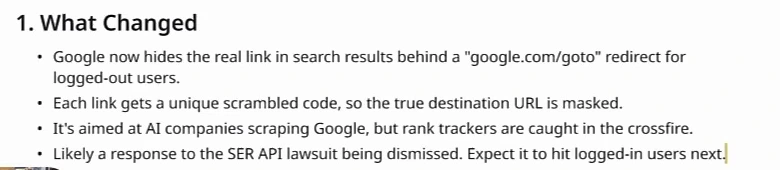
The mechanics are simple. Instead of a result link that says https://example.com/page, the page now contains a link to google.com/goto?url=… followed by a scrambled code. Click it and Google's server sends you on to the real page. The destination isn't readable in the HTML any more, so anything that scrapes the results page sees Google's address instead of the site's.
SEOs first noticed it in late July 2026. Rank-tracking vendors reported a near-complete rollout on logged-out searches from US residential IPs by late August. Independent tests at the time only saw it in logged-out (incognito) sessions, which matches the card's "for logged-out users". Whether it spreads to signed-in searches, as the card predicts, hadn't been confirmed when we checked at the end of September 2026.
Why Google did it: confirmed vs. speculation
Google hasn't published a reason. The video's reading is that it's aimed at AI companies scraping Google for answers, and that it follows a court dismissing Google's first complaint against SerpApi, a company that sells scraped Google results. That fits the timing (the complaint was dismissed in July 2026 and Google refiled in August), and the redirect does make bulk scraping much more expensive. But it's an inference, not a statement from Google, so treat it that way when you explain it to clients.
Why the /goto redirect matters for SEO tools
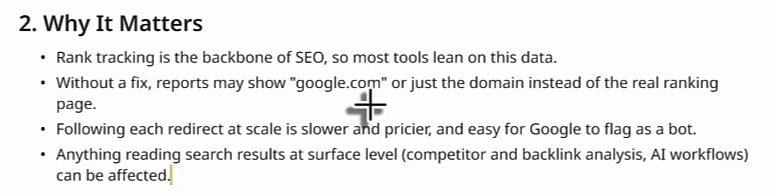
Most rank trackers work by loading Google's results for your keyword and reading which URL sits at each position. With /goto links there are only two options:
- Read the link as-is, and the "ranking page" becomes google.com or a bare domain. That's the broken report the card warns about.
- Follow every redirect to find the real page. That means an extra request per result. Vendors have described needing 500 to 1,000 requests to resolve a five-page check of one keyword, with lightweight HEAD requests refused. It's slower, costs more, and looks more like a bot to Google.
The same applies to anything else that reads search results directly: competitor research, SERP feature tracking, backlink prospecting from search results, and AI agents that search Google and then read the pages. If you run any homemade scripts that parse result URLs, check them.
What actually broke, and what didn't
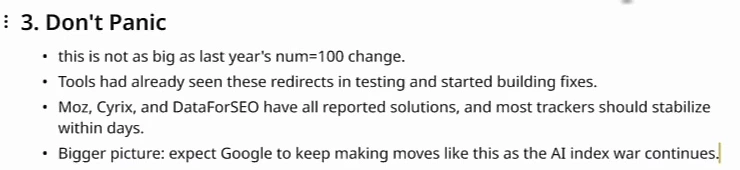
The video's advice is not to panic, and the vendor statements since bear that out, with some differences between tools. As of September 2026:
| Tool or data source | Reported status |
|---|---|
| Semrush | Said its position tracking was unaffected; it adapted before the full rollout |
| SE Ranking | Said it was unaffected |
| Ahrefs | Acknowledged a temporary data inconsistency and said it was working on a fix |
| SerpApi | Confirmed impact on several of its Google APIs, with fixes in progress |
| Moz, DataForSEO | Listed on the video's board as having reported solutions |
| Google Search Console | Not affected. It counts clicks inside Google, not by reading the result links |
The card compares this to last year's num=100 change, when Google stopped returning 100 results per page and trackers had to make ten requests where they used to make one. That one changed impression counts in Search Console for many sites. The /goto change doesn't touch Search Console at all, which is why it's the more manageable of the two.
One open question to watch: if the redirect strips the referrer on some clicks, a share of Google traffic could appear as "direct" in analytics. That was flagged as a risk but not confirmed at scale in September. If your Google organic sessions dip while Search Console clicks hold steady, this is the first thing to check. Our guide to diagnosing a Google traffic drop walks through separating a reporting problem from a real one.
What to do about it
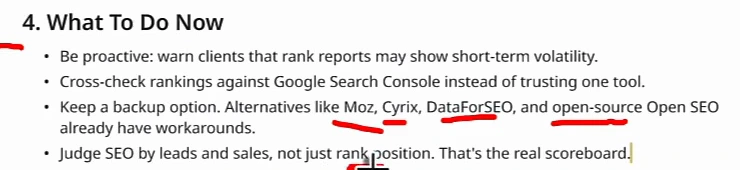
The four steps on the card hold up. Here's how we'd put them into practice:
- Tell clients before they ask. A short note saying "Google changed how it serves result links; some tools showed odd rankings for a few weeks; here's how we're verifying" saves a worried call when a report shows a keyword at "google.com".
- Use Search Console as the reference. Its average position and clicks per page come from Google's own data and aren't affected. If a tracker and Search Console disagree, trust Search Console and dig into the tracker.
- Have a second source. Check your tracker's status page or changelog for a /goto fix. If it hasn't shipped one, run your important keywords through a second tool. The video also points to OpenSEO, an open-source SEO platform you can wire into your own AI tools; that's a reasonable option if you're comfortable building, but not a requirement.
- Report outcomes, not just positions. Leads, calls and sales from organic traffic don't depend on how a scraper reads Google's HTML. Positions are a directional signal; revenue is the scoreboard.
If you're choosing or replacing a tracker, ask the vendor directly how they handle /goto links and whether their data for July and August 2026 needs a caveat. Our roundup of SEO rank tracking software is a starting point.
What it means for AI search tracking
The redirect also matters for the other kind of rank tracking: whether AI assistants mention you. There are reports of google.com/goto links showing up as the cited source in AI answers, which would hide the real site from tools that count citations by domain. That isn't confirmed at scale, but it's a good reason to track AI visibility by brand mention, not only by linked URL.
An AI rank tracker that records whether ChatGPT, Gemini or Perplexity name your brand for a set of prompts isn't affected by how Google formats its links. For a comparison of the options, see the best LLM rank tracker software.
The bottom line
The /goto redirect is a data-collection change, not a ranking change. Google ranks pages exactly as it did before; it just made it harder and more expensive to read the results from outside. For most site owners the practical impact was a few weeks of odd numbers in third-party tools. The lasting lesson is the one on the video's last card: changes like this will keep coming, so don't let any single tool be the only way you know how your SEO is doing.
FAQ
What is google.com/goto?
A redirect Google now uses for search result links. Instead of linking directly to a website, each result links to google.com/goto with an encoded destination, and Google's server forwards the click to the real page.
Does the /goto redirect affect my rankings?
No. It changes how links are delivered on the results page, not how pages are ranked. What it can affect is how third-party tools report your rankings.
Is Google Search Console affected by the /goto redirect?
No. Search Console records clicks inside Google's own systems, so its clicks, impressions and positions aren't affected. Use it to check anything a third-party tracker reports.
Why are my rank tracker results showing google.com?
Your tracker is reading the /goto link instead of following it to the destination. Check whether the vendor has released a fix; until then, verify important keywords in Search Console.
Why did Google add the /goto redirect?
Google hasn't said. The common reading, including in this video, is that it's meant to make large-scale scraping of Google results, including by AI companies, harder and more expensive.
Track the visibility that doesn't depend on Google's HTML. Monitor your brand across AI search with Arvow.

Generate, publish, syndicate and update articles automatically
The AI SEO Writer that Auto-Publishes to your Blog
- Cancel anytime
- Articles in 30 secs
- Plagiarism Free