
SEO Agency Statistics 2026: The Complete Data Report

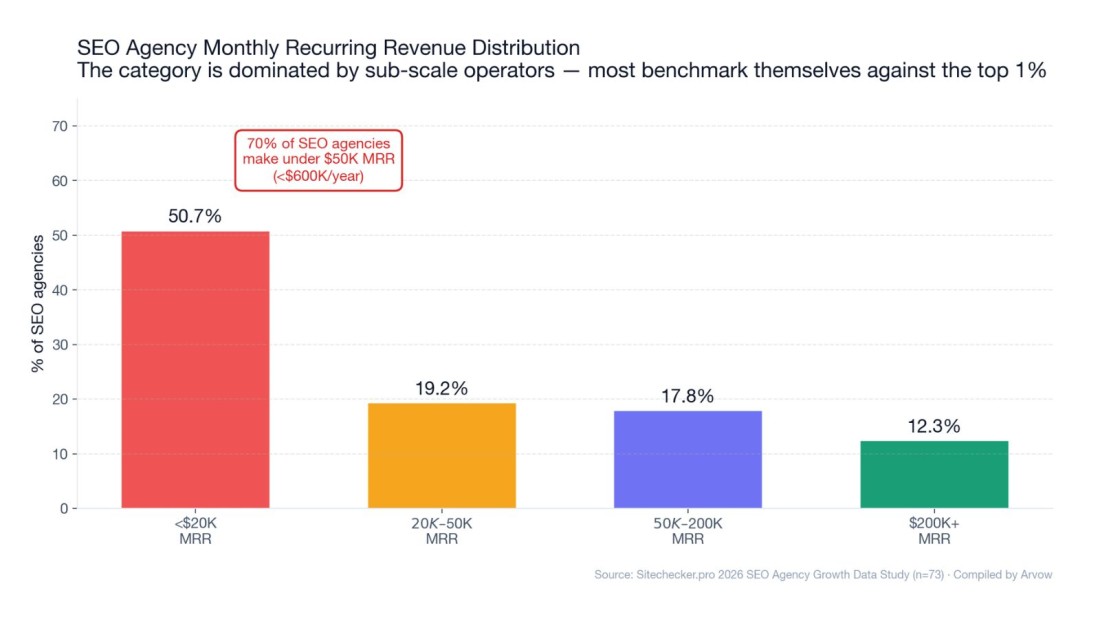
The global SEO services market is projected to hit $129.6 billion by 2030 (Grand View Research, 9.6% CAGR) — yet 70% of SEO agencies make under $50K monthly recurring revenue (sitechecker.pro, 73-agency study), and 86% have monthly retainers of $10,000 or less (Sparktoro, 376 agencies). Inside the same industry: holding-company giant Omnicom completed its $25B+ merger with Interpublic in November 2025, while Forbes Advisor — the highest-profile parasite-SEO casualty of 2024 — lost roughly 70% of its top-3 rankings in just two months after Google’s site-reputation-abuse manual penalty. The agency business is bifurcating fast.
We aggregated data from Ahrefs (439-pro pricing survey), Editorial.Link (518 SEOs), Sparktoro (376 agencies), AgencyAnalytics (220+ leaders), Sitechecker.pro (73 agencies), Conductor’s State of SEO 2025, First Page Sage’s ROI panel, BrightLocal, Backlinko, Focus Digital’s churn report, Grand View Research, and 20+ other primary sources to compile the most rigorous, methodology-checked SEO agency statistics available in 2026. Where studies disagree (and they often do — pricing surveys produce wildly different averages depending on geographic mix), we explain why. Every stat below is dated, sourced, and methodology-checked.
$129.6B global SEO services market projected by 2030 |
86% of agencies have retainers of $10K/month or less |
2.3× retainer churn advantage over project-based agencies |
87% of marketers now use generative AI in workflows |
Key Takeaways (2026)
- The market is enormous, but most operators are tiny: SEO services market projected at $129.6B by 2030 (Grand View Research). Yet 70% of SEO agencies make under $50K MRR and 35.6% are solo operations (sitechecker.pro 73-agency panel).
- Pricing is wildly bimodal: Ahrefs’ 439-pro survey reports agency averages of $3,209/month; Sparktoro’s 376-agency panel reports 49% in the $1K–$5K bracket and 31% in $5K–$10K. The “$15K+ retainer” segment is just 14% of the market.
- Retainer agencies retain 2.3× better than project-based: 18% annual churn for retainer agencies vs 42% for project-based (Focus Digital 2026). Retainer client lifespan averages 56 months vs 24 months for project clients.
- Half of enterprise outsources, against expectations: Over 54% of enterprise brands outsource SEO (Conductor 2025). The “big companies have in-house teams” narrative is wrong.
- AI productivity is real, but margin gain isn’t: 42% of agencies reclaimed 5–10 billable hours weekly through AI (AgencyAnalytics 2025). But only 32% saw net margin growth in 2025 (Sparktoro) — productivity gains are passing through to lower prices and faster delivery, not profit.
- Junior staff are getting cut: 23% of agencies reduced junior copywriting headcount in 2025; 31% plan further cuts in 2026 (DigitalApplied 250-agency survey). Senior-AI productivity dividends (8–10 hours/week) are 2–3× junior dividends — explaining the asymmetric layoffs.
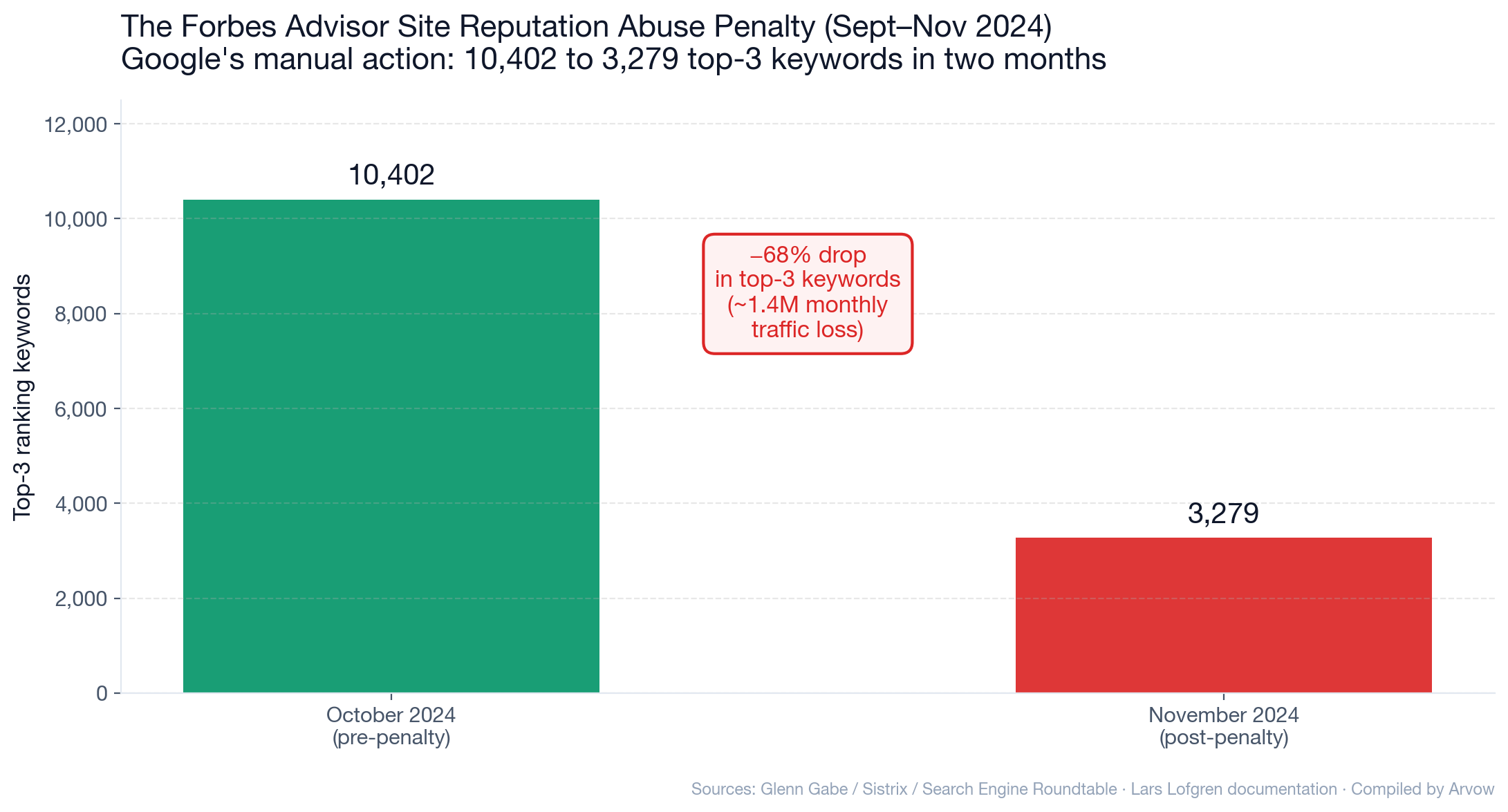
- The Forbes Marketplace case is the agency-side warning: 10,402 → 3,279 top-3 keywords (a ~70% drop, ~1.4M monthly traffic loss) in October–November 2024 from Google’s manual site-reputation-abuse penalty. Parasite-SEO partnerships are now structurally dead.
- SEO ROI varies 4× by vertical: First Page Sage’s 2026 panel reports 1,389% ROI for Real Estate, 1,031% for Financial Services, 702% for B2B SaaS, vs 317% for eCommerce and 117% for Technical-SEO-only. Vertical selection is half the agency-economics game.
- Engagements are lengthening, not shrinking: 31% of agency-client engagements last 36+ months in 2025 (Sparktoro), up from 2024 — despite the AI-disruption narrative.
- The honest paradox: The same survey panels report rising AI threat perception (44% → 53%, Sparktoro) AND rising revenue optimism (60% → 64% expect growth). Practitioners see disruption AND opportunity simultaneously — execution determines which they get.
1. How Big Is the SEO Agency Market in 2026?
The market sizing depends on which analyst you trust.
The macro number
- Grand View Research: Global SEO services market valued at $68.1B in 2023, projected $129.6B by 2030 at 9.6% CAGR.
- Mordor Intelligence: Same market sized at $72.31B in 2025, projected $106.15B by 2030 at 7.98% CAGR.
The disagreement is meaningful — same market, same year, ~$23B gap by 2030. That’s not measurement error; it’s definitional (“SEO services” includes how much in-house spend, freelancer revenue, and adjacent services). Treat both as directionally correct.
The US dominates
- U.S. SEO market: $45 billion (2023), ~65% of the global services market (IBISWorld via SEO Sandwitch aggregation).
- The pricing data corroborates: 40% of US/Canada agencies charge over $125/hour vs only 6% of European agencies (Backlinko 300+ pro survey).
Software vs services
- Global SEO software market: $74.6B (2024) → $154.6B (2030) at 13.5% CAGR (Grand View Research).
- Software is growing faster than services. Agencies are the structural buyers — Ahrefs, Semrush, Surfer, Clearscope, etc. are agency-revenue-funded businesses.
Holding-company consolidation
- Omnicom completed acquisition of Interpublic Group on November 26, 2025, creating a $25B+ revenue entity — the largest agency holding-company merger of the modern era (Campaign US).
- Q3 2025 organic growth divergence: Publicis +5.7%, Omnicom +4%, IPG -5.1%, Dentsu flat. WPP under significant pressure. Havas +3.8%.
- The two-tier separation is real: Publicis + the new Omnicom dominate; WPP / IPG / Dentsu in defensive mode.
For the demand-side picture from the largest enterprise SEO buyers, see our AI Overviews & AI Mode Statistics 2026 and GEO Statistics 2026 — both shape the budget-shifts hitting agencies right now.
2. SEO Agency Pricing Benchmarks: The Wide-Distribution Truth
Pricing surveys produce wildly different averages because of geographic and segment skew. Here’s the full picture across four primary surveys.
The Ahrefs 439-pro survey (the most-cited benchmark)
- General SEO retainer: $2,917/month average. Local SEO: $1,557/month average. Hourly rate: $111/hour average.
- By business type:
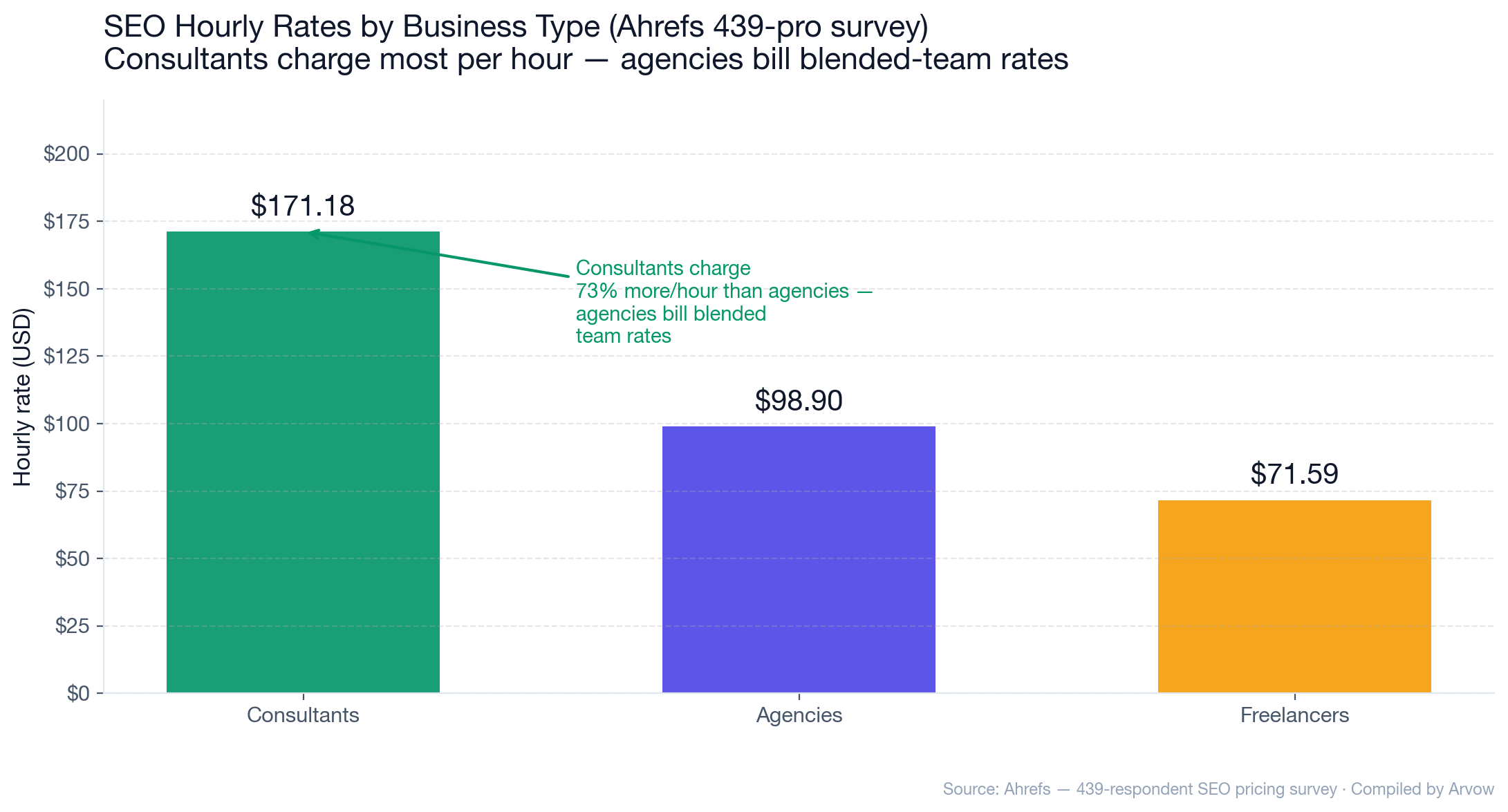
- Agencies: $3,209/month average; $98.90/hour.
- Consultants: $3,250/month; $171.18/hour.
- Freelancers: $1,348.63/month; $71.59/hour.
- Agencies charge 138% more than freelancers on retainer.
- By experience: $73.05/hour (0–2 yrs) → $97.11 (2–4) → $102.03 (5–10) → $118.35 (10+).
The Sparktoro 376-agency panel (2025)
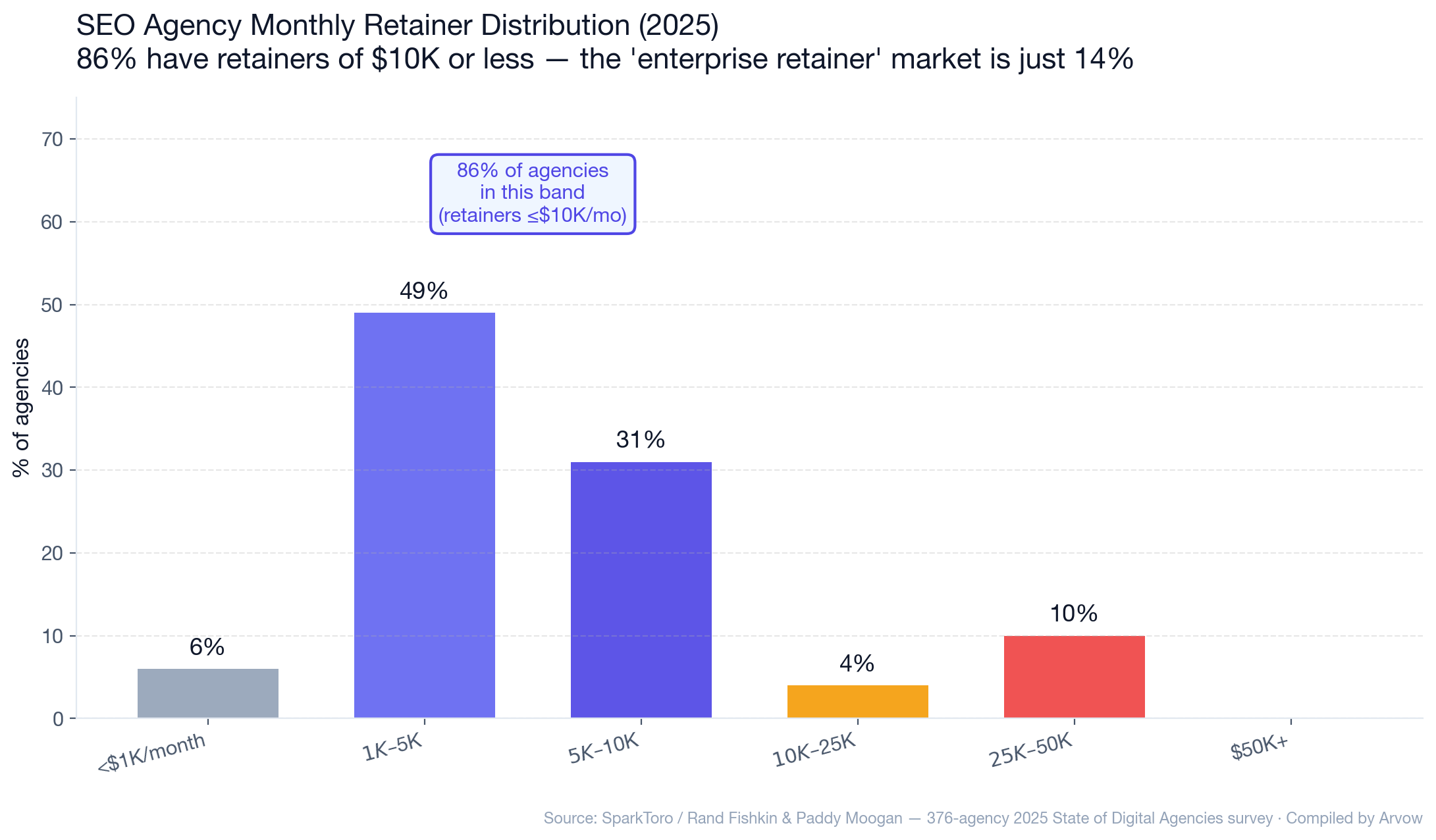
- 86% of agencies have monthly retainers ≤$10K.
- 49% report $1K–$5K, 31% report $5K–$10K, 10% report $25K–$50K.
- The $15K+ tier is just ~14% of the market — and the “$25K+ enterprise retainer” world is the top 10%.
The Backlinko 300+ pro survey (2026)
- Most popular monthly retainer: $501–$1,000. 64% offer retainers below $1,000/month; 30% under $500/month. Only 2% charge $5,000+/month.
- Why the disagreement vs Ahrefs/Sparktoro? Backlinko’s panel skews international (heavy India / Latin America / Eastern Europe). Pricing is right-skewed in those markets.
- Regional differential: 40% of US/Canada agencies charge over $125/hour vs 6% of European agencies — a ~6.7× rate-discrepancy in the same skill segment.
The Sitechecker.pro 73-agency panel (2026, transparent methodology)
- 42.5% of SEO agencies charge under $1K/month. 26% charge $1K–$2.5K. 12.3% command $5K–$10K. Only 8.2% charge above $10K/month.
- Sample is small but disclosed methodology — useful corroboration of the right-skew.
Pricing momentum in 2026
- 70% of agencies surveyed by SEranking either increased pricing recently or plan to in 2025 — primarily citing inflation and AI tooling costs.
- 56.2% of SEO agencies are increasing prices in 2026; 26% holding steady; 2.7% decreasing (Sitechecker.pro).
- The “AI is deflating prices” narrative is contradicted by the supply side — agencies are raising prices, not cutting.
The local-vs-national gap
- Local SEO retainer: $1,557/month average. Worldwide: $3,473.74/month — a 123% premium for non-local work (Ahrefs).
From Arvow: Arvow’s AI SEO Agent automates the structural SEO stack — schema markup, internal linking, FAQ formatting, citation density — that agencies bill manual hours to deliver. Use it inside your agency to reclaim 5–10 billable hours/week per client (the AgencyAnalytics 2025 benchmark) without expanding headcount. Discover the AI SEO Agent →
3. Agency vs In-House: The New Hybrid Default
The “agency vs in-house” framing is collapsing into a hybrid model. Here’s the data.
Enterprise outsources at majority rate
- Over 54% of enterprise brands outsource their SEO campaigns (Conductor State of SEO 2025).
- 81% of B2B companies expect to spend at least $7,500 per month on SEO (Conductor) — an enterprise floor of ~$90K/year minimum.
The cost calculus
- Mid-level in-house SEO specialist: $65,000–$95,000 base salary in North America. Fully loaded: $90,000–$130,000/year including benefits, taxes, software, training.
- Outsourced SEO services: $1,500–$5,000/month for SMB/mid-market — $18K–$60K/year.
- One mid-level in-house hire = roughly the cost of a $7.5–10K/month agency relationship. The math favors agencies for companies under ~$50M revenue.
Agency advantage
- First Page Sage 2026: Average ROI for agency-led SEO is 702% in B2B SaaS, 1,031% in Financial Services, 1,389% in Real Estate over 3 years. (Methodology: agency proprietary data Q1 2021–Q3 2025; not third-party validated, but internally consistent.)
- Agencies typically deliver faster results because of accumulated playbook IP, vendor relationships, and dedicated link-building infrastructure.
In-house advantage
- Brand alignment and product-domain expertise are structurally hard for agencies to replicate.
- For companies over ~$100M revenue with high SEO dependency (Wise, Zapier, Canva — see our pSEO piece), in-house teams of 5–20 SEOs become more cost-efficient than equivalent agency relationships.
The hybrid model wins for fast-scaling companies
- The hybrid model — senior in-house SEO lead owns strategy; agency handles execution and specialized expertise — is increasingly the norm among fast-scaling startups (industry consensus across 2025 commentary; not survey-quantified).
- Hybrid models solve the structural weaknesses on both sides: in-house teams get specialized expertise without hiring for every niche skill; agencies retain client commitment and reduce churn risk.
SEO maturity buffers AI disruption
- Conductor: Organizations with high SEO maturity are more than 3× as likely to report AI Overviews had a positive impact on performance vs those with low SEO maturity.
- Translation: agency-led structural rigor (schema, internal linking, content depth) is a hedge against AI-induced volatility, not a bet against AI.
4. Service Mix: What Agencies Actually Sell in 2026
The agency category fragmented faster than most expected.
Sparktoro 2025 — what agencies offer
- SEO: 81% (most popular service)
- Content strategy: 74%
- SEM/Paid Search: 62%
- Analytics, social media in the next tier
AgencyAnalytics 2025 — paid overtakes SEO
- Paid advertising is now offered by 89% of surveyed agencies — overtaking SEO and web design as the most widely provided service.
- 68% of agency leaders expect paid advertising to deliver the strongest results in 2025 (vs SEO/content).
How both can be true
- Sparktoro panel skews toward SEO-aware operators (“digital agencies” loosely). 81% offer SEO because the panel selects for it.
- AgencyAnalytics panel reflects multi-service agencies. Paid is universal because every full-service agency runs a Google/Meta program.
- The honest read: SEO is the lead service among SEO-first agencies; paid is the lead service among full-service agencies.
Specialization frequency (aggregated benchmark)
- Link-building as separate service: 67%
- Content marketing integration: 60%
- Technical SEO focus: 62%
- Programmatic SEO services: 52% (agencies; per SEO Sandwitch aggregation)
- AI content optimization tools: 45%
- Local SEO / GBP management: 76% of local marketers rate it most valuable (BrightLocal 550-respondent panel)
(Note: SEO Sandwitch is an aggregator citing multiple primary sources; treat as directional benchmarks.)
The Editorial.Link agency mix (518-pro survey)
- 44.4% of survey respondents are agency specialists/executives.
- Agencies allocate 32.1% of overall SEO budget to link-building; in-house teams allocate 36.03%.
- 56% of SEOs outsource at least part of link-building.
The cleanest read: even within agency-heavy panels, half outsource link-building specifically — agencies that can deliver high-quality backlinks at scale capture disproportionate revenue.
For the link-building economics that drive agency margins, see our Link Building Statistics 2026.
5. Client Retention, Churn, and Lifetime Value
This is where agency unit economics live or die.
Annual churn by business model (Focus Digital 2026)
- Retainer-based: 18% annual / 1.6% monthly
- Project-based: 42% annual / 4.2% monthly
- Hybrid model: 28% annual / 2.5% monthly
- Performance-based: 33% annual / 3.1% monthly
Annual churn by service type
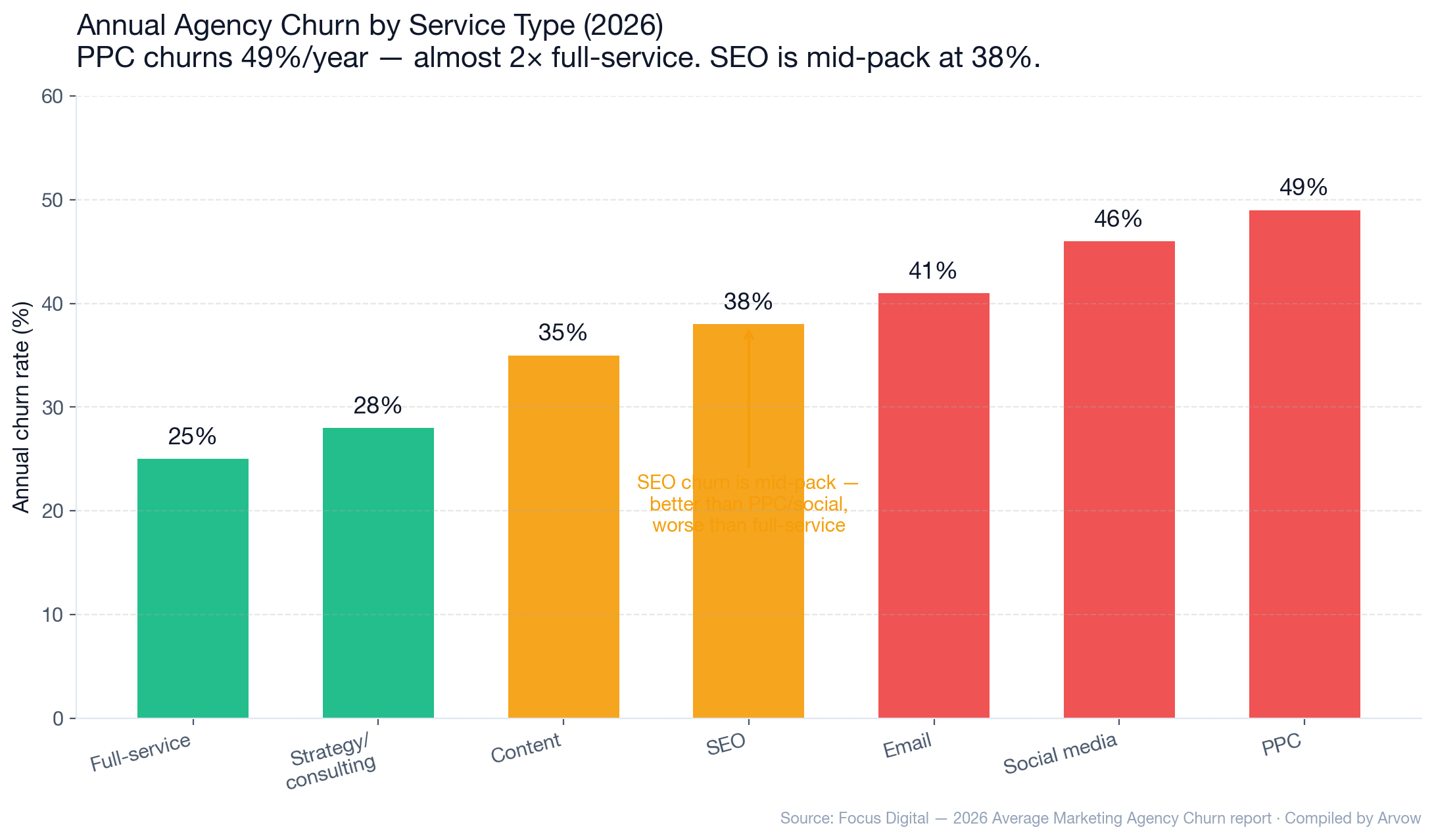
- Full-service: 25% (lowest)
- Marketing strategy/consulting: 28%
- Content marketing: 35%
- SEO: 38%
- Email marketing: 41%
- Social media marketing: 46%
- PPC: 49% (highest)
SEO churn is mid-pack — better than PPC/social, worse than full-service or strategy.
Annual churn by agency size
- 1–10 employees: 32% annual
- 11–25 employees: 24%
- 26–50 employees: 19%
- 51+ employees: 15%
Larger agencies retain about 2× better than 1–10-person shops — driven by dedicated account management, deeper service stacks, and better onboarding.
Client lifespan: the unit economics multiplier
- Retainer clients: 56 months average lifespan (~5 years)
- Project clients: 24 months (~2 years)
The retainer/project lifespan gap is the single biggest unit-economics lever in agency operations.
First-90-day churn risk
- Retainer agencies lose ~8% of clients in months 1–6.
- Project agencies see 28% departure within six months.
- Onboarding investment is the highest-leverage retention tool.
Sparktoro 2025 — engagement length is lengthening
- 31% of agencies report typical engagements over 36 months (up from 2024).
- 19% report 24–36 months.
- 25% under 12 months.
- Despite the AI-disruption narrative, agency-client relationships are growing longer, not shorter.
Where churn dollars go (Sitechecker.pro 73-agency panel)
- 37% of churned clients are retained through service adjustments.
- 27.4% abandon SEO entirely (the most concerning category).
- 19.2% shift budget to Google search ads.
- 15.1% shift to paid social.
- 11% switch to a competing agency.
The honest read: most “churn” is category abandonment, not agency-switching. The market is shrinking on the buyer side, not redistributing.
Agency NPS benchmark
- Agency & consulting NPS: 59 (top-quartile across industries) — Survicate / Retently 2025.
- Median across all industries: 42.
- But: Digital marketing agencies declined from NPS 51 (2025) to 49 (2026) — Sobot benchmark. The 2-point decline reverses a multi-year improvement; AI disruption is reducing client satisfaction marginally.
From Arvow: Arvow’s Autoblog and AI SEO Agent are agency-multiplier tools — embed them in client engagements to compress delivery time, reduce burnout on junior staff, and ship the structural HCU-survival signals at scale. Several Arvow customers run agency models on top of the platform; the operational margins compound. See pricing →
6. SEO ROI by Vertical: The 4× Spread Nobody Publishes
This is the section every competitor skips. Here’s the cleanest available data on vertical-by-vertical SEO ROI.
First Page Sage 2026 ROI by industry (3-year averages)
| Vertical | ROAS | ROI | Break-even |
|---|---|---|---|
| Real Estate | 15.10 | 1,389% | 10 months |
| Medical Device | 12.85 | 1,183% | 13 months |
| PCB Design & Mfg | 12.40 | 1,101% | 11 months |
| Financial Services | 11.10 | 1,031% | 9 months |
| B2B SaaS | 8.75 | 702% | 7 months |
| HVAC Services | 8.15 | 678% | 6 months |
| Construction | 7.40 | 681% | 5 months |
| Legal Services | 6.15 | 526% | 14 months |
| eCommerce | 3.65 | 317% | 9 months |
⚠️ Methodology caveat: First Page Sage’s data is proprietary client data Q1 2021–Q3 2025; not third-party verified, and assumes ~$120K/year agency cost. Treat as directional benchmark for vertical relative performance — the absolute numbers may overstate vs an independent measurement.
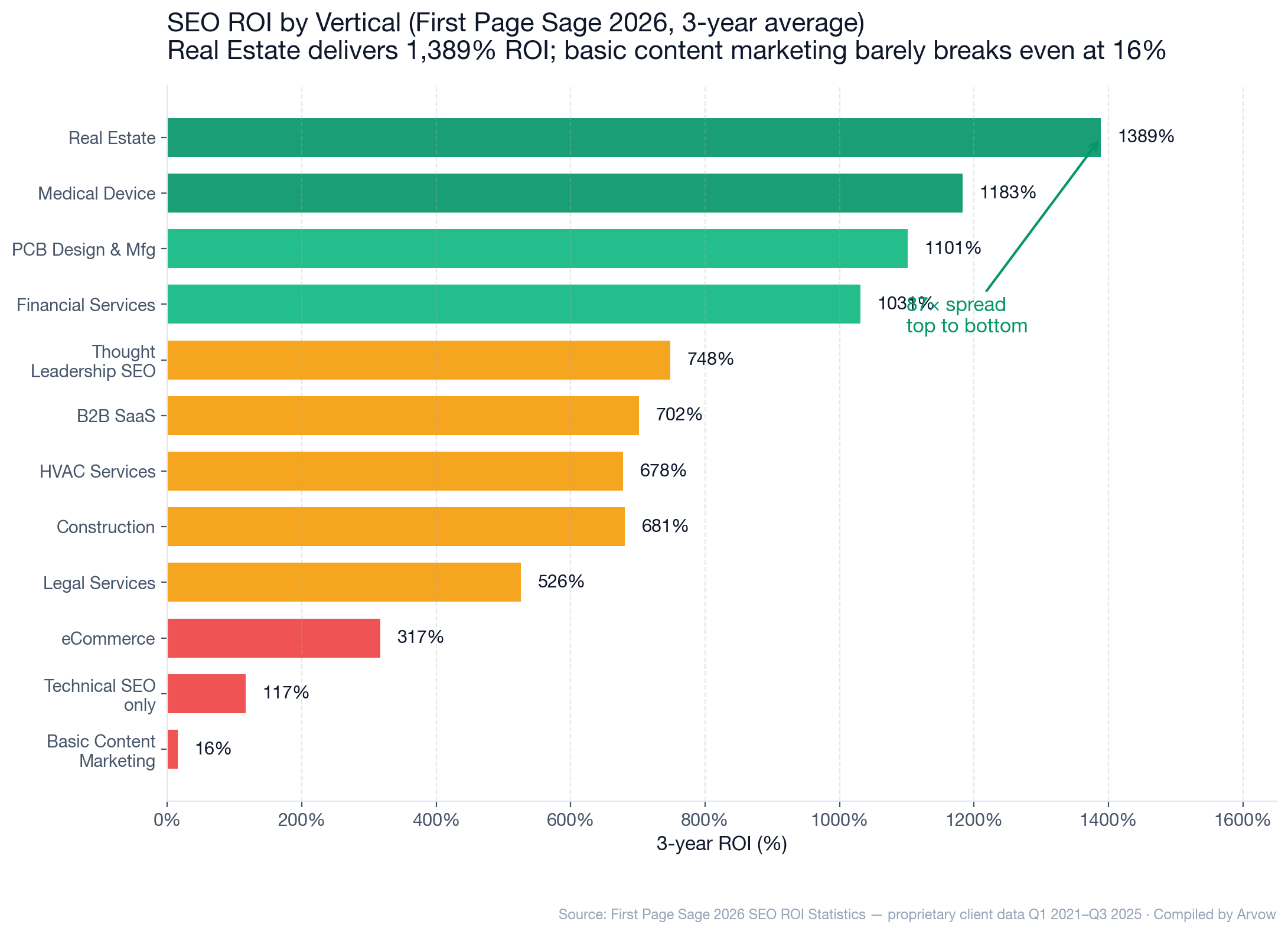
ROI by SEO service type (First Page Sage)
- Thought Leadership SEO: 9.10 ROAS, 748% ROI, 9-month break-even
- Technical SEO Only: 1.35 ROAS, 117% ROI, 6-month break-even
- Basic Content Marketing: 1.05 ROAS, 16% ROI, 15-month break-even
The implication: technical SEO and basic content marketing barely break even on ROI. Thought-leadership / content-strategy-driven SEO is the actual margin driver — confirming why specialized strategy agencies command premium retainers.
B2B SaaS SEO investment ranges (for context)
- SaaS SEO agency pricing: $3,000–$25,000/month (typical mid-market).
- Enterprise SaaS (Monday.com, RingCentral): $50K–$150K/month on SEO campaigns.
- Median private B2B SaaS marketing spend: 8% of ARR. Early-stage 20–30%; mature 5–7% (SaaS Capital 2025).
Time-to-result: the agency “give it 6 months” line is empirically right
- 94.6% of SEO experts agree first signs of success appear between months 2–6 (Morningscore 75-expert survey).
- 82% of experts: SEO takes 6 months to show traffic increases.
- Full results visible after 12–24 months.
- Google’s own Maile Ohye: “between four months and a year to see results after hiring an SEO agency.”
The 30-day result promise is a red flag. The 6-month line is defensible.
The Hunter Talent case study (Backlinko 2026)
- $96,000 total investment over 60 months → $3.8M additional revenue
- Traffic: 232 → 6,288 monthly visitors (2,710% growth)
- 4,122% ROI; 85% of annual revenue from organic
- A documented full-funnel SEO ROI with multi-year data — the cleanest single case study published in 2026.
7. AI Tooling Inside the Modern Agency
AI didn’t kill SEO agencies. It restructured them.
Adoption has saturated
- 87% of marketers use generative AI in at least one workflow in 2026 (DigitalApplied 250-agency survey), up from 51% in 2024 — a 36-point jump in 24 months.
- 64% of creative agencies adopted generative AI tools in 2025 specifically for ideation, visual production, and copywriting speed.
- Nearly 77% of marketing agencies reported AI adoption in 2024 — agencies were ahead of broader marketing in the curve.
Productivity gains are real, but asymmetric
- Marketers recover 6.1 hours/week on average through AI.
- Senior practitioners save 8–10 hours/week. Junior staff: 3–4 hours/week.
- 42% of agencies reclaimed 5–10 billable hours weekly (AgencyAnalytics 2025, n=220+).
- 58% of agencies report AI has reduced content creation time (AgencyAnalytics).
The asymmetry explains junior-staff cuts
- 23% of agencies reduced junior copywriting headcount in 2025.
- 31% plan further cuts in 2026 (DigitalApplied).
- Senior-AI productivity is 2–3× junior productivity → senior staff capture the dividend → junior roles get consolidated.
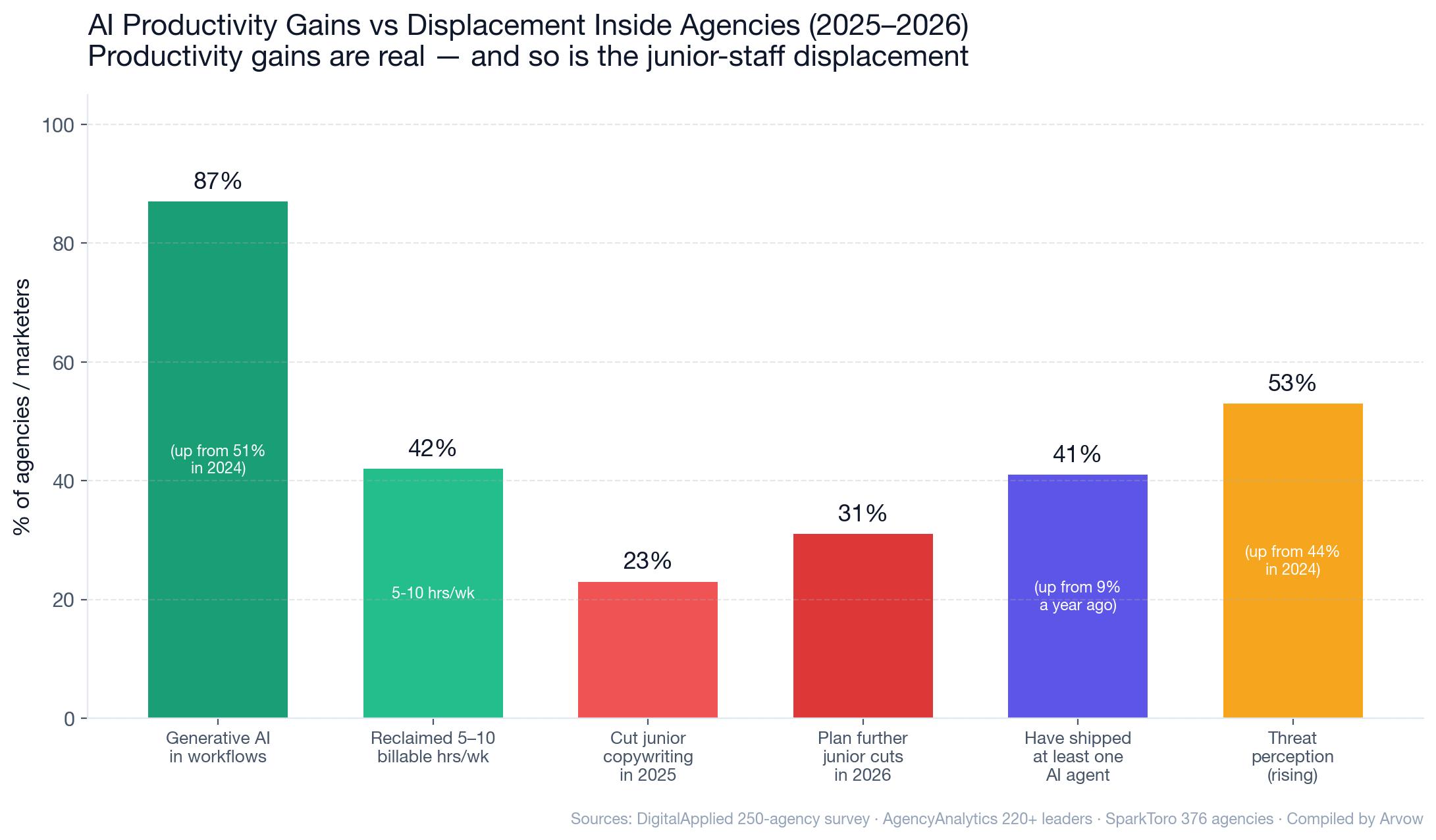
Tooling spend is climbing fast
- Median mid-market marketing team: $1,200/month on AI tools in Q1 2025 → $3,400/month in Q1 2026 — a 2.8× year-over-year increase.
- The tooling-spend growth is starting to offset the labor savings.
Agentic AI deployment
- 41% of agencies have at least one AI agent shipped (DigitalApplied 2026), up from 9% a year ago — a 4.5× growth in 12 months.
- This is the fastest agency-tech adoption ever measured.
AI as a stand-alone offering
- Editorial.Link 2025: 86% of marketing professionals now use AI SEO tools, with backlink automation in their top 3 AI applications.
- 63% of agencies have modified SEO KPIs due to AI Overviews (Sitechecker.pro 73-agency panel).
- 58.9% focus on improving on-page content; 50.7% publish more content overall (in response to AIO).
The AI threat perception (Sparktoro)
- 53% of agencies agree AI poses significant threat in 2025 (up from 44% in 2024).
- 66% agree there are fewer junior staff opportunities ahead.
- 57% cite AI-driven content saturation as a major concern (AgencyAnalytics).
The honest read: agencies see AI as both a productivity dividend AND a strategic threat — and they’re right on both counts.
For the deeper picture on AI’s structural impact on what gets ranked, see our Programmatic SEO Statistics 2026 §6 (the 70% → 3% → 20% AI-ranking-decay curve) and our AI Overviews Statistics 2026.
8. Agency Operations: Revenue, Margins, Billable Utilization
The brutal honesty about how SEO agencies actually run.
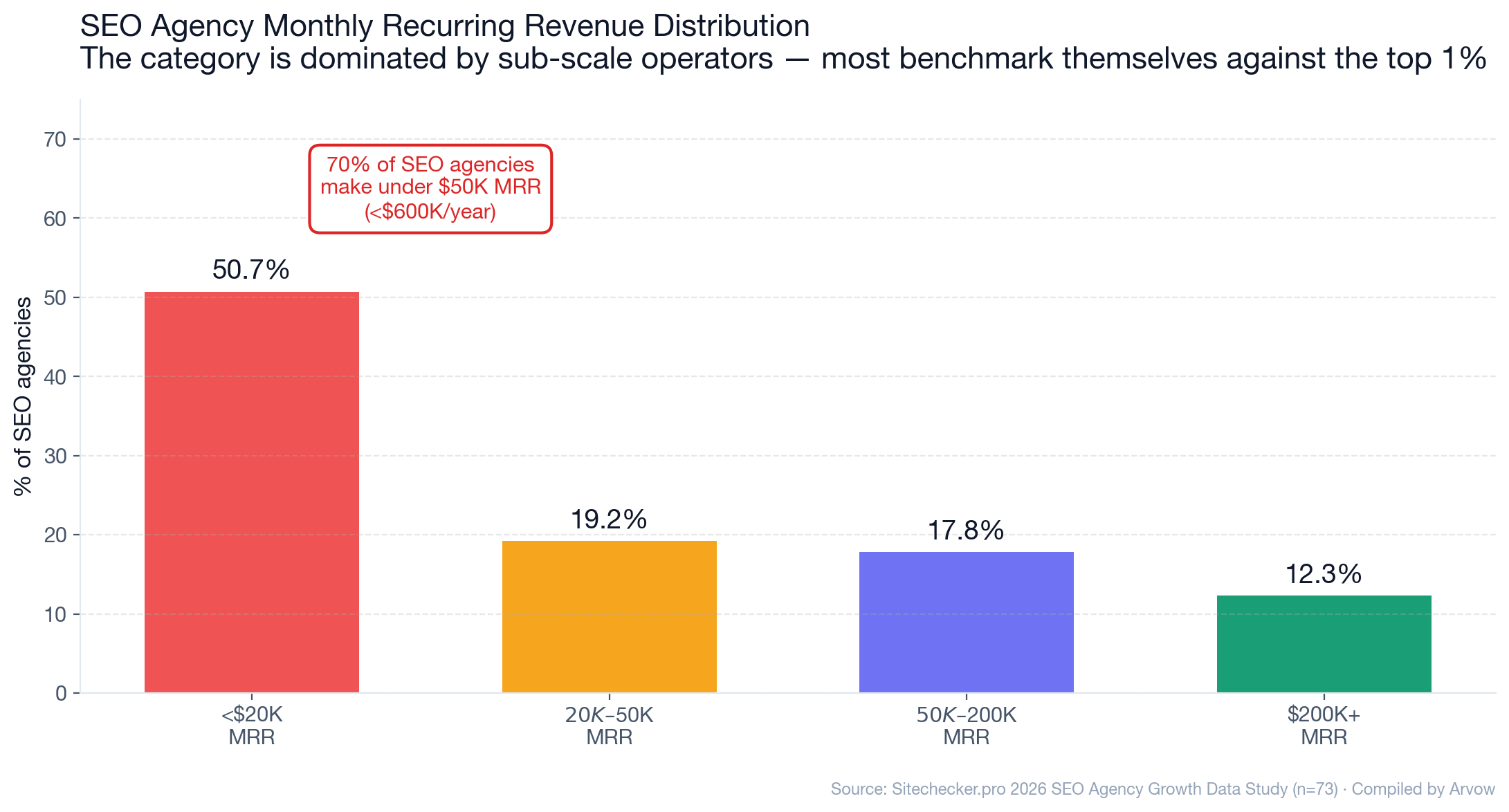
Revenue distribution (Sitechecker.pro 73-agency panel)
- 70% of SEO agencies make under $50K MRR.
- 50.7% under $20K MRR.
- 19.2% in the $20K–$50K range.
- 12.3% over $200K MRR.
The category is dominated by sub-scale operators. The agencies most operators benchmark themselves against (NP Digital, Salt, iPullRank) are the top 1–2%.
Team size distribution
- 35.6% solo operations
- 37% have 2–10 FTE
- 11% have 10–50
- 8.2% have 50–200
- 8.2% have 200+
Solo + 2–10 = 72.6% of agencies are 10 people or less.
Gross margin distribution (Sitechecker.pro)
- 41.1% of agencies report gross margins under 30%.
- 39.7% achieve 30–50%.
- 13.7% reach 50–70%.
- Only 5.5% exceed 70%.
Most SEO agencies are running thin. Under 30% gross margin means almost no operational cushion.
Net profit margin benchmark
- Average after-tax net profit margin: 11–21% (SEranking 115-agency survey).
- Specialized SEO agencies sometimes reach 40% (high-end outliers).
- Mature agencies should target 25–30% EBITDA (industry analyst projection — Financial Models Lab).
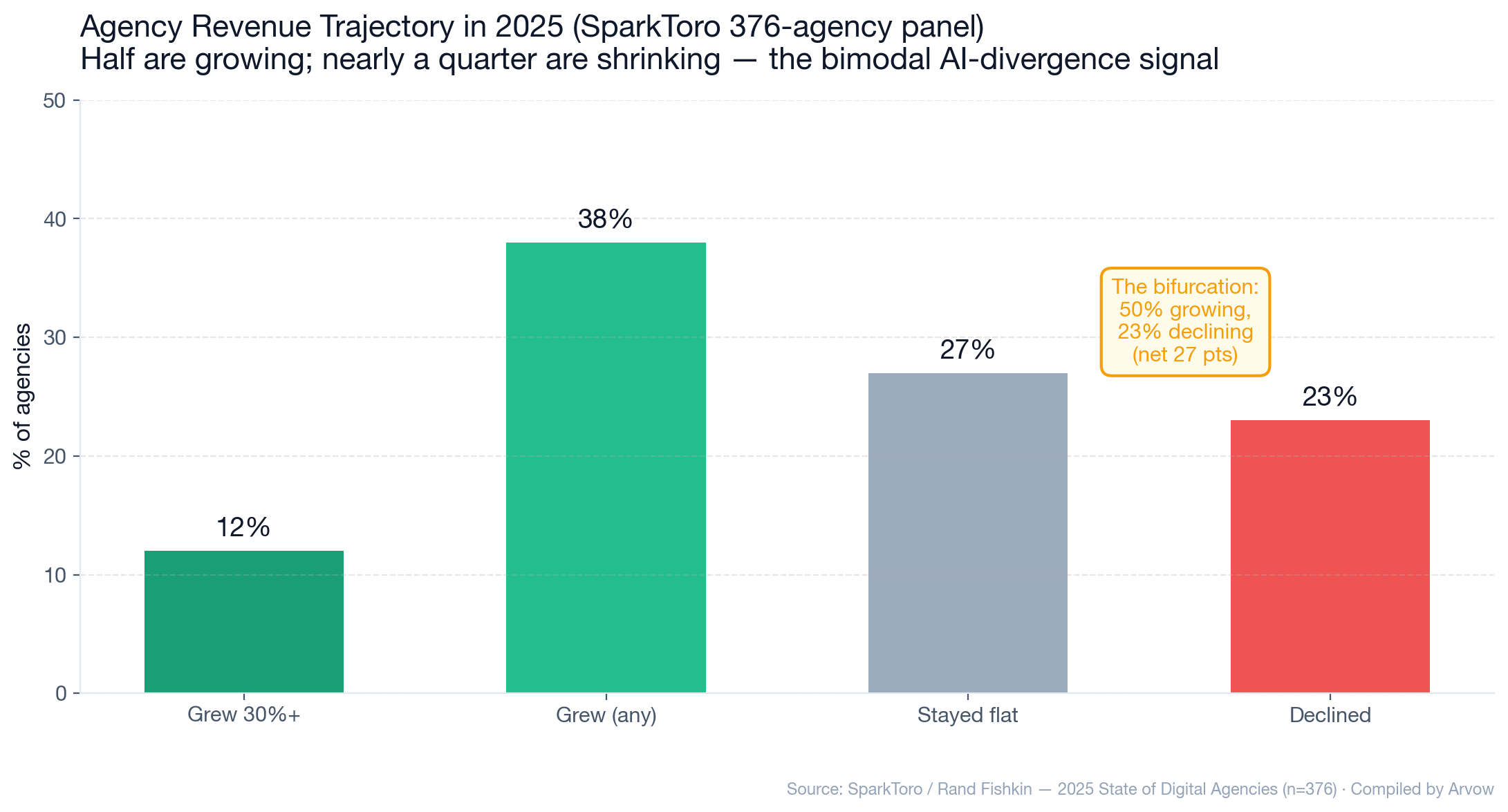
Sparktoro 2025 — revenue trajectory
- 50% of agencies grew revenue YoY in 2025.
- 12% grew 30%+.
- 27% stayed flat.
- 23% declined.
Half the industry is growing; nearly a quarter is shrinking. The bimodal distribution is the AI-divergence signal — winners systematizing AI productivity, losers competing on unsustainable price.
Net margin trajectory (Sparktoro)
- 32% grew net margin in 2025.
- 48% held flat.
- 20% declined.
- Margins are surprisingly stable despite the AI churn discourse.
Billable utilization targets
- 57% of agencies use timesheets.
- Of those: 39% target 70–79% billable utilization; 35% target 80–89%.
- 80%+ billable utilization is the implicit benchmark for a profitable agency.
Sales cycle length is increasing
- 29% of agencies report longer sales cycles vs 2024.
- 66% same.
- Only 5% shorter.
- Sales is harder, not easier — even as agencies report higher productivity. Buyer caution is up.
Pitch conversion benchmark
- 34% of agencies convert 31–50% of pitches delivered (AgencyAnalytics 2025).
- Win rates >30% are the realistic benchmark — closer to enterprise B2B sales than retail.
9. Famous Agency Case Studies & The Reference Players
Five reference agencies operators benchmark themselves against, each with a documented angle.
NP Digital
- The largest Neil Patel-founded full-service digital marketing agency. Global presence; specialists across digital marketing strategy, social, content, web, off-page SEO, and reputation management. Public client list: HALO, North Coast Seafood, others.
- Reference role: “personal-brand-led full-service” benchmark.
Salt.agency
- Positions technical SEO + AI search visibility as core specialization. Works with global brands on complex structural issues affecting crawl efficiency, indexation, and search performance.
- Reference role: technical-SEO specialist agency.
iPullRank (Mike King)
- Enterprise + mid-market specialist combining technical SEO, audience research, and content strategy. Works with top-tier clients; thought-leadership-heavy.
- Reference role: AI-search-first agency thought-leadership benchmark.
Editorial.Link (Vlad Rappoport)
- Pure-play link-building agency that runs the largest annual State of Link Building survey (518 SEOs in 2025).
- Reference role: link-building specialist + industry-survey reference.
Surfer SEO + Backlinko (Brian Dean / Sam Tomic)
- Surfer published the Salesforge case study: $0 → $3M ARR in 2 years on programmatic SEO.
- Backlinko’s 2026 SEO Pricing Guide is the most-cited pricing reference.
- Reference role: content-tooling + thought-leadership platforms backed by agency-services.
Documented winning case studies (with hard numbers)
- Hunter Talent (Backlinko 2026): $96K over 60 months → $3.8M additional revenue. 2,710% traffic growth, 4,122% ROI.
- Webflow’s pSEO experiment: 300 programmatic pages → 6,000 daily impressions in 6 weeks (cited in our pSEO piece §2).
- Salesforge: $0 → $3M ARR in 2 years on Surfer-led pSEO.
- Wise: 260K+ programmatic pages → 46M+ monthly organic visits (our pSEO piece).
- OpenArt (Daydream client): 600+ AI-generator pSEO pages → 1M monthly visits in 8 months.
10. Failure Modes: When Agency Decisions Blow Up Clients
Every competitor publishes the case studies. We name the casualties — and the agency mechanics that produced them.
The Forbes Marketplace site reputation abuse penalty
- In late September 2024, Forbes Advisor experienced a manual penalty under Google’s site reputation abuse policy. SEO analyst Glenn Gabe documented the start as September 25, 2024.
- From October to November 2024: organic keywords ranking in top 3 dropped from ~10,402 → 3,279 — a roughly 70% drop, with an estimated 1.4 million traffic loss.
- The mechanism: Forbes Marketplace, a third-party operator, partnered with Forbes from 2020 to run affiliate-content properties on the Forbes domain, leveraging the host’s authority for high-value categories (credit cards, insurance, health). Lars Lofgren’s September 2024 post “Forbes Marketplace: The Parasite SEO Company Trying to Devour Its Host” was the inflection point.
Google’s site reputation abuse policy (the structural change)
- Effective May 5, 2024. Expanded November 2024 to clarify that “no amount of first-party involvement alters the third-party nature” of parasite content.
- The policy is manually enforced, per Google’s Search Liaison. CNN coupons, Forbes Marketplace, and similar arrangements are explicitly targeted.
The translation for agencies: parasite-SEO partnerships are now structurally dead. Any agency that built revenue on third-party-content-on-host-brand-domain arrangements is exposed.
The JC Penney precedent (legal recourse)
- JC Penney famously hired an SEO agency that resulted in their site being de-indexed. A lawsuit followed.
- Subsequent legal precedent: businesses can sue SEO providers for damages from black-hat-induced losses, if the contract specified prohibited tactics.
- Most agency-client disputes settle privately, without public registries.
The Sitechecker.pro 2026 panel — what’s killing agencies
- 39.7% cite insufficient qualified leads as top growth constraint.
- 24.7% cite AI reducing perceived SEO value.
- 17.8% client churn.
- 16.4% lack of market differentiation.
Lead gen + AI value perception = 64% of growth constraint — both are demand-side problems.
Agency-side failure modes (synthesized)
- Pure-play SEO agencies in commoditized verticals (legal, dental, local services) are the highest-churn segments — 38–46% annual churn (Focus Digital).
- Sub-30% gross margin agencies (41.1% of the panel) have no cushion for client-acquisition swings.
- Agencies running parasite-SEO playbooks are facing structural demand collapse post site-reputation-abuse policy.
- Agencies dependent on commodity content (vs first-party data / specialized expertise) are the AI-deflation casualties.
The contractual safeguards lawyers now recommend
- Contracts should specifically include unacceptable “black hat” tactics: paid links, link wheels, blog networks, parasite hosting, spun content, keyword stuffing, hidden text, cloaking, redirects.
- “If you didn’t specify what’s prohibited, you may have no recourse” (Reboot Online / Wright Hassall).
From Arvow: Track exactly how Google AI Overviews, ChatGPT, Perplexity, Gemini, Claude, and Grok cite your client portfolios — week over week — with Arvow’s LLM Visibility Tracker. Agencies that report citation-share data to clients reduce churn risk meaningfully (the “what’s our visibility actually doing” question is the #1 client-retention conversation in 2026). Track Your Clients’ AI Visibility →
11. The 2026 Outlook: Bifurcation in Real Time
The data converges on one story: the agency category is splitting fast.
AI Overview impact on the SEO product itself
- AI Overviews reduce organic clicks on the top result by an average of 34.5% (Search Engine Land aggregate).
- 76% of AI Overview citations come from URLs ranking in Google’s top 10 (Ahrefs 1.9M citations / 1M AIOs — see our AI Overviews piece).
- Top-ranking page CTR is 58% lower when an AI Overview is present (Ahrefs).
The two-strategy split (Search Engine Land 2026 thesis)
- Traditional SEO: humans browsing, comparing, buying. Optimizing for clicks.
- AI search optimization: information supplied so AI agents can find, trust, and use it without a user visiting.
- The agency role redefinition: “design integrated systems that connect SEO, content, digital PR, social SEO, brand, and conversion optimization” — not single-channel execution.
Future revenue expectations (Sparktoro 2025)
- 64% of agencies expect revenue increase in next 12 months (up from 60% in 2024).
- Only 8% expect decrease (down from 11%).
- Despite AI threat perception rising, operator optimism is higher in 2025 than 2024.
2026 growth initiatives (Sitechecker.pro)
- 60.3% investing in delivery automation.
- 53.4% investing in better tool stack.
- 42.5% developing personal brands.
- 31.5% training teams on AI search strategies.
Automation + AI training together = 92% of agencies — the survivors are betting hard on production-side AI.
Pricing trajectory in 2026
- 56.2% of SEO agencies are increasing prices.
- 26% holding steady.
- 15.1% attempting increases without client buy-in.
- 2.7% decreasing.
The “AI is deflating prices” narrative is contradicted by the supply side. Surviving agencies are raising rates and capturing the productivity dividend.
The bimodal future
The same Sparktoro panel that reports 50% growth and 12% growing 30%+ also reports 23% revenue decline. The bottom-half agencies competing on price against AI-amplified productivity are losing. The top-half agencies investing in specialization, automation, and integrated strategy are gaining.
The same playbook produces both outcomes. Execution determines which an agency lands in.
12. The Contradictions: Why SEO-Agency Stats Don’t Always Agree
The agency-data ecosystem has known disagreements. Here’s how to reason through them.
- Backlinko (300+ pros): average ~$1K/month, 64% under $1,000.
- Ahrefs (439 pros): agency average $3,209/month.
- Sparktoro (376 agencies): 86% have retainers ≤$10K; 49% in $1K–$5K; 31% in $5K–$10K.
Why they differ: geographic skew. Backlinko’s panel skews international (India, Latin America, Eastern Europe). Ahrefs and Sparktoro skew US/UK/Canada/EU. All three are accurate at their measurement layer. The right average depends on your reference market.
- 51+ employee agencies: 15% annual churn.
- 1–10 employee agencies: 32% annual churn.
- PPC services: 49% annual.
- Retainer model: 18%; project model: 42%.
Why they differ: agency size, service mix, and engagement model all matter. A small project-based PPC shop will report 49%+ churn; a large retainer-based full-service agency reports 15%. The “average agency churn” is meaningless without the cuts.
- Sparktoro (376 agencies): SEO is the most popular service at 81%.
- AgencyAnalytics (220+ leaders): Paid advertising is offered by 89%, having overtaken SEO and web design.
Why they differ: panel composition. Sparktoro selects for SEO-aware operators; AgencyAnalytics selects for full-service multi-channel agencies. The two findings are complementary, not contradictory.
- Sparktoro: AI threat perception rising.
- Sparktoro: Revenue optimism also rising.
Why both can be true: agencies see AI as both a productivity dividend (good for revenue) AND a strategic threat (commoditization risk). Practitioners hold both views simultaneously; the data doesn’t force a single narrative.
- Conductor: 91% of enterprise reports SEO positively impacted website performance in 2024.
- Sitechecker.pro: 27.4% of churned clients abandon SEO entirely.
- Sparktoro: 50% of agencies grew revenue in 2025.
- Multiple analyses: AI Overviews reducing clicks 34.5% on top results.
Both are happening simultaneously. SEO is contracting as a click-acquisition channel; expanding as a citation/visibility/brand-authority channel. The agencies that pivot to the second framing grow; those clinging to the first contract.
- Mordor Intelligence: $106.15B by 2030 at 7.98% CAGR.
- Grand View Research: $129.6B by 2030 at 9.6% CAGR.
Same market, two analysts, $23B disagreement by 2030. Treat the directional growth (8–10% CAGR) as the accurate read; treat the absolute numbers as analyst-dependent.
- SEO Sandwitch / Ahrefs aggregation: average 11–14 months.
- Focus Digital 2026: retainer client lifespan 56 months.
Why they differ: the 11–14 month figure is project-weighted (or aggregator-error citing project clients as “agency average”). The 56-month figure is retainer-only. Two different numerators.
13. What This Means for Your Agency / Your In-House / Your Buying Decision
Six concrete moves the data above actually justifies.
1. If you run an agency: pick a side of the bifurcation, fast.
The 50% growing / 23% declining bimodal split is real. The bottom half competes on price and loses to AI deflation. The top half builds specialization (vertical, channel, methodology) and captures productivity dividends. Pick.
2. If you’re hiring an agency: ask for vertical ROI data, not “results.”
First Page Sage’s 4× variance by vertical (1,389% Real Estate vs 317% eCommerce) means general “we deliver SEO ROI” claims are uninformative. Ask for vertical-specific case studies with documented numbers.
3. If you’re sub-$50M revenue: agency > in-house, math-based.
Mid-level in-house SEO costs $90–130K fully loaded. A $7.5K/mo agency relationship costs $90K/year and delivers a deeper service stack, vendor relationships, and accumulated playbook IP. The break-even where in-house wins is roughly $50–100M revenue with high SEO dependency.
4. If you have an agency: check the contract for black-hat-tactic exclusion.
Every legal precedent on agency-induced losses requires the contract to specify what’s prohibited. Add the explicit list: paid links, link networks, parasite hosting, AI-mass-content, etc. Without it, you have no recourse if the agency tanks your domain.
5. If you’re an agency leader: AI training is not optional.
23% cut junior copywriting headcount in 2025; 31% planning more cuts in 2026. The agencies investing in AI productivity capture senior-level dividends (8–10 hr/week). The agencies skipping AI training are the ones competing against AI-amplified competitors.
6. Track AI Overview citation share, not just rankings.
Per our AI Overviews piece: brands cited in AIOs win 35% more clicks; brands not cited see CTR fall 58–61%. The new agency objective is citation, not ranking. Set up LLM Visibility Tracker for your client portfolio.
Ready to act on the data? Arvow’s AI SEO Agent automates the structural HCU-survival stack — schema, citation density, internal linking, FAQ formatting — across every page you publish. Combined with Arvow’s Autoblog for content velocity and Arvow’s link building service for the link-velocity layer, that’s the full agency-multiplier stack.
Or if you want to see the output first: Try 3 Free Articles →
Σ Summary: SEO Agency Statistics 2026 by the Numbers
The 20 highest-leverage stats from this report, in one table.
| # | Stat | Source |
|---|---|---|
| 1 | Global SEO services market: $129.6B by 2030 (9.6% CAGR) | Grand View Research |
| 2 | Omnicom + Interpublic: $25B+ merger completed Nov 26, 2025 | Campaign US |
| 3 | Agency average retainer: $3,209/month | Ahrefs (n=439) |
| 4 | 86% of agencies have retainers ≤$10K/month | Sparktoro (n=376) |
| 5 | 70% of SEO agencies make under $50K MRR | Sitechecker.pro (n=73) |
| 6 | Retainer agencies: 18% annual churn vs 42% for project-based | Focus Digital 2026 |
| 7 | Retainer client lifespan 56 months vs 24 months for project | Focus Digital 2026 |
| 8 | PPC has 49% annual churn — highest of any service | Focus Digital 2026 |
| 9 | Conductor: 54% of enterprise outsources SEO | Conductor 2025 |
| 10 | B2B floor: 81% expect ≥$7,500/mo SEO spend | Conductor 2025 |
| 11 | First Page Sage: 1,389% ROI Real Estate vs 317% eCommerce | First Page Sage 2026 |
| 12 | 87% of marketers use generative AI in workflows in 2026 | DigitalApplied (n=250) |
| 13 | 42% of agencies reclaimed 5–10 billable hours/wk via AI | AgencyAnalytics 2025 |
| 14 | 23% of agencies cut junior copywriting headcount in 2025 | DigitalApplied 2026 |
| 15 | 41% of agencies have shipped at least one AI agent (4.5× YoY) | DigitalApplied 2026 |
| 16 | Forbes Advisor: 10,402 → 3,279 top-3 keywords in 2 months | Glenn Gabe / Sistrix |
| 17 | Sparktoro: 50% of agencies grew revenue in 2025; 23% declined | Sparktoro 2025 |
| 18 | 56.2% of agencies are raising prices in 2026 | Sitechecker.pro 2026 |
| 19 | 94.6% of SEO experts: results visible months 2–6 | Morningscore (n=75) |
| 20 | Agency NPS: 59 (top quartile); declining 51 → 49 for digital marketing | Survicate / Sobot 2025 |
Frequently Asked Questions
How much does an SEO agency cost per month in 2026?
The honest distribution: Ahrefs’ 439-pro survey reports agency averages of $3,209/month (consultants $3,250, freelancers $1,348). Sparktoro’s 376-agency panel reports 86% in the ≤$10K range, with 49% in $1K–$5K and 31% in $5K–$10K. Backlinko’s 300+ pro survey, weighted toward emerging markets, reports a median closer to $501–$1,000/month with 64% under $1,000. The “right” answer depends on your geography, vertical complexity, and required service stack.
Is SEO agency churn really 38%, 18%, or 42%?
All three are accurate at their measurement layer. Retainer-based SEO agencies see 18% annual churn; project-based see 42%; the SEO service category overall churns 38% annually (mix of both models). Larger agencies (51+ employees) hold churn at 15%, while 1–10 person shops see 32%.
What’s the typical SEO agency profit margin in 2026?
Average after-tax net profit margin is 11–21% (SEranking 115-agency survey). 41% of agencies report gross margins under 30%; only 5.5% exceed 70% (Sitechecker.pro). Mature agencies should target 25–30% EBITDA; agencies under $5M revenue typically achieve 10–20% net margin.
How long should I expect to see SEO results from an agency?
94.6% of SEO experts agree first signs of success appear between months 2–6 (Morningscore 75-expert survey). 82% say SEO takes ~6 months to show traffic increases. Full results are typically visible after 12–24 months. Google’s own Maile Ohye says between four months and a year. The 30-day result promise is a red flag.
Should I use an in-house SEO team or an agency?
For companies under ~$50M revenue with normal SEO dependency, the math favors agencies — a mid-level in-house SEO costs $90–130K fully loaded vs $90K/year for a $7.5K/mo agency. Above ~$100M revenue with high SEO dependency, in-house teams of 5–20 SEOs become more cost-efficient. The hybrid model (senior in-house lead + agency execution) is increasingly the default for fast-scaling startups.
Is the SEO agency industry shrinking because of AI?
It’s bifurcating, not shrinking. Sparktoro 2025: 50% of agencies grew revenue; 23% declined. 64% expect revenue to increase in next 12 months. AI is a productivity dividend for senior staff (8–10 hours/week reclaimed) but a commoditization threat for junior-execution-only agencies. The top half is consolidating share; the bottom half is bleeding.
What’s the Forbes Marketplace situation everyone keeps citing?
In late September 2024, Forbes Advisor was hit by a manual penalty under Google’s site reputation abuse policy. Top-3 keyword rankings dropped from 10,402 to 3,279 in two months — roughly a 70% decline. The mechanism: Forbes Marketplace (a third-party operator) had partnered with Forbes since 2020 to run affiliate-content properties on the Forbes domain, leveraging Forbes’s domain authority. Google’s site reputation abuse policy, expanded November 2024, explicitly targets these arrangements regardless of “first-party involvement.” Parasite-SEO partnerships are now structurally dead.
Can I sue an SEO agency for damaging my site?
Yes — but only if the contract specified prohibited tactics. Legal precedent (JC Penney, others) establishes the path. Without an explicit list of prohibited tactics — paid links, link networks, parasite hosting, AI mass content, keyword stuffing, cloaking — you may have no recourse. Most disputes settle privately without public registries.
What’s the most-cited number for AI’s impact on agencies?
87% of marketers now use generative AI in at least one workflow (DigitalApplied 2026, up from 51% in 2024) is the adoption ceiling. 23% of agencies cut junior copywriting headcount in 2025; 31% plan further cuts in 2026 is the labor-displacement number. 42% of agencies reclaimed 5–10 billable hours/week via AI is the productivity headline.
Why is the SEO agency NPS so high (59)?
Agency & consulting consistently scores top-quartile on NPS — 59 in 2025 (Survicate / Retently aggregate). The drivers per AgencyAnalytics 2025: 81% cite strong client relationships as biggest retention factor; 70% cite reporting; 67% effective communication; 49% campaign performance. But the trend is declining slightly: digital marketing agencies dropped from NPS 51 (2025) to 49 (2026).
Methodology and Sources
This report aggregates data from 25+ primary sources published between 2024 and May 2026, with priority on:
- Disclosed-methodology surveys with sample sizes — Ahrefs (n=439 SEO pros), Editorial.Link (n=518 SEOs), Sparktoro / Rand Fishkin (n=376 agencies), AgencyAnalytics (n=220+ agency leaders), Sitechecker.pro (n=73 SEO agencies), Backlinko (n=300+ SEO pros), SEranking (n=115 agencies), Morningscore (n=75 experts), BrightLocal (n=550 local marketers), DigitalApplied (n=250 agencies)
- Industry market sizing — Grand View Research, Mordor Intelligence, IBISWorld
- Enterprise-side surveys — Conductor State of SEO 2025, SaaS Capital 2025
- First-party agency data — First Page Sage 2026 ROI panel (proprietary client data Q1 2021–Q3 2025), Backlinko 2026 pricing case study (Hunter Talent)
- Industry consolidation reporting — Campaign US, Search Engine Land, Skift
- Penalty / policy documentation — Google Search Central, Search Engine Roundtable / Glenn Gabe, Lars Lofgren parasite-SEO documentation
- Aggregator-cited stats — SEO Sandwitch, Focus Digital, marked inline as directional rather than authoritative
Primary sources used
- Ahrefs (SEO pricing study)
- Editorial.Link (State of Link Building 2025)
- SparkToro (2025 State of Digital Agencies, Where Agency Revenue Is Heading)
- AgencyAnalytics (2025 Marketing Agency Benchmarks)
- Sitechecker.pro (2026 SEO Agency Growth Data Study)
- Backlinko (SEO Pricing 2026)
- SEranking (SEO Agency Profit Margins survey, SEO Pricing)
- Conductor (State of SEO 2025)
- First Page Sage (SEO ROI Statistics 2026)
- Focus Digital (Average Marketing Agency Churn 2026)
- DigitalApplied (AI Marketing Statistics 2026, Agentic AI Adoption)
- Survicate (NPS Benchmarks 2025), Sobot (NPS by Industry 2025)
- Morningscore (How Long Does SEO Take)
- BrightLocal (Local SEO research)
- Grand View Research (SEO Software Market)
- Mordor Intelligence (SEO Market)
- Search Engine Roundtable / Glenn Gabe (Forbes Advisor manual penalty)
- Google Search Central (site reputation abuse policy)
- Reboot Online (Black-hat SEO legal recourse)
- Campaign US (Global agency groups H1 2025 report card)
- SEO Sandwitch (140+ SEO Agency Statistics) — used as aggregator citing primary sources, individual stats cross-checked
- Search Engine Land (SEO 2026 outlook)
This page was last updated May 2026. Bookmark it — we update quarterly as Sparktoro, AgencyAnalytics, Editorial.Link, Conductor, and Sitechecker.pro publish new data.
Keep reading

Generate, publish, syndicate and update articles automatically
The AI SEO Writer that Auto-Publishes to your Blog
- Cancel anytime
- Articles in 30 secs
- Plagiarism Free