Free AI Content Detector: Check If Your Text Reads Like AI (2026)

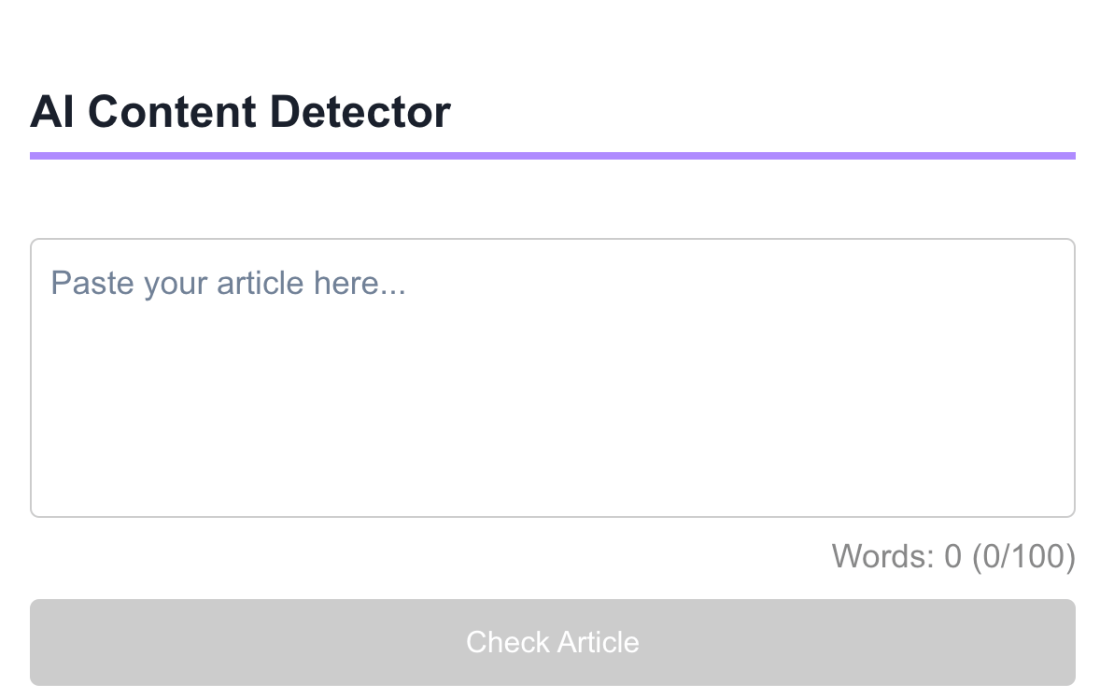
Paste your text below and the checker will tell you how closely it matches the writing patterns of an unedited AI draft — uniform sentence length, stock phrasing, missing contractions, no concrete detail. It runs entirely in your browser. Nothing you paste is uploaded, stored or logged.
Before you use the number for anything that matters, read what it actually measures. It is a style check, not proof of who wrote something, and that distinction matters more than most tools admit.
How to read your score
The score is a weighted blend of eight measurable signals. It answers one question: does this read like a first-pass AI draft? It does not answer "was this written by AI", and no tool can.
| Score | Reads as | What to do |
|---|---|---|
| 0–29 | Human | Nothing. Sentence rhythm and vocabulary look natural. |
| 30–54 | Mixed | Worth one editing pass. Usually a few stock phrases and flat sentence rhythm. |
| 55–74 | AI-patterned | A reader who knows LLM writing would probably notice. Rewrite the flagged phrases and vary sentence length. |
| 75–100 | Heavily AI-patterned | Reads like raw model output. Needs a real edit, not a find-and-replace. |
For calibration: when we built this we ran it across our own blog. Most posts landed between 14 and 26. The highest score we found was 50, on an earlier version of this very page — which is part of why it has been rewritten.
What the checker actually measures
Most detectors return a percentage and no reasoning. Ours shows every signal, because a number you cannot interrogate is a number you cannot act on. Here is the full list.
| Signal | What it looks at | Why it correlates with AI drafts |
|---|---|---|
| Sentence-length variation | Coefficient of variation across every sentence | Human writing swings between four-word sentences and forty-word ones. Models settle into a narrow band, usually 15–25 words. |
| Stock AI phrasing | Around 130 phrases: delve into, it's important to note, navigate the complexities, a testament to | These are overrepresented in model output relative to ordinary prose. Each match is listed so you can rewrite it. |
| Paragraph uniformity | Variation in paragraph length | Unedited drafts produce paragraphs of near-identical size. Human drafts have one-line paragraphs and long ones. |
| Concrete detail | Density of numbers and proper nouns | Models write around specifics they were not given. Real expertise names things: prices, dates, tools, places. |
| Contractions | Rate of don't, it's, you're | Default model register is formal. Most human writing contracts freely. |
| Connective density | Furthermore, moreover, additionally, in conclusion | Models signpost every transition. Human writers mostly just move on. |
| Repeated sentence openers | Formal openers reused across sentences | Marks the rhythmic sameness of generated paragraphs. Conversational openers are excluded, since repeating "So" and "But" is a human habit. |
| Rule-of-three lists | "X, Y and Z" constructions | Models reach for triads constantly, well past the rate at which they occur naturally. |
Why we don't give you a "percentage AI" figure
Every tool that shows you "87% AI-generated" is presenting a style judgement as a probability of authorship. Those are different claims, and the second one is not supportable.
Three things worth knowing before you trust any detector, including this one:
- OpenAI withdrew its own classifier. The company with the most access to how its models write shut down its AI Text Classifier because the accuracy was too low to be useful. If they could not do it reliably, treat confident competitors with suspicion.
- False positives fall unevenly. Detectors flag writing by non-native English speakers far more often than native speakers, because simpler vocabulary and more regular sentence structure look, statistically, like a model. The same is true of anyone writing in a plain, formal register — technical documentation, legal summaries, academic abstracts.
- Editing defeats all of them. We ran one of our own AI-drafted, human-edited articles through this checker and it scored 23. That is not a flaw in the tool. Once specifics, varied rhythm and real opinions go in, the text genuinely no longer reads like a model wrote it — because in every way that matters to a reader, it no longer did.
So use the score the way you would use a readability score: as a prompt to look again at your own writing. Never as evidence about someone else's.
What to do with a high score
The signal breakdown tells you which lever to pull. In rough order of how much they move the result:
- Rewrite the flagged phrases. The chips under your result are literal strings to cut. Most have a shorter, plainer equivalent: delve into is look at, it's important to note that is usually deletable entirely.
- Break the sentence rhythm. Find three consecutive sentences of similar length and cut one in half. A four-word sentence after a thirty-word one does more for readability than any other single edit.
- Add specifics. Replace "significant improvements" with the actual number. Replace "leading tools" with the actual tool names. This lifts the concrete-detail signal and is the edit that most improves the writing regardless of the score.
- Delete the signposting. Cut furthermore, moreover and in conclusion. The paragraph almost always survives without them.
- Let it contract. Do not becomes don't unless you are writing something deliberately formal.
If you would rather not do this pass by hand every time, our AI text humanizer covers the rewriting workflow, and using AI content for SEO covers the editing standard we hold our own published articles to.
Does Google penalise content because it was AI-assisted?
No. Google's stated position is that it rewards helpful, original content regardless of how it was produced, and acts against mass-produced low-value pages whether a human or a model made them. The problem was never the tool. It is that unedited output tends to be generic, and generic pages do not earn rankings.
Which is the practical reason to care about your score: a high number usually means the text is vague, repetitive and interchangeable with a hundred other pages. That is a ranking problem and a reader problem before it is an "AI" problem. We have covered the evidence in more depth in is AI content bad for SEO and does AI content rank on Google, and the underlying data sits in our AI content detector report.
Frequently asked questions
Is this AI content detector free?
Yes, with no account, no sign-up and no limit. It runs as JavaScript in your browser, so it costs us nothing to serve.
Does my text get uploaded or stored anywhere?
No. There is no network request. The analysis happens on your device, and closing the tab discards everything.
Can it detect ChatGPT, Claude or Gemini specifically?
No, and neither can anything else honestly. The signals it measures are common to instruction-tuned models in general. There is no reliable fingerprint that separates one vendor's output from another's once the text is a few paragraphs long.
Can teachers or editors use this to prove someone used AI?
No, and they should not try. A high score means writing is generic and formulaic, which can be true of perfectly honest human work. Using a style score as evidence in an academic or disciplinary process is unfair to the person being accused, and the false-positive rate against non-native speakers makes it actively discriminatory.
Why did my clearly human writing score high?
Most often because it is formal, evenly paced and light on specifics — corporate copy, policy documents and academic abstracts all trip these signals. Check the breakdown: if the flagged phrases genuinely are yours, the score is telling you something about register, not authorship.
How accurate is it?
It is accurate at what it measures, which is stylistic similarity to unedited AI drafts, and it is transparent about every input so you can judge each one. It is not a probability that a machine wrote your text, and we would not trust any tool that claims to be.
The faster fix is upstream. Most of these signals appear because a draft was generated and shipped without an editing pass. Arvow writes with the specifics in from the start — real data, varied rhythm, no delve into — so the pass you just did by hand is one you mostly stop needing.
Generate, publish, syndicate and update articles automatically
The AI SEO Writer that Auto-Publishes to your Blog
- Cancel anytime
- Articles in 30 secs
- Plagiarism Free