
The Free Tool Lead Magnet SEO Strategy We Actually Run (2026)


Most SEO advice stops at the ranking. You find a keyword, you write the page, you get the click — and then the article quietly assumes a stranger who came for information will hand over a credit card.
Usually they don't. So here's the funnel we actually run at Arvow, keyword by keyword: a set of underserved commercial keywords, two articles that rank for them, a free Chrome extension at the end, and the paid product introduced from inside that extension rather than from the blog post. Real numbers, including the unflattering one.
The keyword cluster: about 4,400 searches a month nobody wants
The cluster is five keywords, all variations on the same idea — people looking for a browser extension that shows SEO data on the page they're viewing:
| Keyword | US volume/mo |
|---|---|
| ahrefs seo toolbar | 1,200 |
| seo toolbar | 1,100 |
| seo toolbar for chrome | 800 |
| best seo toolbar | 700 |
| seo toolbar chrome | 600 |
That's roughly 4,400 US searches a month across the group. Not enormous. But look at what sits behind the head term: "seo toolbar" carries a keyword difficulty of 42, a traffic potential of 6.3K, an estimated traffic value of $20K, and a CPC of $4.00.
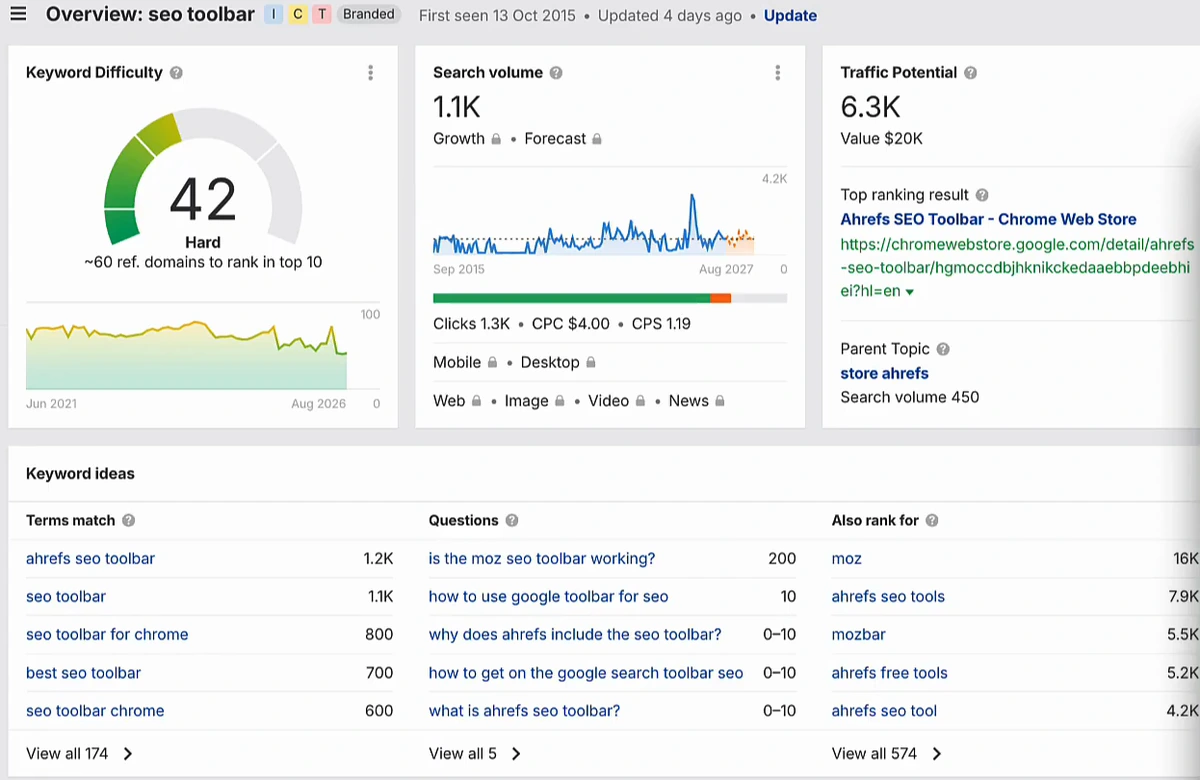
A $4.00 CPC on a 1,100-volume keyword is the tell. Advertisers only bid that on searches that convert. Nobody types "seo toolbar" idly — they type it because they are about to install something and start doing SEO work. That is as close to buying intent as an informational-looking query gets.
The other tell is the parent topic: Ahrefs reports it as "store ahrefs", and the top-ranking result is the Ahrefs SEO Toolbar listing on the Chrome Web Store. Which brings us to the part that makes this cluster underserved.
Half the cluster is competitor brand terms
"ahrefs seo toolbar" is the biggest keyword in the group at 1,200 a month. It is also, obviously, someone else's brand name. The people searching it are not loyal to anything — they want a toolbar, and they've heard of one.
The way to capture that traffic without being obnoxious is a comparison article that genuinely reviews the field, ours included, and lets the reader decide. That's what the 11-best-toolbars roundup is. Its quick-picks block names the Ahrefs SEO Toolbar as the best all-around option — first item on the list — and puts our own extension in the beginner slot:
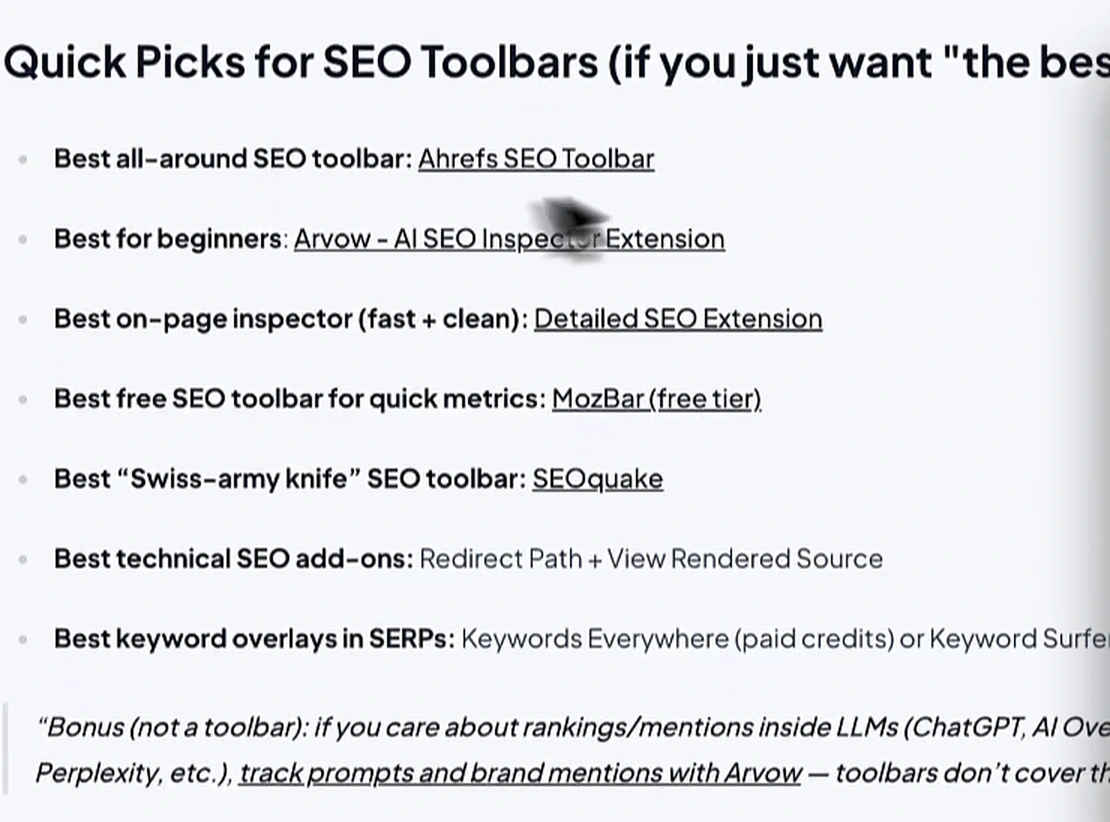
If you want to rank for "best X" when a competitor owns X, you have to actually recommend them somewhere. A page that ranks eleven toolbars and finds its own to be the best at all eleven things converts worse and ranks worse. The second page, a focused piece on the best Chrome SEO toolbar, does the narrower job for the Chrome-specific queries.
What the SERP looks like from the outside
Here's the SERP overview for "seo toolbar for chrome" as of 11 August 2026. Read the DR column:
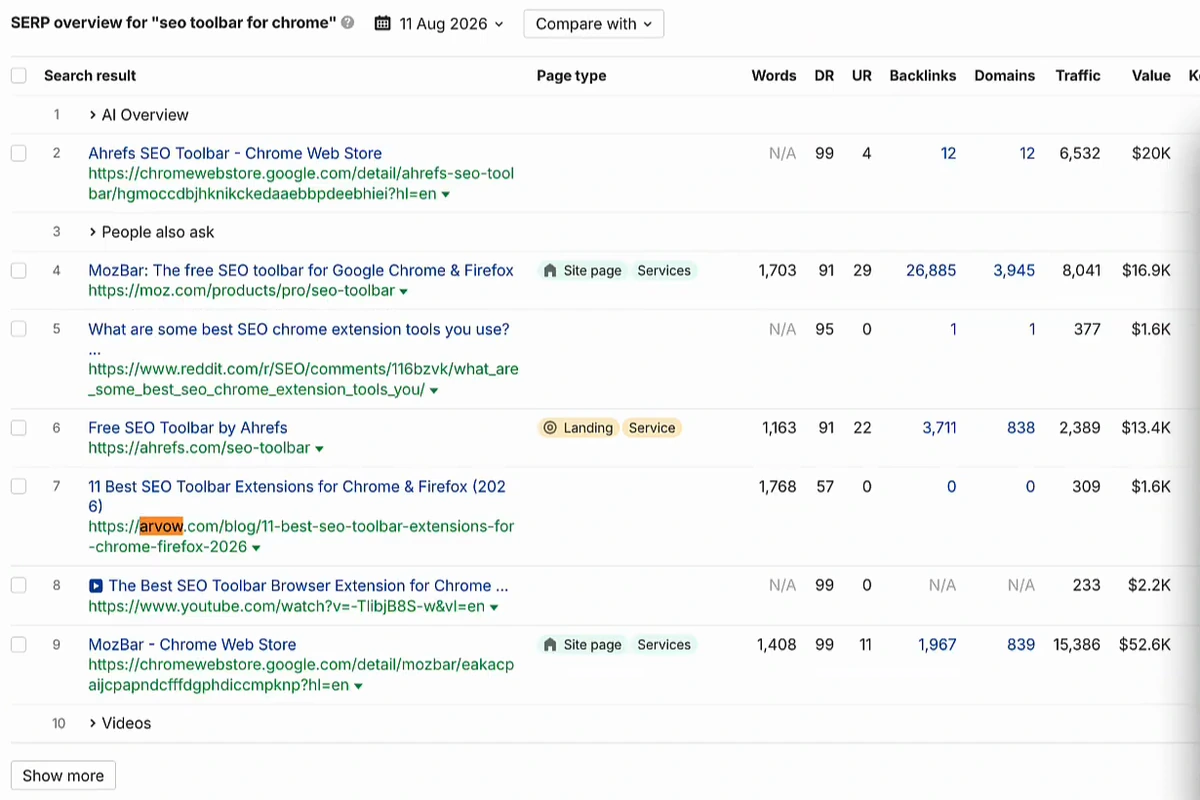
The competition on that page is the Chrome Web Store at DR 99, Reddit at DR 95, Moz at DR 91 with 26,885 backlinks pointing at its toolbar page, and Ahrefs at DR 91 with 3,711. Our roundup sits at position 7 on DR 57 with zero backlinks and zero referring domains — 1,768 words, an estimated 309 monthly visits, $1.6K of traffic value.
Position 7 is not a victory lap, but it's the number that makes the strategy worth copying: the page earns its slot on topical fit and format, not on authority. Note position 8 as well — our YouTube video on the same query, taking a second slot for free.
The pages also oscillate. Pull the SERP twice and one of the two sometimes isn't there. Rankings in the 5–10 band move day to day; expect the traffic line to wobble rather than climb.
The handoff: the article's job is the install, not the sale
This is the part most funnels get wrong. The roundup does not try to sell software. It tries to get one thing done: the reader installs a free Chrome extension.
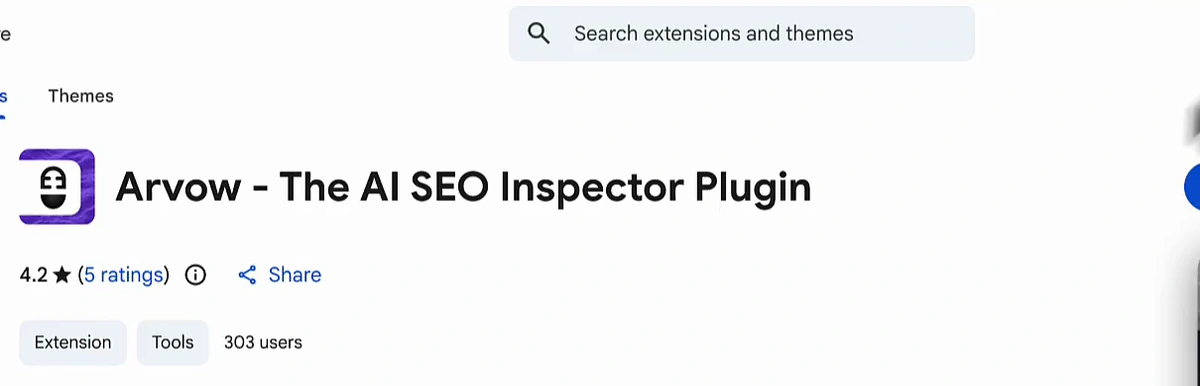
303 users is a small number and I'd rather say it than round it into something vague. The mechanism is what's being tested here, not the scale.
The extension does a real job. Open it on any page and it grades on-page SEO out of 100, reports word count, images, links, page load, and an AI-readiness score, then lists what's broken. All of it is free and all of it is useful on its own — you can install it, fix your alt text, and never think about the paid product.
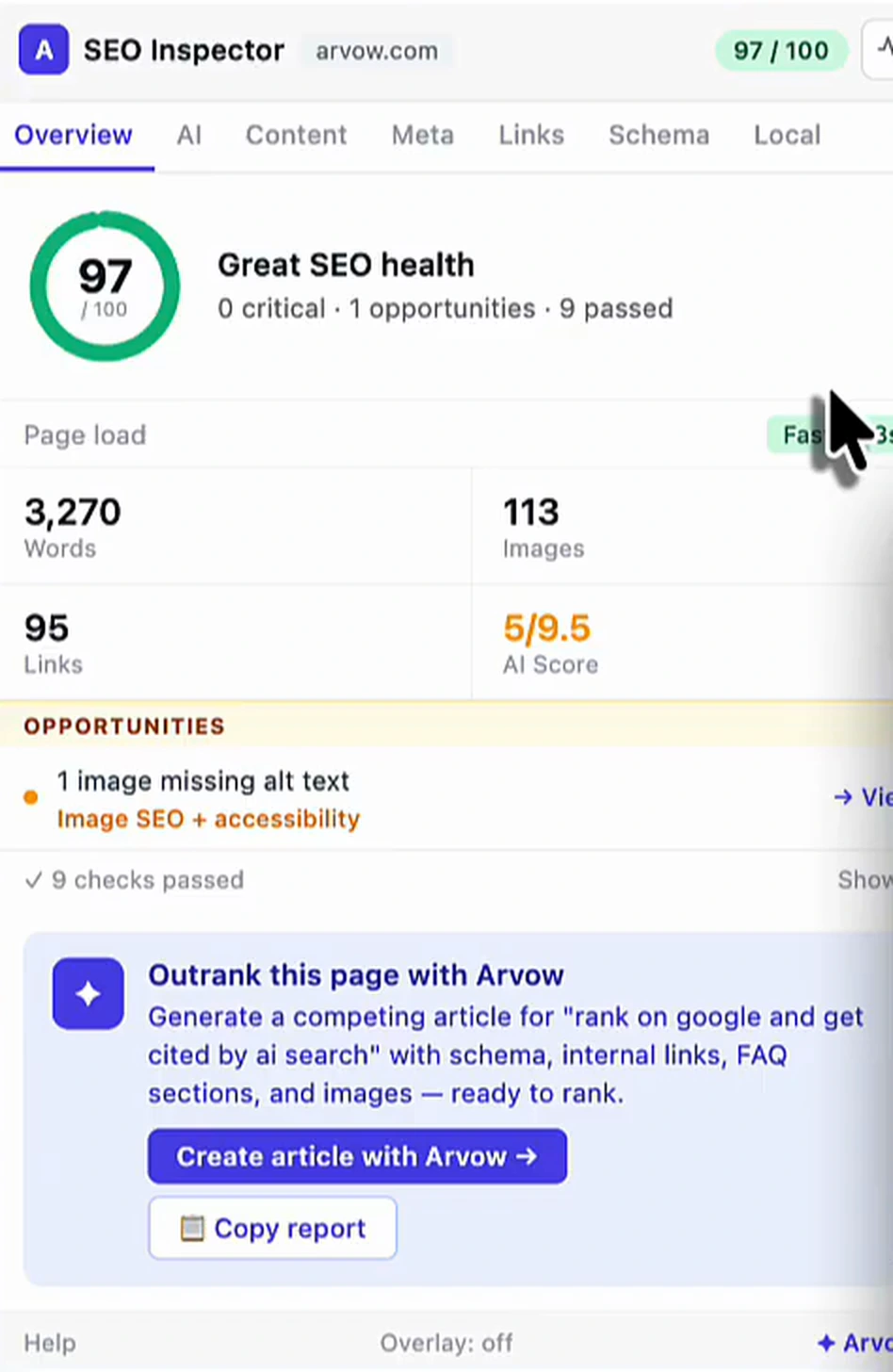
But underneath the findings sits a panel that says Outrank this page with Arvow, offering to generate a competing article for the query the page targets — with schema, internal links, FAQ sections and images. The reader has just been shown a specific, concrete problem. The fix is one click away. That's the entire conversion event.
The sequence is worth stating plainly, because the ordering is the strategy:
- Rank for a commercial keyword the buyer already types, including competitors' brand terms.
- Give away a tool that solves a slice of the problem completely and for free.
- Diagnose something specific and true about the user's own site inside that tool.
- Offer the paid product as the fix for the thing you just diagnosed.
Most people who install never buy, and that's fine — the tool cost nothing to run for them. The ones who do buy arrive already convinced, because the free tool has been telling them the truth about their site for a week.
Honey did this at 12 million users
If the mechanic sounds too small to matter, the biggest example of it is a coupon extension.
Honey sat in your browser and, at checkout, searched the web for a working coupon code. Free, valuable, no catch the user could feel. The revenue came from affiliate commissions — 12 million people installed a money-saving tool and never thought about the business model. Same shape as ours, different monetisation.
How to run this if you're not a SaaS
The keyword half of this transfers cleanly. The tool half needs a bit of thought, because the temptation is to build a calculator, and calculators are a solved and crowded space — "mortgage calculator" and its cousins have been fought over for fifteen years. Build something that runs on the user's own thing instead.
A web design agency
Ship a free extension that analyses conversion-rate optimisation on whatever page the user is looking at. It says: your primary call-to-action is purple, the surrounding buttons are grey, the eye has nowhere to land, here's the change and here's why it lifts clicks. Then: do it yourself, or hire us to do it.
An e-commerce store
Ship the thing buyers check before purchasing — a sizing or compatibility checker, a shipping-cost estimator that works across the retailers they already browse. Rank for the "how do I know if X fits Y" queries and hand them the tool.
A local business
Skip the extension — the format matters less than the giveaway. A free on-site audit, a template, a checklist scoped tightly to one job. Same four steps.
The counter-intuitive part — and the one people resist — is that the tool must give away everything. Tell them exactly how to fix it, in full, no gate. Most business owners who read a complete set of instructions still won't do the work themselves, because they're running a business and don't have the hours. Holding back the answer doesn't create demand; it just makes the tool worse and the trust thinner.
Finding the keyword to hang the tool on
Look for queries where the searcher is one step away from installing, downloading or configuring something — not queries where they're reading around a subject. Three markers:
- The top result is a store listing or a product page, not a blog post. That tells you Google reads the intent as transactional.
- CPC is high relative to volume. $4.00 on 1,100 searches means advertisers have measured the conversion rate and liked it.
- Competitor brand terms sit inside the cluster. Those are the cheapest to rank for with a comparison piece, and the traffic is pre-qualified — someone searching a rival's product name has already decided they want the category.
Our automated keyword research workflow covers the mechanics of pulling the cluster; the full SaaS SEO guide covers what to do once you have it. And if your keyword pool looks thin, the most expensive keywords by CPC are a useful map of where commercial intent concentrates.
Want the free tool itself? The Arvow AI SEO Inspector is on the Chrome Web Store — install it, run it on a page you care about, and see the strategy from the user's side.
Where this can go wrong
Three honest failure modes, since I'm showing the strategy rather than selling it.
The tool has to be independently worth installing. If it's a lead-capture form wearing an extension costume, it gets uninstalled in a day and the reviews say so. Ours sits at 4.2 stars from five ratings — a small enough sample that one bad review moves it a lot.
Building a tool is a real cost. A blog post takes an afternoon; an extension takes engineering plus ongoing maintenance against a moving browser. The maths only works if the cluster is genuinely commercial — otherwise you've built software to serve traffic that was never going to buy.
The plan is more tools, and that's unproven. The next one being considered is a web design inspector along the same lines. Whether one extension per vertical compounds or just fragments attention is not something 303 users can answer yet.
The whole thing in one sentence
Rank for keywords where the searcher is about to install something, give them a free tool that fully solves one problem, and put the paid product where the tool has just proved it's needed.
FAQ
What is a free tool lead magnet in SEO?
It's a genuinely useful free tool — a browser extension, an in-browser checker, an audit — that a piece of ranking content sends readers to instead of asking for a sale. The tool solves one real problem for free, and introduces the paid product from inside itself, at the moment it has diagnosed something the user needs fixed.
Why target a competitor's brand keyword?
Because the intent is already qualified. Someone searching "ahrefs seo toolbar" has decided they want a toolbar; they've just defaulted to the name they know. A comparison article that honestly reviews the field — competitor included, and often recommended — can rank for that query and put your option in front of a reader who is one step from installing.
Can a low-authority page rank against DR 90+ sites?
It can reach the lower half of page one. The roundup discussed here sits at position 7 for "seo toolbar for chrome" on DR 57 with zero backlinks, against Chrome Web Store at DR 99 and Moz at DR 91. It does not beat them. Format match and topical specificity buy you a seat on the page; authority still decides the top three.
How much search volume do you need for this to work?
Less than you'd think, if the intent is commercial. The cluster here is around 4,400 US searches a month across five keywords — small by content-marketing standards, but with a $4.00 CPC on the head term, meaning advertisers have already validated that these searches convert.
Does the free tool have to be a Chrome extension?
No. The extension format works well because it runs on the user's own site and can diagnose something specific about it. But a web-based audit, a template, or a checklist follows the same four steps — rank, give, diagnose, offer. Avoid generic calculators; that space is old and heavily contested.
How do you stop the free tool from cannibalising the paid product?
By making the free tool complete at what it does and different from what you sell. The inspector diagnoses; the paid product does the work of fixing at scale. Someone happy to fix issues by hand was never going to buy, and gating the diagnosis would only have cost you their trust.
Generate, publish, syndicate and update articles automatically
The AI SEO Writer that Auto-Publishes to your Blog
- Cancel anytime
- Articles in 30 secs
- Plagiarism Free