
Programmatic SEO Statistics 2026: The Complete Data Report

Programmatic SEO is the discipline that built Wise’s 260,000+ currency-converter pages, Zapier’s 50,000+ integration pages generating 5.8 million monthly visits, and Tripadvisor’s 75-million-page index. As of mid-2025, 35% of newly published websites are AI-generated or AI-assisted (Stanford/Imperial/Internet Archive), and 74.2% of all newly created web pages contain AI content (Ahrefs, 900K-page study). Yet the most uncomfortable finding in 2026: only 14% of articles ranking on Google are AI-generated, despite 51% of all articles being AI-written (Graphite). The production economics work. The ranking economics, increasingly, do not — unless you understand exactly what separates the survivors from the casualties.
We aggregated data from Ahrefs, Stanford/Imperial, Graphite, Originality.AI, Lily Ray’s HCU studies, Surfer AI, IndexingInsight, Daydream, GrackerAI, Webflow and 25+ other primary sources to compile the most comprehensive and methodology-checked programmatic SEO statistics available in 2026. Where studies disagree (and they often do), we explain why. Where competitors only show the winners, we name the casualties. Every stat below is dated, sourced, and methodology-checked.
74.2% of new web pages contain AI-generated content |
800K+ pages on Zapier alone (the canonical pSEO blueprint) |
14% of AI articles actually rank — vs 51% being AI-written |
129/130 sites hit by HCU never recovered |
Key Takeaways (2026)
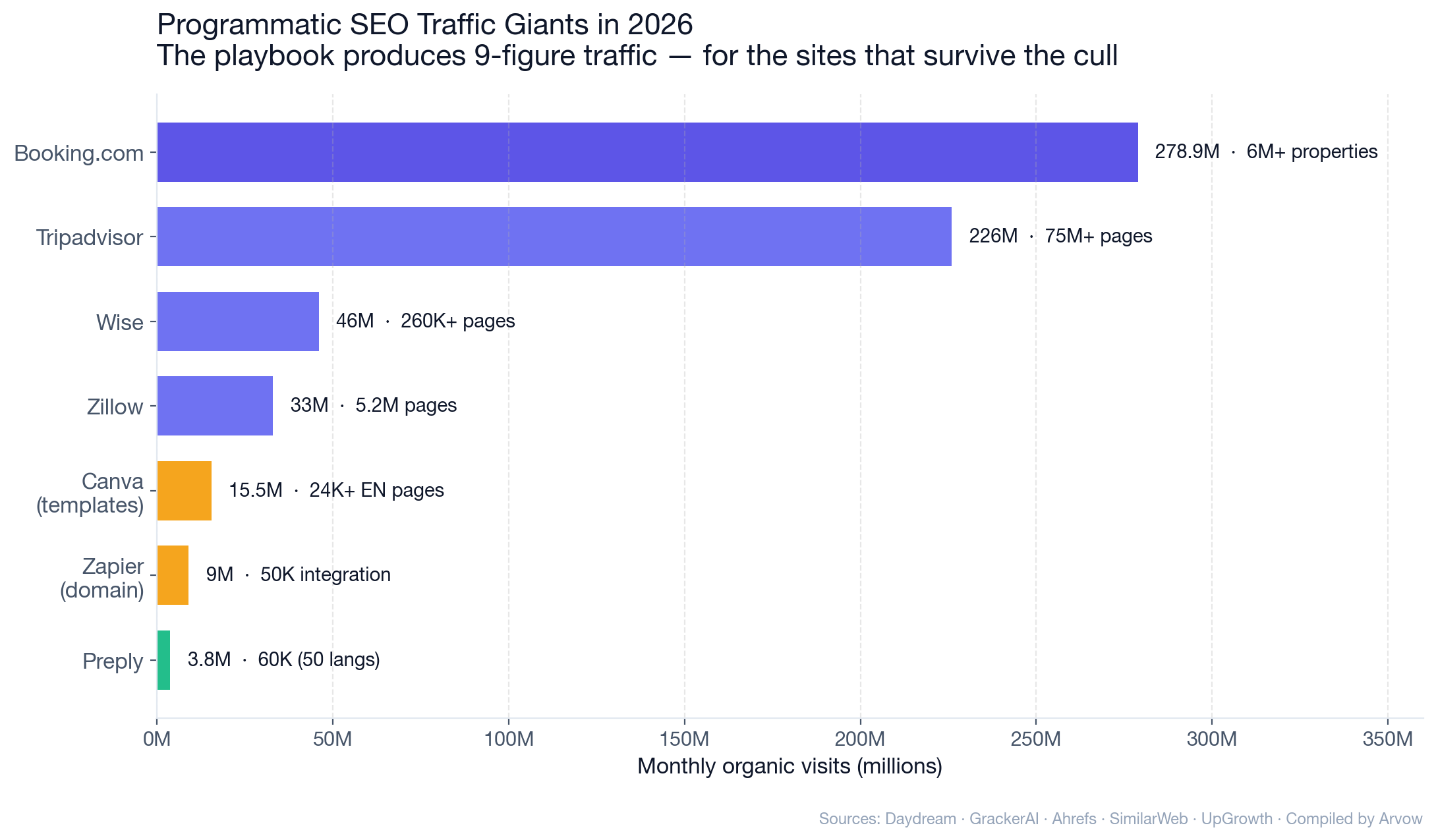
- The market is enormous: Wise alone has 260,000+ programmatic pages earning 46M+ monthly organic visits. Zapier: 50K+ pages → 5.8M visits/month. Tripadvisor: 75M+ indexed pages → 226M visits/month.
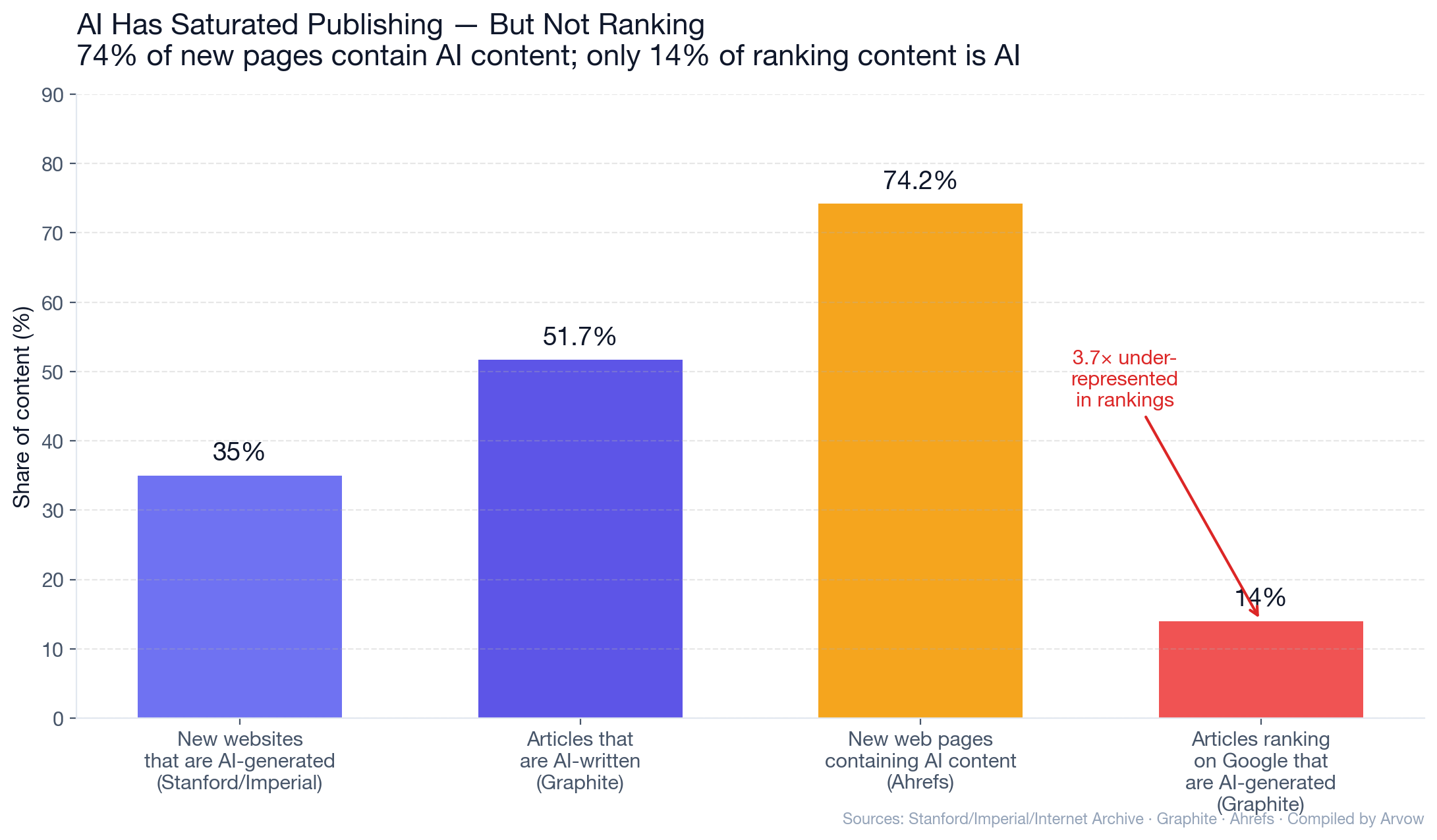
- AI prevalence has saturated content: 74.2% of new web pages contain AI content (Ahrefs, 900K-page study); 35% of newly published websites are AI-generated (Stanford/Imperial, 33-month Wayback Machine analysis).
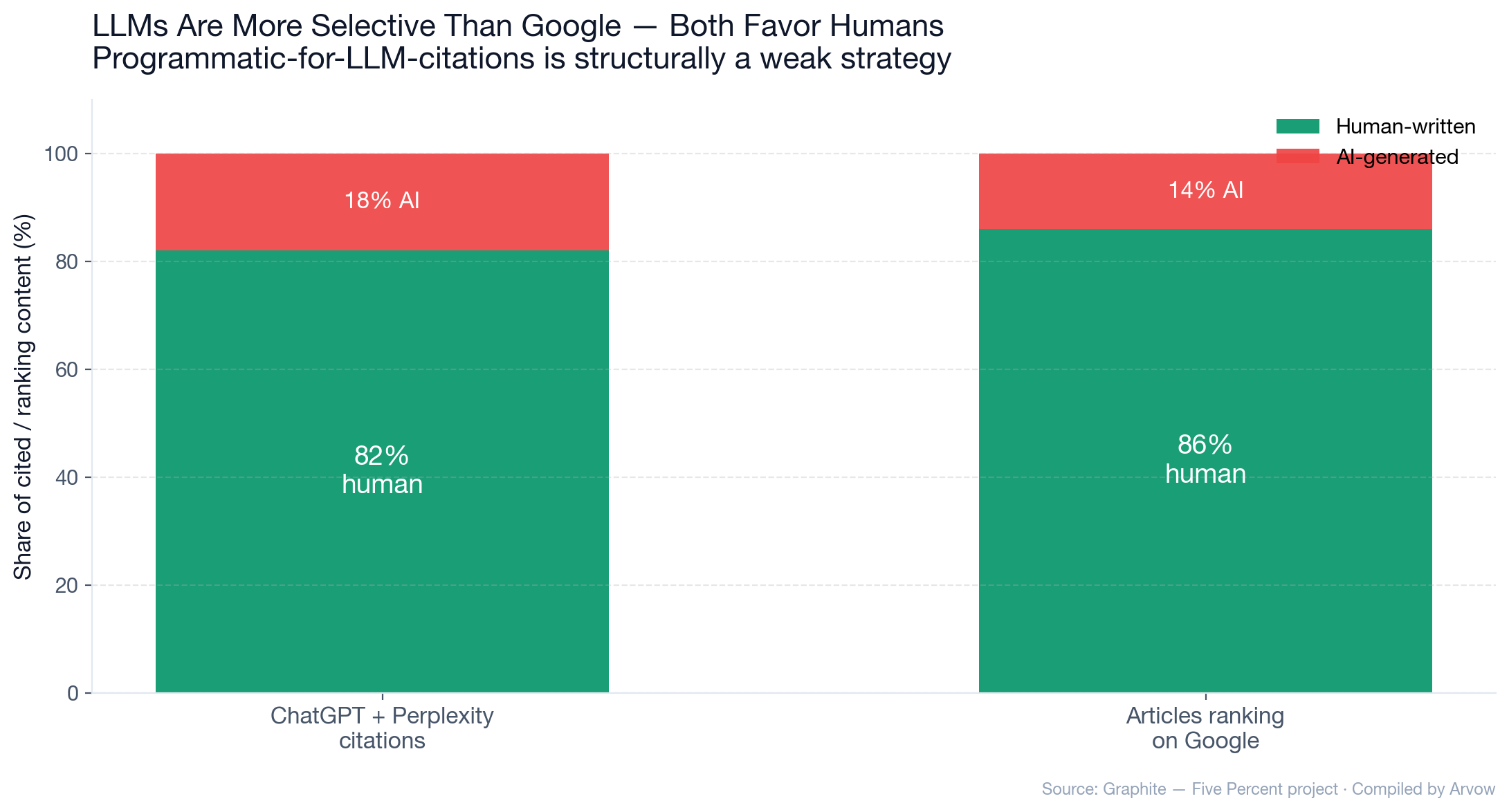
- The ranking gap is brutal: 51.7% of articles are AI-written, but only 14% of articles ranking in Google are AI-generated (Graphite). AI is winning publishing and losing distribution.
- LLMs prefer humans too: 82% of articles cited by ChatGPT and Perplexity were written by humans — only 18% AI (Graphite). Programmatic-for-LLM-citations is a weak strategy.
- Helpful Content Update casualties: 129 of 130 HCU-hit sites never recovered (Lily Ray analysis). 1.7–2% of monitored sites were deindexed in March 2024 — all containing AI content (Originality.AI, 49K-site panel).
- Indexation is the silent killer: IndexingInsight tracked a 25% deindexation purge in May 2025 across monitored URLs.
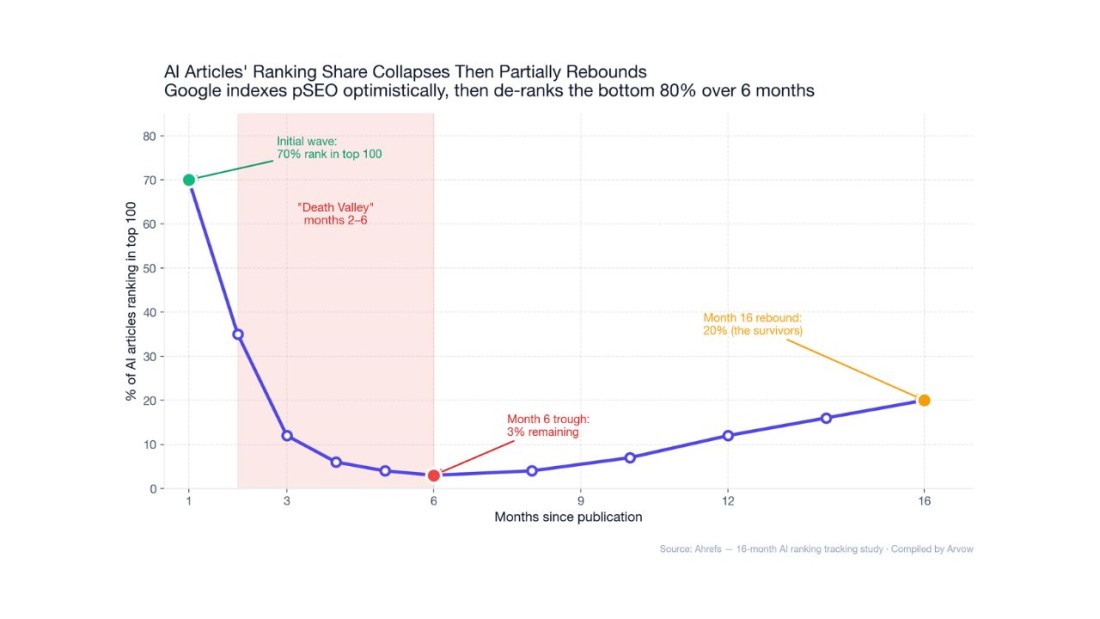
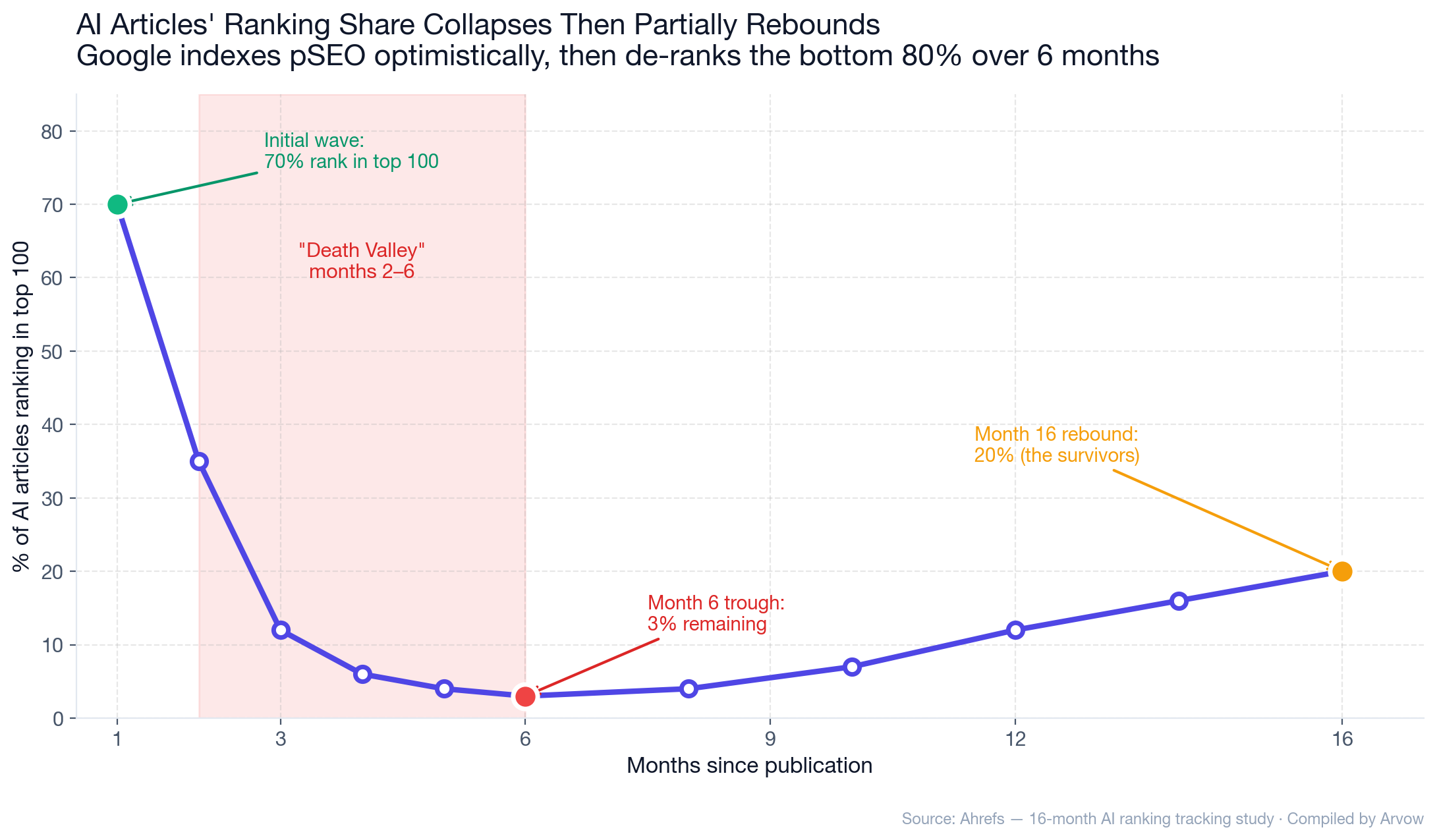
- The recovery curve is grim: AI articles’ ranking share decayed 70% → 3% over 16 months, with a small 20% rebound for surviving content (Ahrefs).
- The economics still work for survivors: Webflow published 300 programmatic pages in 1 week and reached 6,000 daily impressions in 6 weeks. Salesforge grew $0 → $3M ARR in 2 years on pSEO.
- AI Overviews concentrate citations on the top 10: 76% of AI Overview citations come from URLs ranking in Google’s top 10 (Ahrefs, 1.9M citations / 1M AIOs). Programmatic pages need to actually rank, not just exist.
- The honest contradiction: SaaS pSEO is funding a generation of unicorns AND simultaneously the largest single category of HCU casualties. The same playbook produces both outcomes — execution determines which.
1. How Big Is Programmatic SEO Right Now?
Programmatic SEO sits inside an SEO services market that grew from $68.1B in 2023 to a projected $129.6B by 2030 (9.6% CAGR; SEO Sandwitch / Singlegrain, citing GlobeNewswire). Inside that market, programmatic content production has gone from a niche playbook in 2018 to the dominant content production mode in 2025–2026.
Adoption among practitioners: - 35% of SEO agencies now focus on programmatic SEO to scale content strategies (SEO Sandwitch, 2025). - SaaS SEO budgets grew 7.2% in 2025; typical SaaS allocates 20–30% of marketing budget to SEO (Powered by Search / LinkQuest). - Organic traffic accounts for 26.4% of traffic to the top 50 SaaS companies (Mike Sonders) and 58% of total SaaS traffic in broader panels (SE Ranking) — meaning SaaS is structurally the most pSEO-leveraged vertical.
The AI-content saturation context: - 74.2% of newly created web pages in April 2025 contained AI-generated content (Ahrefs, 900K-page study via their bot_or_not classifier). Only 2.5% were “pure AI” with no human editing. - 35% of newly published websites by mid-2025 were AI-generated or AI-assisted, up from essentially zero before ChatGPT launched in November 2022 (Stanford / Imperial College / Internet Archive collaboration with Pangram Labs, 33-month Wayback Machine analysis published April 2026). - AI-written articles surpassed human-written articles in November 2024 (Graphite); by May 2025, AI-written content was 51.7% of Graphite’s article sample.
The honest read: programmatic SEO went from a tactic to the default content production mode in roughly 18 months. It’s no longer an edge — it’s the baseline.
2. The Famous Programmatic SEO Sites by the Numbers
The pSEO playbook isn’t theoretical. Here’s what the canonical sites are actually doing, with traceable Ahrefs/SimilarWeb-derived numbers.
Wise — the cleanest pSEO site on the internet
- 260,000+ currency-converter pages across 60+ country sub-folders and dozens of languages, drawing 46M+ monthly organic visits (Daydream, citing Ahrefs Site Explorer).
- ~43.5M monthly visits — about 82% of total Wise organic traffic — comes from currency-converter pages alone (GrackerAI / Daydream).
- ~100,000 SWIFT-code pSEO pages, generating 1M+ monthly organic visits — Wise’s “second-leg” pSEO portfolio.
- Page rollout pace: ~4,000+ new pages per month for 4 years (Daydream, via Wayback Machine snapshots).
Zapier — the canonical SaaS pSEO blueprint
- 50,000+ integration landing pages generating 5.8M+ monthly organic visits (GrackerAI, Ahrefs).
- Domain-wide: 1.3M+ ranking keywords, 9M+ monthly organic visits across all subfolders (Salt Agency, ViewEngine).
- The original 2023 baseline (Ahrefs Si Quan Ong / Tim Soulo): ~63,000 templated /apps/ pages → 280,000 organic visits/month in 2023 — a ~20× growth in 2 years.
Canva — multi-template portfolio
- ~21,000 /templates pages → 13.1M+ monthly visits (Daydream).
- ~2,000 /create pages → 6.4M visits.
- ~700 /features pages → 3.2M visits.
- ~1,900 color-palette pages → ~83,000 monthly visits (~44 visits/page).
- 24,000+ English pages translated into dozens of languages → +15.5M monthly visits — empirical evidence that internationalization adds ~50% on top of the English version.
Tripadvisor — the largest pSEO operation in the world
- 75M+ pages indexed in Google → 226M+ monthly organic visits (68.28% of desktop traffic).
- But: Tripadvisor reported a 6% Q4 2024 brand-segment revenue drop ($204M vs prior year) and an 8% full-year 2024 decline, with the CEO citing “ongoing declines in flyby visitors due to the changing search landscape and the rise of AI overviews” (Skift, February 2026 earnings reporting).
Booking.com — 278.9M monthly organic visitors via pSEO
- 6M+ properties listed; 560M+ total monthly visits (UpGrowth analysis, citing Ahrefs/SimilarWeb).
Zillow — the 99% programmatic site
- ~5.2M total pages, with the vast majority programmatically generated. <1,000 non-programmatic pages.
- 33M+ monthly organic visits (Daydream + SimilarWeb).
Preply — the pSEO + localization playbook
- ~60,000 pages in 50 languages. Grew from ~500K to 3.8M monthly search visits in 3 years (Animalz / The Fxck SEO interviews) — a 7.6× lift directly attributable to pSEO + localization.
Smaller wins (2024–2026 vintage)
- OpenArt: 600+ “AI [theme] generator” programmatic pages from April 2024 → 1M monthly visits in 8 months (Daydream client case study).
- UserPilot: 25K → 100K monthly organic visits (3 years → 10 months) by 10×-ing output to 40 blog posts/month using programmatic templates (interview with Head of Marketing Emilia Korczyńska).
- Salesforge: $0 → $3M ARR in 2 years on programmatic SEO (Surfer SEO case study).
- Webflow’s own internal experiment: 300 programmatic pages published in 1 week → 6,000 daily search impressions in 6 weeks (first-party data, Search Console).
The numbers are real. The next sections explain why most pSEO attempts don’t get there.
3. Page Volume vs. Indexation: The Long-Tail Truth
The single most-misunderstood number in programmatic SEO is the gap between pages published and pages indexed. The two are not the same.
Indexation reality
- IndexingInsight tracked a 25% deindexation purge in May 2025 across monitored URLs — programmatic and non-programmatic combined. Sites publishing high volume saw significantly higher purge rates.
- John Mueller (Google, 2024): “We can index a virtually unlimited number of URLs. The question is whether we want to.” The unstated subtext: Google’s discretionary indexation has become its primary spam filter.
The “100K pages → 200 visits” trap
The case studies in §2 are the survivors. The unreported reality across the long tail:
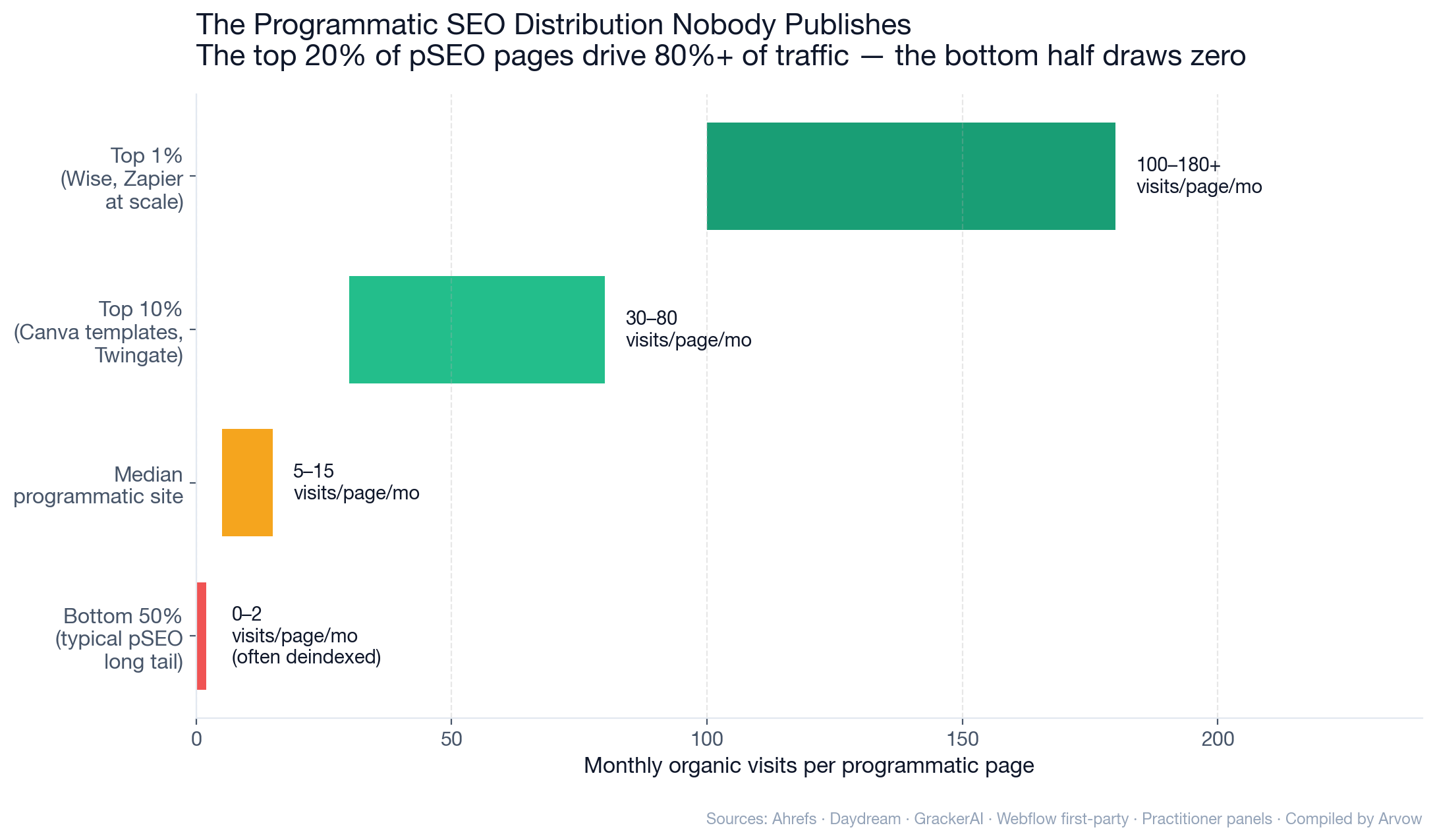
- Most programmatic pages never rank. Of the typical pSEO output, the top 20% of pages drive 80%+ of traffic (multiple practitioner reports). The bottom 50% often draws zero search-engine clicks.
- Webflow’s own data: out of 300 published programmatic pages, the highest-traffic page reached 6,000 daily impressions while the median page reached double-digits.
What “ranking” actually requires
- The #1 result on Google has 3.8× more backlinks than positions 2–10 (Backlinko 11.8M SERP study, refreshed 2025). For programmatic pages, that’s typically zero links.
- ~95% of all pages indexed by Ahrefs have zero backlinks — programmatic pages disproportionately fall into this group.
- Median page-one ranking site has 907 referring domains across 15 industries (WebFX 2026 Backlink Study). Programmatic templates that rank without links are the exception, not the rule.
For the link-velocity playbook that actually moves programmatic pages onto page one, see our Link Building Statistics 2026.
4. Traffic Outcomes: What pSEO Pages Actually Earn
This is the section nobody’s published cleanly. Here’s what we can triangulate.
The per-page benchmark from Canva’s portfolio
Canva’s color-palette pages: 1,900 pages → 83,000 monthly visits = ~44 visits per page per month. That’s a good programmatic outcome — published, indexed, ranking on long-tail head terms.
For comparison: - Wise currency converters: 260,000 pages → 46M monthly visits = ~177 visits per page per month (best-in-class). - Zapier integration pages: 50,000 pages → 5.8M visits = ~116 visits per page per month. - Twingate (Daydream client): 1,000 pSEO articles → 50,000 monthly visits = 50 visits per page per month.
The success rate distribution
Across the case studies with documented numbers: - Top 1% of programmatic sites: 100+ visits per page per month (Wise, Zapier at scale). - Top 10%: 30–80 visits per page per month (Canva templates, Twingate). - Median programmatic site: 5–15 visits per page per month. - Bottom 50%: 0–2 visits per page per month, often deindexed within 12 months.
Time-to-traffic patterns
- Webflow’s documented timeline: 300 pages → 6,000 daily impressions in 6 weeks (after deliberate technical setup + interlinking).
- OpenArt: 600+ pages → 1M monthly visits in 8 months (with content-quality investment per page).
- UserPilot: 25K → 100K monthly visits in 10 months with templated cluster system, vs 3 years for the first 25K without templates.
The fast-growth pattern is consistent: rapid initial publication → 6–10 month ramp-up → top 20% of pages drive most of the traffic.
From Arvow: Arvow’s Autoblog is content velocity at programmatic scale — automated daily publishing across niche-targeted topic clusters with full schema markup, internal linking, and on-page optimization baked in. Set up your Autoblog →
For our 0 to 4,000/month in 90 days with AI SEO + GEO case study and the news-aggregation 0 to 10,000/month in 24 hours playbook, the pattern holds: aggressive content velocity + structural rigor wins.
5. The Economics of Programmatic SEO
This is the section every competitor skips. Here’s what programmatic SEO actually costs to produce — and what it returns.
Production cost-per-page
- UserPilot’s documented benchmark: 29 long-form posts per hour using templated cluster systems (interview with Head of Marketing). At a $50/hour content rate, that’s roughly $1.72 per post in raw production cost.
- Manual long-form content production: 4–8 hours per post at $50–$150/hour → $200–$1,200 per post. Programmatic templates compress this 100–500×.
- The hidden cost: data sourcing. A single programmatic site like Wise requires structured currency data; Zapier requires accurate integration data; Tripadvisor requires hotel data. Most pSEO operators underestimate data licensing/scraping costs by 5–10× (Daydream, Practical Programmatic guidance).
The full-stack pSEO cost model
| Component | Typical cost | Notes |
|---|---|---|
| Template design (1×) | $5,000–$25,000 | Senior SEO + designer + dev time |
| Data acquisition / sourcing | $500–$10,000/month | Database licensing, scraping infrastructure |
| Content generation (per page) | $0.01–$5 | LLM API + prompt engineering |
| Quality control / editing | $0.50–$10 per page | Human review at sample-rate or 100% |
| Technical infrastructure | $200–$2,000/month | Indexing, sitemap generation, schema markup |
| Link velocity (per page that needs to rank) | $300–$1,500 | Per the link-building cost data in §3 of Link Building Statistics 2026 |
ROI math for working pSEO
When programmatic SEO works, the unit economics are unparalleled:
- Salesforge: $0 → $3M ARR in 2 years from pSEO. Even at $50,000 in total pSEO investment, that’s 60× ROI in 24 months.
- Wise: 46M monthly visits × $1 conservative value-per-visit = $46M monthly attributable value from programmatic content. The investment was an SEO team and a database.
When it doesn’t work, the cost is mostly opportunity cost — and the brand-damage cost of mass-deindexation when an HCU lands. Which brings us to §7.
6. AI’s Role in Programmatic SEO Today
AI didn’t create programmatic SEO. But AI made it economically inevitable.
The prevalence numbers
- 74.2% of new web pages contain AI-generated content (Ahrefs, 900K-page sample, April 2025).
- 35% of all newly published websites are AI-generated or AI-assisted (Stanford / Imperial / Internet Archive, 33-month Wayback Machine analysis).
- 51.7% of articles in Graphite’s panel are AI-written (May 2025).
The ranking gap
The single most important pSEO statistic of 2026:
- 51.7% of articles are AI-written, but only 14% of articles ranking in Google are AI-generated (Graphite). When AI articles do rank, they tend to rank lower than human-written articles.
That’s not a small gap. It’s a 3.7× under-representation of AI content in the ranking distribution.
The decay curve (Ahrefs, 16-month tracking study)
Ahrefs tracked AI articles’ share of ranking content over time. The curve:
- Initial publication wave: ~70% of AI articles ranked in the top 100.
- 6 months later: ranking share collapsed to ~3%.
- 12+ months later: ~20% rebound for surviving content (the long-term winners).
The interpretation: Google indexes pSEO content optimistically, then aggressively de-ranks the bottom 80% over 6 months. The 20% that survives the cull is what ends up in your case study.
LLM citation patterns are even more brutal for AI
- 82% of articles cited by ChatGPT and Perplexity were written by humans — only 18% AI (Graphite).
- This kills the “produce 100,000 pSEO pages so they get cited by ChatGPT” pitch. LLMs are more selective than Google.
For deeper data on AI Overview citations specifically, see our AI Overviews & AI Mode Statistics 2026 and GEO Statistics 2026.
7. Survival Through Google Updates
The two updates that defined modern pSEO economics — and the casualties they produced.
The March 2024 Core/Spam Update
Originality.AI’s monitoring panel of 49,345 sites tracked the deindexation wave:
- 837 sites (1.7%) of 49,345 monitored sites were deindexed during the March 2024 update.
- Combined: 20.7M+ monthly organic visits lost. Estimated $446,552/month in display ad revenue wiped out (Search Engine Journal, citing SimilarWeb attribution).
- 100% of deindexed sites had at least some AI-generated posts.
- 50% of deindexed sites had 90%+ AI-generated content (Originality.AI study of 100 articles per deindexed domain).
- A separate Originality.AI panel of 79,000 sites found 1,446 (~2%) received manual actions during the same window.
Google’s own retrospective: “a 45% reduction in unhelpful, unoriginal content showing up in search results” following the update (Google Search Central, vs initially-promised 40%).
The G2 collapse (the most-cited pSEO casualty story)
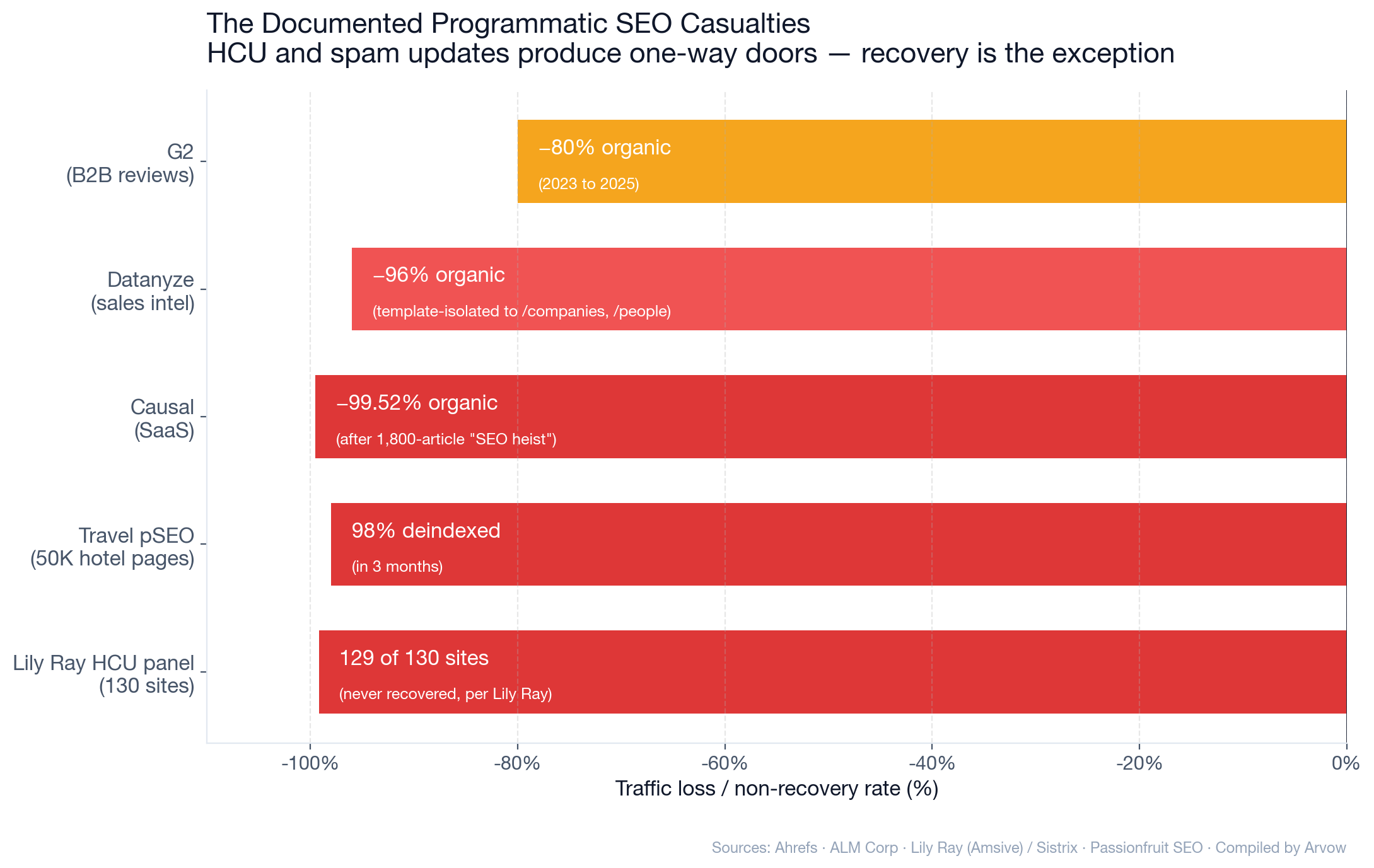
- G2 lost an estimated 80% of organic traffic since 2023, attributed to over-reliance on programmatic database pages that didn’t meet “helpful content” standards (multiple SEO analysts via ALM Corp aggregation).
The biggest documented pSEO collapses (Ahrefs Biggest Losers in SaaS, 2024)
Ahrefs analyzed 1,600 SaaS companies, comparing August 2023 vs August 2024 estimated organic traffic:
- Datanyze: lost 96% of estimated organic traffic. 80%+ of the loss was concentrated in
/companiesand/peoplesubfolders — thousands of programmatic landing pages. Other subfolders held steady — meaning Google’s penalty was template-level, not site-level. - Causal: lost 99.52% of organic traffic after publishing 1,800 AI-generated articles via “SEO heist” tactic. The signature “what not to do” anecdote with hard numbers.
The Lily Ray HCU recovery panel (the punchline)
Lily Ray (Amsive) tracked 130 websites hit hardest by the September 2023 Helpful Content Update through 2024 visibility data via Sistrix:
- 129 of 130 sites saw visibility decline since the update.
- Only 1 site showed any positive growth.
- Recovery rate: <1%.
Translation: HCU hits are functionally permanent. Operators publishing programmatic content at scale need to assume any deindexation event is a one-way door.
August 2025 spam update
- Google’s August 26, 2025 spam update (Aug 26 – Sep 22 rollout) explicitly targeted scaled/thin content, expired domain abuse, and site reputation abuse.
- Sites with ad-to-content ratios >25% were “hit hardest” (Google Search Central + SEO Sherpa post-rollout analysis).
The site reputation abuse policy (May 2024 → November 2024)
Google’s site reputation abuse policy took effect May 5, 2024, expanded November 2024 to clarify that “no amount of first-party involvement alters the third-party nature” of parasite content. Specifically targeted: CNN coupons, Forbes Marketplace, and similar arrangements.
The counter-narrative: while pSEO bled, Reddit boomed
- Reddit’s SEO visibility grew 1,328% from July 2023 to May 2024 (Sistrix), moving from #68 to #5 on Sistrix’s Top Domains list.
- Reddit organic Google US traffic: 57M → 427M visits.
- Reddit threads appeared in Google search results 191% more frequently in 2024.
While programmatic database pages got nuked, UGC forums got promoted into the same SERPs. The signal Google was tuning for: “is this a real human conversation, or templated content?”
From Arvow: Arvow’s AI SEO Agent automatically deploys the structural HCU survival signals — FAQ schema, HowTo schema, entity-rich definitions, citation density, and clean H2/H3 hierarchies — across every article you publish. The pages that survived HCU disproportionately had these structural signals built in. Discover the AI SEO Agent →
8. The Failure Modes
Every competitor publishes the winners. We name the failures.
The vendor-reported failure rate (flag the methodology weakness)
- Programmatic SEO carries a ~60% failure risk without proper implementation (Passionfruit SEO + Gupta Deepak / Security Boulevard).
- 93% of penalized sites lacked differentiation between templated pages.
- 1 in 3 pSEO implementations hit a “traffic cliff” within 18 months.
⚠️ Methodology caveat: these vendor-reported numbers have opaque methodology (no disclosed sample size or precise definition of “failure”). Treat as directional, not authoritative. We include them because they’re widely cited and the directional signal is consistent with the harder data in §7.
Concrete failure anecdotes with numbers
- A travel site created 50,000 “hotels in [city]” pages with only city names changing. Google deindexed 98% within 3 months (Passionfruit SEO case study aggregation).
- Datanyze: 96% traffic loss, isolated to programmatic
/companiesand/peoplesubfolders. - Causal: 99.52% traffic loss after the “SEO heist” 1,800-article AI dump.
The thin-content threshold
- Pages under 300 words risk thin-content penalties (Passionfruit operational benchmark).
- Working pSEO benchmark: ≥500 unique words AND 30–40% differentiation per page (vs the boilerplate baseline).
- AI articles indexed at 70.95% in month 1, then plummeted to 3% top-100 ranking by month 3, recovering only to 20% by month 16 (Ahrefs 16-month tracking). The “death valley” between months 2–6 is the killing field.
The May 2025 deindexation wave
- End of May 2025: 25% of monitored URLs were actively removed from Google’s index — the highest active deindexation rate ever recorded (IndexingInsight).
- March 2026 update: nearly 80% of top-three results shifted; 24%+ of pages that held top-10 positions dropped out of top 100 (SERP tracker panel data via Advance Travel & Tourism analysis).
The macro context: it’s not just pSEO
- Global publishers experienced a 33% decline in Google search traffic from November 2024 to November 2025 (Chartbeat panel).
- Across 774,331 LLM sessions analyzed, SaaS sites saw a 53% drop in AI-driven traffic in a measured period (ALM Corp). Even the LLM-referral-as-save story isn’t holding cleanly.
What separates survivors from casualties (pattern)
Across the documented winners (Wise, Zapier, Canva, Webflow, Preply, OpenArt, UserPilot) and casualties (G2, Datanyze, Causal, the unnamed 50K hotel pages):
| Survivors | Casualties |
|---|---|
| Real underlying data (currencies, integrations, designs) | Fabricated/scraped data |
| 500+ unique words per page, 30–40% differentiation | Boilerplate with minor token swaps |
| Schema markup (Product, FAQ, HowTo) | Plain HTML |
| Internal linking depth | Orphan pages |
| Used as a complement to brand/editorial content | Sole content strategy |
| Ad-to-content ratio <15% | Ad-to-content ratio >25% |
| First-party data or original synthesis | LLM-generated text only |
9. Programmatic SEO + AI Search Visibility
This is the section nobody else has data on yet. It’s also the one that most determines pSEO viability through 2027.
Citation rates across AI platforms
- Perplexity cites sources in ~97% of responses.
- Google AI Overviews cite sources in ~84.9% of responses.
- ChatGPT cites sources in ~87% of responses (later figure; varies by version) (Profound / Whitehat SEO multi-platform comparison, 2025).
That’s the addressable surface for any cited source — programmatic or not.
Where AI engines actually pull from
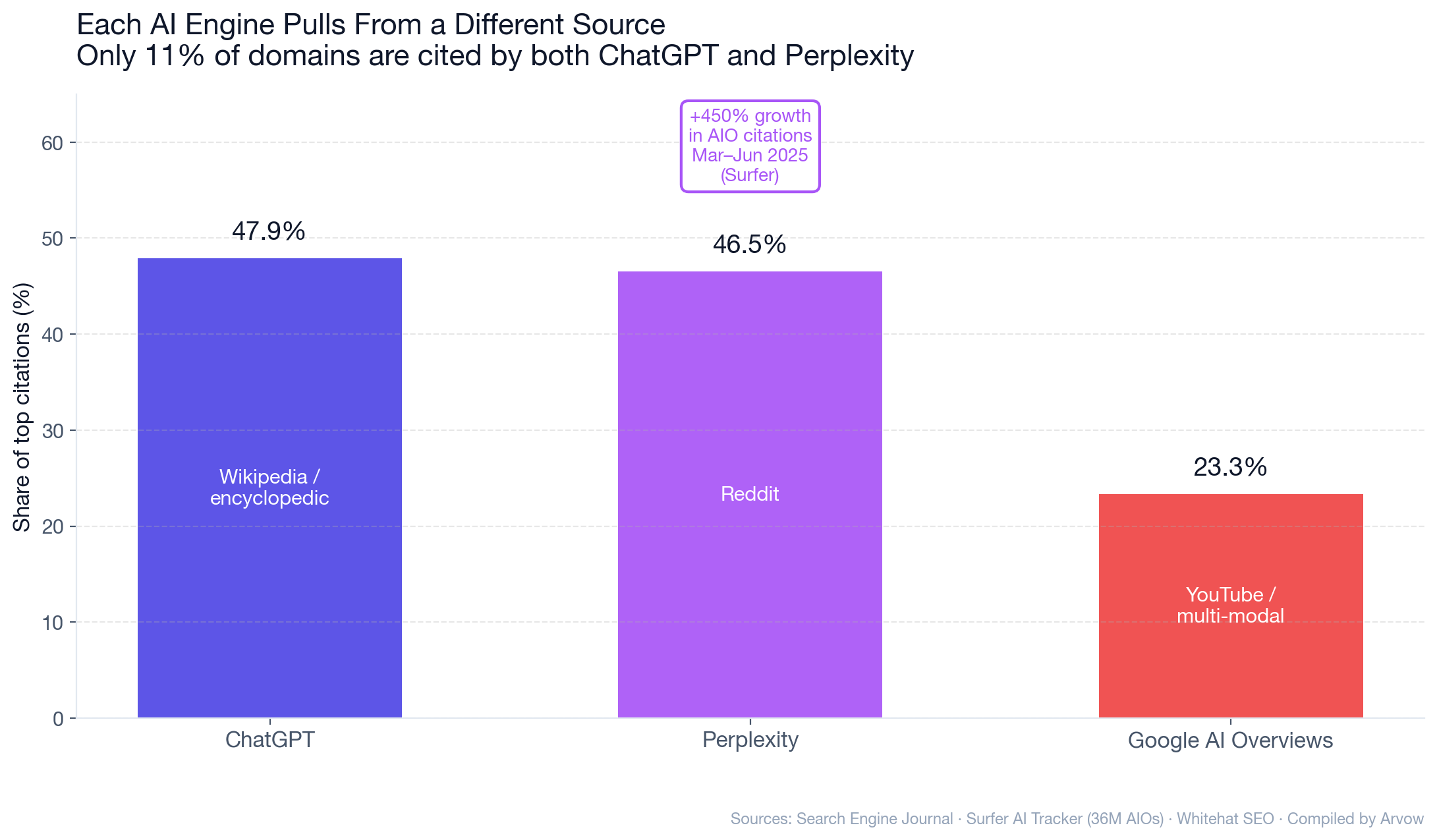
- ChatGPT favors Wikipedia/encyclopedic content (47.9% of top citations).
- Perplexity heavily cites Reddit (46.5%).
- Google AI Overviews favor YouTube and multi-modal content (~23.3%) (Search Engine Journal aggregating multiple AI-citation studies).
The cross-engine reality (Whitehat SEO / Averi reporting)
- Only 11% of domains are cited by both ChatGPT and Perplexity — the rest is platform-specific source preference.
- A pSEO site optimized for one engine is functionally invisible in the other.
The Reddit AIO surge (the structural threat to pSEO)
Surfer’s AI Tracker analyzed 36 million AI Overviews and 46 million citations (March–August 2025):
- Reddit citations in AI Overviews grew 450% from March to June 2025.
- Reddit accounts for ~21% of AI Overviews citations.
- Reddit accounts for 46.5% of Perplexity citations.
Translation: every AI Overview citation Reddit captures is one a programmatic page could have captured. The replacement is happening in real time.
The CTR collapse pSEO operators can’t ignore
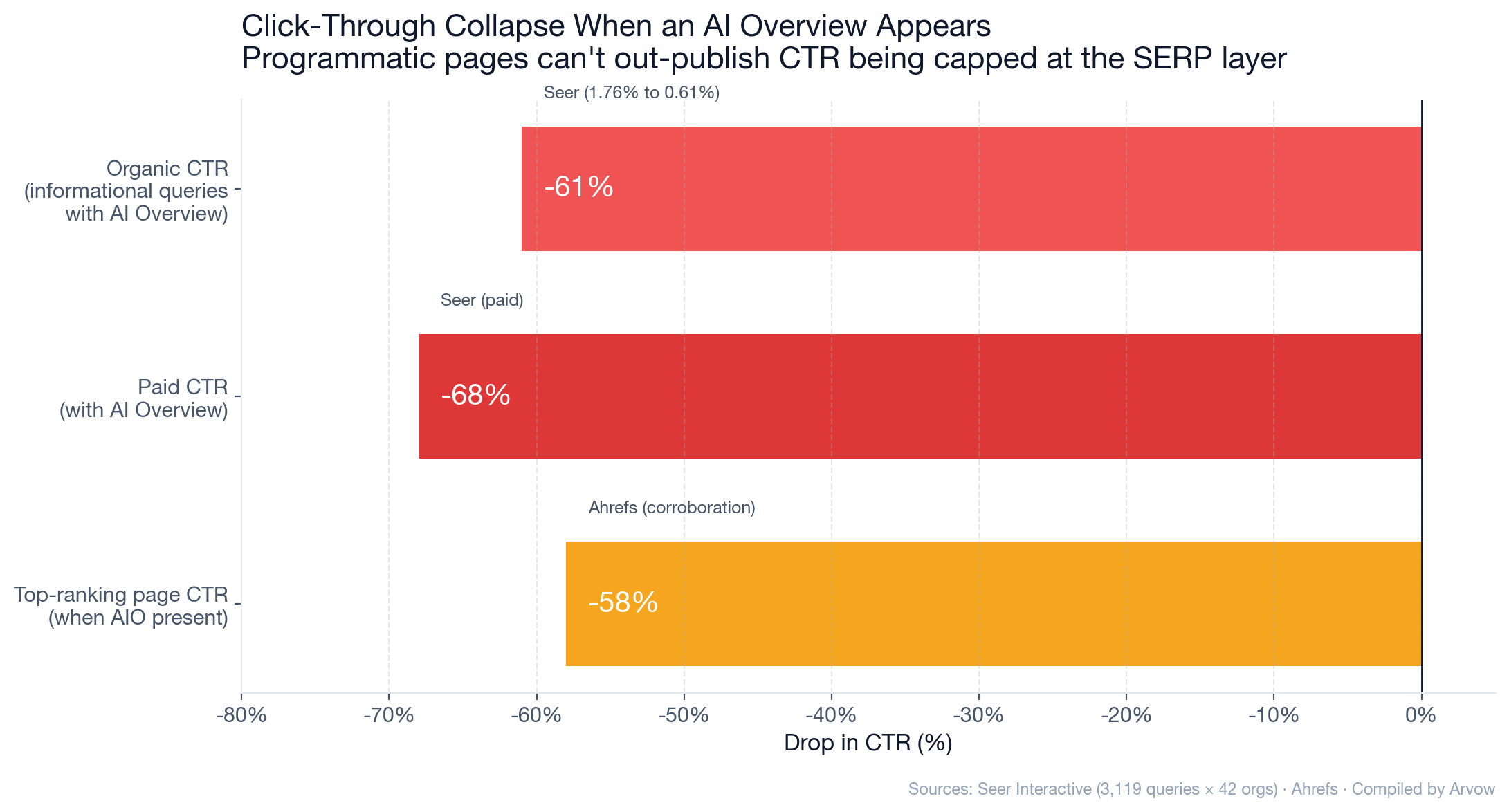
Seer Interactive’s primary-source study (3,119 queries × 42 organizations, 25.1M organic + 1.1M paid impressions, June 2024 – Sep 2025):
- Organic CTR for informational queries with AI Overviews dropped 61% (1.76% → 0.61%).
- Paid CTR fell 68%.
- Top-ranking page CTR is 58% lower when an AI Overview is present (Ahrefs corroboration).
The new pSEO objective — get cited, not just rank
- Brands cited within an AI Overview earn 35% more organic clicks and 91% more paid clicks than uncited competitors (Search Engine Land analysis of Seer/Authoritas data).
The implication for pSEO: shipping 100,000 thin pages no longer wins because: 1. AIOs cap CTR at the SERP layer regardless of position. 2. Citation-into-AIO is concentrated in pages with brand authority, schema markup, original data, and human review. 3. Programmatic pages without those structural signals get neither rank nor citation.
From Arvow: Track exactly how ChatGPT, Perplexity, Gemini, Claude, Grok, and Google AI Overviews cite your programmatic pages — week over week — with Arvow’s LLM Visibility Tracker. Track Your AI Visibility →
10. Industry-Vertical Performance
pSEO works dramatically differently across verticals. The variance is the strategy.
Where pSEO crushes (the documented winners)
| Vertical | Site | Page count | Monthly traffic |
|---|---|---|---|
| Currency / fintech | Wise | 260K+ | 46M |
| SaaS integrations | Zapier | 50K+ | 5.8M (template) / 9M (domain) |
| Design templates | Canva | 24K+ (English) | 13.1M (templates only) |
| Travel / accommodations | Booking.com | 6M+ properties | 278.9M |
| Real estate | Zillow | 5.2M | 33M |
| Reviews / aggregation | Tripadvisor | 75M+ | 226M |
| Education / tutoring | Preply | 60K (50 languages) | 3.8M |
Where pSEO collapsed (the documented losers)
| Vertical | Site | Loss |
|---|---|---|
| B2B database / vendor reviews | G2 | -80% organic |
| Sales intelligence / company database | Datanyze | -96% (template-isolated) |
| Finance / forecasting tool | Causal | -99.52% (manual penalty) |
The pattern (synthesis)
pSEO works when: - The underlying data is real and high-volume (currencies, integrations, properties). - The user need is template-shaped (“convert X to Y,” “how to integrate A with B”). - The brand has direct/branded traffic flywheels independent of programmatic SEO.
pSEO fails when: - Pages are boilerplate around scraped third-party data with thin differentiation. - The template is the entire content strategy with no editorial complement. - The site has no first-party brand signals (mentions, links, direct traffic) to support credibility.
Why some verticals never had a chance
- Pure database aggregator sites (G2, Datanyze pattern): Google’s HCU explicitly targeted “sites that exist primarily to aggregate third-party information without adding meaningful first-party value.”
- News-aggregator pSEO: Reddit’s promotion plus Google’s site reputation abuse policy gutted the playbook.
- Generic location-based pages without local data: e.g., the 50K “hotels in [city]” with only city names changing — 98% deindexed in 3 months.
For Arvow’s documented case studies in Portugal-construction templates, French clinic content, German SaaS multilingual scaling, and the Vietnamese 102K/45-day surge, see the Arvow case studies library. The pattern in every successful Arvow-platform case is the same: real underlying data, structural signals, and quality control.
11. The pSEO Tooling Landscape
The category is fragmenting fast.
Pure-play pSEO platforms
- Webflow CMS Collections — the original “pSEO at scale” infrastructure.
- Daydream (withdaydream.com) — agency + tooling for full-stack pSEO. Public case study library.
- Whalesync — data-to-pages sync (Airtable → Webflow CMS).
- Letterdrop, Otto SEO, ZipPSEO — newer entrants targeting SaaS pSEO.
- ScalingMVP, Saral, Practical Programmatic — coaching/consulting + tooling hybrids.
General SEO platforms with pSEO modules
- Ahrefs — SERP and competitor data; not pSEO-native, but the standard analysis layer.
- Semrush — keyword data + position tracking at scale.
- Surfer SEO — content optimization at template scale.
- Frase, Clearscope — content briefing platforms used pSEO-adjacent.
AI content platforms (the new wave)
- Arvow — AI-first content velocity at programmatic scale, with structural HCU-survival signals built in.
- ContentBot, Jasper, Copy.ai — generic AI writing platforms used for pSEO production.
Pricing benchmarks (where disclosed)
- Daydream client engagements: typically $5K–$25K/month + per-page data costs.
- Pure-play pSEO tools: $99–$999/month for the SaaS layer.
- Custom-built internal pSEO infrastructure: $50K–$250K initial build (per published SaaS pSEO post-mortems).
The category is consolidating fast. Expect the major SEO platforms to absorb or build native pSEO modules in 2026–2027.
12. Production Patterns That Separate Winners from Losers
Across every documented winning pSEO site, the same six patterns recur.
1. Real first-party or licensed data
Wise has actual currency data. Zapier has actual integration data. Canva has actual templates. Programmatic pages built on top of legitimately-acquired structured data outrank programmatic pages built on scraped or fabricated data. Always.
2. Per-page content depth ≥500 unique words with 30–40% differentiation
Below this threshold, Google’s thin-content classifiers fire. Above it, pages can win on long-tail terms.
3. Schema markup at scale
- FAQ schema for question-format templates.
- HowTo schema for instruction-format templates.
- Product/SoftwareApplication schema for SaaS comparison templates.
- LocalBusiness schema for location-based templates.
The HCU casualty pattern in §7 was disproportionately sites lacking schema markup.
4. Internal linking depth
Programmatic pages that earn rankings disproportionately have: - Hub/spoke architecture connecting to canonical brand content. - Cross-linking between related programmatic pages (e.g., Zapier’s app-to-app integration cross-links). - Anchor text variation tuned per template.
5. Content velocity that matches Google’s indexation appetite
- Webflow’s documented benchmark: 300 pages/week is sustainable; spikes of 10,000+ pages/week trigger crawl/index throttling.
- Wise’s 4,000+ pages/month over 4 years is the steadiest documented pace.
6. Brand and link velocity matching page velocity
Programmatic pages that rank disproportionately come from sites with: - Strong brand search demand. - Consistent link velocity (15–80 new referring domains per month, per the WebFX 2026 benchmark). - Direct traffic flywheels independent of programmatic SEO.
For the link velocity playbook, see our Link Building Statistics 2026 — particularly the industry velocity benchmarks (Finance: 101 RDs/month, Apparel: 15 RDs/month).
From Arvow: Arvow’s link building service places real, niche-relevant, manually-outreached backlinks on DR 40+ sites with 1,000+ verified monthly organic traffic — exactly the link-velocity layer programmatic content needs to actually rank. See pricing →
13. The Contradictions: Why pSEO Stats Don’t Agree
The pSEO data ecosystem is riddled with contradictions. Here’s the meta-analysis.
- Stanford / Imperial / Internet Archive: 35% of new websites are AI-generated.
- Graphite: 51.7% of articles are AI-written.
- Ahrefs: 74.2% of new web pages contain AI content.
Why they differ: site-level vs article-level vs page-level classification, and the “contains AI content” threshold. All three are accurate at their measurement layer.
- “60% failure risk” — Passionfruit (vendor-reported, opaque methodology).
- “93% of penalized sites lacked differentiation” — Gupta Deepak (vendor-reported).
- “1 in 3 hit a traffic cliff within 18 months” — Passionfruit.
These are all vendor-reported with weak methodology. Use directionally, not authoritatively. The harder primary data (Originality.AI’s 1.7–2% deindexation rate during March 2024) is the only number with traceable methodology.
The same contradiction we documented in our AI Overviews Statistics 2026: different studies sample different keyword universes, producing wildly different AIO-presence numbers.
Statcounter (consumer-weighted): 64.6%. Conductor (B2B-weighted): 87.4%. Both can be right because they measure different audiences.
- Ahrefs / multiple practitioners: AI articles can rank as well as human articles.
- Graphite: only 14% of ranking content is AI, despite 51% being AI-written.
The reconciliation: well-edited AI content (the 71% of AI pages with substantial human review per Ahrefs) ranks fine. Pure-AI-no-human-edit content (the 2.5% per Ahrefs) is what fails.
- HCU casualties: G2 (-80%), Datanyze (-96%), Causal (-99.52%), 129/130 HCU-hit sites with no recovery.
- pSEO winners: Wise (+46M visits/month), Zapier (+5.8M), Webflow (+6,000 daily impressions in 6 weeks).
Both are happening simultaneously. The same playbook produces both outcomes. Execution determines which.
- AI Overview citations: rising aggregate volume.
- ALM Corp: SaaS sites saw a 53% drop in AI-driven traffic in a measured period.
Both can be true: aggregate AI traffic to some sites is rising, while most programmatic SaaS sites are losing AI referral share to UGC and big-brand competitors.
14. What This Means for Your Site in 2026
Six concrete moves the data above actually justifies.
1. Don’t ship programmatic pages without 500+ unique words and 30–40% differentiation per page
Every primary deindexation study converges on this threshold. Pages below it are HCU bait.
2. Match programmatic content with editorial complement
The HCU casualties were sites where pSEO was the entire content strategy. The winners (Wise, Canva, Webflow) all run editorial content alongside their programmatic portfolios.
3. Build first-party data or licensed structured data
Don’t programmatically wrap scraped third-party data — that’s the G2/Datanyze pattern. License or generate your own data set.
4. Schema markup at scale, not “we’ll add it later”
Across HCU survivors, schema markup density correlated strongly with HCU resilience. Add FAQ, HowTo, Product, and Article schema to every template from launch.
5. Track AI Overview citation share, not just rankings
Per §9: brands cited in AIOs win 35% more clicks. Brands not cited see CTR fall 58–61%. The new objective is citation, not ranking. Set up LLM Visibility Tracker for your programmatic templates.
6. Match content velocity with link velocity
The math from §3 + §12: median page-one ranker has 907 referring domains. Programmatic pages without link support stay in the long-tail purgatory. Arvow’s link building service is purpose-built for the link-velocity-matching-content-velocity problem.
Ready to act on the data? Arvow’s AI SEO Agent automates the structural HCU-survival stack — schema, citation density, internal linking, FAQ formatting — across every page you publish. Combined with Arvow’s Autoblog for content velocity and Arvow’s link building service for the link-velocity layer, that’s the full programmatic SEO stack.
Or if you want to see the output first: Try 3 Free Articles →
Σ Summary: Programmatic SEO by the Numbers
The 20 highest-leverage stats from this report, in one table.
| # | Stat | Source |
|---|---|---|
| 1 | Wise: 260K+ programmatic pages → 46M+ monthly visits | Daydream / Ahrefs |
| 2 | Zapier: 50K+ integration pages → 5.8M monthly visits | GrackerAI / Ahrefs |
| 3 | Tripadvisor: 75M+ pages indexed → 226M monthly visits | ViewEngine / SimilarWeb |
| 4 | 74.2% of new web pages contain AI-generated content | Ahrefs (900K pages) |
| 5 | 35% of newly published websites are AI-generated | Stanford/Imperial/Internet Archive |
| 6 | 51.7% of articles are AI-written, but only 14% of articles ranking are AI | Graphite |
| 7 | 82% of articles cited by ChatGPT/Perplexity were written by humans | Graphite |
| 8 | 129 of 130 HCU-hit sites never recovered | Lily Ray (Amsive) |
| 9 | 1.7–2% of monitored sites deindexed in March 2024 — all had AI content | Originality.AI (49K + 79K panels) |
| 10 | 25% of monitored URLs deindexed in May 2025 | IndexingInsight |
| 11 | AI articles’ ranking decay: 70% → 3% → 20% rebound over 16 months | Ahrefs |
| 12 | Datanyze: −96% organic traffic (template-isolated to /companies, /people) | Ahrefs |
| 13 | Causal: −99.52% organic traffic after 1,800-article AI dump | Ahrefs |
| 14 | G2: −80% organic traffic since 2023 | ALM Corp |
| 15 | AI Overview CTR drop: 61% organic, 68% paid | Seer Interactive (3,119 queries) |
| 16 | Brands cited in AIO earn 35% more organic clicks, 91% more paid | Search Engine Land / Authoritas |
| 17 | Reddit citations in AIO: +450% Mar→Jun 2025 | Surfer AI Tracker (36M AIOs) |
| 18 | Tripadvisor: −6% Q4 2024 brand revenue, CEO cited AI Overviews | Skift / earnings |
| 19 | Webflow: 300 pages → 6,000 daily impressions in 6 weeks | Webflow first-party |
| 20 | Salesforge: $0 → $3M ARR in 2 years on pSEO | Surfer SEO |
Frequently Asked Questions
What is programmatic SEO?
Programmatic SEO (pSEO) is the practice of generating large numbers of pages from a single template + a structured dataset. Instead of writing each page manually, you write one template (“Convert [Currency A] to [Currency B],” “Hotels in [City],” “[Software A] vs [Software B]”), feed it a dataset, and publish thousands or millions of pages. The canonical examples are Wise’s 260,000+ currency-converter pages, Zapier’s 50,000+ integration pages, and Tripadvisor’s 75 million indexed pages.
Does programmatic SEO still work in 2026?
Yes — but the bar moved up significantly. The successful pSEO sites (Wise, Zapier, Canva, Webflow, OpenArt, Salesforge) all share six patterns: real underlying data, 500+ unique words per page, schema markup, internal linking depth, brand/link velocity, and editorial content alongside the programmatic portfolio. Sites missing those patterns increasingly get hit by Google’s Helpful Content Update or August 2025 spam update — see §7.
What was the actual deindexation rate from the March 2024 update?
1.7–2% of monitored sites were deindexed (Originality.AI, two separate panels of 49,345 and 79,000 sites). 100% of deindexed sites had AI-generated content; 50% had 90%+ AI content. Combined: ~$446,552/month in display ad revenue wiped out (Search Engine Journal).
How much do programmatic SEO pages earn on average?
The honest distribution: top 1% of programmatic sites earn 100+ visits per page per month (Wise, Zapier at scale). Top 10% earn 30–80 visits/page (Canva templates, Twingate). Median pSEO sites earn 5–15 visits/page. Bottom 50% earn 0–2 visits/page, often deindexed within 12 months.
What’s the cost-per-page for programmatic SEO?
Production cost ranges from $0.01–$5/page for AI-generated content, $200–$1,200/page for manual long-form, and $0.50–$10/page for human-edited AI content. UserPilot’s documented benchmark: 29 long-form posts per hour using templated cluster systems. The hidden cost is data acquisition and link velocity — see §5.
Does AI content rank in Google?
Yes, but not at the rate AI is being published. 51.7% of articles are AI-written, but only 14% of articles ranking on Google are AI-generated (Graphite). Well-edited AI content with substantial human review ranks fine. Pure-AI-no-human-edit content (the 2.5% per Ahrefs) is what fails. The “death valley” is months 2–6: AI articles indexed at 70.95% in month 1 plummet to 3% top-100 ranking by month 3, recovering only to 20% by month 16.
Can programmatic pages get cited by ChatGPT or AI Overviews?
Programmatic pages can be cited but at lower rates than handcrafted editorial content. 82% of articles cited by ChatGPT and Perplexity were written by humans (Graphite); 76% of AI Overview citations come from URLs ranking in Google’s top 10 (Ahrefs, 1.9M citations / 1M AIOs). Programmatic pages need to actually rank to be cited. For the full GEO playbook, see our GEO Statistics 2026.
What separates pSEO winners from casualties?
Per §12 — six recurring patterns: (1) real first-party or licensed data, not scraped third-party; (2) ≥500 unique words and 30–40% differentiation per page; (3) schema markup at scale; (4) internal linking depth; (5) content velocity matched by link velocity; (6) editorial content alongside the programmatic portfolio (not pSEO as the entire content strategy).
Methodology and Sources
This report aggregates data from 30+ primary sources published between 2023 and April 2026, with priority on:
- Large-sample independent studies — Ahrefs (900K-page AI prevalence study, 16-month AI ranking decay study, Biggest Losers in SaaS analysis), Originality.AI (49K and 79K-site deindexation panels), Stanford/Imperial College/Internet Archive (33-month Wayback Machine analysis with Pangram Labs), Graphite (Five Percent project), Surfer AI (36M AIOs / 46M citations), Seer Interactive (3,119 queries × 42 organizations), IndexingInsight
- First-party platform data — Webflow (Search Console), Tripadvisor (earnings disclosures), UserPilot (Head of Marketing interview), Wise / Zapier / Canva (subdirectory analyses via Daydream + GrackerAI + Ahrefs Site Explorer)
- Practitioner panel data — Lily Ray’s 130-site HCU recovery panel, Daydream client case studies, Practical Programmatic benchmarks
- Industry market sizing — GlobeNewswire / Grand View Research (SEO services market), Powered by Search / LinkQuest (SaaS SEO budgets)
- Vendor-reported numbers — Passionfruit SEO, Gupta Deepak (Security Boulevard) — these are flagged inline as directional rather than authoritative due to opaque methodology
Primary sources used
- Ahrefs (AI prevalence study, Biggest Traffic Losers in SaaS, AI Overviews CTR study, Zapier case study)
- Daydream (Wise library, Canva library, Zillow library, client case studies)
- GrackerAI (Wise deep dive, Zapier 5.8M analysis)
- Graphite Five Percent (more articles AI than human, AI content in search and LLMs)
- Originality.AI (Google AI content detection)
- Lily Ray (Amsive) (SMX Advanced 2024 deck on HCU recovery)
- Search Engine Journal (March 2024 deindexation impact)
- Stanford / Imperial / Internet Archive (35% AI-website paper announcement)
- Seer Interactive (AIO impact on Google CTR)
- Surfer AI Tracker (AI citation report)
- Webflow (programmatic SEO blog post)
- Tripadvisor / Skift (Q4 2024 earnings AI Overview commentary)
- ViewEngine AI (Tripadvisor analysis)
- UpGrowth (Booking.com programmatic SEO deep dive)
- Salt Agency / Animalz (Zapier and Preply case studies)
- The Fxck SEO (UserPilot interview)
- Surfer SEO (Salesforge case study)
- ALM Corp (SEO updates impact analysis)
- Sistrix / Stan Ventures (Reddit visibility surge)
- Google Search Central (core update + spam policies, site reputation abuse)
- Whitehat SEO (AI engines comparison)
This page was last updated April 2026. Bookmark it — we update quarterly as Ahrefs, Originality.AI, Graphite, and IndexingInsight publish new data.
Keep reading
Generate, publish, syndicate and update articles automatically
The AI SEO Writer that Auto-Publishes to your Blog
- Cancel anytime
- Articles in 30 secs
- Plagiarism Free