
AI Overviews & AI Mode Statistics 2026: The Complete Data Report

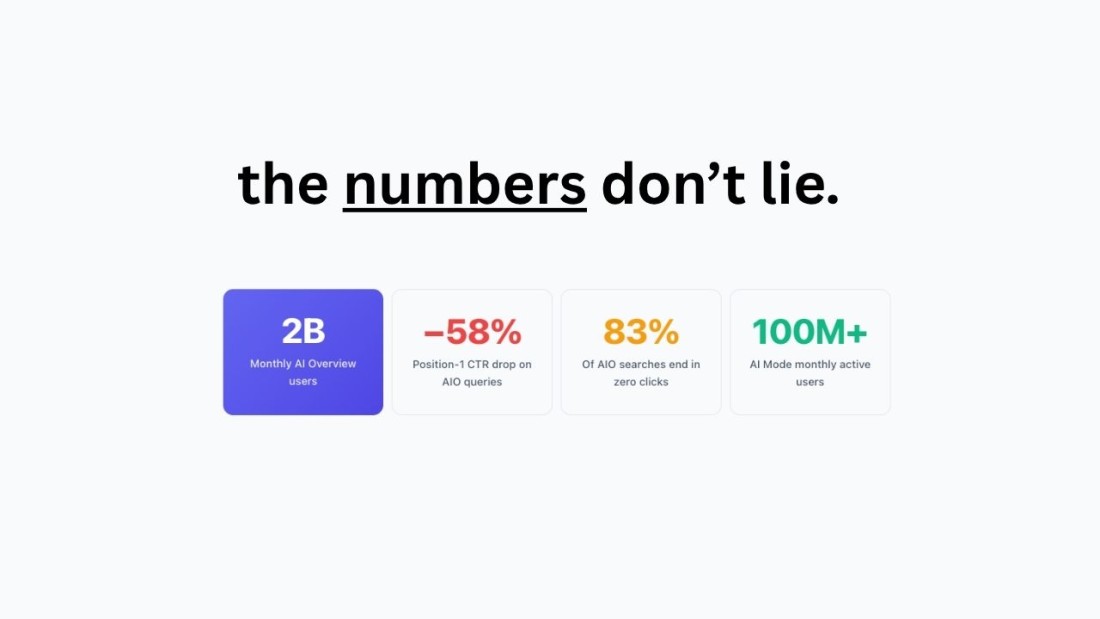
AI Overviews now reach 2 billion users every month and appear on nearly half of all Google searches as of Q1 2026. AI Mode — Google’s full-AI search layer — hit 100 million monthly active users across the U.S. and India within just two months of launch. Position-1 clickthrough rates have collapsed by 58% on AIO queries compared to December 2023, and 83% of AIO searches now end in zero clicks. This is the biggest shift in search since mobile.
We aggregated data from BrightEdge, Semrush, Ahrefs, Seer Interactive, Pew Research and 25+ other primary sources to compile the most comprehensive AI Overviews and AI Mode statistics available in 2026. Every stat below is dated, sourced, and methodology-checked.
|
2B
Monthly AI Overview users
|
−58%
Position-1 CTR drop on AIO queries
|
83%
Of AIO searches end in zero clicks
|
100M+
AI Mode monthly active users
|
Key Takeaways (2026)
- Prevalence: AI Overviews now trigger on 48–50% of tracked Google searches (up from ~31% a year ago). AI Mode has 100M+ monthly active users.
- CTR collapse: Position-1 clicks are down 58% on AIO queries (Ahrefs). Organic CTR for AIO queries fell from 1.76% to 0.61% — a 61% drop (Seer Interactive).
- Zero-click reality: 83% of AIO searches end in zero clicks. Only 1% of AI summary citations get clicked (Pew Research).
- Publisher pain: Small publishers have lost 60% of search traffic in two years vs just 22% for large publishers (Chartbeat).
- Branded CTR actually rises: Branded-query CTR goes up 18.68% when AIO appears — non-branded falls 19.98% (Amsive).
- Citations favor brands, not Reddit: 86% of AI citations are brand-managed sources per Yext’s 6.8M-citation study — contradicting the “Reddit is winning” narrative.
- AI Mode is different: 69% of AI Mode traffic is transactional — nearly the mirror image of AIO’s informational skew.
- The contradiction nobody talks about: AIOs peaked at 24.6% of queries in July 2025, then fell to 15.7% by November as Google pulled back on sensitive topics.
- Market share shift: ChatGPT’s share of the AI chatbot market fell from 87% to 68% in 12 months. Gemini tripled in the same window.
- First-party Arvow data: LLM SEO increased Arvow’s ChatGPT leads by 38%, and one NY dentist hit 3,200/mo visits and got cited in every LLM using AI-first SEO.
1. AI Overviews & AI Mode Adoption by the Numbers
Adoption is no longer the story. Saturation is.
AI Overviews now reach 2 billion monthly users across more than 200 countries and 40 languages — up from 1.5 billion in May 2025 (Sundar Pichai, Q2 2025 Alphabet earnings). AI Mode — Google’s answer-first search layer — hit 100 million monthly active users in the U.S. and India within two months of its May 2025 launch.
On the SERP side, the growth is equally aggressive:
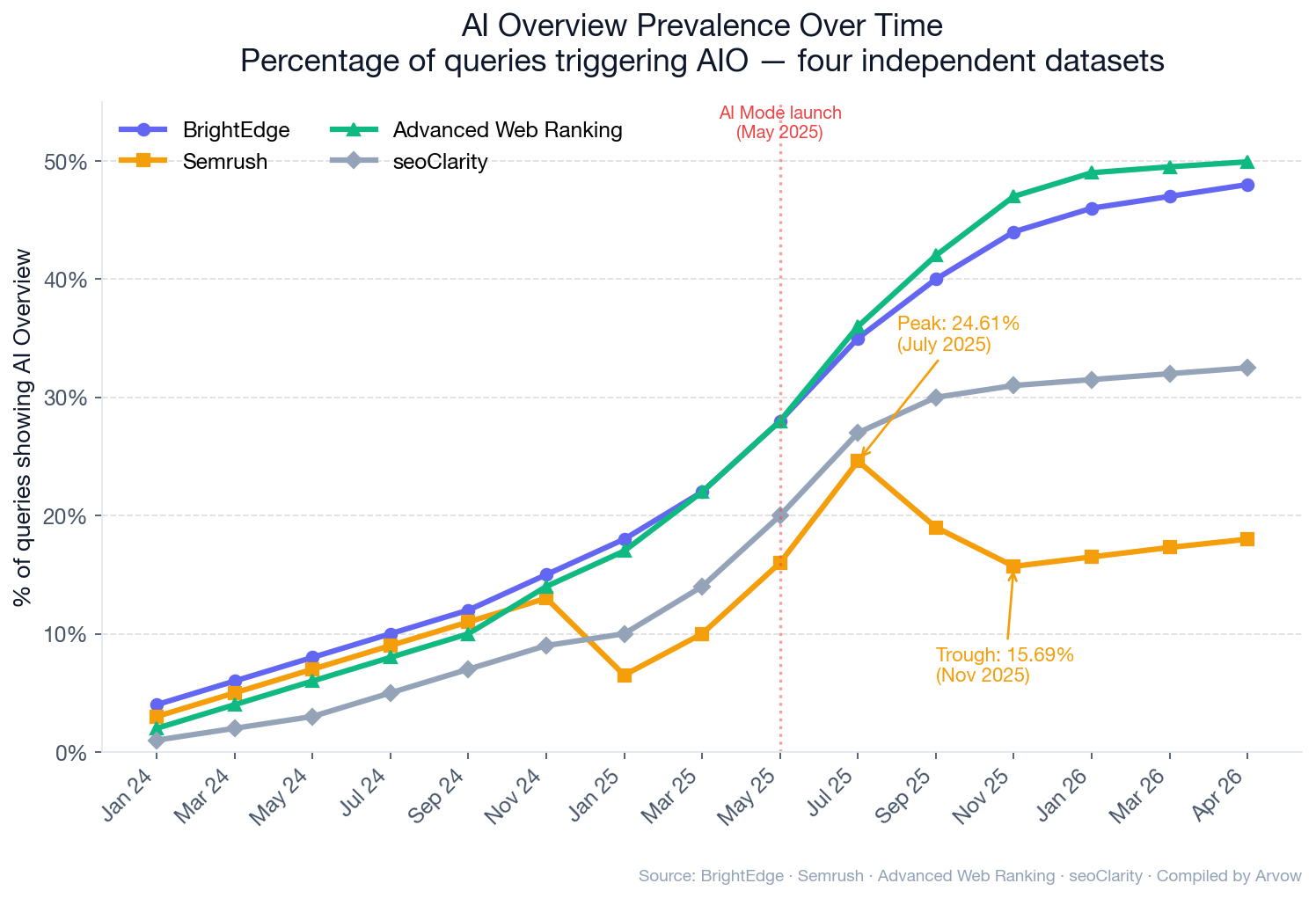
- 48–50% of tracked queries now show an AI Overview as of Q4 2025–Q1 2026, up from ~31% in Feb 2025 — a 58% year-over-year increase (BrightEdge, Feb 2026).
- AIOs appeared on 49.92% of search results in Q4 2025, up from 18.55% in Q3 2024 (Advanced Web Ranking).
- 25.11% of Google searches triggered an AIO in a 21.9M-search enterprise sample from Sep–Oct 2025 (Conductor, Apr 2026).
- 30% of U.S. desktop keywords now show AIOs — up from 10% in March 2025. Mobile saw 474.9% year-over-year growth (seoClarity, Oct 2025).
- 9.46% of global desktop keywords show AIOs. Volume-weighted, that’s 12.8% of all Google searches — roughly 23 billion searches per month (Ahrefs, analysis of 55.8M AIOs).
- AI Mode expanded to 200+ countries in a 48-hour window in October 2025 and now supports 40+ languages (Google).
Here’s the twist nobody’s talking about:
AIOs peaked at 24.61% of queries in July 2025 — then fell to 15.69% by November. Google actively pulled AIO back in sensitive categories, especially health and shopping (Semrush, analysis of 10M+ keywords).
That retreat-and-rebuild pattern matters. AIO isn’t a monotonic trend line — it’s a moving target Google keeps tuning.
Google’s own framing: Pichai told investors AIOs drive “over 10% more queries globally for the types of queries that show them” — a direct counter to the “AI is killing search” narrative. Whether that holds up depends on whether you’re Google or one of the publishers we’ll cover in §3.
2. The CTR Impact: How Clicks Have Actually Shifted
This is the section every SEO wants numbers for. The headline: if AI Overviews appear, position-1 clicks drop in half. But the reality is more nuanced than the headline.
The position-1 collapse
Ahrefs ran the largest independent CTR study to date — 300,000 keywords, half with AIOs and half without, aggregated Google Search Console data December 2023 vs December 2025:
- Position-1 CTR is down 58% on AIO queries (Ahrefs, Feb 2026).
- CTR fell from 0.073 (Dec 2023) to 0.016 (Dec 2025) on AIO queries. Non-AIO CTR also fell — from 0.076 to 0.039 — showing the entire SERP is shifting, not just AIO queries.
- Position-by-position losses: Pos 1 = −58.0%, Pos 2 = −50.8%, Pos 10 = −19.4%.
Top ranks take the biggest hit. That’s unusual. Most past Google changes punished positions 4–10 while sparing 1–3. AIO does the opposite.
The Seer Interactive study — cleanest before/after data
- Organic CTR fell from 1.76% (June 2024) to 0.61% (Sep 2025) — a 61% decline (Seer Interactive, Nov 2025).
- Paid CTR fell 68% — from 19.7% to 6.34% in the same window.
- Sample: 3,119 informational queries, 25.1M organic and 1.1M paid impressions, 42 organizations.
The brand-vs-non-brand split (nobody talks about this)
Amsive tested 700,000 keywords across finance, education, SaaS, healthcare, and pets:
- Overall CTR drop when AIO appears: −15.49%
- Non-branded queries: −19.98%
- Branded queries: +18.68% — AIO actually helps branded CTR
- Keywords outside top 3: −27.04%
- AIO + Featured Snippet combined: −37.04%
The brand-lift finding is the single most under-reported stat in the 2025–2026 discourse. If you’re a brand, AIO is a net positive when users search your name. If you’re an affiliate site ranking for generic terms, it’s catastrophic.
Publisher-level data
- Pew Research Center: Users with AI summaries clicked a traditional search result in only 8% of visits vs 15% without — roughly half (Pew, July 2025; 68,879 searches tracked).
- Only 1% of AI summary citations get clicked (Pew).
- Daily Mail’s CTR dropped 56.1% on desktop and 48.2% on mobile when AIO appeared; some queries fell from 6,000 clicks to 100 (MailOnline / Search Engine Land, May 2025).
- UK publishers: 47.5% desktop CTR drop, 37.7% mobile (Authoritas, 3,500 UK news keywords).
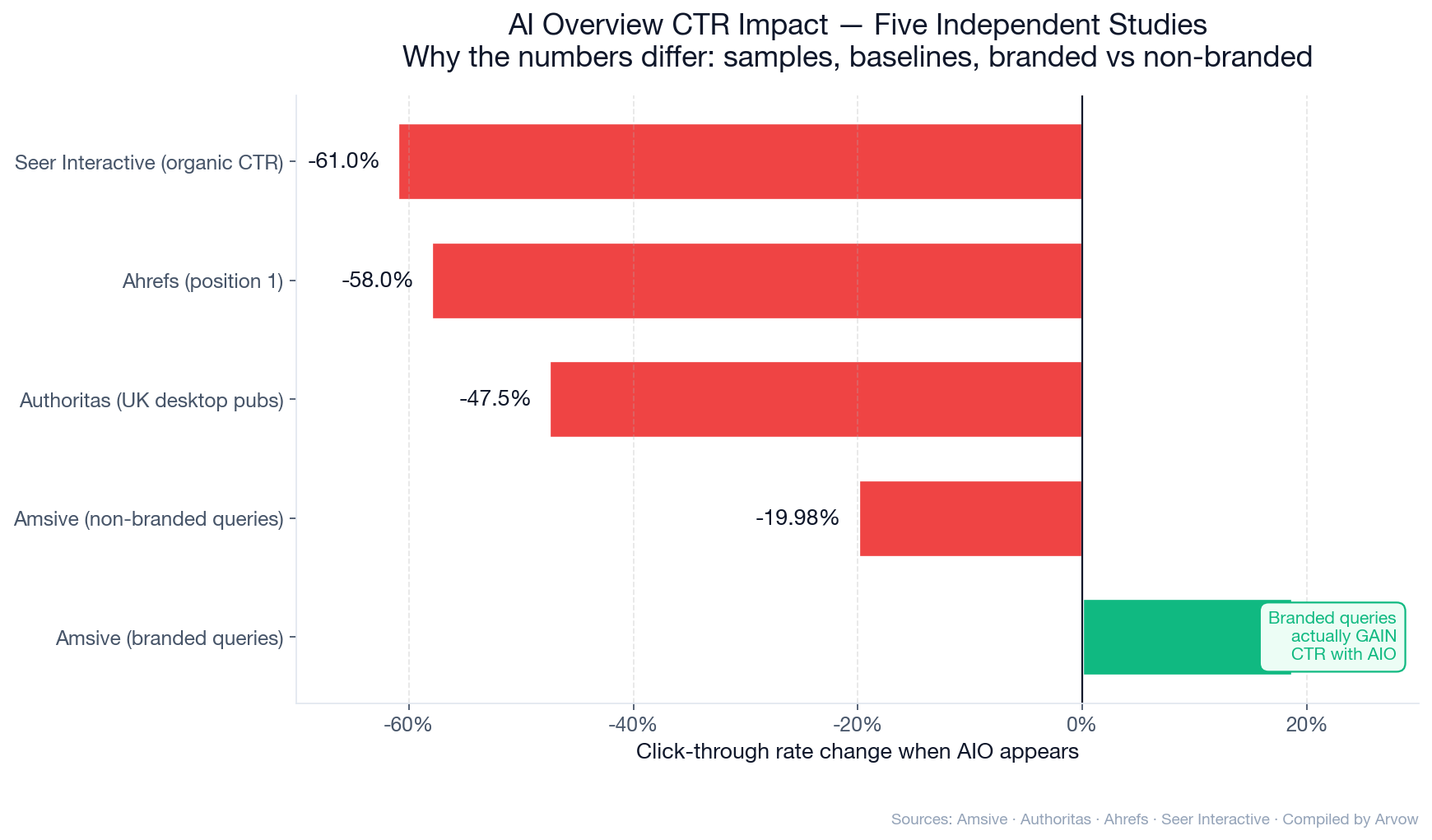
Why the −58%, −61%, and −15% numbers all coexist
Different samples, different baselines, different query mixes. All three are accurate. AIO’s impact depends on four variables:
- Whether you’re cited in the AIO itself. Seer: +35% organic CTR and +91% paid CTR when cited vs not.
- Whether your query is branded. Amsive: +18.68% vs −19.98%.
- Which position you hold. Ahrefs: −58% at pos 1, −19% at pos 10.
- Which niche you’re in. Covered in §6.
The practical implication: optimizing for AIO citation is no longer optional. Being cited in an AIO is the difference between losing traffic and gaining it.
Arvow’s AI SEO Editor rewrites your existing content with the structural patterns AI Overviews actually cite — FAQ schema, entity-rich definitions, clean H2/H3 hierarchies, and direct-answer paragraphs. See how it works →
3. Traffic Loss & the Rise of Zero-Click Search
Publishers aren’t losing clicks. They’re losing entire visits.
- Global Google search traffic to publishers fell 33% year-over-year to November 2025 (US −38%, Europe −17%); Google Discover referrals down 21% globally (Chartbeat / Reuters Institute, Jan 2026).
- Page views from Google Search fell 34% for publishers between December 2024 and December 2025 (Chartbeat, Mar 2026).
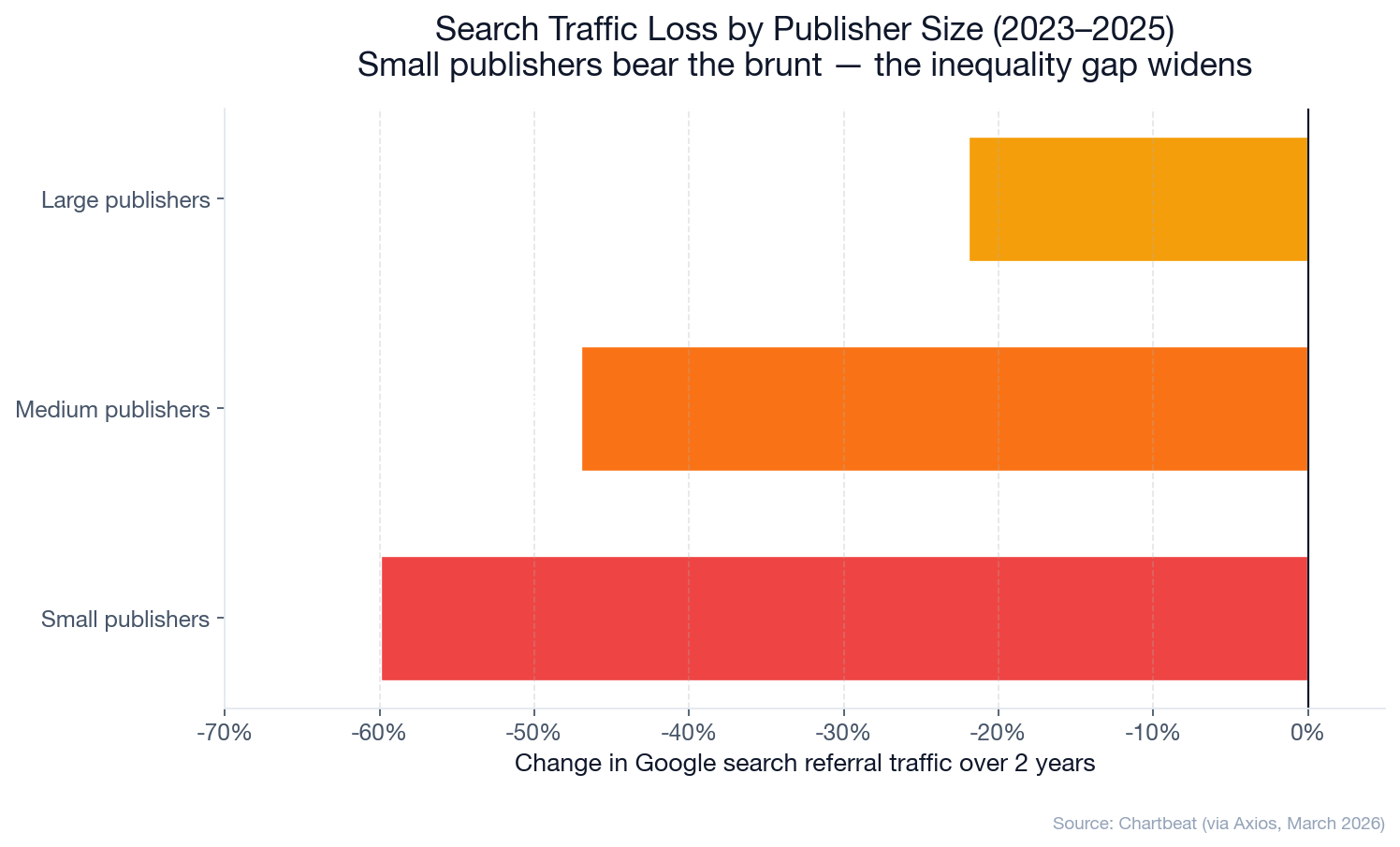
- Small publishers lost 60% of search referral traffic over two years. Medium publishers −47%. Large publishers −22% (Chartbeat, Mar 2026).
That last one is the real story: the publisher inequality gap is widening. Large brands with direct traffic and strong citation presence in AIO are absorbing losses. Small sites are dying.
The zero-click reality
- 83% of AIO-triggering queries end in zero clicks, vs ~60% for non-AIO queries (Datos/SparkToro clickstream panel covering tens of millions of US and EU users, Aug 2025).
- 26% of AI-summary visits end the user’s session entirely, vs 16% for non-AIO visits (Pew Research, July 2025).
- When an AIO appears, ~70% of pages cited inside it change in 2–3 months — AIO citations are structurally volatile (Authoritas).
- Overall US zero-click queries now sit at 39.2% (37.1% in the EU/UK).
Specific publisher anecdotes
- A lifestyle publisher saw CTR drop from 5.1% to 0.6%; an automotive site lost 25% of traffic despite ranking #1 (Professional Publishers Association via Digiday, Aug 2025).
- Digital Content Next members saw a median −10% YoY search-referral decline over 8 weeks in May–June 2025 (−7% news, −14% non-news) — aligning with Google’s AI Mode rollout timeline.
- News brand referrals plunged 16% the week of May 25, 2025; non-news publishers fell 17% the week of June 22.
What publishers expect next
- News publishers forecast search-engine traffic down 43% within 3 years. About 20% expect losses over 75% (Reuters Institute survey of 280 media leaders across 51 countries, Jan 2026).
That forecast is more pessimistic than current data — but publishers are usually right about their own traffic.
4. How Users Actually Behave in AI Overviews
Usage is massive. Trust is not.
Exposure
- 58% of U.S. adults conducted at least one Google search in March 2025 that produced an AI summary (Pew, 900-person browsing panel).
- 65% of Americans say they at least sometimes encounter AI summaries; 45% see them “often” or “extremely often” (Pew ATP survey, 5,153 respondents, Oct 2025).
- 93% of U.S. adults visited at least one page mentioning AI in March 2025 — median of 60 such visits per person per month (Pew Data Labs).
Trust is surprisingly low
- Only 21% of Americans find AI summaries “extremely or very useful.” 52% say somewhat, 28% not too/not at all.
- Only 6% trust AI summaries “a lot.” 46% have little to no trust (Pew, Oct 2025).
Yet people use them anyway:
- 80% of search users rely on AI summaries at least 40% of the time (Bain, Feb 2025).
- 44% of AI search users say it’s their primary source of insight — beating traditional search (31%), retailer/brand sites (9%), review sites (6%) (McKinsey, Aug 2025; 1,927 respondents).
- 68% of LLM users use these platforms for researching and summarizing; 48% for news/weather; 42% for shopping recommendations (Bain).
The age and education gap
- Adults under 30 see AI summaries often: 62% — vs just 23% of those 65+.
- College graduates: 57% vs 38% for less-educated users.
- Liberal Democrats: 56% (Pew ATP, Oct 2025).
Query length effects
- 1–2 word searches trigger AIOs 8% of the time.
- 10+ word searches trigger AIOs 53% of the time.
- 60% of question-format queries produce an AIO (Pew browsing data).
That’s a 7× increase in AIO triggering when users ask longer, natural-language questions — exactly the kind of queries people type into ChatGPT and Claude.
The additive (not cannibalistic) pattern
- 20% of Americans are “heavy AI users” (10+ uses/month) as of June 2025. 40% use AI tools monthly.
- But 87% remain heavy Google users (SparkToro + Datos, analysis of US desktop clickstream Q1 2023–Q1 2025).
- Among heavy Google users, traditional search share grew from 84% (Q1 2023) to 87% (Q1 2025) — traditional search has not dipped.
AI isn’t replacing Google. It’s adding a new channel on top of existing behavior.
5. Which Query Types Get Hit Hardest
Every niche gets a different AIO reality. This is where the “average” stats break down.
Intent mix is shifting fast
Semrush’s 10M-keyword study tracked AIO intent composition over 2025:
| Intent type | Jan 2025 | Oct 2025 |
|---|---|---|
| Informational | 91% | 57% |
| Commercial | 8% | 18% |
| Transactional | 2% | 14% |
| Navigational | <1% | >10% |
Translation: AIO is no longer just “information.” It’s aggressively expanding into commercial and transactional SERPs — the exact SERPs that generate revenue for affiliate sites, ecommerce, and SaaS.
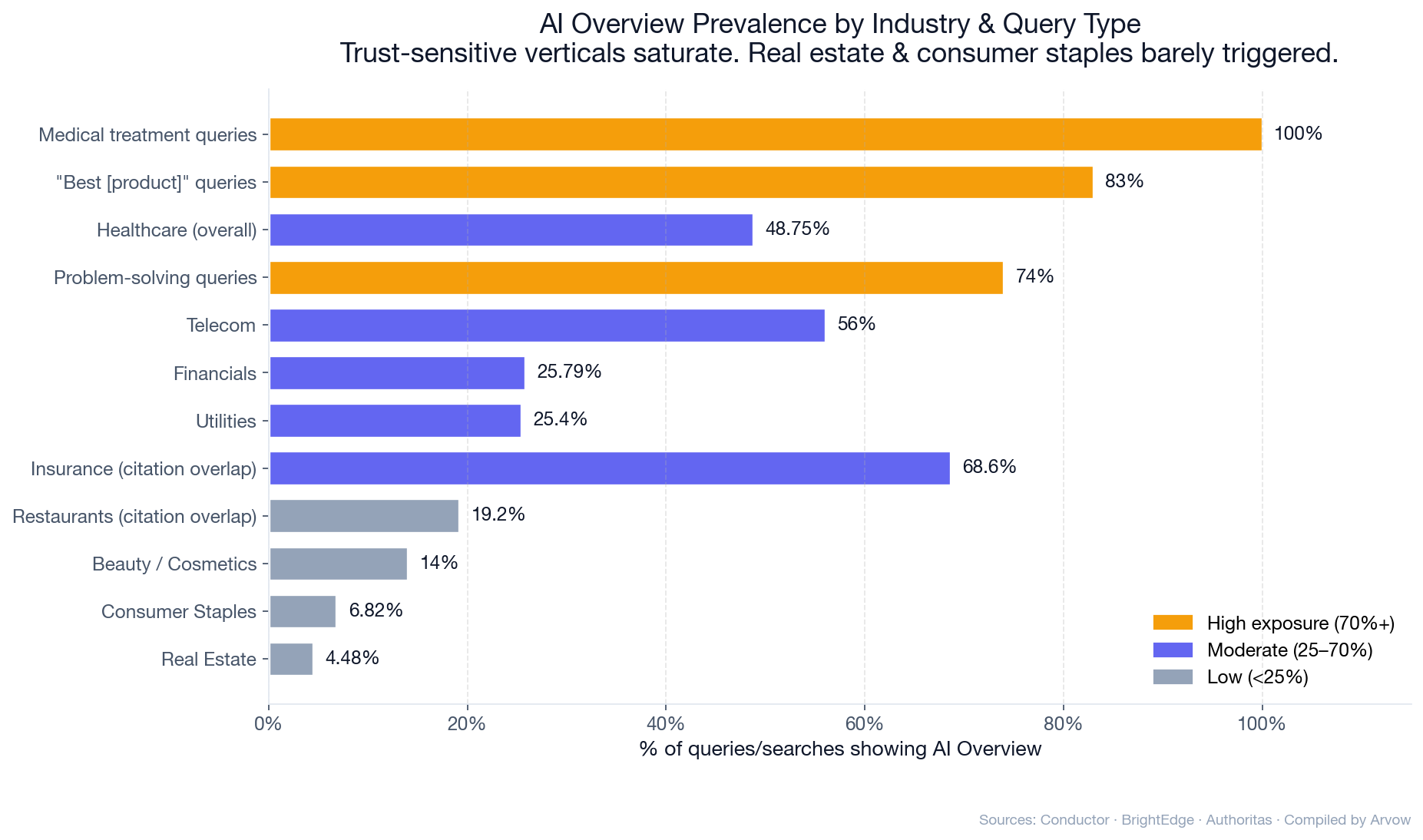
Healthcare: functionally 100% AIO
- Treatment/procedure medical queries show 100% AIO presence (up from 45% in 2023).
- Symptoms/conditions: 93%. Overall healthcare: 89% (BrightEdge, Dec 2025).
- But “near me” health queries dropped from 100% AIO to 0% after Google reversed course on sensitive local-health queries. This is Google actively de-risking.
Ecommerce: the intent split
BrightEdge’s Black Friday 2024 vs 2025 comparison:
- “Best [product]” queries: 5% AIO coverage (2024) → 83% (2025) — a +78 point jump.
- Informational ecommerce (“best air fryer”): 83% AIO.
- Transactional ecommerce (“buy air fryer”): only 13% AIO.
Google is deliberately pulling back from purchase-intent queries. Research-phase queries are where AIO dominates.
The full industry ranking (Conductor, 21.9M-search sample)
| Industry | AIO presence |
|---|---|
| Healthcare | 48.75% |
| Financials | 25.79% |
| Utilities | 25.40% |
| Consumer Staples | 6.82% |
| Real Estate | 4.48% (lowest) |
Trust-sensitive verticals get the most AIO coverage. High-volatility verticals (real estate, consumer staples) get the least.
Authoritas’ 10,000-keyword study adds more nuance
- AIOs trigger 42% of the time for keywords with 501–2,400 monthly search volume.
- Telecoms has the highest rate (56%). Beauty/cosmetics the lowest (14%).
- Problem-solving queries: 74% AIO. Specific questions: 69%. Product/service range queries: just 10.8%.
- Topic research queries: only 3.37% AIO.
Citation overlap with organic top-10
How much do AIOs actually “reward” organic ranking? BrightEdge’s 16-month industry study:
- Healthcare: 75.3% citation overlap with top-10 organic.
- Education: 72.6%.
- B2B Tech: 71.0%.
- Insurance: 68.6%.
- Finance: 32.2%.
- Ecommerce: 22.9%.
- Restaurants: 19.2%.
Trust-sensitive verticals draw citations heavily from top-10 organic. Ecommerce and restaurants largely don’t — ranking doesn’t guarantee citation.
If you’re running content across multiple niches (agency work, SaaS portfolios, affiliate sites), Arvow’s Autoblog can segment your publishing strategy per niche — AI Mode-optimized content for high-AIO categories, traditional SEO for low-AIO categories. Set up your Autoblog →
6. Industry & Niche-Level Impact — Who Loses Most
The “average” AIO impact stat is misleading. Averages hide the fact that niches experience wildly different levels of pain.
The affiliate / review-site bloodbath
- “Best [product]” queries: 5% AIO coverage in 2024 → 83% in 2025 (BrightEdge). That’s the entire affiliate model getting gutted.
- Keywords outside top 3 see −27.04% CTR when AIO appears (Amsive). For affiliate sites that rely on pos 4–10 traffic, this is existential.
- Ecommerce AIO-organic citation overlap is just 22.9% (BrightEdge). Ranking #1 for a commercial query doesn’t reliably get you cited.
The healthcare exception
- Healthcare shows 48.75% AIO presence overall (Conductor) but 89% for condition/treatment queries (BrightEdge).
- Yet 75.3% of AIO citations in healthcare come from organic top-10 — the highest overlap of any industry.
- “Near me” health queries dropped to 0% AIO after Google’s reversal.
Translation: if you’re a medical content site with strong organic rankings, AIO is a net citation win. If you’re relying on “near me” local health traffic, you’ve already recovered.
Travel, news, and lifestyle
- Professional Publishers Association (UK): a lifestyle publisher’s CTR dropped from 5.1% to 0.6% — an 88% relative decline.
- An automotive site lost 25% of traffic despite ranking #1.
- News publishers saw −16% search referrals the week Google expanded AI Mode (May 25, 2025).
Vertical winners
- Real Estate: 4.48% AIO presence (lowest among measured industries).
- Consumer Staples: 6.82%.
- Beauty/cosmetics: 14% (Authoritas).
- Restaurants: 19.2% citation-to-organic overlap — low AIO saturation, but when AIO does appear, it rarely overlaps with who’s ranking.
Small publishers carry the brunt
- Small publishers: −60% traffic over two years.
- Medium publishers: −47%.
- Large publishers: −22% (Chartbeat).
The data reads brutally: if you don’t have brand direct traffic and entity-level visibility, you’re losing. If you do, you’re taking share.
7. Who Gets Cited in AI Overviews
This is the section every brand wants decoded.
How AIOs are structured
- 88% of AI summaries cite three or more sources. Only 1% cite a single source.
- Median summary length: 67 words (range 7–369).
- 97% of AIOs cite at least one source from the top 20 organic results (seoClarity, 432K keyword study).
- Average citations per AIO has fallen from 5 (May 2025) to 3 (October 2025) — Google is tightening who gets cited.
- AIO average height: 1,200 px (Feb 2026), up 15% YoY. Peak was 1,340 px in Dec 2025. Standard desktop viewport is ~900 px — meaning AIOs push all organic results below the fold (BrightEdge).
The 17% rule
Only about 17% of sources cited in AIOs rank in the organic top 10. This has been flat for a year (BrightEdge, Feb 2026). Another 49–53% rank somewhere in the top 100.
In other words: ranking organically is a weak predictor of AIO citation.
But it’s trending up: AIO-organic overlap grew from 32.3% (May 2024) to 54.5% (Sep 2025) — a 22.3 percentage point increase.
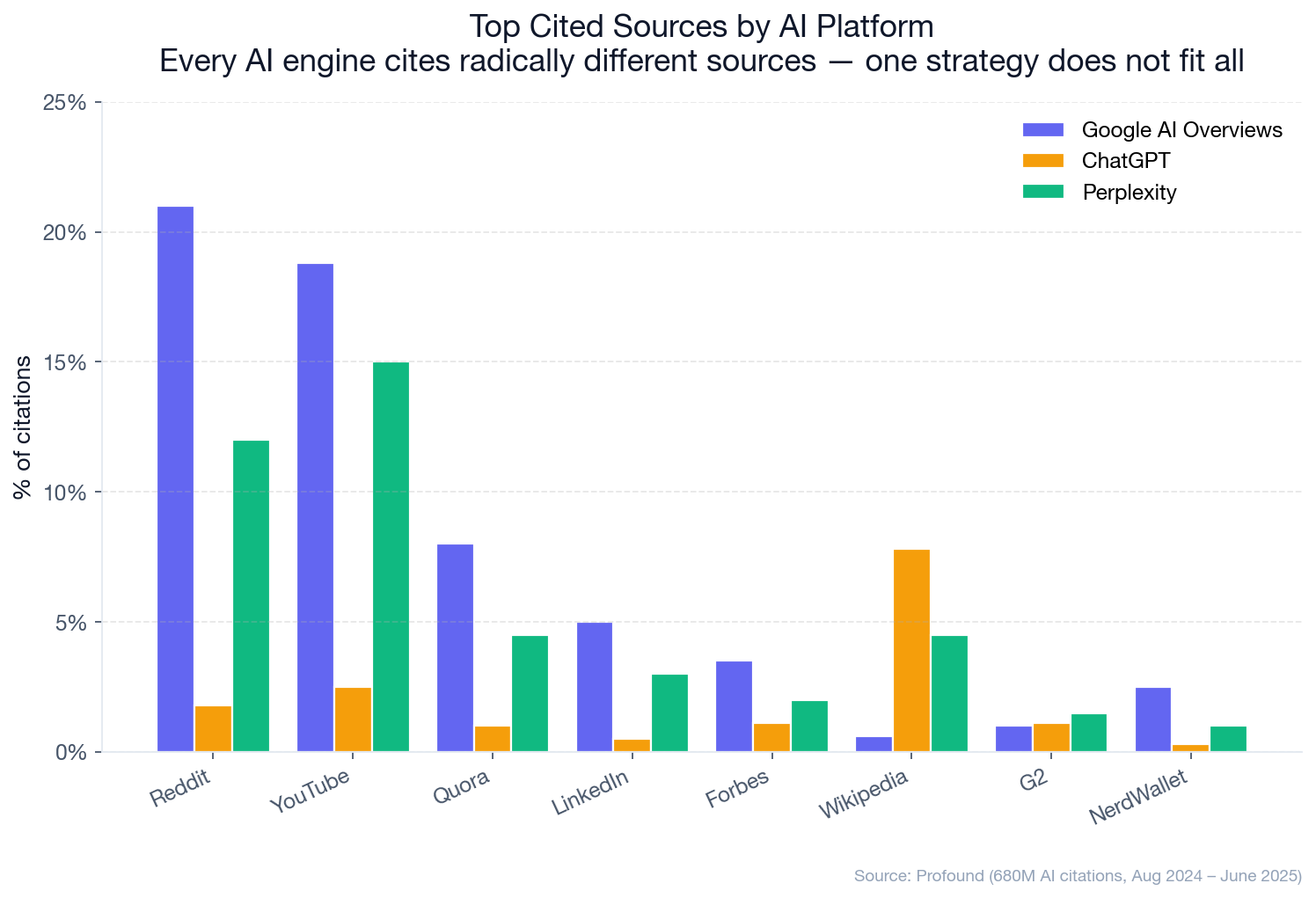
Top cited sources (Profound, 680M citations)
Google AI Overviews: - Reddit 21.0% - YouTube 18.8% - Quora, LinkedIn, Gartner, NerdWallet, Forbes follow - Wikipedia: 0.6%
ChatGPT: - Wikipedia 7.8% (47.9% of ChatGPT’s top-10 sources) - Reddit 1.8% - Forbes 1.1% - G2 1.1%
The brand-managed finding (most under-reported stat of 2025)
Yext analyzed 6.8 million AI citations across ChatGPT, Gemini, and Perplexity (July–August 2025, 1.6M queries per model, 20,820 unique domains):
- 86% of AI citations come from brand-managed sources.
- 44% from first-party websites
- 42% from listings (Google Business Profile, etc.)
- 8% from reviews/social
- Only 2% from Reddit-type forums once you control for location and intent
This flatly contradicts the “Reddit is winning AI search” narrative. Reddit and YouTube dominate unfiltered Profound-style aggregate citation counts, but when you break down by intent and control for user location, brand-owned content dominates.
Industry-specific citation mix (Yext)
| Industry | First-party | Listings | Reviews/social |
|---|---|---|---|
| Retail | 47.6% | — | — |
| Finance | 48.2% brand-owned | — | — |
| Healthcare | — | 52.6% | — |
| Food Service | — | 41.6% | 13.3% |
The citation mix is industry-specific. Finance and retail brands need strong first-party content. Healthcare and food service need dominant listings presence.
Semrush’s contradicting view
A Semrush analysis of 150,000 citations found: - Reddit 40.1% - Wikipedia 26.3% - YouTube 23.5% - Google 23.3% - Yelp 21%
These are different methodologies (aggregate counts vs intent-controlled). Both are valid — they measure different things.
Arvow’s LLM Visibility Tracker shows you exactly how ChatGPT, Perplexity, Gemini, Claude, Grok, and Google AI Overviews cite your brand today — and how that visibility shifts week by week. Track Your AI Visibility →
Real case studies
- Arvow’s own LLM SEO strategy increased ChatGPT-driven leads by 38% using entity-dense content and structured Q&A formatting.
- A New York dentist reached 3,200 monthly visits and got cited in every major LLM within 90 days of publishing AI-first optimized content.
- One site went from 0 to 4,000/mo in 90 days with AI SEO + GEO — and another hit 10,000/mo in just 24 hours.
8. AI Mode: The Newer Layer Everyone’s Sleeping On
AI Mode is Google’s answer-first, chat-style search experience. Launched May 2025. Different from AI Overviews — and getting under-covered in every stats roundup we analyzed.
Adoption
- AI Mode hit 100M monthly active users in the U.S. and India within ~2 months of launch (Alphabet Q2 2025 earnings).
- By December 2025, Google confirmed ~75M MAU in the U.S. specifically (updated AI Mode disclosure).
- Expanded to 200+ countries and territories in a 48-hour window in October 2025, now supports 40+ languages (Google).
Traffic composition — the transactional shift
Here’s the data nobody’s talking about:
- AI Mode referral traffic is 69% transactional (Search Engine Land analysis).
- That’s the near-mirror of AIO’s informational skew (97.7% informational per Ahrefs).
Translation: AI Mode is where purchase-intent queries are migrating. If you’re an ecommerce brand, SaaS company, or anyone monetizing transactional intent, AI Mode matters more than classic AIO.
AI Mode SEO impact (Semrush)
Semrush’s early AI Mode impact study found: - Clicks to cited sites from AI Mode are longer-session, higher-conversion than classic organic. - AI Mode citations are 5–10x less overlap with organic top-10 than AIO citations — the bar for AI Mode citation is fundamentally different. - Query reformulation inside AI Mode conversations generates “follow-up” traffic patterns Google has never had before.
Ads are coming fast
- Google Ads appear at the bottom of 25% of AIO SERPs — up from <1% in March 2025. That’s a 394% year-over-year increase (Semrush).
- In commercial query categories, ad presence in AIO climbed to ~40% in November 2025.
- Ads are now being tested in AI Mode conversations, with multiple reports of sponsored placements in answer threads.
Comparison grid
| Feature | AI Overviews | AI Mode | Featured Snippets |
|---|---|---|---|
| Launched | May 2024 | May 2025 | 2014 |
| Users | 2B monthly | 100M MAU (US+India) | — |
| Query mix | 97.7% informational | 69% transactional | Mixed |
| CTR impact | −58% (pos 1) | Not yet measured | −5% to −15% |
| Ads | 25% of SERPs | Testing | No |
| Citation count | 3 avg (was 5) | Fewer, deeper | 1 |
| Overlap with top-10 organic | 54.5% | Much lower | ~95% |
Arvow’s AI SEO Agent automatically injects the schema markup — FAQ, HowTo, Product, Article — that AI Mode disproportionately rewards. Schema coverage is the single highest-leverage AI Mode optimization. Discover the AI SEO Agent →
9. Revenue & Monetization Impact
The economic impact of AIO is lopsided: publishers lose, advertisers lose per-click but gain in AI traffic quality, and Google monetizes both sides.
Publisher revenue vulnerability
- 78% of DCN member publishers’ digital revenue comes from advertising — which depends on traffic (Digital Content Next, Aug 2025).
- Google surpassed 90% of the digital advertising market share in Q2 2025 for the first time (DCN).
When a single platform controls 90% of ad revenue AND the traffic source, losing 33% of Google search traffic (as publishers did in 2025) directly collapses revenue.
Advertiser pain — nobody’s discussing this
- Paid CTR for AIO queries fell 68% — from 19.7% (June 2024) to 6.34% (Sep 2025) (Seer Interactive).
- Non-AIO paid CTR still fell 32% — from 19.1% to 13.04%. The ad-click economy is compressing across the board.
But: AI-sourced traffic is 4.4× more valuable
- The average AI search visitor is worth 4.4× more than a traditional organic search visitor (Semrush).
- LLM sign-up conversion: 1.66% vs search sign-ups: 0.15% — a 10× higher conversion rate for sign-ups (Microsoft Clarity, 1,200+ sites, Dec 2025).
- LLM subscription conversions: 1.34% vs search: 0.55%.
ChatGPT vs Google traffic quality
- ChatGPT referrals convert 7% of traffic to transactional sites vs Google’s 5% (Similarweb, Mar 2026).
- ChatGPT referrals average 15 minutes on site vs 8 minutes from Google.
- 12 pageviews per ChatGPT visit vs 9 per Google visit.
AI traffic is fewer visits but dramatically higher quality per visit.
Shopify’s AI commerce data
- AI-referred traffic to Shopify grew 7× between January 2025 and early 2026.
- AI-attributed orders up 11×.
- Holiday 2025 AI-referred visitors converted 31% higher than traditional channels.
The scale gap
- AI sources still send just 0.1% of total referral traffic across ~35,000 websites (Ahrefs, March 2025).
- Google still sends 345× more traffic than ChatGPT + Perplexity + Gemini combined.
- Ahrefs’ own business attributes ~3% of conversions to AI (their “how did you hear about us” data).
AI traffic is small but growing fast and converting dramatically better than search. Google is still the volume play. AI is the quality play.
The GEO market
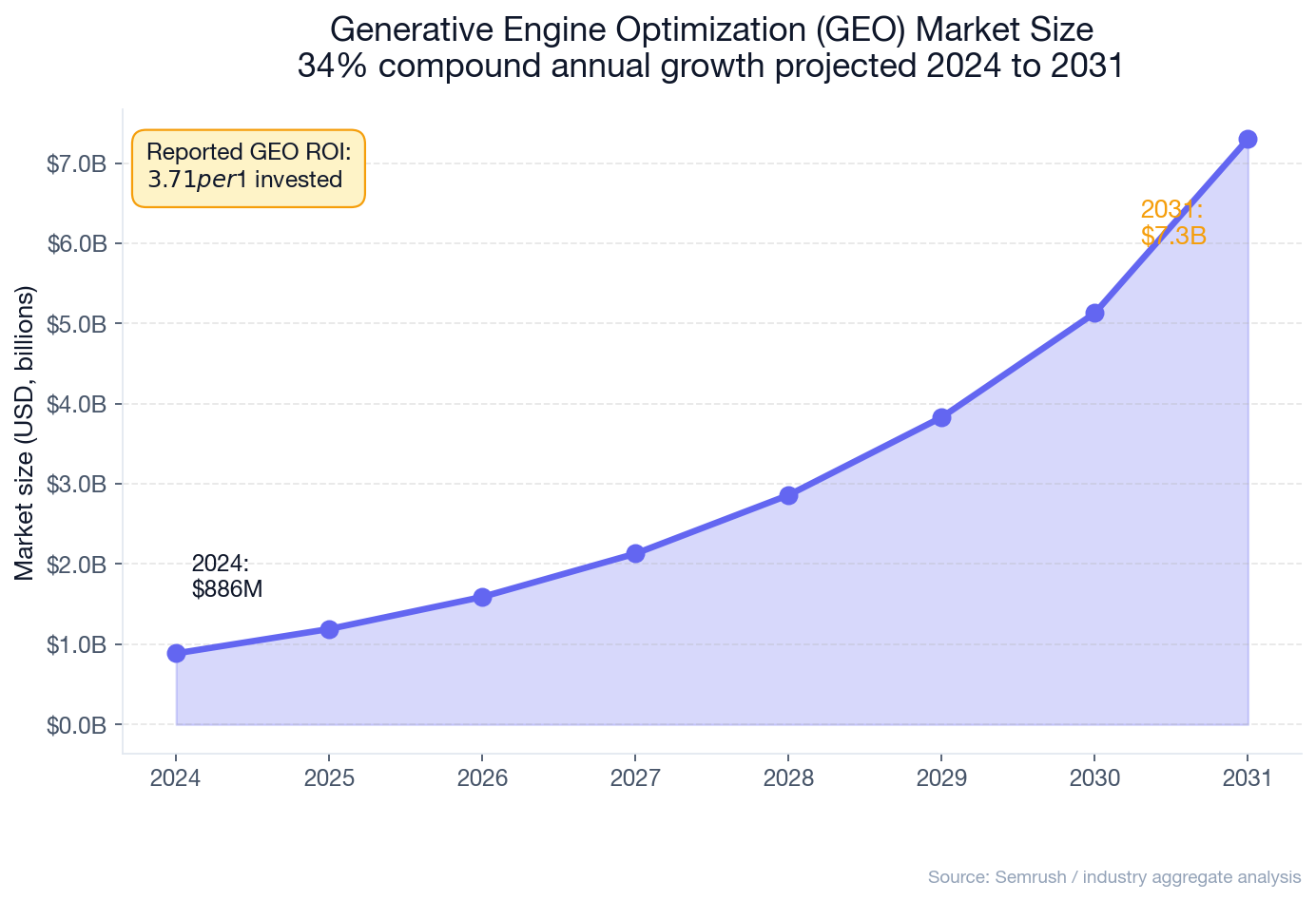
- GEO market grew to $886 million in 2024.
- Projected to reach $7.3 billion by 2031 (34% CAGR).
- Reported GEO ROI: $3.71 per $1 invested (Semrush).
Google’s AI monetization
- Google made $1.2 billion from Gemini subscriptions in 2025.
- Gemini app passed 750M monthly active users by Q4 2025 (Alphabet Q4 2025 earnings).
Google isn’t just shifting traffic away from publishers — it’s building a direct consumer subscription business on top.
10. How the SEO Industry Is Responding
The industry is adapting faster than the data would suggest.
Survey responses
- 68% of organizations are actively changing strategies due to AI search.
- 54% look to SEO teams to lead the response.
- 57% describe their outlook as “cautiously optimistic.”
- 32% remain in observation mode (BrightEdge, 750+ marketer survey, June 2025).
- 27% of marketers target both AI Overviews and ChatGPT.
- 18% also target Perplexity and Claude.
- 14% rely on content/editorial teams for AI search strategy.
The measurement gap
- Only 16% of brands systematically track AI search performance (McKinsey).
- 64% of marketing leaders are unsure how to measure AI search success (Yext, Oct 2025).
- 72% of marketing leaders believe AI search will surpass traditional SEO within 3 years (Yext).
That’s the single largest confidence-capability gap in modern SEO: most leaders know AI search matters, almost none know how to measure it.
Where brands show up in AI
- A brand’s own sites only comprise 5–10% of the sources AI search references. AI pulls more from affiliates, UGC, and review sites (McKinsey).
This is why Arvow’s approach — systematically building entity-level visibility across multiple content surfaces — works. Owned-site optimization alone isn’t enough.
Investment trajectory
- 56% of marketers already use generative AI for SEO.
- 61% see AI as key to their strategy.
- 98% plan to increase AI SEO spend in 2026 (Semrush).
The academic case for GEO
The Princeton/Georgia Tech/Allen Institute “Generative Engine Optimization” paper (Aggarwal et al., KDD 2024) benchmarked 10,000 queries and found:
- Including citations, quotations, and statistics boosts source visibility in generative responses by over 40%.
First hard academic evidence that GEO is an actual optimization discipline with measurable tactics.
Ecommerce SEO priorities
- 20.7% of ecommerce SEO professionals say ChatGPT-like alternatives will have the biggest impact on their strategies in the next 2 years.
- 20% cite AI Overviews specifically (Digitaloft / SEJ aggregated).
Priorities are split between optimizing for Google’s AI layer vs building visibility in non-Google AI engines.
Case study: direct traffic is the lifeboat
- 68% of Daily Mail’s traffic is direct (not search) — insulating it from AIO losses. Despite a 56% CTR loss on AIO queries, overall traffic is “only” down 19.5% YoY. Direct traffic, brand search, and newsletter funnels matter more than ever.
For tactical depth, see our AI content marketing statistics (parallel stats roundup) and AI visibility tracking tools.
11. AI Overviews vs Other AI Search Engines
Google isn’t the only AI search surface. The rest of the market is moving fast — and changing the share balance monthly.
The platform scale check
- ChatGPT weekly users: 900M globally (Feb 2026), up from 400M in Feb 2025. Daily queries exceed 2.5 billion (OpenAI).
- ChatGPT daily active users: ~122.6M (Oct 2025).
- Gemini app: 750M MAU by Q4 2025, up from 650M the prior quarter (Alphabet).
- Perplexity: 276.5M monthly visits (Oct 2025), though fell to 239.7M in November (−13% MoM).
- Claude: 157M monthly visits.
Market share is shifting
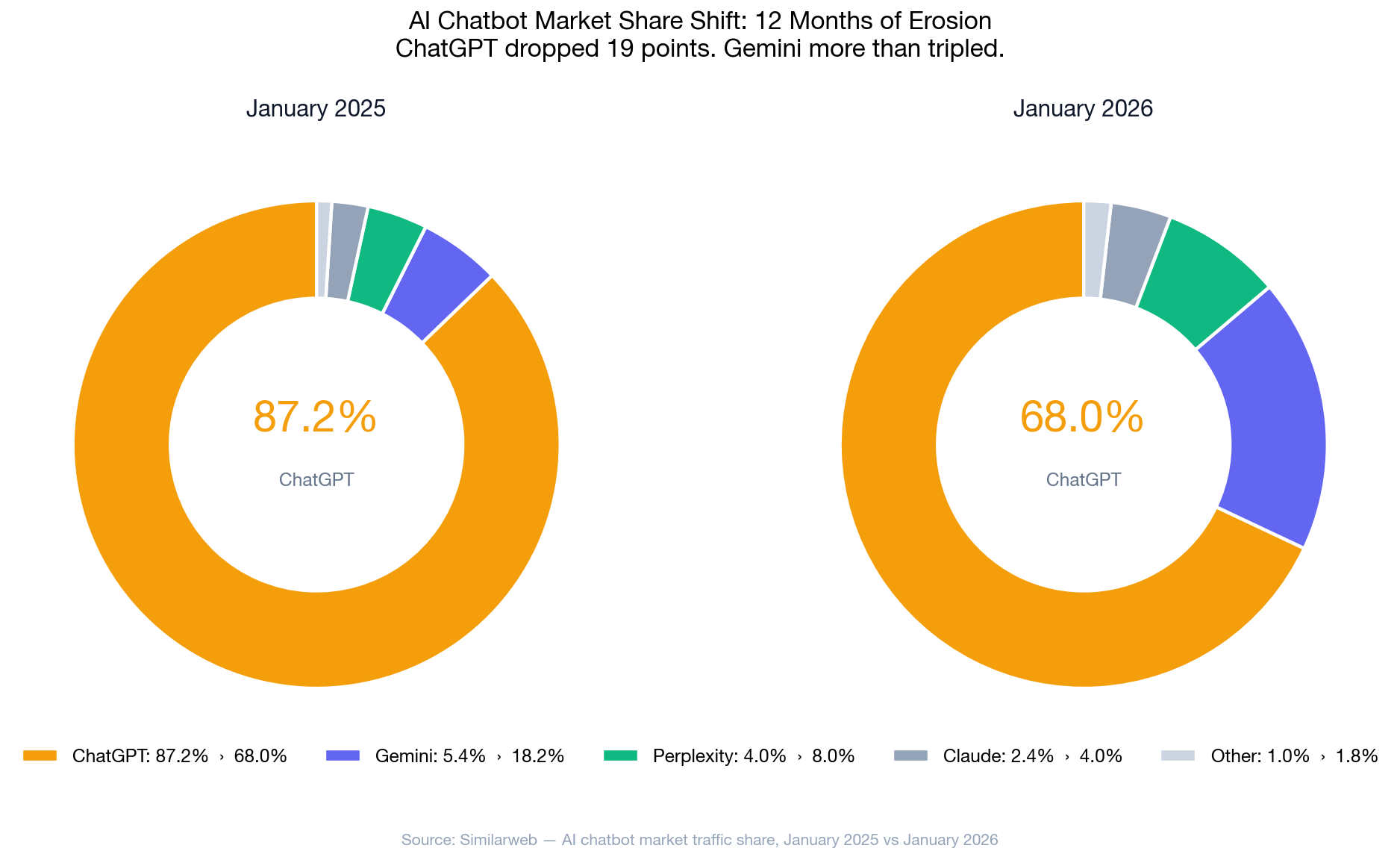
- ChatGPT’s share fell from 87.2% (Jan 2025) to 68% (Jan 2026).
- Gemini jumped from 5.4% to 18.2% — more than tripling.
- AI platform visits grew +28.6% overall (Jan 2025 → Jan 2026), but AI referral traffic to external sites was flat in the same period. AI platforms are keeping users captive.
Referral traffic growth
- ChatGPT referrals to 250 news/media sites grew 98% from Jan 2025 (123.2M) to April 2025 (243.8M).
- ChatGPT referrals up 52% YoY from Sept–Nov 2025 (Similarweb).
- Gemini referral traffic grew 388% between Sept and Nov 2025 — accelerating far faster than ChatGPT’s ~1% growth in the same window.
- AI-referral traffic to news/media sites grew 770% year-over-year — the biggest YoY growth of any vertical (Similarweb).
Share of AI referrals
Different studies give different splits: - Ahrefs (March 2025, ~35K sites): ChatGPT 50%, Perplexity 30.7%, Gemini 17.6%. - Conductor (April 2026, 13,770 enterprise domains): ChatGPT 87.4%. Much higher — reflecting enterprise-heavy sample.
AI leads the top of the funnel (Similarweb, Jan 2026 US panel)
- Product discovery stage: 35% AI vs 13.6% traditional search.
- Evaluation stage: 32.9% AI vs 15% search.
- Purchase stage: 24.3% AI vs 22.1% search.
AI is no longer a research-phase tool. It’s winning at every funnel stage — and narrowly at purchase.
Share of total web traffic
- AI referral traffic = 1.08% of total web traffic on average across 10 industries (Conductor, Q3–Q4 2025, 3.3B sessions).
- ChatGPT = 87.4% of all AI referrals.
- IT industry: 2.8% AI referral share (highest).
- Communication Services: 0.25% (lowest).
Conversion quality beats volume (recap)
- ChatGPT converts 7% of transactional traffic vs Google’s 5%.
- 15 min avg session vs 8 min from Google.
- 12 pageviews per visit vs 9.
- LLM sign-up conversions 10× higher than search (Microsoft Clarity).
If you’re prioritizing volume, Google still dominates. If you’re prioritizing conversion, AI-referred traffic is disproportionately valuable — and worth building strategy around.
For the full landscape, see our ChatGPT statistics 2026 and best AI visibility tracking tools.
12. User Demographics: Who’s Using AI Search
The “AI search user” is not who you think.
The generational divide
- 34% of Gen Z (ages 16–27) use AI chatbots for search — far above other age groups (Appinio/Claneo, 2,000 respondents US + Germany).
- 62% of adults under 30 see AI summaries extremely often vs 23% of those 65+.
- 25% of 18–29-year-olds have visited generative AI tools vs 13% overall (Pew Data Labs).
The heavy-user curve
- 20% of Americans now use AI tools 10+ times per month — up from 3% in January 2023.
- AI heavy-user share grew ~7× in 2.5 years (SparkToro + Datos).
- But growth is slowing. Most adopters who are going to adopt already have.
The additive pattern (counter-intuitive)
- 87% of US desktop devices are heavy Google users (Q1 2025) — up from 84% in Q1 2023.
- Traditional search usage grew even as AI tools exploded.
This is the single most important demographic finding in AI search: AI adoption hasn’t cannibalized Google. Users who adopt AI add it on top of their Google use, rather than replacing it.
Commerce behavior
- 1 in 3 Gen Z shoppers turn to AI platforms over other channels for shopping advice.
- 1 in 4 Millennials do the same (BigCommerce / Future Commerce).
Developers are ahead of everyone
- 84% of Stack Overflow developers use or plan to use AI tools (up from 76% in 2024).
- 51% of professional developers use AI tools daily.
- But trust is falling: only 29% say they trust AI (down from 40% in 2024).
- 66% cite “AI solutions that are almost right but not quite” as their biggest frustration.
- 45% report debugging AI-generated code takes longer than writing it themselves.
The developer adoption curve is a leading indicator. High usage + falling trust is where the general-consumer market is heading.
Geography
- US users are 1.6× more likely to receive AI traffic than users in India or the UK (Ahrefs).
- AI Mode and AIO are available in 200+ countries but actual usage is heavily US-centric.
13. The Contradictions: What the Data Doesn’t Agree On
This is the section nobody else writes. The 2025–2026 AIO data is riddled with contradictions. Most stats pages pick a single number. We laid them side by side.
- Ahrefs: −58% at position 1 (300K-keyword study, Dec 2023 vs Dec 2025)
- Seer Interactive: −61% organic CTR (3,119 queries, June 2024 vs Sep 2025)
- Amsive: −15.49% overall, −19.98% non-branded, +18.68% branded (700K keywords)
- Authoritas: −47.5% desktop, −37.7% mobile (UK publisher sample)
All are accurate. Each measures different baselines, samples, and query mixes. The useful takeaway: your CTR impact depends on whether you’re cited in AIO, whether your query is branded, your ranking position, and your niche.
- Ahrefs (May 2025): 9.46% global, 12.8% volume-weighted
- Reuters Institute (Jan 2026): ~10% of US search results
- Semrush (Nov 2025): 15.69% (after peaking at 24.61% in July 2025)
- Conductor (Apr 2026): 25.11%
- BrightEdge (Feb 2026): ~48%
- Advanced Web Ranking (Q4 2025): 49.92%
The gap isn’t measurement error. It’s sample composition: BrightEdge tracks the keyword types most likely to show AIOs. Ahrefs samples broadly. Semrush includes the AIO pullback period.
- BrightEdge (general): 17% of AIO citations are from organic top 10
- BrightEdge (Sep 2025 industry avg): 54.5% overlap (was 32.3% in May 2024)
- BrightEdge healthcare specifically: 75.3% overlap
- BrightEdge restaurants: 19.2% overlap
AIO-organic overlap depends heavily on vertical. Trust-sensitive niches (healthcare, finance, insurance) draw heavily from top-10 organic. Commercial niches (ecommerce, restaurants) largely don’t.
- Profound (680M citations, aggregate): Reddit 21.0% of AIO citations
- Semrush (150K citations): Reddit 40.1%
- Yext (6.8M citations, intent-controlled): Reddit-type forums = only 2% after controlling for location and intent
When controlled for intent and location, 86% of AI citations come from brand-managed sources, not Reddit. The “Reddit is winning” narrative is an artifact of aggregate counting, not intent-aware analysis.
- Google/Pichai: AIOs drive “over 10% more queries globally” for the types of queries that show them — and Google’s public stance is that clicks to external sites are up.
- Every independent study: Clicks are down 15–68% depending on methodology.
These can both be true if Google is measuring total queries (expanded search behavior) while independent studies measure per-query CTR. The honest read: more searches happening, fewer of them resulting in clicks to your site.
- BrightEdge: AIO grew 58% YoY to reach ~48% of queries in Feb 2026.
- Semrush: AIO peaked at 24.61% in July 2025, fell to 15.69% by November.
The reconciliation: Google pulled AIO back from sensitive categories (especially health, shopping, financial advice) in Q3–Q4 2025 while simultaneously expanding coverage in non-sensitive categories. The “overall AIO coverage” stat depends on which categories you’re sampling.
- Axios/Chartbeat: Small publishers lost 60% of search traffic.
- SparkToro/Datos: Traditional search share actually grew from 84% to 87% among heavy users.
Both are right. Search volume is growing. Search clicks to publishers are collapsing. Google is keeping more traffic inside its own ecosystem.
14. What This Means for Your Site in 2026
Six things the data above actually implies — grounded in the stats, not in speculation.
1. Optimize for citation, not just ranking
Being cited in an AIO is worth +35% organic CTR and +91% paid CTR vs not being cited on the same query (Seer). Yet only 17% of AIO citations come from the organic top 10 (BrightEdge). Ranking #1 is not sufficient — your content needs structural features (clean Q&A formatting, FAQ schema, entity-dense definitions, direct-answer paragraphs) that AIO actually extracts.
2. Build structured data aggressively
The Princeton/Georgia Tech GEO paper found citations, quotations, and statistics boost source visibility in generative responses by over 40%. FAQ schema and HowTo schema are specifically rewarded by AI Mode. Most sites have neither.
3. Build brand direct traffic
68% of Daily Mail’s traffic is direct — which is why their overall traffic is “only” down 19.5% despite a 56% AIO CTR loss. In an AI-first world, brand search, newsletter subscribers, and direct-to-site URL memorability are defensive moats.
4. Publish more, not less
98% of marketers plan to increase AI SEO spend in 2026 (Semrush). AI Mode rewards content freshness and entity coverage breadth. Sites publishing weekly or less will lose to sites publishing daily. Content velocity is no longer optional — Arvow’s Autoblog is how teams publish daily without scaling headcount.
5. Track AI visibility separately from organic rankings
Only 16% of brands systematically track AI search performance (McKinsey). The measurement gap is the opportunity gap. Teams that instrument their AI visibility — how often they appear in ChatGPT, Perplexity, Gemini, Claude, Grok, and Google AI Overviews — will make better decisions than teams still looking at Search Console alone.
6. Know which niche you’re in
If you’re in ecommerce or real estate, AIO pressure is relatively low (~5–20%). If you’re in healthcare, finance, or tech, you’re in the 48–89% AIO range. Niche-level strategy beats generic “AI SEO advice” every time.
Ready to act on the data? Arvow’s AI SEO Agent automatically deploys the exact structural optimizations the studies above say AI Overviews reward — FAQ schema, HowTo schema, entity linking, on-page SEO, internal linking, image alt text. Discover the AI SEO Agent →
Or if you want to see the output first: Try 3 Free Articles →
Σ Summary: AI Overviews & AI Mode by the Numbers
The 20 highest-leverage stats from this report, in one table.
| # | Stat | Source |
|---|---|---|
| 1 | AI Overviews reach 2 billion monthly users across 200+ countries | Alphabet Q2 2025 earnings |
| 2 | AI Mode has 100M+ monthly active users (US + India) | Alphabet Q2 2025 |
| 3 | AIOs appear on 48–50% of tracked queries (Q4 2025–Q1 2026) | BrightEdge, Advanced Web Ranking |
| 4 | AIOs peaked at 24.61% in July 2025, fell to 15.69% by November | Semrush |
| 5 | Position-1 CTR is down 58% on AIO queries vs Dec 2023 | Ahrefs (300K-keyword study) |
| 6 | Organic CTR fell from 1.76% to 0.61% — a 61% decline | Seer Interactive |
| 7 | Branded CTR rises 18.68% when AIO appears; non-branded falls 19.98% | Amsive |
| 8 | Only 1% of AI summary citations get clicked | Pew Research |
| 9 | 83% of AIO-triggering queries end in zero clicks | Datos/SparkToro |
| 10 | Global publisher search traffic fell 33% YoY to Nov 2025 | Chartbeat/Reuters Institute |
| 11 | Small publishers lost 60% of search traffic in 2 years; large just 22% | Chartbeat |
| 12 | 58% of US adults saw an AI summary in March 2025 | Pew |
| 13 | “Best [product]” queries: 5% AIO (2024) → 83% (2025) | BrightEdge |
| 14 | Treatment/procedure medical queries: 100% AIO presence | BrightEdge |
| 15 | Only 17% of AIO citations come from top-10 organic | BrightEdge (Feb 2026) |
| 16 | 86% of AI citations are brand-managed sources | Yext (6.8M citations) |
| 17 | ChatGPT market share: 87.2% (Jan 2025) → 68% (Jan 2026) | Similarweb |
| 18 | Gemini app reached 750M monthly active users (Q4 2025) | Alphabet Q4 2025 |
| 19 | Average AI search visitor is worth 4.4× more than a Google visitor | Semrush |
| 20 | 98% of marketers plan to increase AI SEO spend in 2026 | Semrush |
Frequently Asked Questions
How often do AI Overviews appear in Google search results in 2026?
AI Overviews appear on roughly 48–50% of tracked Google searches as of Q1 2026 (BrightEdge, Advanced Web Ranking). Prevalence varies wildly by industry: healthcare treatment queries hit 100% AIO, while real estate sits below 5%. Semrush also found AIO peaked at 24.61% of queries in July 2025 before Google pulled back to ~15.69% by November.
How much do AI Overviews actually reduce click-through rates?
Position-1 CTR is down 58% on AIO queries vs December 2023 (Ahrefs, 300K-keyword study). Seer Interactive found an overall organic CTR drop of 61% — from 1.76% to 0.61% — from June 2024 to September 2025. Amsive’s 700K-keyword study showed a smaller 15.49% average decline, but branded queries actually gained 18.68% CTR when AIO appears.
What’s the difference between AI Overviews and AI Mode?
AI Overviews are the AI-generated summary boxes that appear at the top of some Google search results (97.7% of AIO queries are informational, per Ahrefs). AI Mode is Google’s full conversational-search experience launched May 2025 — 69% of AI Mode traffic is transactional. AI Mode has 100M+ monthly active users and is where purchase-intent queries are migrating.
How do I get cited in AI Overviews?
Three structural factors correlate with AIO citation: (1) schema markup (FAQ, HowTo, Product), (2) direct-answer paragraph formatting matching the query, and (3) entity-dense content that names specific brands, products, places, and people. The academic GEO paper found citations, quotations, and statistics boost source visibility by over 40%. Tools like Arvow’s LLM Visibility Tracker let you measure your AIO citation rate across queries.
Which industries are hit hardest by AI Overviews?
Healthcare (48–89% AIO presence), tech (71%), education (72.6%), and insurance (68.6%) are the most AIO-saturated verticals. Real estate (4.48%), consumer staples (6.82%), beauty (14%), and restaurants (19.2%) are the least affected. Affiliate/review sites in the “best [product]” niche saw AIO coverage explode from 5% (2024) to 83% (2025) — functionally erasing that content category.
Is AI Overview traffic worth optimizing for given the low click rates?
Yes, but the math is different. Only 1% of AIO citations get clicked (Pew), but when you are cited, organic CTR is 35% higher and paid CTR is 91% higher than not being cited (Seer). Also: AI traffic converts 4.4× better than Google organic traffic (Semrush) and 10× better for sign-ups (Microsoft Clarity). Volume is falling. Quality per visit is rising fast.
Are AI Overviews going to replace traditional Google search?
Not soon, and maybe never cleanly. Traditional Google search usage among heavy users actually grew from 84% to 87% between Q1 2023 and Q1 2025 (SparkToro/Datos) — AI is additive, not replacive. However, 72% of marketing leaders believe AI search will surpass traditional SEO within 3 years (Yext). The safe bet: both surfaces remain important, with AI search capturing a rising share of high-value transactional behavior.
Should small publishers even bother with SEO in 2026?
SEO is still the largest single traffic source for most sites, but strategy has changed. Small publishers have lost 60% of search traffic over two years vs 22% for large publishers (Chartbeat). The winning 2026 playbook: (1) build direct/newsletter traffic as a moat, (2) optimize structurally for AIO citation (not just ranking), (3) focus on niches with low AIO saturation, and (4) publish at content velocity large publishers can’t match without AI assistance.
Methodology and Sources
This report aggregates data from 30+ primary sources published between October 2024 and April 2026. We prioritized:
- First-party platform data — Alphabet earnings, OpenAI disclosures, publisher internal analytics (Daily Mail, DCN)
- Large-sample independent studies — Ahrefs (300K, 55.8M keywords), Semrush (10M+ keywords), BrightEdge (16-month panel), Pew Research (68,879 searches), Yext (6.8M citations), Conductor (21.9M searches)
- Consumer-panel research — Pew browsing panel, Datos/SparkToro clickstream, McKinsey, Bain
- Academic research — the Princeton/Georgia Tech GEO paper (Aggarwal et al.)
- Traffic analytics platforms — Similarweb, Chartbeat, Microsoft Clarity
Primary sources used
- Advanced Web Ranking (Q3 2025 CTR report)
- Ahrefs (AI Overviews CTR study, 55.8M AIO analysis, AI traffic research)
- Alphabet Q2 and Q4 2025 earnings calls
- Amsive (AIO CTR research)
- Authoritas (AIO user intent research, SERP volatility)
- Bain & Company (Consumer reliance on AI search)
- BrightEdge (AIO one-year review, Healthcare AI evolution, Black Friday comparison, SEO Survey)
- Chartbeat / Axios / Reuters Institute (Publisher traffic 2025)
- Conductor (2026 AEO/GEO Benchmarks)
- Daily Mail / WAN-IFRA (via Search Engine Land)
- Digital Content Next (DCN member study)
- Digiday (State of AI referral traffic 2025)
- McKinsey (Winning in the age of AI search)
- Microsoft Clarity (via Digiday)
- Pew Research Center (AI summaries browsing panel, ATP opinion survey, Data Labs)
- Princeton/Georgia Tech/Allen Institute (GEO paper, Aggarwal et al.)
- Profound (AI platform citation patterns)
- Seer Interactive (AIO CTR September 2025 update)
- Semrush (AI Overviews Study, Most-cited domains, AI Mode SEO impact, GenAI stats)
- seoClarity (AI Overviews research)
- Shopify (AI commerce data)
- Similarweb (Most used AI, GenAI stats, AI referral winners)
- SparkToro + Datos (State of Search 2025)
- Stack Overflow (Developer Survey 2025)
- Yext (AI Citations study)
This page was last updated in April 2026. Bookmark it — we update every quarter as BrightEdge, Semrush, Ahrefs, Seer, and Pew publish new data.
Keep reading
- AI content marketing statistics 2026
- ChatGPT statistics 2026
- Blogging statistics 2026
- 7 best AI visibility tracking and LLM brand-tracker tools
- Arvow vs Semrush AI Visibility Toolkit
- SearchGPT: the new AI search engine
- Prompt tracking in LLMs for AI SEO software
Generate, publish, syndicate and update articles automatically
The AI SEO Writer that Auto-Publishes to your Blog
- Cancel anytime
- Articles in 30 secs
- Plagiarism Free