
How to Get 65,200/mo Traffic to Your Site with AI ($11,000 Value)

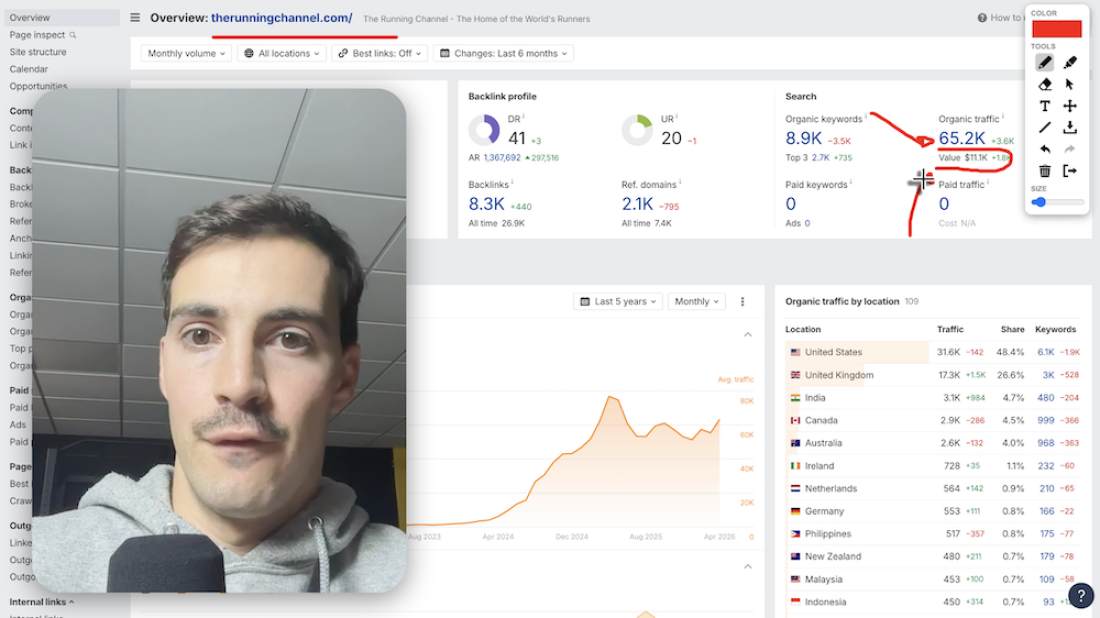
Table of Contents
There's a brand called The Running Channel. All they do — quote unquote — is publish news articles about running. London Marathon coverage. Boston Marathon recaps. Training news. Elite runner profiles.
That's it. That's the site.
And that simple strategy pulls in nearly 65,000 visitors every single month. If you tried to replicate that traffic through Google Ads, you'd be paying at least $11,000 per month to bid on the same keywords. They're getting it for free.
In this post, I'll break down exactly how this works, why it's a huge missed opportunity for most sites, and the full automated workflow — using a specific Claude prompt plus Arvow — to replicate it on your own site. This works for any niche: local businesses, SaaS, e-commerce, agencies, creators. Any language. Any geography.
Full walkthrough:
Let's break it down.
The $11,000/Month SEO Value Nobody Talks About
Quick math on why this matters. When someone pulls in 65,000 monthly visitors through SEO, that traffic has a real dollar value — the amount a competitor would have to spend on Google Ads to buy that same traffic.
For The Running Channel, that's around $11,000 per month. Every month. For free.
That's not even counting the other ways they monetize the traffic: display ads on the site, affiliate links, sponsored posts, a podcast, and an official merch store. The news articles are the top of the funnel feeding all of it.
Here's the kicker — they're also getting cited by LLMs. Google's AI Overviews mention their brand thousands of times. ChatGPT, Perplexity, Copilot, Claude — all referencing their articles when users ask running-related questions.
You can track this kind of AI visibility for your own brand (or any competitor) using Arvow's LLM Brand Monitor. Log into Arvow, go to Analytics → Brand Monitor, add your brand, and track how often you show up across ChatGPT, Claude, Gemini, Perplexity, and Grok — plus the sentiment of each mention. You can track unlimited prompts and even bulk-import them.
Why Your Site Needs a /news Section
Here's the core insight most businesses miss. You don't need to become a news site. You need to add a news section to the site you already have.
Take any business. Say you run an e-commerce store selling Pokémon plushies. You probably already have /shop, /blog, /about. What you're missing is /news — a dedicated section covering current events in your niche.
New card releases. Tournament results. Celebrity trading card purchases. Pricing news. Convention announcements. All aggregated and published on your domain.
What this does:
Lifts the relevance of your entire domain for your niche's core keywords.
Drives fresh, recurring traffic from people searching for current events.
Increases your chances of being cited by LLMs, which love fresh, sourced, structured news content.
Improves user experience for existing visitors, who now have a reason to return to your site regularly.
Builds topical authority — the signal Google uses to reward sites that cover a topic comprehensively.
This works for any niche with current events. Plumbing has news. SEO has news. Fitness has news. Agency services have news. Software has news. If there's activity in your industry — product launches, regulatory changes, acquisitions, events, trends — there's news to be published.
Most businesses ignore this entirely. That's the opportunity.
The Claude Prompt That Finds Your News Angles
Here's where the automation starts. The first piece of the workflow is a Claude prompt that researches your niche, identifies the specific news categories that would drive the most relevant traffic, and generates the search queries to find current stories.
You input three things:
Your niche (e.g., "Pokémon," "AI SEO software," "local plumbing")
Your target audience (e.g., "Pokémon enthusiasts and collectors," "SEO agency owners")
Your geographical focus (e.g., "US," "UK," "global")
Claude then runs a multi-step research process to identify the sub-topics within your niche that have the highest content velocity (i.e., where the most news is actually happening), the types of stories that would interest your target audience, and the specific search queries to find current articles.
The output is a set of targeted search queries you can feed directly into Arvow's news pipeline. You don't need the paid extended-thinking version of Claude for this — the regular model works fine. Extended thinking just adds polish.
(The full master prompt is available — drop a comment on the YouTube video with the word "prompt" and it'll be sent to you.)
Turning Claude's Research Into AI News Articles
Once Claude has identified the right queries for your niche, the next step is feeding those into Arvow to actually generate the news articles.
Inside Arvow, you go to Add News Articles and paste in each query. A few advanced options matter:
Geographical focus — match what you told Claude (US, UK, global, etc.)
Time window — past day, past week, past month depending on how fresh you want the coverage
Hit "Search Stories" and Arvow pulls current news stories matching your queries. Select the ones you want to cover, hit "Add Articles," and Arvow generates full news pieces from each one.
Each article includes:
A compelling headline
A short intro framing the story
Key takeaways (bulleted, LLM-friendly)
The full news body written like an AI journalist wrote it
Source citations at the bottom linking to the original reporting
An AI-generated featured image matching the story
The citations are crucial. This isn't plagiarism — it's aggregated journalism with proper attribution, written in your brand's voice. Google and LLMs both reward this kind of sourced, referenced content.
You can bulk-generate dozens of articles in one batch. Open the generation panel, review each article, edit anything you want to change using the Arvow SEO Editor, and publish directly to your site.
Fully Automating News Publishing
Manually running the prompt → generating articles → publishing loop every day defeats the purpose. The real leverage comes from full automation.
In Arvow, go to Campaigns → AutoBlogs → Create New. Name it something like "Automated Niche News Section." Enable full automation mode. Set your publishing cadence — three news pieces per day, four per week, whatever fits your strategy.
Select your site, hit create, and the entire workflow runs on autopilot. Arvow handles:
Research — pulling current stories based on your configured queries
Generation — writing full news articles with images and sources
Publishing — pushing them directly to the /news section of your site
This integrates natively with Shopify, WordPress, Webflow, Framer, Wix, and more. For custom stacks, there's an API and webhook option so you can connect it to anything.
Set it up once. Wake up every morning to three new news articles published on your site, driving fresh traffic and feeding your topical authority.
Why Most Sites Don't Do This (And Why You Should)
If this is so effective, why aren't more businesses doing it?
Two reasons.
First, most business owners don't realize news content is even a viable SEO strategy for their niche. They think news belongs to newspapers. It doesn't. News belongs to whoever shows up first with good coverage.
Second, the workload to do it manually is brutal. Identifying stories, researching sources, writing articles, creating images, publishing, repeating — every day. No small business has time for that. Which is exactly why AI makes it newly possible.
The Running Channel example shows what happens when a brand commits to this strategy. Nearly 70,000 monthly visitors. Thousands of LLM citations. Real revenue from ads, affiliates, and products.
Now imagine layering this on top of a business that already sells something. An e-commerce store with a news section covering industry events. A SaaS company with a news section covering ecosystem updates. A local service business with a news section covering neighborhood events and local regulatory changes.
The Running Channel case study is compelling because it's pure — they only do news. But the real opportunity is for businesses that already have a product, already have traffic, and just need a news section to amplify everything they're already doing.
Putting It Together
Here's the full automated workflow, from zero:
Run the Claude master prompt with your niche, audience, and geography → get your news research plan.
Feed the queries into Arvow → generate your first batch of news articles to test the concept.
Create a /news section on your site (Arvow publishes directly to most major platforms).
Set up an AutoBlog campaign → full automation, 3–7 articles per week on schedule.
Track the results — monitor traffic growth, keyword rankings, and LLM citations using Arvow's brand monitor.
Do this for 3–6 months and you'll have a news section rivaling dedicated publishers in your niche — feeding recurring traffic into the rest of your business.
For a deeper dive into the full AI + SEO strategy behind this, check out the Arvow Academy, which has courses covering news SEO, programmatic SEO, AI content systems, and getting cited by LLMs.
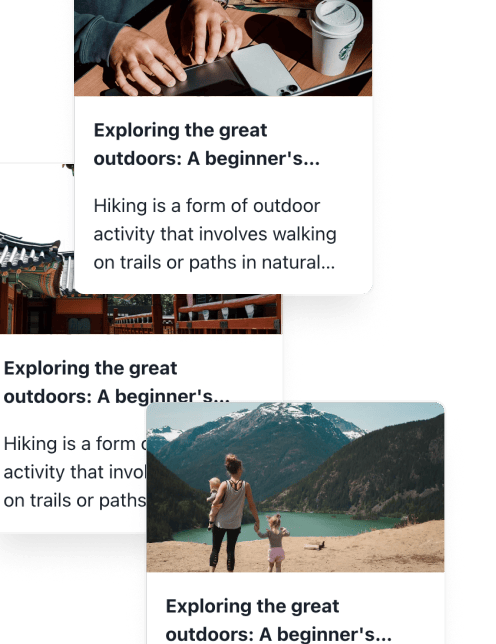
Generate, publish, syndicate and update articles automatically
The AI SEO Writer that Auto-Publishes to your Blog
- Cancel anytime
- Articles in 30 secs
- Plagiarism Free