
SaaS SEO Course: How to Rank #1 on Google and Get Cited by ChatGPT

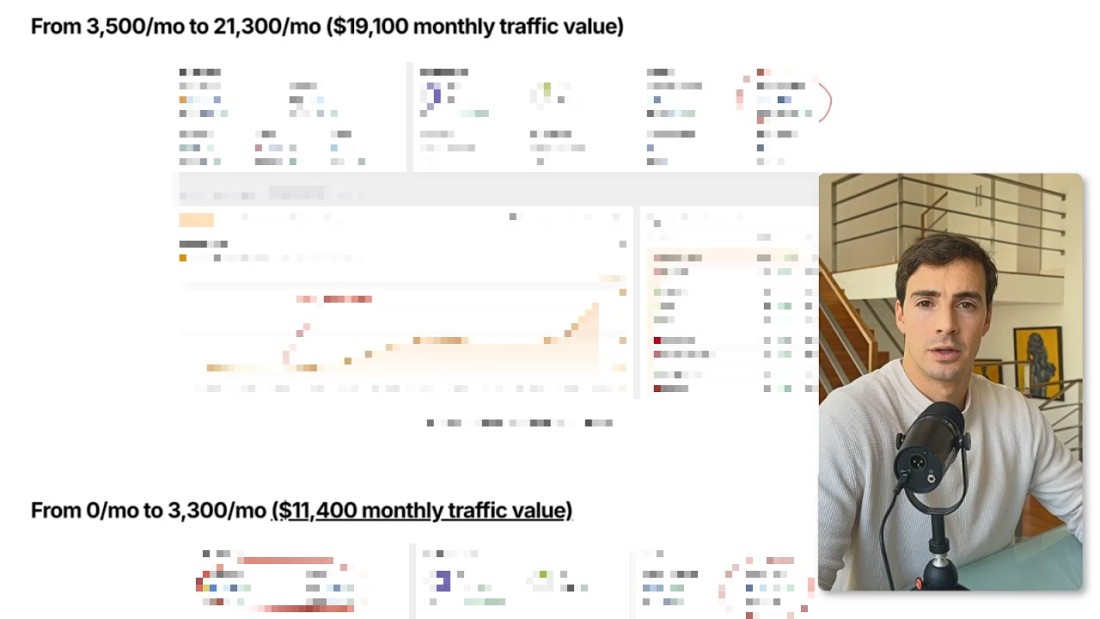
Table of Contents
If you run a SaaS business and you're struggling to get consistent organic traffic — or you've watched competitors get mentioned inside ChatGPT while your product gets ignored — this guide is for you.
This is a complete SaaS SEO course: a step-by-step system for ranking your software on Google and getting your brand recommended by AI tools like ChatGPT, Perplexity, Google AI Mode, Grok, and Claude. By the end, you'll know exactly what content to produce, which keywords to target, and how to set up the four-page framework that's driven 10x traffic growth for multiple SaaS companies.
Proof This Works: Real SaaS Traffic Results
Before diving into strategy, here's why this system is worth your time.
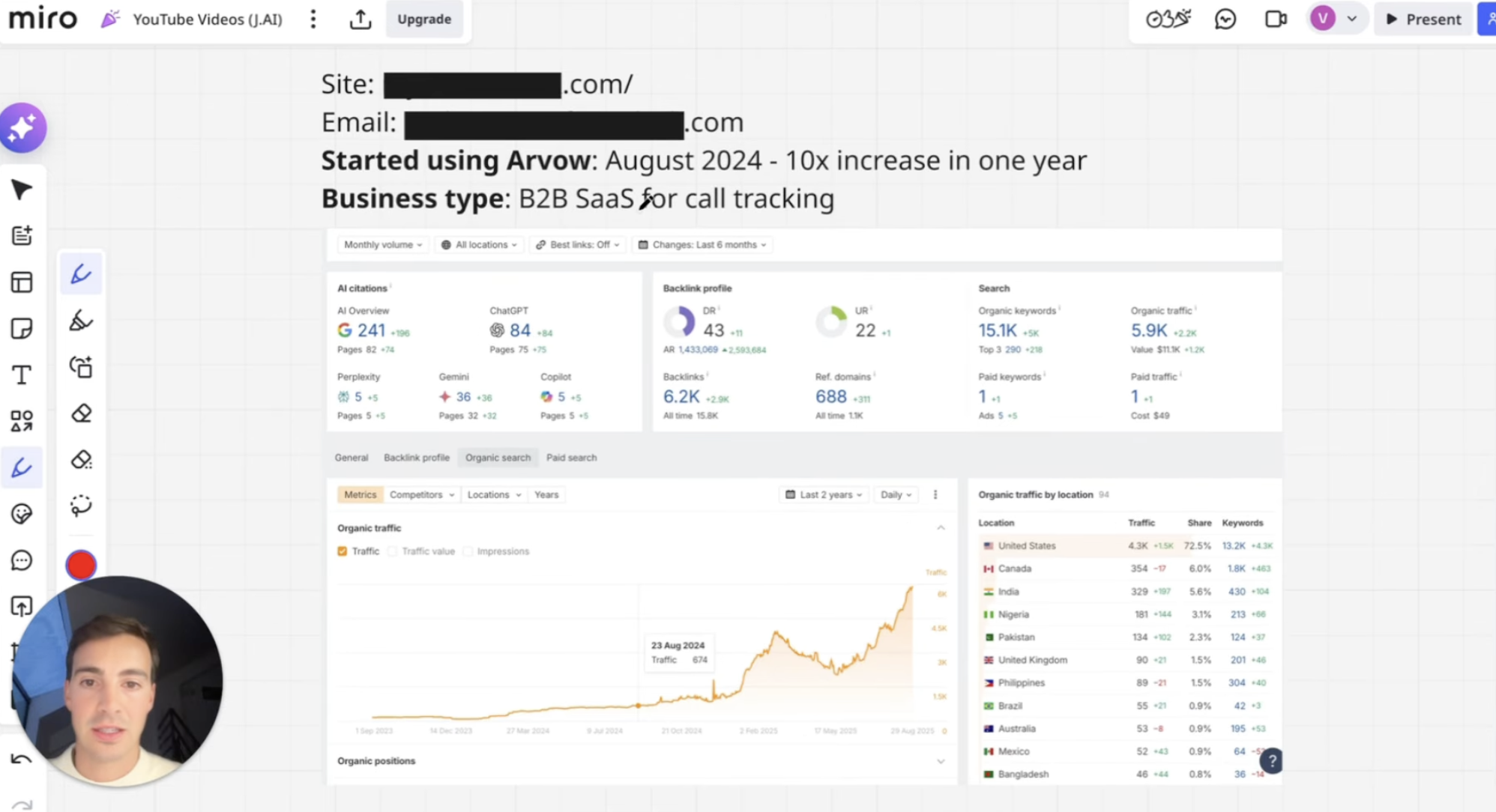
B2B call tracking SaaS — Started with near-zero organic traffic in August 2024. Implemented this system and grew to 6,000 monthly organic visits, while simultaneously increasing citations across ChatGPT, Perplexity, Google AI Overviews, and Copilot.
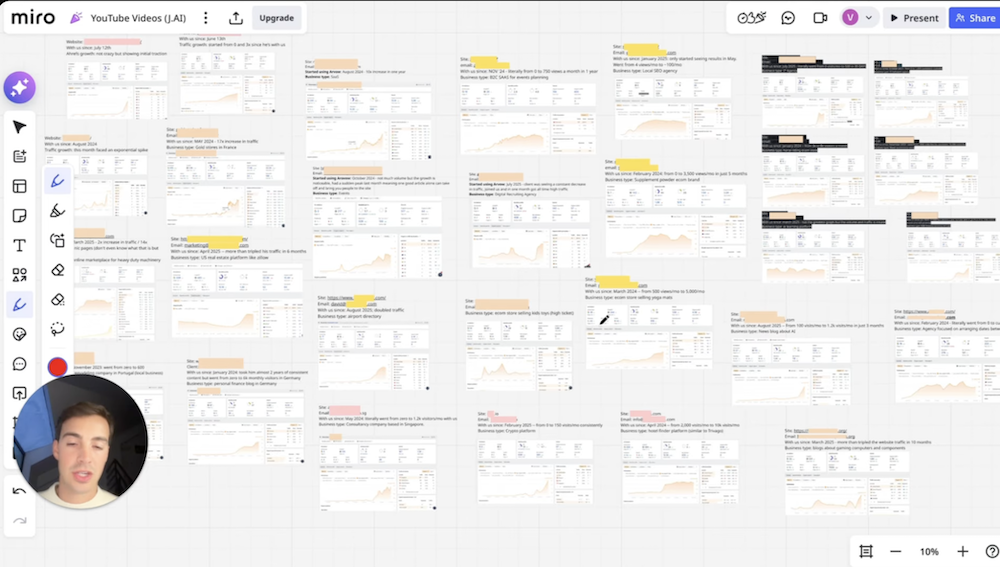
Other results from the same playbook:
Feature adoption tracker SaaS: 4K → 21K monthly visits (value equivalent: ~$20K/month in paid traffic)
B2B AI invoice SaaS: 0 → 3K/month
B2B AI appointment SaaS: 6K → 20K/month, plus surging LLM citations
AI content repurposing SaaS: Significant organic + LLM mention growth on day of implementation
CRO engine SaaS: 0 → 12K/month
UGC management SaaS: 0 → 900/month traffic value, then 0 → 12K/month
Why Traffic Alone Is a Vanity Metric
One important caveat before we go further: traffic numbers can be meaningless. The only thing that matters is traffic from people who are likely to buy your product.
Take a SaaS site ranking for 15,000 keywords with 6K monthly visits valued at $11,000. That $11,000 "value" means if a competitor wanted to buy the same traffic through Google Ads, they'd pay at least $11,000/month — while this company gets it for free. That's meaningful.
But a site pulling 500K monthly visits from people searching "OpenAI revenue 2023" will never convert those visitors into paying customers. High traffic from the wrong keywords = zero revenue. We'll come back to this when we cover keyword selection.
How This System Works: The 3-Step Framework
At a high level, the entire system comes down to three things:
Step 1: Produce Content That Satisfies Search Intent
Google's search ranking systems work by matching a user's query to the most relevant result. If someone searches "best CRM for doctors," Google will rank the page that best answers that question — not just any CRM page.
The same logic applies to LLMs. When someone prompts ChatGPT, it generates an answer that satisfies the intent of their prompt. If your content directly addresses what that person is asking — and does so better than competitors — your brand gets cited.
Different queries = different content formats. Search "how to tie a tie" and you'll see short videos and images because that's what satisfies the intent. Search "best project management software for agencies" and you'll see listicle articles. Match the format to the intent.
Step 2: Target Keywords with High Buying Intent
Not all traffic is equal. Consider an iPhone repair shop. They could rank for:
"How to repair an iPhone" — 10,000 searches/month
"How much does it cost to repair an iPhone" — 1,000 searches/month
The first keyword drives more traffic. But the second keyword has infinitely higher buying intent. Someone searching "how to repair" probably wants to DIY it. Someone searching "how much does it cost" wants to pay someone.
Research on keyword intent consistently shows that bottom-of-funnel keywords — where someone is close to making a purchase decision — convert at dramatically higher rates despite lower search volumes.
For SaaS, this means prioritising keywords from people who are:
Already aware they have a problem
Actively evaluating solutions
Comparing specific tools
Step 3: Produce the Content at Scale
Once you know what to produce and why, the third step is simply execution — writing and publishing the content. The rest of this guide covers exactly what to produce and how to structure it.
The Keyword Matrix: Choosing What to Target
Before we cover the four content types, let's talk about keyword selection. You need a way to prioritise which keywords to go after first.
Use a simple buying intent vs. competition/traffic matrix:
HIGH BUYING INTENT | ✅ | ✅ Low | High Traffic | Traffic | ❌ | ❌ | LOW BUYING INTENT
Low traffic + high buying intent ✅ — Easy to rank, high conversion rate. Start here.
High traffic + high buying intent ✅ — Harder to rank but worth pursuing once you have authority.
Low or high traffic + low buying intent ❌ — Avoid. Rankings don't translate to customers.
Low Competition + Buyer-Aware Keyword Formulas
1. Competitor alternative keywords "[Competitor] alternative" — The word "alternative" signals high buying intent. The person knows the competitor's product and is actively shopping for something different. These keywords also tend to have lower difficulty because most brands don't target their competitors' names.
2. Modifier + product + ICP format "Best [modifier] [product] for [ICP]" Examples:
Best affordable SEO software for agencies
Fastest note-taking app for students
Cheapest CRM for ecommerce stores
Best customer support SaaS for doctors
3. Competitor vs. competitor "[Competitor A] vs [Competitor B]" — Bottom-of-funnel. Person is at the decision stage.
Keywords vs. Prompts: The LLM Difference
On Google, you'd search: "Triple Whale alternative"
In ChatGPT, you'd prompt: "I run an ecommerce store and I'm looking for software to track sales. I don't want to pay for Triple Whale and I need it to support 10 seats."
The intent is identical — but the LLM prompt contains far more context. This is why LLM search behaviour differs from traditional search: the AI can understand nuanced situations and give hyper-specific recommendations. The implication for your content: be hyper-specific about exactly who your product serves, what it does, and how it compares.
The 4 Types of Content Every SaaS Needs
This is the core of the system. Build these four page types and you will rank for high-intent keywords and start appearing in LLM recommendations.
Content Type 1: Alternative Pages
What they are: Pages targeting "[Competitor] alternative" searches.
Why they work: Anyone searching for an "alternative to [tool]" is high-intent by definition. They know the category. They've used or evaluated a competitor. They want to buy — they just haven't picked their tool yet. These are the best leads you can capture through organic search.
The format: A listicle article — "10 Best Alternatives to [Competitor]" — where your product is listed first, followed by other options.
Type "best alternatives to Herman Miller" into Perplexity and the first cited brand is Autonomous — not Herman Miller itself. Why? Because Autonomous published a detailed listicle article: "10 Best Alternatives to Herman Miller That Feel Premium."
Herman Miller doesn't have this page. That's a missed opportunity. If you type in "Herman Miller alternative" and they show up first, saying "We know you're looking for an alternative — but here's why there isn't one better. Take 10% off your next purchase" — they'd capture traffic that's currently going to competitors.
Your action: Make a list of every direct competitor. Create one alternative page per competitor. Put yourself first on each list.
A note on LLMs vs Google: There's an important asymmetry here. Studies show roughly one-third of pages cited by LLMs like ChatGPT don't appear in the top results on Google. Why? Because Google shows you the top results and you click through a few. An LLM reads everything — including results buried on page 5 or 10 — to give you the most complete answer. So even if you're not ranking #1 on Google yet, publishing this content can still get you cited by AI tools.
How to scale this: Arvow lets you bulk-produce alternative listicle articles. Upload your competitor list, configure tone, ICP, language, and internal/external linking preferences, and generate all your alternative pages at once. You can target 150+ languages for international markets.
Content Type 2: Comparison Pages
What they are: "[Competitor A] vs [Competitor B]" pages.
How they differ from alternative pages: Alternative pages are broad ("here are 10 options"). Comparison pages are one-on-one head-to-heads. Both types are high buying intent, but comparisons capture people who have already narrowed their decision to two specific tools.
Examples:
Slack vs Microsoft Teams
Stripe vs PayPal vs Wise
Notion vs Confluence
Webflow vs WordPress
Shopify vs WooCommerce
You'd create pages comparing:
Yourself vs each competitor
Two competitors against each other (where you appear as a recommendation)
Thinkific — an online course hosting platform — has built an entire library of comparison pages: "Thinkific vs Teachable," "Thinkific vs Kajabi," "Thinkific vs Podia," etc. Each follows the same structure: a clean, scannable comparison table covering features, pricing, and best use cases.
The result? When someone goes into Perplexity and asks "What's the best platform to host my online course?" and then narrows it down with follow-up prompts, Thinkific's comparison pages get cited — because the information is right there, well-structured and detailed.
Your action: List every competitor. Build a "You vs [Competitor]" page for each. Then identify the top two or three comparison queries your buyers are making and build those pages too (e.g., "[Top Competitor] vs [Second Competitor]" — where you appear as the better third option).
Content Type 3: Competitor-Focused Pages
What they are: In-depth informational content about your competitors' products — their pricing, features, limitations, and common pain points — published on your site.
Why this works: Your competitors' customers are searching Google every day for information about the product they're already using. "How does Slack pricing work?" "What's the Slack message history limit?" "PayPal international transfer fees." These people are in-market. They're using a product in your category. And if you publish better information about your competitor than the competitor publishes about themselves — you can intercept those searches.
Search "what are PayPal's fees to send money" on Perplexity and the first result cited is Wise — a PayPal competitor. Not PayPal itself.
Wise publishes a detailed, well-structured page covering PayPal's fee structure — complete with an embedded fee calculator, which is far more useful than PayPal's own fees page. Result: Wise captures ~800 monthly visitors from this single page. These are people who are actively thinking about transferring money. Wise's page closes with: "By the way, you'd pay 10% less using Wise." That's bottom-of-funnel traffic converting directly.
Shopify does the same thing — they publish PayPal-focused content on their blog, targeting PayPal users and steering them toward Shopify's payment infrastructure.
What to publish:
"[Competitor] pricing: how it works"
"[Competitor] message/user/storage limits"
"How [Competitor] compares on [specific feature]"
"[Competitor] integrations list"
"Common [Competitor] problems and alternatives"
Your action: Identify the informational queries your competitors' customers are searching for. Publish better answers than your competitors do. Mention your product as the solution where appropriate.
Content Type 4: Informational Pages
What they are: Classic top-of-funnel content answering questions your target customers ask — regardless of whether they mention a specific brand.
"But AI Overviews answer everything now — why bother?"
Here's the key insight: even if Google's AI Overviews answer the query directly and your site gets fewer clicks, your brand is still cited. The AI says "according to [Your Brand], here's the answer" — and includes a link. That citation builds brand awareness and trust even without the click.
More importantly: as traditional Google search traffic shifts toward LLM-based search, having your content as a cited source in the LLM's training and retrieval data becomes more valuable than a #3 Google ranking.
Wise is a perfect example of this pattern. Traditional search traffic has declined as AI Overviews absorb queries. But citations of wise.com across AI tools have increased. The brand is still being recommended — the delivery mechanism just changed.
The depth advantage: LLMs reward specificity. When someone prompts ChatGPT with "I'm currently using Slack, I have 500 members, I need unlimited message history, and my budget is under $800/month" — the AI pulls from sources that are specific about these parameters. Generic content gets ignored. Specific, detailed content gets cited.
What to publish:
How-to guides for problems your product solves
"What is [category/concept your buyers care about]"
Best practices content for your ICP's industry
Deep-dive explanations of features and use cases
Pricing breakdowns and ROI calculations
Customer case studies (see our case studies page)
Classic SaaS SEO Foundations (Don't Skip These)
The four content types above work best when your core site is solid. Here's what that looks like:
Homepage With a Clear Message
Your homepage needs to instantly communicate what your software does and who it's for. If you drive traffic from all these content pages but the homepage is confusing, you'll lose the conversion. Clear messaging is the foundation of SaaS conversion rate optimisation.
A Page for Every Feature
Each feature your product has deserves its own dedicated page. This does two things:
It helps users understand your product's depth
It gives Google and LLMs specific, indexable information about what your software does
On Arvow's features pages, each capability has its own page. When an LLM is asked "does [product] have X feature?" — having a dedicated page for that feature dramatically increases the chance of a correct, positive citation.
Use Case Pages Targeting Your ICP
Beyond features, build pages for who you serve:
"[Product] for ecommerce stores"
"[Product] for agencies"
"[Product] for B2B SaaS companies"
These pages let Google and LLMs understand the contexts where your software applies. They also directly address the "is this right for me?" question that buyers ask during evaluation.
Active Social Presence
LLMs don't just index your website. According to multiple analyses of LLM citation patterns, YouTube is the #1 cited source in LLM responses, followed by Reddit, then the open web. This means:
Publish YouTube videos demonstrating your product and covering your niche
Be active on Reddit (answer questions in relevant subreddits genuinely — don't spam)
Publish on LinkedIn and Twitter/X
Get mentioned in industry-specific communities
Non-Branded Social Mentions
Beyond your own social presence, third-party recommendations carry significant weight. When other accounts mention your product positively — in reviews, comparisons, recommendation posts — LLMs see these as credible signals. Pursue PR, guest posts, podcast appearances, and community engagement to build non-branded mentions.
Backlinks From Authoritative Sites
Backlinks remain one of the strongest ranking signals in Google's algorithm, and authoritative citations also inform LLM training data. Build links from industry publications, directories, review sites (G2, Capterra, Product Hunt), and relevant blogs.
Putting It All Together: Your SaaS SEO Action Plan
Here's the complete system in summary:
Phase 1: Competitor Research
List every direct competitor (aim for 10+)
Identify their informational keywords — what are their customers searching for?
Map out the "vs" queries buyers use when comparing tools in your category
Phase 2: Build the Four Page Types
Alternative pages — "Best [Competitor] alternatives" (one per competitor, you listed first)
Comparison pages — "You vs [Competitor]" and "[Competitor A] vs [Competitor B]"
Competitor-focused pages — In-depth content about your competitors' features, pricing, and pain points
Informational pages — Deep content about the problems your product solves
Phase 3: Strengthen Your Core
Ensure your homepage message is razor clear
Build out feature pages and use case pages
Get active on YouTube, Reddit, and LinkedIn
Phase 4: Scale
Use Arvow to produce alternative and comparison pages in bulk across 150+ languages
Set up internal linking between content pieces and product/feature pages
Monitor LLM citation growth alongside traditional search metrics
Frequently Asked Questions
Why target competitor-related keywords instead of generic ones?
People searching for competitor brand names are already market-aware. They know what your product category does. They're actively evaluating options. These keywords get you in front of buyers — not browsers.
Isn't traffic the most important metric?
Traffic is a vanity metric if it's not from buyers. 1,000 visitors from "how to tie a tie" are worth less to your SaaS than 10 visitors from "best [your category] software for [your ICP]." Focus on buying intent over raw volume.
Why produce informational content if AI Overviews absorb the clicks?
Because LLMs cite sources — and being cited builds brand recognition even without a click. As search behaviour shifts toward conversational AI tools, having your content as a trusted source in LLM responses becomes a distribution channel in its own right.
How do I know if my content is getting cited by LLMs?
Manually prompt ChatGPT, Perplexity, and Google AI Mode with the queries you're targeting and check whether your brand appears. There are also emerging tools for tracking AI citations at scale — Arvow's platform provides visibility into LLM mention growth alongside organic search metrics.
How long does this take to see results?
Based on the case studies above, results typically start appearing within 2–6 months depending on domain authority and content volume. The companies that went from 0 to 12K+ monthly visits did so by publishing consistently across all four content types simultaneously, not one at a time.
Want This Implemented for Your SaaS?
If you don't have the time or bandwidth to build this out yourself, the team at Arvow implements this exact system for SaaS companies. The results above — 0 to 12K/month, 4K to 21K/month, 6K to 20K/month — are all businesses that had this strategy built and executed for them.
You can book a call here to see if it's a fit.
Or if you want to run it yourself, Arvow's AI content platform lets you produce all four content types at scale — alternative pages, comparison pages, competitor-focused content, and informational articles — with brand-tailored output, bulk publishing, internal linking, and multilingual support built in.
Generate, publish, syndicate and update articles automatically
The AI SEO Writer that Auto-Publishes to your Blog
- Cancel anytime
- Articles in 30 secs
- Plagiarism Free