
MarketMuse Review 2026: Is It Worth It for Agencies?


MarketMuse is one of the original AI content optimization platforms — it's been around longer than Surfer SEO, longer than Frase, longer than most of the cluster. That heritage shows in the depth of its topic modeling and competitive content analysis. It also shows in the price tag: $999/month for Premium, demo-required pricing on the public site, and a cost structure that punishes solo SEOs and rewards mid-sized agencies.
We've been testing AI content optimization tools for the past three years across multiple client sites. This MarketMuse review breaks down exactly when it's the right pick, when it isn't, and how its pricing math actually plays out at agency scale — including the specific brief volume where Premium pays for itself versus Standard.
TLDR: MarketMuse is the agency pick if you're publishing 27+ briefs per month across at least three users. Below that volume, you're overpaying. Above that volume, the unlimited-everything ceiling on Premium genuinely outperforms per-brief pricing from competitors.
7.5/10 our agency rating, after 3 years of testing |
$999 monthly cost of Premium tier (unlimited users + briefs) |
27 briefs/mo where Premium beats Standard for a 3-user agency |
10+ years in market — oldest tool in the AI content optimization cluster |
At a glance
| Best for | Mid-sized agencies (3–10 users) publishing 30+ briefs/month |
| Pricing | Free → Standard $149/mo → Premium $999/mo (demo-only on site as of 2026) |
| Strongest feature | Topic modeling depth — finds adjacent topics other tools miss |
| Biggest weakness | Steep learning curve and opaque pricing for solo users |
| Free trial | Yes, free tier with 35 queries/month, no card required |
| Our agency rating | 7.5 / 10 |
| Best alternatives | See our roundup of MarketMuse alternatives |
What MarketMuse actually does
At its core, MarketMuse is a topic modeling engine wrapped in a content optimization workflow. You feed it a target keyword, it analyzes the top-ranking pages, builds a topic model of the entities and concepts those pages cover, and produces a content brief telling your writer what to include.
Three things differentiate it from the Surfer / Frase / Clearscope cohort:
- Topic depth. MarketMuse's model surfaces second-order topics — concepts your competitors don't yet cover but that share semantic territory with the keyword. For pillar content, this is genuinely valuable. For product pages and short-form, it's overkill.
- Site Inventory. It crawls your entire site, scores each page's topical authority, and recommends which pages to update versus rewrite. No competitor we've tested does this as well.
- Strategy Documents. A higher-tier feature that maps editorial strategy across topic clusters. Useful in theory; in practice we've found it only earns its keep when you're managing a single large content site, not a portfolio of clients.
Pricing: the agency math nobody talks about
MarketMuse moved their public pricing behind a "book a demo" wall in early 2026, which is a friction point worth flagging upfront. Based on the most recent third-party data and our own quoted pricing from late 2025, the structure is:
- Free: $0/month, 35 queries, single user, no content briefs
- Standard: $149/month, 1 user (+$99 each additional), $25 per content brief
- Premium: $999/month flat, unlimited users, unlimited briefs
The "$25 per brief" detail on Standard is the part that catches agencies. We've seen teams budget for Standard at $149 and then watch the bill triple once they're producing 8–10 briefs/month. The breakeven point is precise:
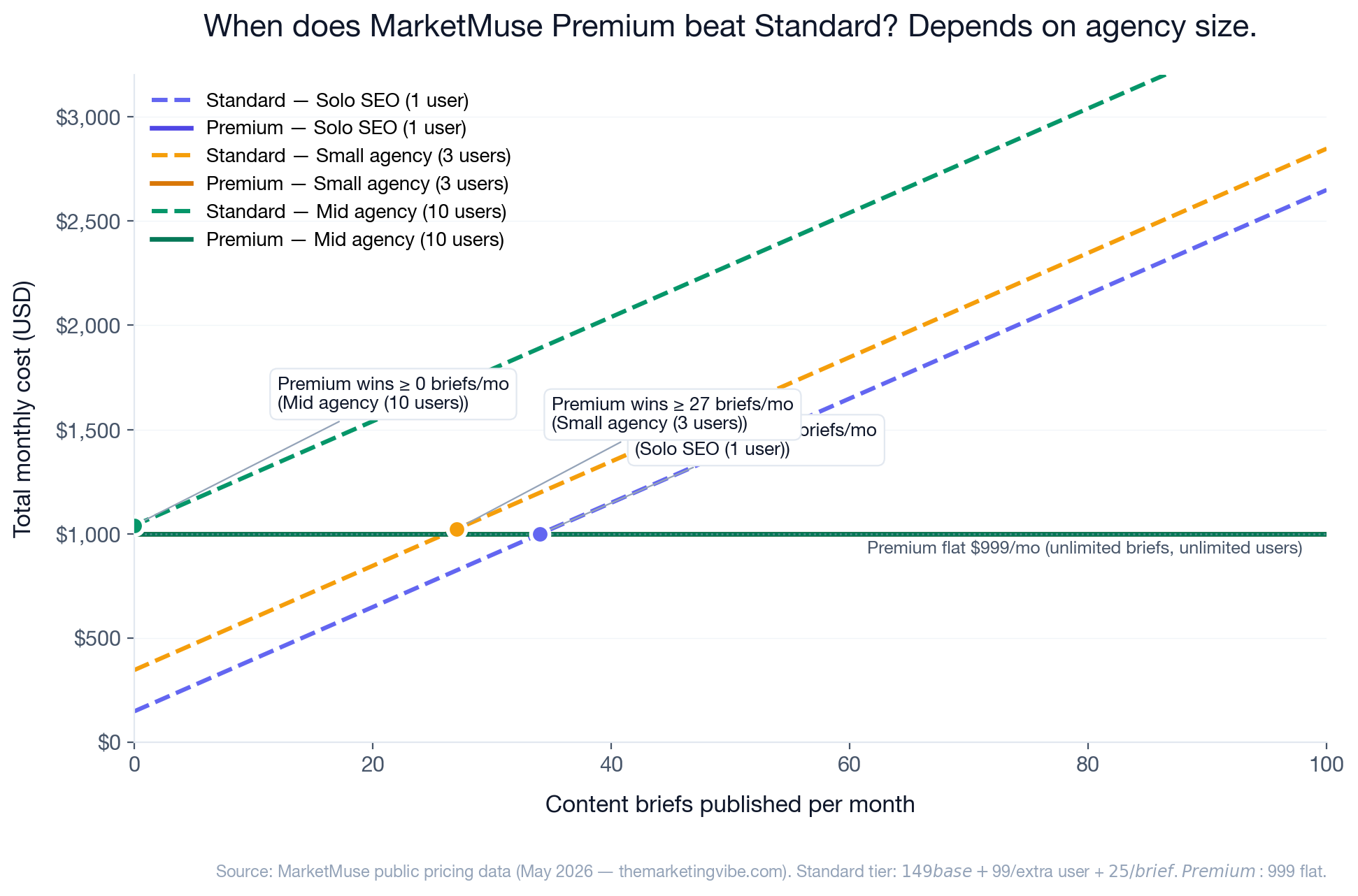
Three numbers worth committing to memory:
- Solo SEO: Standard is cheaper until you exceed 34 briefs/month. Above that, switch to Premium.
- Small agency (3 users): Crossover at 27 briefs/month. Standard's per-user fees push the math down.
- Mid agency (10 users): Standard is never cheaper. The base seat fees alone ($149 + 9 × $99 = $1,040) already exceed Premium's flat $999.
If you're publishing under 20 briefs/month with one user, MarketMuse Standard is the wrong product — you'll get more value from a $99–$199/mo tool like Frase or Clearscope alternatives. If you're publishing 50+ briefs/month with a team of five, MarketMuse Premium is genuinely competitive at $999/mo flat.
Key features, evaluated
Topic Navigator
MarketMuse's flagship is the topic clustering tool. Type a seed keyword and it returns a hub-and-spoke map of related topics, each scored by traffic potential and competitive difficulty.
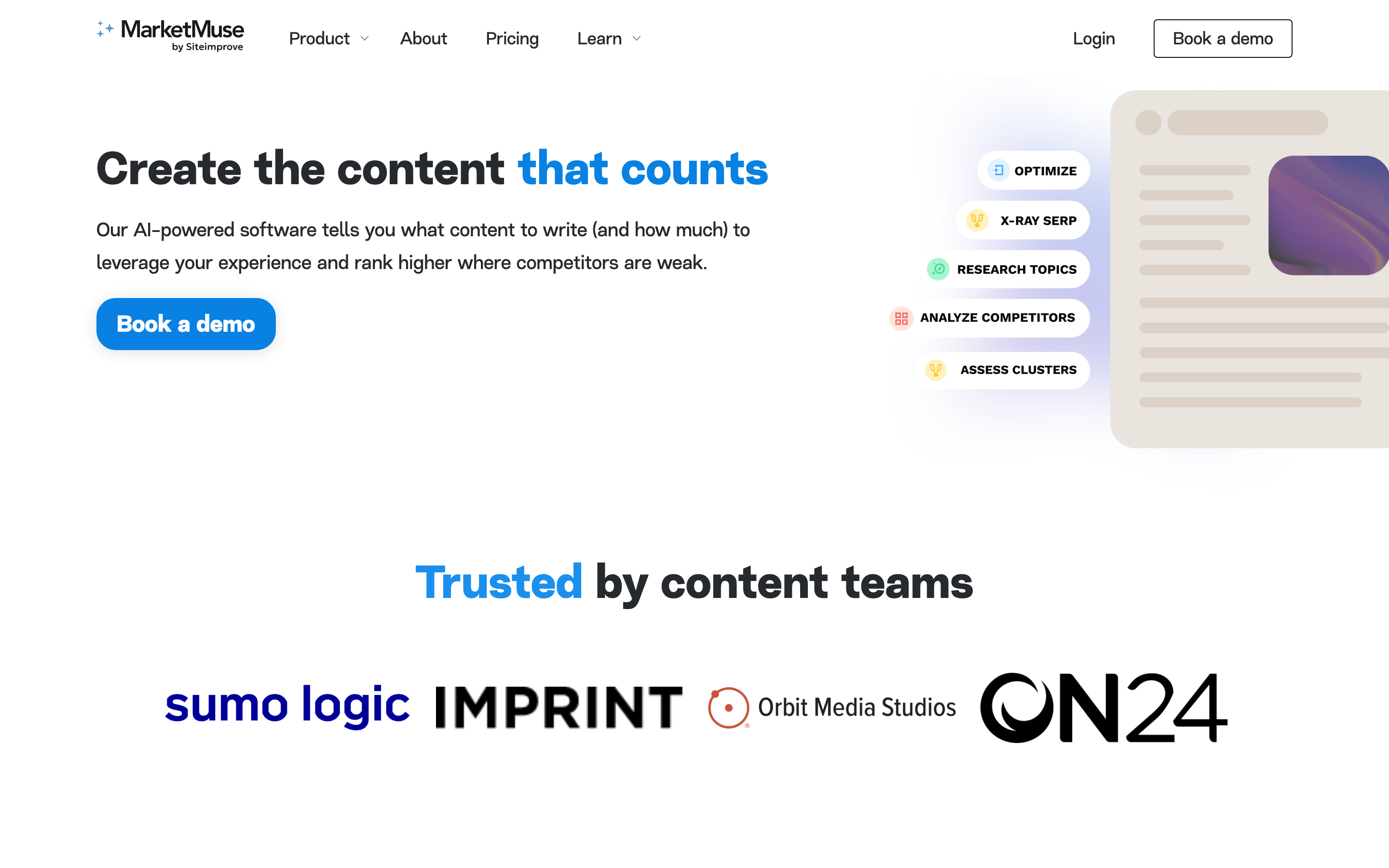
What we like: the second-order topic suggestions are stronger than any competitor we've tested. For a client in a niche industry, MarketMuse surfaced 14 sub-topics within a week that Surfer's content editor missed entirely.
What we don't: the UI shows scores without explaining their derivation. A "Personalized Difficulty: 24" score is meaningless until you've used the tool for two months and built up a feel. Onboarding could be twice as fast with one good tooltip per metric.
Content Briefs
Briefs are MarketMuse's most-used feature. You enter a target keyword; it returns a structured brief with target word count, topic coverage requirements, recommended H2s, internal-linking suggestions, and a competitive analysis.
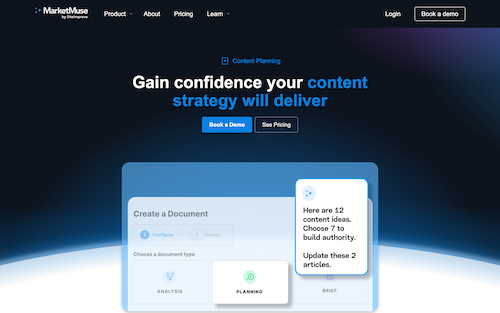
For agencies the killer feature here isn't the brief itself — it's the writer assignment workflow. You can hand a brief to a contractor with view-only access, they write inside MarketMuse's editor, the optimization score updates in real time, and you approve before publish. We've handed dozens of briefs to freelancers this way without buying them their own seats. (On Standard you can't — only Premium has the multi-user workflow.)
Site Inventory
The Site Inventory crawl is genuinely differentiated. Point it at a domain, wait an hour, and you get a topic-by-topic map of every page on the site, scored against competitors. For an agency taking on a new client, it's the fastest way we've found to identify low-hanging update opportunities.
The catch: it only handles one site per plan on Standard, and one site per plan on Premium. Agencies managing 10+ client sites can't use this feature properly without buying multiple accounts. That's the single biggest friction point for the agency ICP MarketMuse markets to.
What's missing for agencies
Three things MarketMuse still doesn't do well in 2026:
- No multi-client workspaces. Each "Site Inventory" treats one domain. There's no way to view all your clients' inventories in a single dashboard, switch between them with one click, or bulk-export reports per client. Tools like our own AI SEO Agent or white-label SEO reports handle this natively; MarketMuse doesn't.
- No real automation. Briefs are generated on demand, briefs are assigned manually, status changes don't trigger Slack messages. For a team running an agency content workflow, this becomes a project management problem you solve outside MarketMuse.
- Limited integrations. WordPress, Google Docs, and Zapier are it. No native Notion, Airtable, or Asana. For agencies built on Notion (most of the small-mid ones we work with) this means double-entry.
Where MarketMuse genuinely wins
Three use cases where we've seen MarketMuse outperform every competitor we've tested:
Topic modeling for pillar content. When you're building a 4,000-word definitive guide and need the topic model to be exhaustive, MarketMuse's topic depth is real. Surfer and Frase will give you 80% of the topics; MarketMuse gives you 95%.
Site audits for new client onboarding. Site Inventory in week one of a new engagement gets you a defensible content roadmap faster than any manual audit. The output is presentation-ready — a deliverable in itself.
Editorial calendar enforcement. If your team has a habit of writing posts that don't fit any topic cluster, the Strategy Document feature genuinely helps. It's the closest thing in the market to a "is this article worth writing?" gate.
Where it falls short
The pricing wall. Hiding pricing behind "book a demo" in 2026 is a self-inflicted wound. SEOs and agency owners shop with their wallets — making them sit through a 30-minute call to learn whether they can even afford the tool is friction. We routinely talk teams out of MarketMuse evaluations for this reason alone.
The learning curve. Two-month minimum to feel comfortable. For agencies hiring junior content strategists, this is a real onboarding cost.
The agency angle. MarketMuse markets to agencies but the product was clearly designed for in-house content teams. Multi-client workflows are bolted on, not native. If you manage 10+ clients with distinct content programs, MarketMuse forces you into compromises that purpose-built agency tools don't.
Best MarketMuse alternatives
We've covered this in depth in our MarketMuse alternatives roundup, but the short version:
- Frase — better for solo SEOs and small teams. Cheaper, friendlier UI, slightly weaker topic depth.
- Surfer SEO — better for SERP-driven optimization. Stronger on-page scoring, weaker topic modeling. See our existing Surfer SEO review for the full breakdown.
- Clearscope — strongest for editorial teams that prioritize writer experience. Cleanest UI in the cluster.
- Arvow — purpose-built for agency multi-client workflows. End-to-end automation including brief generation, publishing, and white-label reporting that MarketMuse doesn't attempt.
Either way, it's worth seeing how MarketMuse stacks up against the full field — we rank it in both our roundup of the best AI SEO content optimization tools for agencies and the best SEO software for agencies.
Who should buy MarketMuse?
Decision framework, agency edition:
| Your situation | Verdict |
|---|---|
| Solo SEO, < 20 briefs/mo, one site | Skip — overkill, overpriced for your volume |
| Solo SEO, 30+ briefs/mo, focused on pillar content | Standard tier worth testing |
| Small agency (2–4 users), single large client site | Premium worth testing |
| Mid agency (5–10 users), multi-client portfolio | Maybe — depends on whether site-inventory limitation is a deal-breaker |
| Mid+ agency (10+ users), heavy multi-client workflow | Look elsewhere — Arvow, Surfer Cloud, or a custom stack will serve better |
Verdict
7.5 / 10 for the agency use case.
MarketMuse remains the deepest topic modeling tool in the market and the right pick for in-house content teams, single-site programs, and pillar-content-heavy strategies. For multi-client agency operations specifically, the lack of native multi-tenancy and the demo-only pricing are real friction points that competitors with newer architectures don't share.
If your agency publishes 27+ briefs per month across three or more users on a single primary client, Premium pays for itself fast. If you're managing a portfolio of 10+ small clients each producing 2–5 briefs per month, the math doesn't work — and the workflow doesn't fit either.
We'd recommend Premium for the right agency profile, the free tier for evaluation, and a hard pass on Standard for any team larger than two people.
FAQ
Is MarketMuse better than Surfer SEO?
Different jobs. MarketMuse wins on topic modeling depth and site-level inventory. Surfer wins on SERP-driven on-page optimization speed. For an agency running both pillar and product content, you'd pick MarketMuse for the former, Surfer for the latter.
Does MarketMuse have a free trial?
Yes — a free tier (not a time-limited trial), with 35 queries per month, no credit card required. It's enough to evaluate Topic Navigator but not to test the brief workflow.
Can MarketMuse generate content?
It generates briefs and outlines, not full drafts. The Content Brief output goes to your writer (human or AI). Agencies looking for end-to-end content generation should look at tools that include drafting, not just optimization.
Why is MarketMuse pricing hidden?
MarketMuse moved to demo-required pricing in early 2026. Public third-party data still references the $149 / $999 tiers, but custom quotes can vary. Worth asking for written terms before signing.
Is MarketMuse worth it for solo SEOs?
Only if you're publishing 30+ pieces a month on a single site. Below that volume, cheaper tools (Frase, Surfer's lowest tier, Clearscope alternatives) deliver more value per dollar.

Generate, publish, syndicate and update articles automatically
The AI SEO Writer that Auto-Publishes to your Blog
- Cancel anytime
- Articles in 30 secs
- Plagiarism Free